
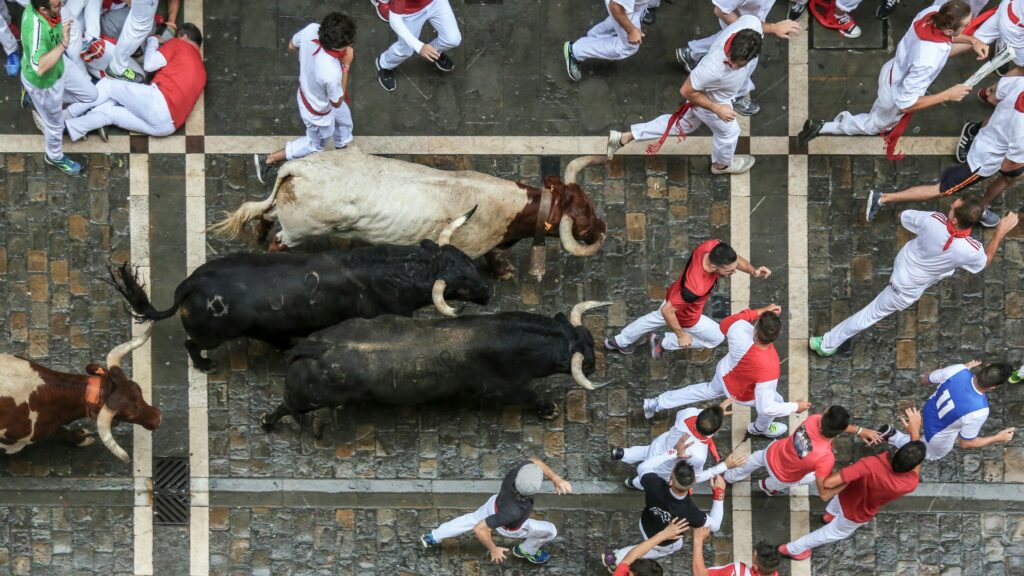
The encierro route in Pamplona stretches 875 meters from the corrals at Santo Domingo to the callejón at the entrance of the plaza. Every morning during San Fermín, six fighting bulls and a herd of cabestros (steers) run this course in under three minutes. Each section of the route: Santo Domingo, Mercaderes, La Curva de Estafeta, Calle Estafeta, Telefónica, and the callejón, presents distinct terrain, spacing, and challenges that change with every run.
We walk this route for hours every day during the fiesta, and we run it every morning alongside the bulls. This is a section-by-section breakdown of the bull run route as experienced from inside the barriers, not from a balcony, not from a map, but from the cobblestones themselves.
Santo Domingo: The Uphill Sprint and First Challenge of the Encierro Route
The encierro begins at the base of Calle Santo Domingo, where the corrals open and the bulls charge uphill toward the Plaza Consistorial. This is La Cuesta, the slope. It is the section where the bulls are at their fastest.
According to Mat Dowsett in Encierro! (2003), “The pack will run uphill from the corral at the bottom of Santo Domingo for the entire length of the street. At the top of Santo Domingo is the Plaza Consistorial, or Town Hall Square.”
The bulls are fresh here. They have been in the corralillo since the evening before. This is their first encounter with the narrow streets, the noise, and the crowd. Their speed on the incline is remarkable, and runners are overtaken quickly. There can also be significant separation within the herd along this stretch. Individual bulls react differently to an unfamiliar environment.
“One of the biggest challenges early in the route is that the bulls are fairly fresh and at their fastest, especially running up the hill. In that section, you’re so quickly being overtaken that you have to be able to get out of the way very quickly. It’s really hard to predict, but the bulls are getting a sense of the streets because it is their first time running in this environment.”
, Dennis Clancey, Founder of Encierro and member of La Única Peña
Dennis describes seeing distinct waves of runners along Santo Domingo. The first wave consists of nervous first-timers who begin running too early and exhaust themselves long before the bulls arrive. This is one of the most common mistakes on the encierro route: spending energy when none is needed. The bulls will overtake every runner. The key is timing the start of your run so you are rested and alert as they approach.
One sensory detail that catches even prepared runners off guard is the sound, or rather, the lack of it. You hear the bells around the necks of the cabestros (steers), but not until they are nearly upon you. Dowsett notes that these steers serve a specific role: “A few minutes after the herd has gone, four steers, or ‘cabestros’ are released from a pen next to the corral. These big brutes are often known as the clear-up team and they run the length of the course in order to collect and herd any stray bulls.”
Mercaderes: A Technical Left Turn Into Tight Quarters
At the top of Santo Domingo, the herd crosses the Plaza Consistorial diagonally and enters Calle Mercaderes (Merchant’s Street. The character of the encierro route shifts here. As Dowsett describes in Encierro!, “Mercaderes runs slightly downhill and opens up a little as it goes past Calle Chapitela.”
The slight downhill grade means the bulls gain speed through Mercaderes. They build momentum as they approach the sharpest turn on the course. This is a technical stretch of the encierro route. Runners must manage the narrowing street while preparing for what comes next: La Curva de Estafeta.
La Curva de Estafeta: Where Momentum Meets Physics
The left turn from Mercaderes is immediately followed by a sharp right turn into Calle Estafeta. This is La Curva de Estafeta, arguably the most unpredictable section of the entire encierro route.
Dowsett writes extensively about this turn in Encierro!: “The herd approaches the corner generally towards the left side of the course and picking up speed as it has come downhill along Mercaderes. In doing this they have generated a great deal of force and momentum and are suddenly faced with a sharp turn.” He adds one consistent observation: “One fact does remain: the corner slows the bulls down.”
Dennis frequently receives questions about whether bulls will go tight around the turn or swing wide. The answer depends on the day. The separation of the herd varies from morning to morning. The speed at which they arrive varies. The temperament of individual animals differs too. We have seen encierros where the bulls came through as a tight pack barely touching the barriers, and others where individual animals separated and struck out toward the walls.
Dowsett himself witnessed this unpredictability on the encierro route firsthand: “I have stood on the curve on a rainy day when the course was packed. The experienced runners I was with all expected that the bulls would be slipping all the way up the course, would be separated by the time they reached us and would crash heavily into the corner. Yet when the bulls ran they came past as a tight pack that barely brushed the barriers.”
“Mercaderes is a very technical part of the route because you have a left turn followed by a right turn at La Curva de Estafeta. We tell people to stay away from La Curva. It’s an area that’s quite crowded, and people for the first time don’t quite know what’s happening. It’s not a place to find yourself as a first-time runner.”
, Dennis Clancey, Founder of Encierro and member of La Única Peña
Calle Estafeta: The Longest Section of the Encierro Route
Once through the curve, the encierro route enters Calle Estafeta, the longest continuous section of the course. As Dowsett notes in Encierro!, “Estafeta is the longest continuous stretch of the run.” The street runs gradually uphill. The bulls have slowed from the turn.
This is where the encierro transforms. The upper portion of Estafeta is the most competitive section of the entire encierro route. Experienced mozos (runners) compete for position on the horns here. The bulls’ reduced speed allows for longer, more sustained runs beside them. Some of the finest running in San Fermín history has happened along this stretch.
“The second part of Estafeta is one of the most competitive parts of the run route. You have the greatest runners wanting to get on the horns, competing for space, because the bulls are a bit slower at that point. They can get very long runs. Some of the best runs happen there.”
, Dennis Clancey, Founder of Encierro and member of La Única Peña
For first-time runners considering Estafeta, understand that while it is a straightaway, it is not simple. The density of runners competing for the same space on the encierro route creates challenges. Add in those who started too early and are now fatigued, and the difficulties multiply.
Telefónica: The Deceptive Widening
At the top of Estafeta, the encierro route opens into the area known as Telefónica, named for the telephone exchange building at this junction. According to Dowsett in Encierro!, “About two thirds of the way up Estafeta the street widens out a little on the right. At the top of Estafeta barriers force the bulls into an area that sweeps gradually to the left. At this point a number of streets meet and the section is known as Telefónos.”
The added width gives some first-time runners a false sense of security. But the crowd density at Telefónica is among the highest on the encierro route. Many runners who started too early have accumulated here. The convergence of multiple streets adds to the volume of people.
“Some first-time runners are attracted to the end of Estafeta and Telefónica because of its width. But given how many people are running too early and how many people are competing for space there, it’s still very dangerous.”
, Dennis Clancey, Founder of Encierro and member of La Única Peña
The Callejón: The Final Section of the Encierro Route
From Telefónica, the encierro route runs downhill toward the entrance of the plaza. This final section funnels through the callejón, the narrow passageway leading into the ring. Dowsett provides precise measurements in Encierro!: “From 7.5 metres at the top the funnel drops to the red doors of the bullring itself, which presents the narrowest section of the course at a mere 3.9 metres.”
The callejón is where pileups occur. The combination of the downhill grade, the dramatic narrowing, and sheer runner volume creates bottleneck conditions. Every runner should understand these dynamics before stepping onto the encierro route.
“We certainly want first-time runners to avoid the callejón. Given the history of pileups and how quickly things evolve there, it’s just very dangerous.”
, Dennis Clancey, Founder of Encierro and member of La Única Peña
The Crowd: A Force of Its Own
Beyond the terrain and the animals, there is a third factor that shapes every encierro: the crowd itself. In some cases, the people around you on the encierro route present as much of a challenge as the bulls.
Make no mistake: the bulls remain the primary danger. People will not gore you. But experienced runners understand that Pamplona’s encierro route is unlike the smaller town runs across Spain. The crowd density changes the dynamic in both directions.
“In some ways, experienced runners will talk about the fact that given that there is such a crowd, the bulls tend to focus on individuals a little less than you might find in other towns in Spain. That’s not to say that a bull isn’t bravo and won’t strike out on its own and go after people. You always have that risk. But given the density of the crowd, that density sometimes can help to channel the bulls through the center of the route.”
, Dennis Clancey, Founder of Encierro and member of La Única Peña
This channeling effect is a practical observation, not a safety guarantee. The one constant across all eight mornings of San Fermín is that awareness cannot lapse. The animals are unpredictable. Day to day, given their speed, separation, and temperament, they will do different things. The encierro route is the same 875 meters every morning. But the encierro that unfolds across it is never the same twice.
What Every First-Time Runner Should Know About the Encierro Route
If there is one message from nearly two decades of running this course, it is this: there is nowhere safe on the encierro route in Pamplona. If you want to be safe, rent a balcony.
The most common mistake first-timers make is assuming they need to run the entire 875 meters. They do not. The bulls will overtake every runner. The objective is not to outrun them. Time your entry so you are rested and alert when the herd arrives. Dowsett measured the route at approximately 838 meters from corral sand to bullring sand. The commonly cited 875 meters accounts for the full barrier-to-barrier course. Either way, no runner covers the full distance ahead of the bulls.
For a first run on the encierro route, Dennis recommends choosing a straightaway. Pick a section of the route you understand. Find where sightlines are clear and dynamics are simpler than the technical turns. Stay away from La Curva de Estafeta. Stay away from the callejón. Pick a section of Estafeta where you can see what is coming. Commit to your position and remain aware throughout your time on the route.
Spanish Vocabulary Related to the Encierro Route
Encierro (en-see-EH-rro): The running of the bulls; literally “enclosing” or “penning,” referring to the act of moving bulls from corrals to the plaza. The encierro route in Pamplona is the 875-meter path that defines this event.
La Cuesta (lah KWES-tah): The slope; the uphill section of Santo Domingo.
La Curva de Estafeta (lah KOOR-vah deh es-tah-FEH-tah): The curve at the entrance to Calle Estafeta, where Mercaderes turns sharply right.
Mozo (MOH-thoh): A runner in the encierro.
Cabestros (kah-BES-trohs): Steers that run with the bulls to guide and calm the herd.
Callejón (kah-yeh-HONE): The narrow passageway funneling into the plaza.
Corralillo (kor-ah-LEE-yoh): The small corral where the bulls are held the night before the encierro.
Ganaderías (gah-nah-deh-REE-ahs): The ranches that breed the fighting bulls.
Frequently Asked Questions
How long is the encierro route in Pamplona?
The encierro route in Pamplona spans approximately 875 meters from the corrals at Santo Domingo to the plaza entrance. Mat Dowsett measured the course at 838 meters from corral sand to bullring sand in his book Encierro! (2003). The full course takes the bulls under three minutes to complete.
What is the most dangerous section of the encierro route?
The callejón, the narrow funnel leading into the plaza, is the most dangerous section of the encierro route. It narrows dramatically from 7.5 meters to just 3.9 meters. Pileups are common here. La Curva de Estafeta is also high-risk due to unpredictable dynamics as bulls navigate the sharp turn.
Where should a first-time runner position themselves on the encierro route?
First-time runners should choose a straightaway section of Calle Estafeta where sightlines are clear. Dennis Clancey recommends avoiding La Curva de Estafeta, the callejón, and Telefónica for a first run. The key is to pick a section you understand and time your start so you are rested when the bulls arrive.
Do the bulls run the same way every day during San Fermín?
No. Each encierro is different. The animals’ speed, separation within the herd, and temperament vary from morning to morning. Different ganaderías (ranches) supply the bulls for each day, and even the same breed can behave differently depending on conditions. The route is constant, but the run never repeats.
What are cabestros and what role do they play in the encierro?
Cabestros are trained steers that run with the fighting bulls to help guide and calm the herd through the streets. According to Mat Dowsett in Encierro! (2003), they are “often known as the clear-up team” and run the length of the course to collect any bulls that have separated from the pack. The steers learn the route over the week of San Fermín and become more sure-footed with each run.
Planning to run? We walk the recorrido every day during San Fermín and run it every morning. Book a tour and we will walk every meter of these 875 meters with you, section by section, contingency by contingency, before you ever step onto the route.
Dennis Clancey is the founder of Encierro and has been running the encierro in Pamplona since 2007. A member of La Única Peña (the oldest peña in Pamplona), Dennis is the only member without Basque, French, or Spanish heritage. His expertise has been featured in Chasing Red, CNN’s Seeing Red, and Esquire Network coverage. He and the Encierro team have guided nearly 4,000 clients through the traditions and realities of San Fermín.