
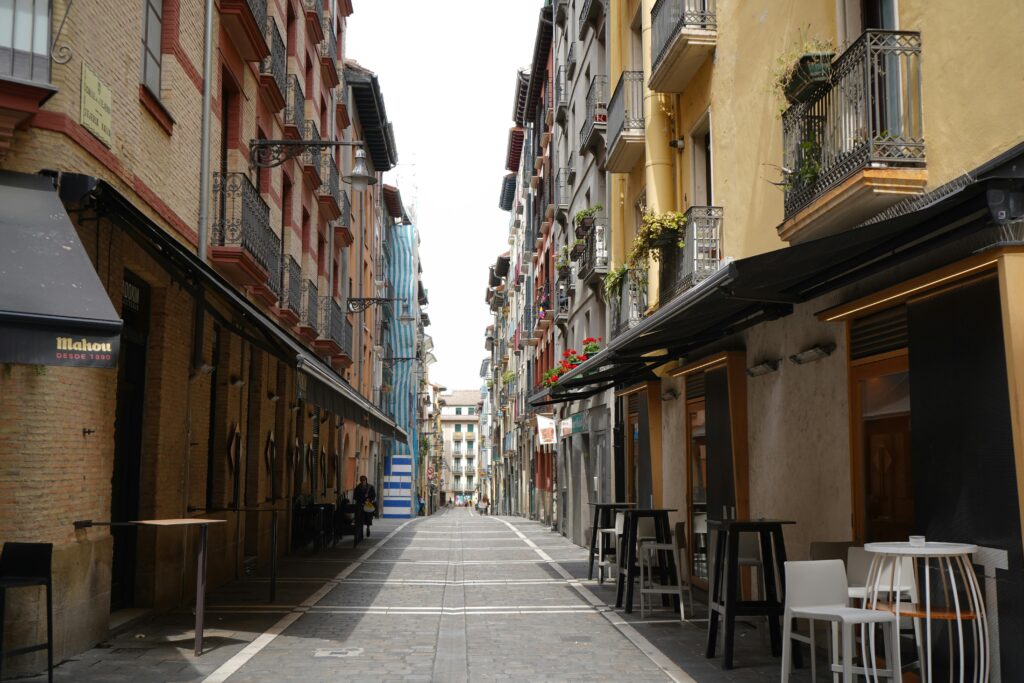
Every morning during San Fermin, six toros bravos sprint through the streets of Pamplona. They are not alone. Running alongside them are the cabestros: steers that have been trained to guide the herd along the 875-meter route from the corrales at Santo Domingo to the end of the course. These animals are among the most important and least understood participants in the encierro. They keep the bulls together, they set the pace, and in recent years, their evolving role has become a subject of conversation among the runners who share the street with them.
What Are Cabestros?
Cabestros are castrated bulls. Their temperament is generally calm, and their purpose is functional: they serve as guides for the toros bravos. As Ray Mouton writes in Pamplona (2002), the bulls are accompanied by steers and oxen, animals trained to herd bulls. All of their lives these bulls have been led to water, food and new pastures by oxen and steers and their training is to obediently follow them. The toros bravos, having never run the encierro course before, rely on the cabestros to show them the way. The cabestros, by contrast, run the route year after year and know it well.
Mat Dowsett explains in Encierro! (2003) that the steers are used to keep the bulls in a herd and guide them along the course calmly and quickly. When a bull is within its herd and surrounded by cabestros, it is generally tranquil and focused on moving forward. The cabestros are the anchors of the formation.
How Many Cabestros Run?
The number has changed over the years, and Dennis Clancey notes that the city of Pamplona continues to experiment with what works best.
It’s typically six cabestros that are running with the main herd. And there are six additional cabestros that follow as the cleanup steers.
Dennis Clancey, Founder of Encierro and member of La Unica Pena
The main group of six runs alongside the six toros bravos from the moment the corrales open. The second group of six is released a few minutes later from a paddock beside the corralillo. These cleanup cabestros run the full length of the course to collect any bull that may have separated from the original pack.
I expect the city will continue to experiment with the number of cabestros it feels is appropriate to use. I’ve seen four. I’ve seen none. I’ve seen two. I’ve seen one.
Dennis Clancey, Founder of Encierro and member of La Unica Pena
The variation is significant. In years past, some encierros have run with no cabestros at all, while others have used as many as the current six-plus-six configuration. Each year, the city evaluates what has worked and makes adjustments. Runners should expect annual announcements about cabestro usage for the upcoming fiesta.
Training and Speed
In recent years, the city has invested in training cabestros for speed. This is a relatively new development, and it has had consequences that experienced runners have noticed.
It was in recent years that they started really training the cabestros to ensure they had the speed that the bulls had.
Dennis Clancey, Founder of Encierro and member of La Unica Pena
The result is that cabestros are sometimes the fastest animals in the herd. They know the route, they have run it before, and with the added training, they can outpace the toros bravos. For runners who position themselves to run on the horns of the fighting bulls, this creates an unexpected challenge.
It’s been to the consternation of some runners who were trying to run on the horns that sometimes it’s the cabestros that are out front leading because they’re the fastest, and they know the route.
Dennis Clancey, Founder of Encierro and member of La Unica Pena
Dennis experiences this personally at La Curva de Estafeta, where he runs. The trained cabestros take the turn as tightly as possible because they have learned the geometry of the corner. Dennis has had to avoid cabestros that were cutting the turn at speed, which adds a variable that did not exist in previous decades.
Can Runners Use Cabestros Strategically?
The short answer is no. Some runners might assume that the cabestros, being calmer than the toros bravos, offer a safer animal to run alongside. But Dennis is clear that their presence complicates rather than simplifies the experience.
It makes a beautiful run with el toro bravo more complicated for the experienced mozos. Because sometimes it’s those out front around the toros bravos.
Dennis Clancey, Founder of Encierro and member of La Unica Pena
The issue is one of identification and positioning. When cabestros are mixed in with the toros bravos, a runner must quickly distinguish between the animals while running at full speed. The cabestros’ speed and their tendency to take the lead can disrupt the spacing that experienced runners rely on when positioning themselves relative to the fighting bulls.
Dowsett notes in Encierro! (2003) that Pamplona’s encierro uses the most structured system of steers of any bull run in Spain. The cleanup cabestros, released after the main herd, are described as very large but also quite timid. Their job is specifically to find and collect any bull that has separated from the pack, a role that becomes critical whenever a suelto occurs.
How Cabestros Affect the Encierro’s Character
The cabestros fundamentally shape how the encierro plays out each morning. When the steers run well and the herd stays together, the encierro moves quickly and relatively predictably. When a cabestro stumbles or gets separated from the group, it can trigger a chain reaction that affects the entire herd.
Mouton captures this dynamic in Pamplona (2002), describing the ideal scenario: all of the animals should swiftly complete the course in an organized fashion, flying down the street in formation, shoulder to shoulder. The cabestros are what make that formation possible. Without them, the toros bravos would have no guide on a route they have never seen before, running through streets filled with thousands of people.
Vocabulario
- Cabestros (kah-BEHS-trohs): Castrated bulls (steers) trained to guide the toros bravos through the encierro route.
- Corralillo (koh-rrah-LEE-yoh): The small holding pen adjacent to the main corrales where the cleanup cabestros are kept.
- Toro bravo (TOH-roh BRAH-voh): The fighting bull breed. These are the six bulls that the cabestros guide through the route.
- Suelto (SWEL-toh): A bull that separates from the herd. The cleanup cabestros are specifically tasked with collecting sueltos.
- Pastores (pahs-TOH-rehs): The drovers who follow the herd with long sticks, working alongside the cabestros to keep the bulls on course.
Frequently Asked Questions
What is a cabestro?
A cabestro is a castrated bull (steer) used to guide fighting bulls through the encierro. They are calm, trained, and familiar with the route.
How many cabestros run in the encierro?
Currently, six cabestros run with the main herd and six additional cleanup cabestros are released afterward. However, the city of Pamplona adjusts this number periodically.
Are cabestros dangerous to runners?
Cabestros are not aggressive, but they are large animals running at speed. Dennis Clancey notes that trained cabestros can outpace the fighting bulls and take turns tightly, which creates close calls for experienced runners.
What do the cleanup cabestros do?
They are released a few minutes after the main herd and run the full route to find and collect any bull that has separated from the pack.
Understanding the Full Picture
The cabestros are not a footnote in the encierro. They are a core part of the system that keeps the run moving and the herd together. Understanding their role, their numbers, and their evolving training helps runners make better decisions on the street. Our team covers the full cast of the encierro, from the toros bravos to the cabestros to the pastores, as part of every tour. Book a tour with Encierro and learn what every animal on the route is doing and why.