
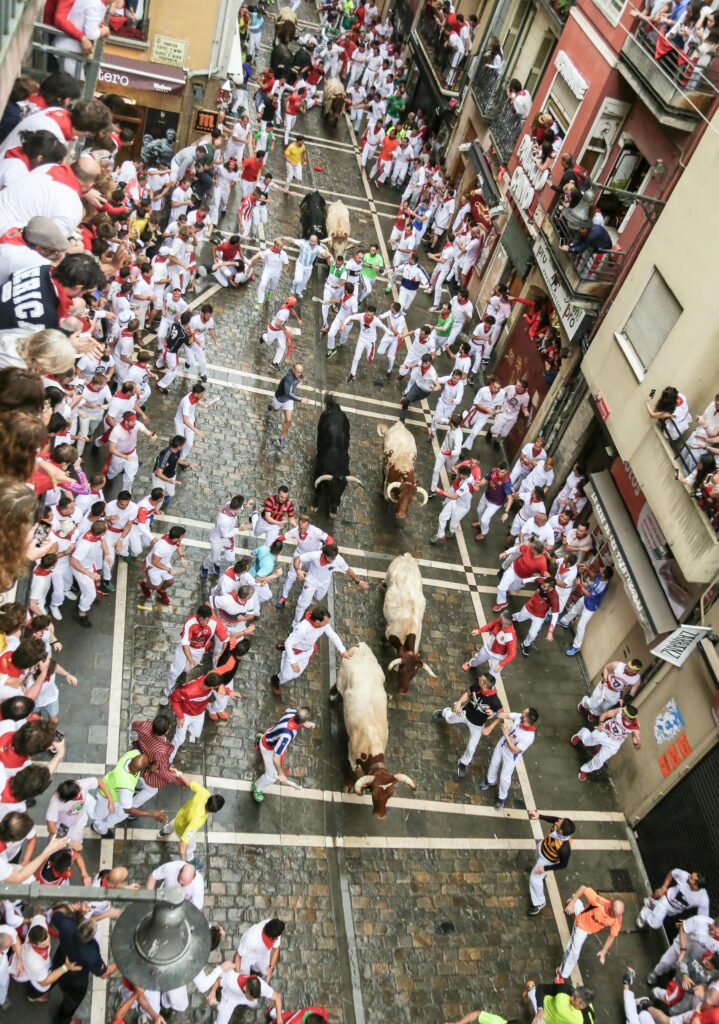
Spatial awareness is the core principle that underlies everything Dennis teaches about running the encierro. It is not a specific technique or a set of rules. It is a way of thinking about your position on the street, your orientation relative to the herd, the geometry of the route, and the crowd around you, all in real time as the bulls move toward you and past you. Spatial awareness is the discipline of paying attention to what is actually happening rather than following predetermined instructions. It is the skill that allows a runner to process the chaos of the encierro and make decisions that keep them safe and keep them in contact with the herd they came to run with. For runners preparing for the encierro, understanding what spatial awareness actually means is more valuable than memorizing dozens of tactical rules.
Spatial Awareness Includes Understanding the Timeline
Spatial awareness is not just about your immediate physical position. It also includes understanding the sequence and timeline of events that are unfolding on the route. Dennis explains how this works:
“The more visualizing, the more thinking you can do along that run route, coming up with a finite plan to execute, the easier it will be to try to distill your sensory perceptions down to what actually matters.”
Dennis Clancey, Founder of Encierro and member of La Única Peña
This statement captures the essence of the Encierro preparation philosophy. Before the run, when you are standing on the actual streets of the route, you visualize and think through what will happen. You imagine the herd approaching. You consider multiple scenarios. You develop a plan for how you will respond when the bulls reach your position. This mental rehearsal is not visualization in a mystical sense. It is practical thinking about cause and effect.
The benefit of this preparation is that when the actual herd is approaching and your sensory input is overwhelming, your brain already has a framework. You are not trying to solve a new problem in real time. You are executing a plan that you have already thought through. Your sensory perceptions, which would otherwise be chaos, can be filtered to the information that matters to your plan and your position.
The Sequence of Events on the Route
Every encierro follows a predictable sequence from the perspective of a runner on a specific section of the route. According to Mat Dowsett in “Encierro!” (2003), the route from the corral through the plaza and into the various streets has a clear progression. The first rocket fires at 8:00 am. The second rocket fires 10 to 20 seconds later, confirming that all bulls have left the corral. From Santo Domingo, the bulls take roughly 20 to 30 seconds to reach the plaza. The plaza takes additional seconds. Mercaderes is shorter but narrower. La Curva is chaotic and unpredictable. Estafeta opens up but still moves quickly.
A runner who has walked the route and mentally rehearsed these timings, these distances, and these transitions can build a mental map of the encierro. This map becomes spatial awareness. When a runner is standing on Estafeta waiting for the bulls, if they have built this mental map, they understand approximately how much time has passed since the first rocket, how long it should take for the bulls to reach them, and roughly when they can expect to see or hear the herd approaching.
Sensory Filtering and Distilling What Matters
The challenge of the encierro is not a lack of sensory input. The challenge is the opposite: an overwhelming flood of information. There are thousands of people shouting. There is movement everywhere. There is the sound of hooves on cobblestones. There are voices of pastores and other runners. There is the crowd noise. There is the echo of the streets creating an acoustic environment that is difficult to parse.
If a runner is trying to process all of this information, they will be paralyzed. The preparation and visualization that Dennis emphasizes is a tool for learning to filter sensory input down to what actually matters. For a runner on Estafeta, what actually matters is the location of the herd relative to you, the momentum of the herd, and the proximity of other runners near you. The fact that someone thirty meters away is shouting does not matter. The color of someone’s shirt does not matter. The personal conversations of spectators do not matter.
A runner who has developed spatial awareness has trained their attention to focus on the signals that are relevant to their position and their plan. This is learnable. It is not innate talent. It comes from repeated visualization, repeated walking of the route, and repeated practice of asking: what matters in this moment?
Experience as the Ultimate Teacher
Dennis is also explicit about the limits of preparation and the irreplaceability of actual experience:
“There’s nothing that ultimately prepares you to execute the running of the bulls more than the practice of actually doing it.”
Dennis Clancey, Founder of Encierro and member of La Única Peña
This is why Dennis’s philosophy does not attempt to convince people that a tour or a preparation session will make them ready to run. Instead, the philosophy is to prepare people as thoroughly as possible in the time available, and then to accept that the first run is a learning experience. The real preparation happens afterward, when a runner has experienced the actual event and can now build on that experience.
This is why Dennis’s clients report a particular phenomenon:
“It’s usually after that first run that our clients will say, okay, all that stuff that we discussed, it’s all making sense now.”
Dennis Clancey, Founder of Encierro and member of La Única Peña
The first run is when everything clicks. The abstract concepts of spatial awareness become concrete. The mental map that seemed theoretical on the street becomes real when the bulls are actually moving through it. The importance of position becomes clear when you are actually standing in or out of the path of the herd. The value of the preparation becomes obvious in retrospect.
Honest Framing: No Guarantees, But Preparation Improves Outcomes
Dennis is careful not to oversell the safety benefits of preparation, but he is also clear about what preparation does accomplish:
“We can’t keep them safe. There’s no guarantee of anything, but from my experience, the more you prepare and the more you think through and have a plan, the better off you are in the moment.”
Dennis Clancey, Founder of Encierro and member of La Única Peña
This is an honest statement. The encierro is inherently unpredictable. Preparation does not eliminate risk. But preparation does improve a runner’s ability to make good decisions in real time. A runner who has thought through what they will do if separated from the herd by Estafeta will respond differently than a runner who has not thought it through. A runner who understands the timeline of the route will have better spatial awareness than a runner who is hearing the sequence of events for the first time as they happen.
The philosophy is not false confidence. It is realistic preparation: we acknowledge the unpredictability, and we do what we can to be ready anyway.
Spatial Awareness Teaches You to Read the Herd
Part of spatial awareness is learning to read the actual herd in front of you: its cohesion, its speed, its direction. Is the herd running as a tight pack, or are individual bulls stringing out? Is the herd taking the turns cleanly, or is the geometry of the route disrupting it? Are the steers (cabestros) visible and guiding, or are they separated from the bulls? These are the questions that a spatially aware runner asks in real time.
The answers to these questions change the tactics available to a runner. If the herd is tight and moving quickly as a unit, your options are different than if the herd is strung out. If a bull has separated and is alone on the route, the spatial dynamic is entirely different. Reading the herd is a skill that develops through experience, but it is accelerated through guided visualization and preparation on the actual route.
Building Your Spatial Awareness: The Role of the Run Route Tour
The encierro preparation tours that Dennis offers are fundamentally built around the development of spatial awareness. Rather than standing in a classroom and discussing the route, the tours involve standing on the actual streets where the encierro will happen, walking the path that the bulls will take, and mentally rehearsing the sequence of events. A runner standing on Santo Domingo, looking up the slope, visualizing the herd approaching uphill, and thinking through how they will position themselves is building spatial awareness in the actual environment where it will be tested.
This is why the tours are more effective than videos or guides. The spatial information is embedded in the actual geography of the streets, the acoustic properties of the corridors, the sight lines from different positions, and the understanding of distance that comes from physically walking the route.
Vocabulario: Spanish Terms Related to Awareness and Positioning
Posición (poh-see-see-OHN): Position on the route. A fundamental concept in spatial awareness.
Conciencia espacial (con-see-EN-see-ah es-pah-see-AHL): Spatial awareness; the fundamental principle of encierro running.
Cabestros (cah-BES-trohs): The steers that guide the bulls. Reading whether the cabestros are visible and in their proper role is part of spatial awareness.
Suelto (SWEL-toh): A separated bull. Recognizing a suelto in real time requires spatial awareness and changes everything about how a runner should respond.
Frequently Asked Questions
What exactly is spatial awareness in the encierro context?
Spatial awareness is the skill of understanding your position on the street, the location of the herd relative to you, the geometry of the route, and the crowd around you, all in real time. It includes understanding the timeline of the encierro and the sequence of events. It is the discipline of paying attention to what is actually happening and filtering sensory input to focus on what matters.
Can I develop spatial awareness without running the encierro?
You can build foundational spatial awareness through visualization, studying the route, and guided tours of the actual streets. But true spatial awareness develops through experience. The first run is when the abstract concepts become concrete and real. This is why the first run is so valuable: it is not failure if your first run is about learning and building spatial awareness. That is its purpose.
How long does it take to develop strong spatial awareness?
Spatial awareness develops gradually over multiple runs and seasons in Pamplona. A runner who has done preparation tours and mental rehearsal will have better spatial awareness on their first run than they would without preparation. But sustained spatial awareness, the ability to consistently read the herd and make sophisticated positioning decisions, develops over years of participation and experience.
Is spatial awareness the same as courage or bravery?
No. Spatial awareness is a skill of attention and decision-making, not a character trait. A runner with strong spatial awareness and good positioning might never need to be particularly brave because they are not in dangerous situations. A runner with poor spatial awareness might need to rely on luck and physical toughness. The goal is to develop spatial awareness so that you are in control of your experience, not dependent on luck.
Develop Spatial Awareness with Guided Preparation
Spatial awareness is the foundation of running the encierro with intention and control. Our preparation sessions are designed specifically to help you develop spatial awareness through visualization, route familiarization, and guided thinking about the sequence of events. Study the full route or book a walking tour with Encierro and build spatial awareness on the actual streets where the encierro happens.