
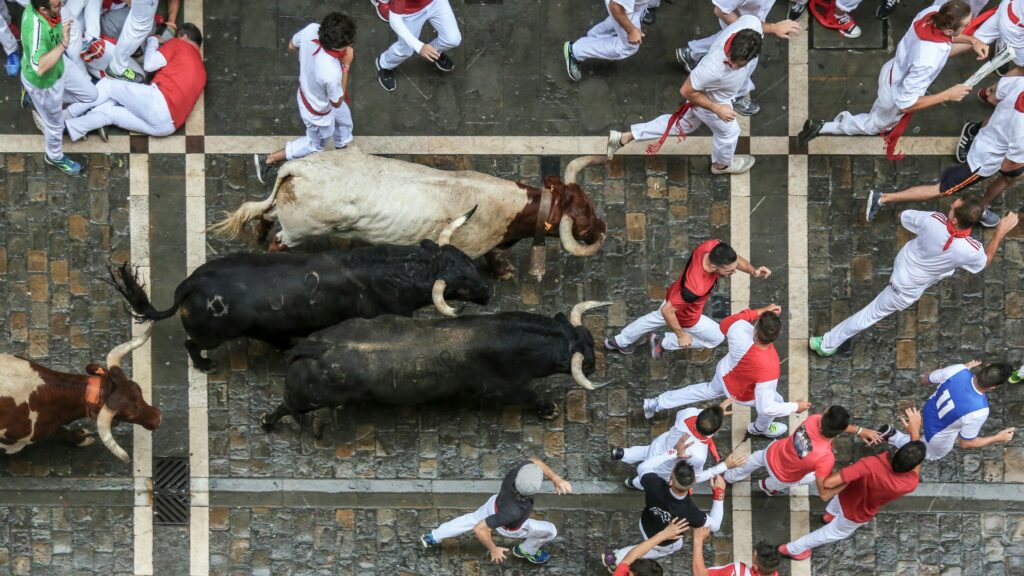
The santo domingo bull run section is where the encierro begins, and it is the most intense stretch of the entire 875-meter route. Six fighting bulls and their accompanying cabestros explode from the corrales at the bottom of Calle Santo Domingo and charge uphill for roughly 200 meters to the Plaza Consistorial. The herd consistently covers this ground in 40 to 45 seconds. For runners, those seconds compress a lifetime of decision-making into a single uphill sprint with tall stone walls on both sides and almost nowhere to escape.
We have stood at the bottom of Santo Domingo hundreds of times, watched the gates swing open, and run alongside the herd up that slope. This is what the start of the encierro actually looks and feels like from inside the barriers.
The Santo Domingo Bull Run Layout: Walls, Slope, and the Corral Exit
The Santo Domingo bull run begins at the corral exit in Pamplona, where the corrales sit at the lowest point of the route. From there, Calle Santo Domingo runs uphill to the Plaza Consistorial (Town Hall Square). The street surface is not cobblestone at the start but rough tarmac, transitioning to stone as you climb. On both sides, tall stone walls rise well above head height, creating a narrow channel with no doorways, alcoves, or side streets to duck into. The only pavement runs along the left side.
High on the right wall, spectators line a bastion wall that overlooks the entire run from above. Below them, set into a niche in the stone, sits a small statue of San Fermín. This niche has been in place since 1981 and serves as the spiritual anchor of the encierro’s starting point.
The slope itself is what gives the Santo Domingo bull run its character. As Mat Dowsett describes in Encierro! (2003), the bulls are released from the corral exit and run the full length of the street at an incline. This is the Cuesta de Santo Domingo, and it is where the bulls are at their fastest and most tightly packed. Red and orange painted lines on the ground mark the route boundaries, a visual guide that becomes critical when the street fills with runners.
One hazard that catches people off guard is the white stone surface along sections of the walls. When wet from overnight rain or morning humidity, that stone becomes slick. As Cadena SER reported during the 2025 fiesta, even hazards unrelated to the bulls themselves can cause injuries on the Cuesta de Santo Domingo. Losing your footing here, where there is no room to recover, is one of the worst positions a runner can find themselves in.
The Encierro Start: What Happens in the First 45 Seconds
At 8:00 a.m., the barrier at the corral exit in Pamplona is pulled back. The first rocket (chupinazo) signals the gate is open. A second rocket confirms all six bulls have left the corrales. From that moment, the herd is moving uphill through the Santo Domingo bull run at full speed.
The bulls’ speed on the incline is remarkable, and runners are overtaken quickly. According to Dowsett in Encierro! (2003), the pack typically reaches the Plaza Consistorial in 40 to 45 seconds from the corral. That pace leaves almost no margin for error.
One thing that catches even prepared runners off guard is the sound, or rather, the lack of it at first. You hear the bells around the necks of the cabestros before you see anything. Then comes the rumble of hooves on tarmac, growing louder by the second. By the time you can identify individual animals, they are already on top of you.
Dennis Clancey, Founder of Encierro and member of La Única Peña: “Santo Domingo rewards runners who understand positioning and spatial awareness. The visibility advantage from the slope means you can see the herd coming from a distance, but only if your head is on a constant swivel. You have to be aware of what is ahead of you, behind you, and beside you at all times. That is the tactical approach to running this section.”
The Cántico: Singing to the Saint Before the Run
In the minutes before the encierro begins, runners gather beneath the niche of San Fermín in Santo Domingo to sing the cántico, the benediction to the saint. The prayer is sung three times: at five minutes before, three minutes before, and one minute before 8:00 a.m.
The words, sung in Spanish, ask San Fermín for guidance and blessing: runners raise rolled newspapers toward the statue and sing in unison. The ceremony is dominated by Basque and Spanish runners who have been running Santo Domingo for years or decades. It is one of the most deeply traditional moments of the entire fiesta.
Dennis Clancey, Founder of Encierro and member of La Única Peña: “Runners come to Santo Domingo to sing the benediction to the saint at five, three, and one minutes before the run. My advice for first-timers is not to go down to the niche to sing. Respect the tradition from a short distance. The cántico is about asking for protection, and the runners who gather there treat it seriously. You can participate without crowding the space. San Fermín’s red cloak is there watching over everyone.”
Tactical Positioning: Where to Stand and Where Not To
Santo Domingo is not the section we recommend for first-time runners. The combination of speed, tight walls, and limited escape routes makes it unforgiving if something goes wrong. Experienced Spanish and Basque mozos dominate this stretch because they understand the terrain intimately.
For those who do run the Santo Domingo bull run, positioning is everything. The left side of the street offers a narrow pavement, but it also puts you against a smooth, flat wall with no handholds. The right side has the bastion wall above, but the crowd density near the niche of San Fermín makes that area congested. Photo sequences from the Fuente Ymbro encierro show how quickly the herd fills the width of the street, leaving runners pressed against both walls.
The slope provides one significant tactical advantage: visibility. Because Santo Domingo runs uphill, a runner positioned partway up the street can look back downhill and see the herd approaching from the corral. This is a luxury that flat sections of the route like Calle Estafeta do not offer. The key is using that visibility to time your entry into the run rather than standing still and hoping for the best.
Dennis Clancey, Founder of Encierro and member of La Única Peña: “The visibility from the slope is your best tool. You can see the herd coming. But that advantage disappears the moment you stop paying attention. Head on a constant swivel. Know where you are going before the bulls arrive, and commit to your line. Hesitation in Santo Domingo gets people hurt.”
The Encierrillo: How the Bulls Arrive the Night Before
The bulls that run Santo Domingo each morning do not simply appear at the corral gate. The night before, at approximately 10:30 p.m., the encierrillo takes place. This is a short, controlled drive where pastores (herdsmen, identifiable by their green polo shirts) guide the bulls from the Corrales del Gas on the edge of Pamplona up to the Corrales de Santo Domingo, the holding pens at the bottom of the street.
As the sanfermines.net encierrillo guide explains, this transfer allows the bulls to settle overnight before the morning run. It is not possible for runners to participate in the encierrillo. Only the pastores handle the animals during this process.
For those who want to observe, the area around El Búho restaurant near the top of Santo Domingo offers a vantage point where you can watch the bulls being driven into the corrales the night before. It is a quieter, more intimate experience than the encierro itself, and it gives you a chance to see the animals up close before the chaos of the morning.
Santo Domingo’s History: One Death, Many Lessons
Santo Domingo is often perceived as the most dangerous section of the encierro route, but historically, the statistics tell a more nuanced story. As Dowsett notes in Encierro! (2003), the rapid 40 to 45 second transit means the bulls pass through quickly, which paradoxically reduces the window for extended contact with runners compared to longer sections like Estafeta or the callejón.
That said, this section has seen tragedy. On July 9, 1961, Vicente Urrizola Isturiz, a 32-year-old Town Hall employee, was gored at the top of the Cuesta de Santo Domingo by a bull from the Don Álvaro Domecq ranch. The injuries to his vertebrae and spinal cord proved fatal. He died 30 hours after the event.
The lesson of Santo Domingo is not that it is safe. It is that its dangers are specific: the speed of the herd, the impossibility of escape once the bulls are upon you, and the false confidence that comes from being able to see them approach. Respect for this section begins with understanding that seeing the bulls is not the same as being ready for them.
Spanish Vocabulary for Santo Domingo
Cántico (KAHN-tee-koh): The sung prayer to San Fermín performed three times before the encierro begins.
Cuesta de Santo Domingo (KWES-tah deh SAHN-toh doh-MEEN-goh): The slope; the uphill section from the corrales to Plaza Consistorial that defines the encierro start.
Corrales (kor-RAH-les): The pens where the bulls are held before the encierro.
Encierrillo (en-thee-eh-REE-yoh): The nighttime transfer of bulls from the outer pens to the corrales at Santo Domingo.
Pastores (pahs-TOH-res): The herdsmen who guide the bulls during the encierrillo and run behind the herd during the encierro. Identifiable by their green polo shirts.
Mozo (MOH-thoh): A runner in the encierro.
Frequently Asked Questions About Santo Domingo
Is Santo Domingo the most dangerous section of the encierro?
Santo Domingo is intense because of the bulls’ speed and the narrow, walled street with limited escape options. However, statistically, more injuries occur in other sections like the callejón. The danger here is specific to the 40 to 45 second window when the herd passes through at full speed.
Can you watch the encierrillo the night before?
Yes. The encierrillo takes place around 10:30 p.m. the evening before each morning’s encierro. Spectators can watch from designated areas near the top of Santo Domingo. Only pastores handle the bulls during this process; public participation is not allowed.
What is the cántico sung before the encierro?
The cántico is a prayer to San Fermín sung by runners gathered beneath his statue in Santo Domingo. It is performed at five minutes, three minutes, and one minute before 8:00 a.m. Runners ask the saint for guidance and protection during the run.
Should first-time runners start at Santo Domingo?
We do not recommend Santo Domingo for first-time runners. The speed of the herd, the narrow walls, and the lack of escape routes make it unforgiving. Experienced Spanish and Basque runners dominate this section. First-timers should consider starting further along the encierro route where the terrain offers more options.
The Santo Domingo bull run sets the tone for every encierro. The corrales open, the herd charges uphill through a stone corridor with no second chances, and within 45 seconds the bulls have already reached the Plaza Consistorial. Understanding the encierro start means understanding that it does not wait for you to be ready. It begins, and you either move with it or you are in the way.
We will walk this section with you in person, explain every meter of it, and make sure you understand the terrain before you ever set foot on La Cuesta. That preparation is what separates a runner from a spectator who wandered onto the course.
Ready to experience the encierro with expert guidance? Book your Encierro experience and run with people who know every cobblestone of this route.
About the Author: Dennis Clancey is the founder of Encierro and has been running the encierro in Pamplona since 2007. A member of La Única Peña (the oldest peña in Pamplona), Dennis is the only member without Basque, French, or Spanish heritage. His expertise has been featured in Chasing Red, CNN’s Seeing Red, and Esquire Network coverage. He and the Encierro team have guided nearly 4,000 clients through the traditions and realities of San Fermín.