Why This Page Exists
The Language of the Bull Run
If you are preparing to run with the bulls in Pamplona, watching from a balcony on Calle Estafeta, or simply trying to understand what you are watching, the language of the encierro and the San Fermín festival is not optional. It is operational. Knowing the difference between a suelto and a descolgado, between cabestros and mansos, between the vallado and the doble vallado can determine what you do in a critical moment on the street.
This dictionary covers every major term you will encounter in Pamplona: the running of the bulls itself, the route section by section, the bulls and their ranches, the peñas and their histories, la comparsa, the ceremonies from the txupinazo to the Pobre de Mí, the food and drink, the music and its instruments, the religious sites, the neighborhoods, and the Basque language that runs through it all.
One rule applies throughout: Basque spellings take precedence over Spanish spellings for words that exist in both languages. Txupinazo, not chupinazo. Txistorra, not chistorra. Pintxos, not pinchos. Txoko, not choco.
From Dennis Clancey, Founder
Learning the language of Fiesta allows you to experience it more richly. I recommend everyone learn a few words, particularly in Basque before they go to Fiesta. It opened more doors for me than I can remember.
Dennis Clancey, Encierro.com
Section 1
The Festival
The names, identities, and overarching terms for the celebration itself.
Sanfermines
The plural name for the entire festival. Written as one word: Sanfermines. The celebration runs July 6 through July 14 each year in Pamplona, Spain. Locals and runners refer to the festival simply as “las fiestas.”
Fiesta de San Fermín
The formal Spanish name for the festival. It honors the city’s patron saint and first bishop, San Fermín, who was martyred in the 3rd century. His feast day is July 7.
Fiestas
Used colloquially by locals to refer to Sanfermines. When a pamplonesa says “las fiestas,” there is only one set of fiestas she means.
Iruña / Iruñea
The Basque name for Pamplona. Used interchangeably in Basque contexts throughout the festival. Iruñea is the full form; Iruña is the common short form. Both are correct.
Nafarroa
The Basque name for Navarre (Spanish: Navarra), the autonomous community of Spain where Pamplona is located. The festival draws its dual identity from both Spanish and Basque culture.
Euskara / Euskera
The Basque language. One of the oldest living languages in Europe and the only language in the region with no known linguistic relatives. Widely spoken in Navarre and the Basque Country. You will hear it spoken and sung throughout Sanfermines.
Euskal Herria
The broader cultural and geographic Basque homeland across northern Spain and southwestern France. Pamplona sits within the Basque cultural sphere, which is why Basque language and traditions permeate the festival even though Navarre is administratively separate from the Basque Country.
San Fermín Txikito
Literally “Little San Fermín.” A smaller local festival held each September in Pamplona. Distinct from the main July Sanfermines, it draws primarily local residents and is a quieter, more intimate affair.
Section 2
People and Roles
The runners, herders, and participants who make the encierro function.
Mozo / Moza (pl. Mozos / Mozas)
The runners. Participants in the encierro who run in front of the bulls. Traditional dress: white shirt, white trousers, red faja (sash), red pañuelo (neckerchief). Women who run are mozas. The word carries a sense of youth and boldness in Spanish.
Corredor (pl. Corredores)
Runner. Used interchangeably with mozo. Any person who runs in the encierro.
Pastor (pl. Pastores)
Official herders. Approximately 12 professionals who run at the back of the herd during the encierro, armed with long wooden poles called varas. Their job: keep the herd together, prevent bulls from turning back toward the starting corrals, and protect runners from a suelto (separated bull). They wear green shirts to distinguish themselves from runners. Without the pastores, the run would be chaos.
Dobladores
Runners stationed inside the doble vallado (the double fencing gap). They stand still within the 2 meter gap between the two barriers during the run, emerging to redirect stray or separated bulls. A skilled and risky position that requires experience and nerve.
Pamplonica (pl. Pamplonicas)
A resident of Pamplona. The traditional pamplonica festival outfit is the white and red attire of Sanfermines. During the festival, the term is used affectionately for any local who owns the streets as a native.
Vara
The long wooden pole carried by pastores during the running of the bulls. Used to prod stragglers and separate runners from a suelto. The pastores use their varas with precision, not force.
Section 3
The Encierro
The core vocabulary of the running of the bulls itself: what happens, what can go wrong, and how the run is managed.
Encierro
The running of the bulls. From the Spanish verb encerrar, meaning to enclose or to pen in. Eight animals (six fighting bulls and two guide steers) run 848.6 meters from the corrals on Cuesta de Santo Domingo to the Plaza de Toros. The run takes place July 7 through 14 each year, beginning at 8:00 AM.
Encierrillo
The small encierro. Each evening during the festival (at approximately 10:00 to 10:30 PM), the six fighting bulls for the following morning are transferred on foot from the Corrales del Gas in Rochapea to the Corrales de Santo Domingo, a distance of about 440 meters. No runners participate. Absolute silence is required. Flash photography is prohibited. A pass is required to watch. It is one of the most atmospheric events of the festival.
Manada
The herd. The collective group of bulls and steers running together. A manada that stays tight is safer for runners than a scattered one.
Suelto / Descolgado
A separated bull. A fighting bull that has become detached from the herd. The most dangerous situation in the encierro: a suelto is disoriented, unpredictable, and can turn on runners without warning. The great majority of fatal gorings in San Fermín history have involved a separated bull. If you hear shouting after the main herd has passed, a suelto is on the street.
Pelotón
The pack of runners clustered at the front of the run, just ahead of the bulls. Running in the pelotón is the most exposed position on the route.
Cogida
A goring. The moment a bull’s horn makes contact with a runner, lifting or throwing them. Not all cogidas are cornadas (see below). A runner can be struck and escape without a horn wound.
Cornada
A horn wound. The specific injury from a bull’s horn penetrating the body. Cornadas are the most serious injuries in the bull run and are tracked year to year in the official parte de heridos (injury report).
Herido (pl. Heridos)
Injured person. Any runner or bystander hurt during the encierro, whether by horn, trampling, or fall. The daily parte de heridos is the official injury count released after each run.
Monocornio
A one-horned bull. Considered especially dangerous because its trajectory when charging is far harder for a runner to predict. The blind side of a monocornio is a serious hazard.
Cohete (pl. Cohetes)
Rocket or firecracker. Four rockets signal the stages of the encierro each morning: the first when the corral gates open and the bulls are released; the second when the last bull has cleared the starting corrals; the third when all bulls have entered the Plaza de Toros; and the fourth when all bulls are secured in the inner bullring corrals. The run is not over until the fourth cohete.
Vallado
The wooden fencing that lines the entire 848.6 meter encierro route. Assembled fresh each year from interlocking wooden panels. The fence is what keeps the bulls on the route and gives spectators a place to climb when a suelto approaches.
Doble Vallado
Double fencing. A two-barrier system used in open areas and street intersections, with a 2 meter gap between the inner and outer barrier. Dobladores stand inside this gap. Mandatory since 1941, after a bull named Liebrero broke through a single fence on July 8, 1939.
Section 4
The Route
848.6 meters from the corrals to the bullring. Every section has its own character and its own danger.
Corrales de Santo Domingo
The starting corrals at the base of Cuesta de Santo Domingo, where the bulls are held from the night before and released at 8:00 AM. The moment the gates open, the first cohete fires and the encierro begins.
Cuesta de Santo Domingo
The opening stretch. A sloping uphill street approximately 280 meters long. The most dangerous section of the route: bulls run fastest here, still fresh, and the uphill grade gives them no reason to slow down. Named for its proximity to the former Convento de Santo Domingo, now the Archivo General de Navarra.
Plaza Consistorial
The Town Hall Square. The route opens into this large plaza immediately after Cuesta de Santo Domingo. The square gives the bulls room to spread out and accelerate. The txupinazo is fired from the Ayuntamiento balcony that overlooks this square on July 6.
Calle Mercaderes
A short connecting street between the Plaza Consistorial and Calle Estafeta. The route turns sharply right at the end of Mercaderes into Estafeta, creating the most notorious hazard on the route.
La Curva
The sharp right turn from Calle Mercaderes into Calle Estafeta. The most notorious hazard on the running of the bulls route. Bulls lose footing on the cobblestones here, pile into each other, and runners can become trapped against the fencing or the wall. Never call this “Dead Man’s Corner.” The correct name is La Curva. Always.
Calle Estafeta
The longest straight section of the route, approximately 315 meters. This is the iconic street of the encierro: the balconies, the packed crowds, the thundering hooves on cobblestone. By the time the bulls reach Estafeta they have been running for 30 seconds and may be beginning to tire slightly. The name comes from a postal station (estafeta) that once operated on this street.
Telefónica
The section of the route that narrows past the former Telefónica building as it approaches the callejón. The crowds are densest here and the funneling effect can create compression that has injured runners even without direct bull contact.
Callejón
The narrow corridor that leads from Telefónica into the Plaza de Toros. A bottleneck and one of the most dangerous sections for falls. Runners who go down in the callejón are at serious risk from the bulls behind them and the runners piling in from the street.
Plaza de Toros
The bullring. Built in 1844 and seating approximately 19,500 spectators. The endpoint of every encierro. Once the bulls enter the ring, the vaquillas (young heifers) are released for the public to test their nerve against padded horns.
Corrales del Gas
The main bull corrals in the Rochapea neighborhood, where the fighting bulls are housed throughout the festival. Each evening, six bulls are transferred from here to the Corrales de Santo Domingo via the encierrillo.
Section 5
The Bulls and Cattle
The animals at the center of everything: the fighting bulls, the guide steers, and the ranches that breed them.
Toro Bravo / Toro de Lidia
The fighting bull. Six run each encierro. Bred specifically for aggression, strength, stamina, and intelligence. Each animal weighs approximately 500 to 600 kilograms. These are not ordinary cattle. Generations of selective breeding have produced animals that are faster, stronger, and more reactive than any domesticated bull you will encounter anywhere else.
Cabestros
Castrated male steers trained specifically to guide fighting bulls. Two cabestros accompany each encierro run. Because they are calm and move with purpose, the toros bravos follow them. Without cabestros, a separated fighting bull has no lead to follow and becomes a suelto.
Mansos
Literally “tame ones.” Used interchangeably with cabestros. The guide steers that keep the manada (herd) together and moving in the correct direction.
Ganadía (pl. Ganadías)
A bull-breeding ranch or cattle operation. Each year the eight morning runs of San Fermín feature bulls from eight different ganadías, one ranch per morning. The selection of ganadías determines the character of each run: some ranches produce faster bulls, others more aggressive ones.
Vaquillas
Young female fighting heifers released into the bullring after each morning’s encierro, one by one, with horn tips capped (emboladas) to reduce injury. Members of the public enter the ring to test their nerve with recortes. No deaths have been recorded in the vaquillas event, but injuries are common.
Emboladas
Padded or capped horn tips. Applied to vaquillas before they are released into the bullring. Reduces but does not eliminate the risk of serious injury. Blows from an embolada horn can still break bones.
Recortes
Acrobatic evasive movements performed by runners in front of a bull or vaquilla. A legitimate athletic discipline with its own competitions entirely separate from bullfighting. The term describes the act of cutting or sidestepping at the last moment.
The Ganadías of San Fermín
The ranches whose bulls regularly appear in the San Fermín encierros. Lineup changes year to year but these names are the constants of the modern era.
| Ganadía | Location | Notes |
|---|---|---|
| Victoriano del Río | Guadalix de la Sierra, Madrid | One of the most frequent participants in the modern era |
| Jandilla | Mérida, Badajoz | Known for fast, athletic bulls |
| Cebada Gago | Medina Sidonia, Cádiz | Full name: Herederos de José Cebada Gago |
| Miura | Lora del Río, Sevilla | The most feared ganadía in the tradition. Associated with the highest goring rates in the run’s history. |
| Fuente Ymbro | San José del Valle, Cádiz | Consistent presence in the San Fermín rotation |
| Núñez del Cuvillo | Vejer de la Frontera, Cádiz | Active participant across multiple decades |
| La Palmosilla | Tarifa, Cádiz | Southern Andalusian ranch |
| José Escolar Gil | Lanzahíta, Ávila | Central Spain breeding operation |
Section 6
Events and Ceremonies
The rituals, ceremonies, and recurring events that define the rhythm of San Fermín from opening to closing.
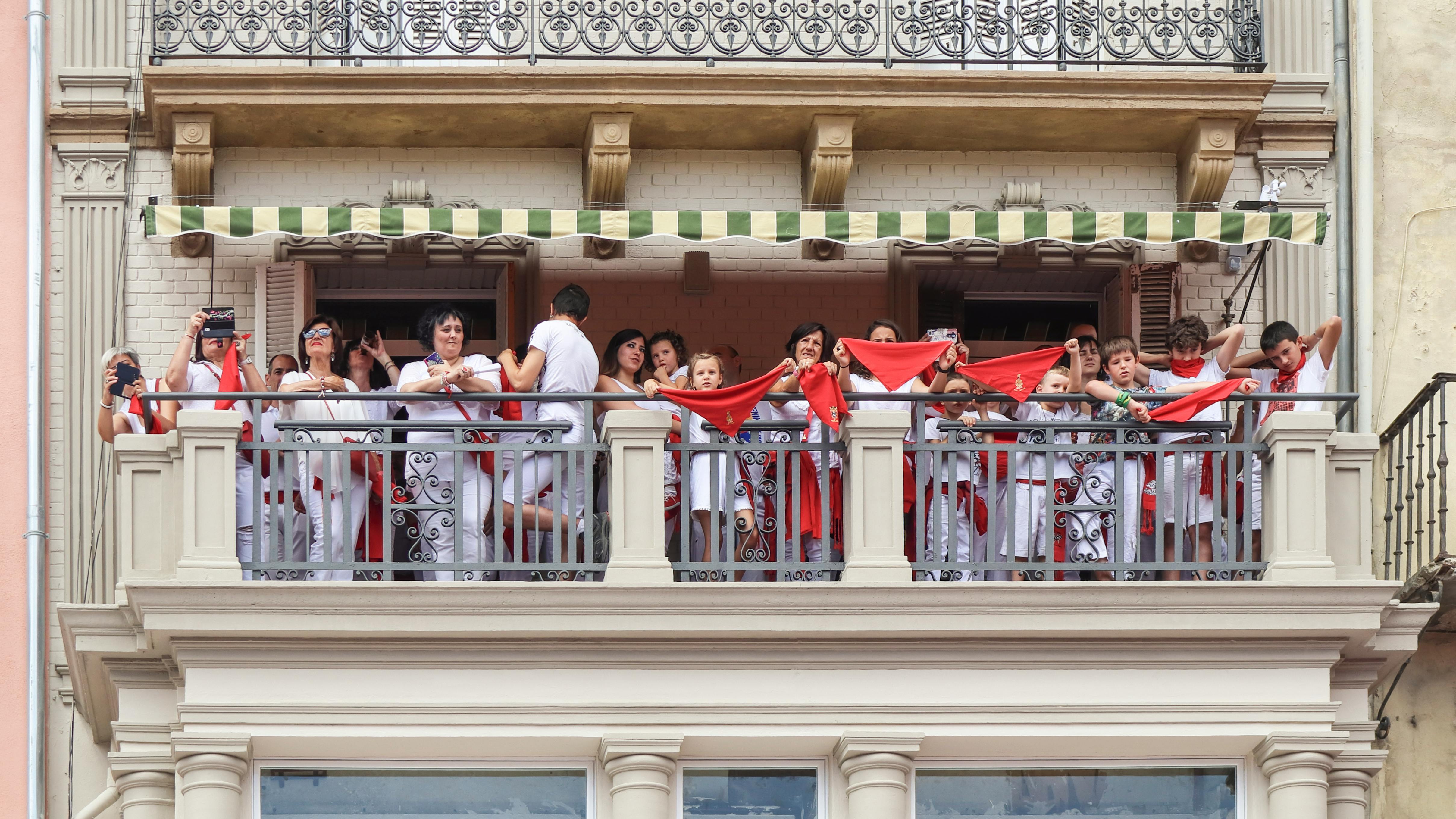
Revelers on the balconies of Pamplona hold their red pañuelos aloft, waiting for the txupinazo to start fiesta. The pañuelo is not tied until the rocket fires.
Txupinazo
The opening ceremony rocket. Fired from the balcony of the Ayuntamiento at noon on July 6 to officially launch Sanfermines. The moment the rocket fires, the crowd shouts “¡Viva San Fermín! ¡Gora San Fermín!” and the pañuelos are tied. Followed by mass wine spraying and the beginning of the festival. Basque spelling: txupinazo. Not chupinazo.
A San Fermín Pedimos
The prayer sung before each encierro at the niche of San Fermín on Cuesta de Santo Domingo, at 7:55 AM each morning of the run. The text: “A San Fermín pedimos, por ser nuestro patrón, nos guíe en el encierro dándonos su bendición.” In Basque: “Entzun arren San Fermín zu zaitugu patroi zuzendu gure oinak entzierro hontan otoi.” Ends with three rounds of “¡Viva San Fermín! ¡Gora San Fermín!” It began as an informal tradition among a group of Pamplona friends in the 1950s and is now one of the most emotionally powerful moments of the entire festival.
La Procesión de San Fermín
The main religious procession on July 7 (the saint’s feast day). The image of San Fermín is carried solemnly through the streets of the Old Town, the only time each year the saint’s image leaves the Capilla de San Fermín. One of the oldest continuous traditions of the festival.
Riau-Riau
The traditional melody (formally titled Vals de Astrain, composed by Miguel Astrain and popularized by Ignacio Baleztena in 1914) played during the city councilors’ procession from the Ayuntamiento to the Capilla de San Fermín on July 6. Historically, peñas would drown out the music and delay this procession for hours as a form of political protest. The tradition was suspended and is now managed tightly, but the melody remains one of the emotional anchors of the festival. For the full account, including the failed 2012 attempt to restore the original procession, see our complete history of the Riau-Riau tradition.
Diana
The morning wake-up march. Brass bands and txarangas play through the streets of Pamplona at approximately 6:00 AM before each encierro, rousing participants, building energy, and creating the crescendo that ends with the 8:00 AM run. If you sleep through the diana, you have missed the atmosphere of the morning.
Pobre de Mí
The closing ceremony. At midnight on July 14, participants gather in the Plaza Consistorial and sing: “Pobre de mí, pobre de mí, que se han acabado las fiestas de San Fermín.” (Poor me, poor me, the Festival of San Fermín has ended.) Candles are lit. Pañuelos are removed. It is the most emotionally raw moment of the entire festival for anyone who has spent the week in Pamplona.
Gora San Fermín
“Long live San Fermín!” in Basque. The Basque counterpart of “¡Viva San Fermín!” in Spanish. Both versions are shouted together at the end of the morning prayer and throughout the festival. Note the accent on the í.
Vaquillas
See Section 5. Young heifers released into the bullring after each morning’s encierro. This is the event that draws the largest crowds to the Plaza de Toros immediately after the bull run ends.
Kalejira
A street procession with music and dancing. From Basque kale (street) and jira (tour or round). The format of many festival marches through the Old Town: a band at the front, dancers behind, and a crowd filling the street. The giants, the peñas, and the folk dance groups all move through the city in kalejira format.
La Ronda / Las Rondas
The nighttime musical rounds. Groups moving through the bars and streets of Pamplona after midnight, playing music, drinking, and singing. Hacer la ronda is to do the bar rounds: moving from one establishment to the next in the Old Town through the early hours. The rondas are where the festival lives when the bulls are not running.
Bota
A traditional leather wine bag. Squeeze the bag and direct a stream of wine into your mouth without touching the spout to your lips. A genuine skill with a genuine learning curve. An essential fixture at Sanfermines and one of the most photographed objects of the festival.
Section 7
The Peñas
The social clubs that generate the music, the marching, and the soul of Sanfermines. There are 17 official peñas and each one has a name, a history, and a color.
Peña
A social club. In the San Fermín context, peñas are organized groups with their own headquarters (local), distinctive uniforms (blusón and pañuelo), banners (pancartas), and a packed festival program. They march through the streets after each corrida, filling Pamplona with txarangas and noise. The 17 official peñas are governed by the Federación de Peñas de Pamplona.
Blusón
The distinctive peña smock or jacket, worn over the white Sanfermines outfit. Each peña has its own plaid or solid color design. The blusón is how you identify which peña a person belongs to from across the street.
Pancarta
The banner carried by each peña in processions and at the bullring. Each peña’s pancarta is a point of pride. In 1977, the Donibane peña had theirs stolen on July 7 and had to march with their smaller backup pancarta.
Txosna (pl. Txosnas)
Outdoor peña bar stalls set up in the festival grounds near the Ciudadela and the recinto de fiestas. Managed by the peñas, serving kalimotxo, beer, and mixed drinks throughout the festival. The txosnas are where the peñas gather when they are not marching.
Federación de Peñas de Pamplona
The governing body of the 16 Pamplona peñas (plus the Ansoáin peña). Peña Mutilzarra is notably not a member of the federation.
Irrintzi
The traditional Basque war cry or victory cry. A high-pitched, piercing yelp. Also the name of the peña founded in 1951, whose members wear black blusones. The peña Irrintzi is credited with formalizing the group singing of the pre-encierro prayer tradition as it is practiced today.
All 17 Peñas of San Fermín
| Peña | Founded | Colors and Notes |
|---|---|---|
| La Única | 1903/1913 | Green pañuelo, faja, and alpargata ties; blue and white plaid blusón. The oldest peña. Name comes from being “the only one” marching in the early festival years. Dennis Clancey is a member. |
| Muthiko Alaiak | 1931 | Blue small-check blusón. Basque for “jolly lads.” Organized dance groups and is the origin of the “Uno de Enero” kalejira melody. |
| El Bullicio Pamplónés | 1933 | White outfit, no blusón; peña shield embroidered on pañuelo. |
| La Jarana | 1940 | Blue pañuelo and faja; blue-check blusón. Named for the street where founders originally gathered. |
| Oberena | 1941 | Green, white, and black. Strong ties to the world of the bulls. Has counted legendary matadors among its honorary members. |
| Aldapa | 1947 (club) / 1958 (peña) | No blusón; shield on pañuelo. Named after the bar where members first gathered. Headquartered on Calle Jarauta. |
| Anaitasuna | 1949 | Red pañuelo with image of San Fermín; shield on shirt pocket. Basque for “brotherhood.” |
| Los del Bronce | 1950 | White and blue plaid blusón. Named after “la gente de bronce,” the rowdy working-class fans who filled the sunny bleacher sections. |
| Irrintzi | 1951 | Black blusón. Named for the Basque war cry. Credited with formalizing the pre-encierro prayer tradition. |
| Alegría de Iruña | 1953 | Green blusón with red collar and cuffs; green-trimmed red pañuelo. Has operated a charity program (“Operación Patata”) since 1960. |
| Armonía Txantreana | 1956 | Plain white, no blusón. Credited with popularizing the all-white Sanfermines outfit across all peñas. The first neighborhood peña in Pamplona. From the Txantrea neighborhood. |
| Donibane | 1977 | Light blue blusón; blue pañuelo with shield. Largest membership of any peña. From the San Juan neighborhood. Donibane is Basque for San Juan. |
| La Rotxa | 1979 | Rochapea neighborhood peña. La Rotxa is the Basque name for Rochapea. |
| 7 de Julio San Fermín | 1979 | Black and white plaid blusón. Founded on the feast day of San Fermín. Organizes annual trips to visit the ganadías that will run in the following year’s encierros. |
| Sanduzelai (formerly San Jorge) | 1980 | White and black plaid blusón. Renamed in 1996. From the San Jorge neighborhood. |
| Peña Mutilzarra | 1992 | Red blusón; red pañuelo with shield. Not a member of the Federación de Peñas. Organizes the annual Riau-Riau popular procession and hosts rondalla competitions during the festival. |
| El Charco | 2019/2020 | Blue and white striped blusón; blue pañuelo and faja. From Ansoáin: the only peña from outside Pamplona proper. |
Section 8
La Comparsa: Giants, Bigheads, and Figures
The papier-mâché characters that parade through Pamplona every morning of the festival. A tradition dating to at least 1600.
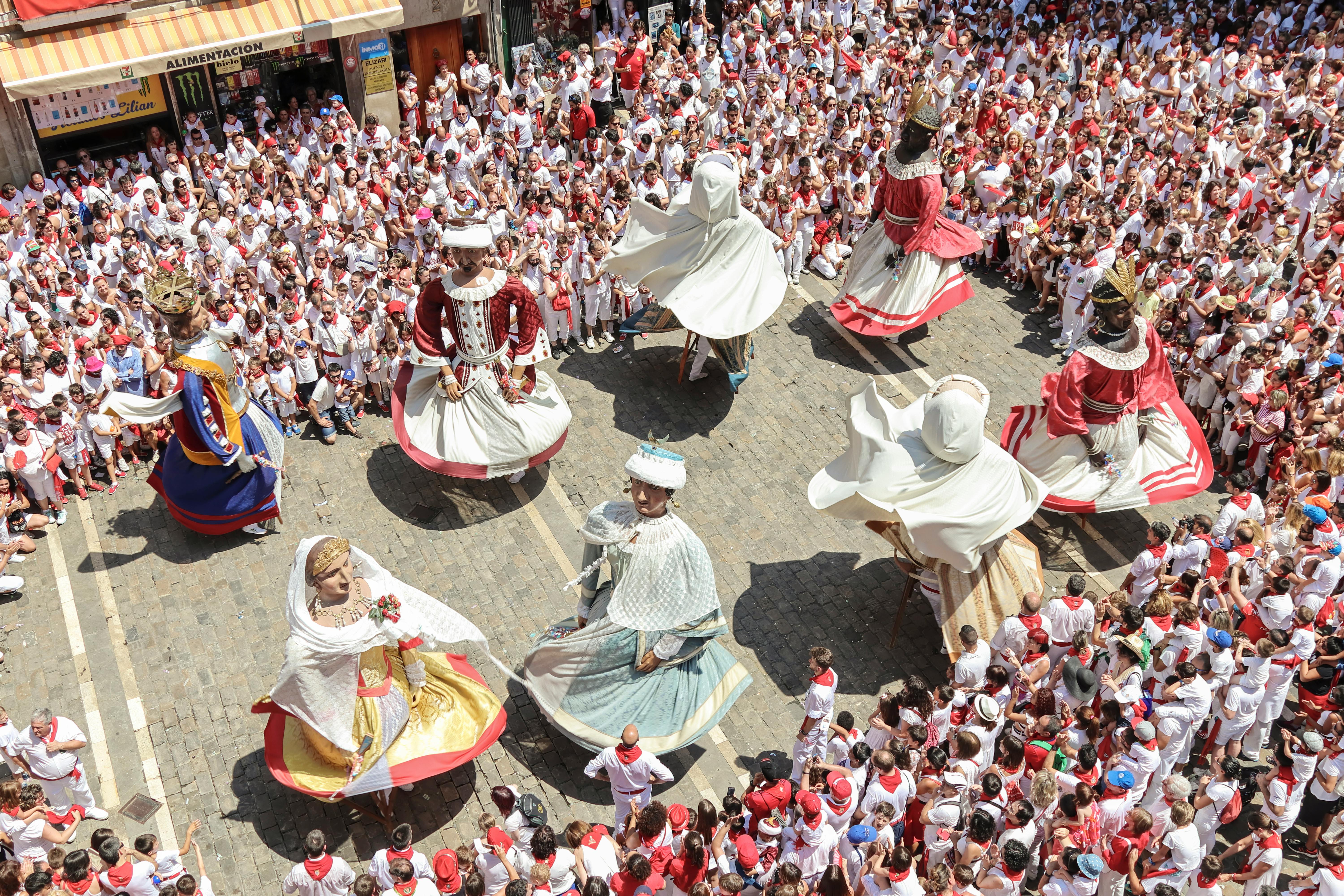
Los Gigantes dancing in Town Hall Square. The eight papier-mâché giants represent four pairs of kings and queens from four world regions.
La Comparsa
The official troupe of giant and comic figures that parade through Pamplona each morning of the festival (July 7 through 14) and on the evening of July 6. The full troupe consists of 8 giants, 5 cabezudos, 6 kilikis, and 6 zaldikos. The first documented comparsa in Pamplona dates to 1600.
Gigantes
The giants. Eight papier-mâché figures (four pairs of kings and queens) created in 1860 by Tadeo Amorena, representing European, Asian, African, and Afro-American royalty. Each figure is carried and animated by a hidden bearer who makes it dance and spin through the streets. Children reaching up to touch the giant’s skirts is one of the iconic images of San Fermín.
Cabezudos
The bigheads. Five figures with oversized papier-mâché heads worn by costumed people who walk with exaggerated solemnity through the crowds. They represent traditional authority figures. Solemn-faced, dignified, and slightly absurd.
Kilikis
Six comic figures with tricorn hats and grim expressions, each carrying a sponge-tipped stick with which they chase and whack children (and adults who are not paying attention) in the crowd. Named individually: Barbas (Beards), Patata (Potato), Verrugón (Big Wart), Coleta (Ponytail), Caravinagre (Vinegar Face, the most recognizable), and Napoleón.
Zaldikos
Literally “little horses” in Basque (from zaldi, horse). Six hobby-horse figures with riders who chase spectators through the streets and swat them with foam rods. The word zaldiko is also the name of the folk dance group Zaldiko Maldiko, which in 1934 became the origin of the Peña Muthiko Alaiak.
Caravinagre
Literally “vinegar face.” The most recognizable of the six kilikis, and the figure most associated in public memory with the comparsa. If someone in Pamplona refers to a kiliki without specifying which one, they often mean Caravinagre.
Section 9
Traditional Dress
The clothing of San Fermín carries meaning. Every piece has a history and a reason.
Pañuelo
The red neckerchief. A small square of red cloth tied around the neck at the moment of the txupinazo on July 6 and worn continuously until the closing Pobre de Mí on July 14. The red represents the martyrdom of San Fermín, whose blood the color symbolizes. Often features the crest of the festival or an image of the saint. Tying the pañuelo is not just a fashion act: it is the moment you formally enter the festival.
Faja
The red waist sash. Wrapped tightly around the waist over a white shirt. Worn as a matched set with the pañuelo. The red of the faja and pañuelo against the white of the shirt and trousers is the visual identity of Sanfermines the world over.
Blusón
The peña smock or jacket, worn over the white and red San Fermín outfit. Each peña has its own distinctive plaid or colored design. If someone is wearing a blusón, they belong to a specific peña and you can identify which one by the pattern. See Section 7 for each peña’s colors.
Txapela
The Basque beret. Worn in red for festival use (red signals fiesta; black is for everyday work). The txapela is a Basque cultural marker as recognizable as the pañuelo. Basque spelling: txapela. Spanish spelling: boina.
Boina
The Spanish word for beret. The traditional Navarrese boina is red, with historical associations to Carlist political culture. In everyday use, boina and txapela refer to the same object; the choice of word signals cultural and linguistic identity.
Jubón
A traditional bodice or doublet jacket. Part of formal Navarrese folk costume, seen in official processions and folk dance performances during the festival. Not everyday festival attire, but present in the more ceremonial events of Sanfermines.
Alpargatas
Rope-soled canvas shoes. The traditional and correct footwear for the encierro and for Sanfermines generally. White canvas with colored ribbon ties that signal peña affiliation for members. Never wear sandals, flip-flops, or smooth-soled shoes in the encierro: grip on cobblestones can be the difference between staying upright and falling.
Cintas
The ribbon laces on alpargatas. The color of the cintas indicates peña membership. La Única members, for example, wear green cintas to match the peña’s signature color.
Section 10
Food and Drink
What you eat and drink in Pamplona during San Fermín is not incidental. It is part of the experience.
Pintxos
Basque spelling (Spanish: pinchos). Small bar snacks, typically a slice of bread topped with something and held together by a toothpick. The quintessential food of Pamplona’s bar culture. You point, you eat, you move to the next bar. Ordering pintxos requires no Spanish: eye contact and a gesture work fine.
Txistorra
A thin, fast-curing chorizo-style sausage from Navarre. Made with pork, paprika, and garlic. Thinner and fattier than standard chorizo. Grilled or fried and served in sandwiches (bocadillos) or as pintxos. One of the defining tastes of Navarre. Basque spelling: txistorra. Not chistorra, not cistora.
Chuletón
A massive bone-in ribeye steak, dry-aged and grilled over charcoal. The signature main course of Navarrese grill restaurants (asadores). When a group in Pamplona says they are going for chuletón, they mean a serious, unhurried meal. One of the great steaks of Spain.
Chuleta
A chop or cutlet. Smaller than a chuletón. Chuleta de cordero (lamb chop) is widely eaten in Navarre, where the lamb is excellent.
Kalimotxo
Red wine mixed with cola (typically Coca-Cola), in equal parts. The unofficial party drink of Sanfermines. Cheap, energizing, and ubiquitous at the txosnas. Basque spelling: kalimotxo. Not calimotcho, not calimocho.
Patxaran
A sloe-berry liqueur from Navarre, made by macerating arán (blackthorn sloe berries) in aniseed aguardiente. Drunk cold as a digestif after a large meal. One of the most distinctively Navarrese flavors you will encounter. Basque spelling: patxaran. Spanish: pacharán.
Txakoli / Txakolí
A lightly sparkling, very dry white wine from the Basque Country. Traditionally poured from height to aerate it, producing the distinctive stream of wine you will see in bars throughout Pamplona. Ideal with pintxos.
Vino de Navarra
Wines from the DO Navarra appellation. Navarre is especially known for its rosados (rosé wines), which are widely considered among the finest in Spain and pair naturally with the food of the festival.
Sagardotegi
A Basque cider house. The word combines sagardo (cider) and tegi (place). Cider houses are cultural institutions of the Basque Country: communal, seasonal, and central to Basque social life. Also the setting in which the txalaparta percussion instrument is believed to have originated.
Kubata
A rum and Coke or gin-based mixed drink. Standard order at txosnas and festival bars. The txosna version tends to be stronger than what you would order in a sit-down bar.
Section 11
Music and Instruments
The sound of San Fermín is as distinctive as its imagery. These are the instruments and ensembles that create it.
Txistu
A traditional Basque and Navarrese vertical fipple flute with three finger holes, played one-handed while the same musician beats the ttun-ttun (small drum) with the other hand. The most characteristic instrument of Navarrese folk music. The txistu player (txistulari) is the walking embodiment of Basque musical culture and appears in every major procession during Sanfermines.
Ttun-Ttun
A small cylindrical drum played one-handed by the txistulari while simultaneously playing the txistu with the other hand. Together, txistu and ttun-ttun produce one of the most instantly recognizable sounds in the world of folk music. If you hear it in Pamplona, something ceremonial is about to happen nearby.
Gaita
Basque and Navarrese bagpipe. Similar in sound to Scottish or Galician bagpipes but played using a direct blowing technique rather than a bag of air. The gaita and txistu together are the defining instruments of Navarrese folk music and appear together in festival processions throughout the week.
Txalaparta
An ancient Basque percussion instrument. Two long wooden planks laid horizontally on supports, beaten vertically by two players (txalapartariak) using thick wooden sticks (makilak). The players alternate and interlock rhythms in a form of call and response. Believed to have originated at Basque cider farmhouses (sagardotegi) to announce the end of the apple pressing season. Now a fixture of Basque cultural festivals and one of the most distinctive sounds in European traditional music.
Txaranga
A street brass band. Groups of friends with wind instruments: trumpets, trombones, saxophones, clarinets. They march and play energetically through the streets of Pamplona, generating the noise that makes the festival feel like the festival. Each peña has its own txaranga. Basque spelling: txaranga. Not charanga.
Fanfarre
A marching brass band. Similar to a txaranga. The terms are sometimes used interchangeably in the festival context.
Diana
The morning wake-up march. Played through the streets of Pamplona at approximately 6:00 AM before each encierro. The diana builds the emotional temperature of the city from sleepy post-celebration calm to the focused anticipation of the 8:00 AM run. Hearing the diana from your window is one of the defining sensory memories of the festival.
Rondalla
A traditional ensemble of plucked string instruments: guitars, bandurrias, laúdes. A Spanish and Navarrese folk format, heard in bars, peña headquarters, and informal gatherings throughout the festival week.
Alboka
A traditional Basque double-pipe horn instrument, made from animal horn. Less common than the txistu or gaita at Sanfermines but present in the broader Basque musical tradition that the festival draws from.
Section 12
Songs and Key Phrases
The words you will hear repeated for eight consecutive days. Know them before you arrive.
“Uno de Enero, dos de Febrero…”
The de facto anthem of Sanfermines. Written by Ignacio Baleztena and set to the kalejira melody of the Ingurutxo, a circular folk dance from the Navarrese village of Leitza. The song counts the months of the year and arrives at July 7 as the climax. Sung constantly throughout the festival week by everyone from peña members to tourists who pick it up in the first hour of being in Pamplona.
Riau-Riau
The melody (Vals de Astrain) played during the city councilors’ procession to the Capilla on July 6. Also the term for the boisterous crowd tradition of blocking the procession and delaying it through sheer noise and mass. The riau-riau protest tradition was a form of political resistance and is one of the most contested episodes in the festival’s modern history.
Pobre de Mí
The closing song, sung at midnight on July 14 in the Plaza Consistorial: “Pobre de mí, pobre de mí, que se han acabado las fiestas de San Fermín.” Poor me, poor me, the Festival of San Fermín has ended. People cry. Veterans of many Sanfermines cry harder than first-timers.
Gora San Fermín / Viva San Fermín
The festival’s central cheer. Gora is Basque for “long live” or “up with.” Both versions are shouted together at the end of the morning prayer, at the txupinazo, and throughout the festival. The bilingual alternation reflects the dual identity of Navarre.
Aupa!
A Basque exclamation: “up,” “let’s go,” or “yeah.” The casual version of Gora. You will hear Aupa! hundreds of times a day during Sanfermines as a greeting, a toast, a rally cry, and general expression of festive enthusiasm.
Irrintzi
The Basque war cry or victory cry: a high-pitched, piercing yelp. Used throughout the festival as an expression of Basque cultural pride, athletic triumph, and general exuberance. Also the name of one of the peñas.
Jota
A lively Navarrese and Aragonese folk dance and musical form. Characterized by fast footwork, castanets, and an upbeat triple meter. Regularly performed by folk dance groups during Sanfermines processions and public events.
Aurresku
A traditional Basque honor dance, performed as a formal greeting or tribute. Appears in the more ceremonial and official moments of the festival. Distinguished by its improvised solo footwork sections.
Section 13
Religious and Ceremonial Sites
The spiritual geography of San Fermín: where the saint lives, where runners pray, and where processions begin and end.
Capilla de San Fermín
The Chapel of San Fermín, located inside the Iglesia de San Lorenzo on Calle Mayor. Built between 1696 and 1717. The saint’s image (capotico) resides here permanently and leaves only once per year for the July 7 procession. Runners come to this chapel before the festival begins and throughout the week to ask the saint’s protection before the encierro.
Iglesia de San Lorenzo
The Church of San Lorenzo, which houses the Capilla de San Fermín. An active parish in the Old Town, open for Mass throughout the year and visited by hundreds of thousands of pilgrims and tourists during Sanfermines.
Capotico
The red and gold cape covering the polychrome wooden bust-reliquary of San Fermín. Runners invoke the saint before each encierro, asking him to “give them a cape” (capo) of protection. The word is a diminutive of capote. The capotico is one of the most visually recognized objects of the festival.
Iglesia de San Saturnino (San Cernin)
One of the oldest churches in Pamplona, located in the Casco Viejo. Built on the site where the city’s first baptisms are said to have taken place. The historic borough of San Cernin (one of the three original boroughs of medieval Pamplona) takes its name from this church. Its bell towers are a dominant feature of the Pamplona skyline.
Iglesia de San Nicolás
Anchors the San Nicolás neighborhood, one of the three original medieval boroughs of Pamplona. The three churches (San Saturnino, San Nicolás, and the Cathedral) frame the spiritual geography of the Old Town.
La Procesión de San Fermín
The solemn religious procession on the morning of July 7, the saint’s feast day. The saint’s image is carried through the streets of the Casco Viejo. One continuous tradition stretching back to the 14th century. The most formal and spiritually significant event of the entire festival.
Section 14
Places and Landmarks
The physical Pamplona that the festival inhabits: squares, bars, streets, promenades, and fortifications.
Plaza del Castillo
The main square of Pamplona. The social and geographic heart of the city: nearly 14,000 square meters of open space surrounded by arcades and historic buildings. The location of Café Iruña, Bar Txoko, Casino Eslava, and other landmark establishments. During Sanfermines, the plaza is the meeting point for everyone.
Bar Txoko
A historic bar on Plaza del Castillo. Ernest Hemingway frequented it after bullfights (then spelled “Choko”). Txoko means “corner” or “cozy spot” in Basque. Basque spelling: Txoko. Never write Bar Choko or Bar Choco.
Café Iruña
The famous Belle Époque café on Plaza del Castillo, opened in 1888. Hemingway’s favorite Pamplona establishment and one of the inspirations for the café scenes in The Sun Also Rises. A landmark of Sanfermines culture and one of the great cafés of Spain.
Ayuntamiento / Casa Consistorial
The Town Hall. An 18th-century Baroque and Neoclassical building on the Plaza Consistorial. The balcony from which the txupinazo is fired each July 6. Built at the order of King Charles III, who in 1423 unified the three medieval boroughs of Pamplona into a single municipality on the spot where all three converged.
Paseo de Sarasate
The main promenade of Pamplona, named for Pablo de Sarasate (1844 to 1908), the celebrated violinist and composer born in the city. Lined with chestnut trees and flanked by the Palacio de Navarra. A site for outdoor concerts and summer dances. Often referred to by locals as the “Paseo de Valencia” (a long-standing popular nickname for the stretch).
Pablo de Sarasate
(1844 to 1908) Pamplona’s most celebrated native son. A virtuoso violinist and composer of international renown who performed across Europe and the Americas. His name appears on the city’s main promenade, its music conservatory (Conservatorio Pablo Sarasate), and a monument in the Paseo.
La Ciudadela
The star-shaped 16th-century citadel, built under Philip II beginning in 1571 to the design of military engineer Giacomo Palearo. A perfectly preserved Renaissance military structure: a regular pentagon with five bastions (baluartes) at its angles. Now demilitarized and converted to a public park with lawns, modern sculpture, and event spaces. The festival grounds (recinto de fiestas) and txosnas are concentrated in the Vuelta del Castillo park surrounding the Ciudadela.
Río Arga
The Arga River, flowing along the eastern edge of the Old Town. A second-order tributary of the Ebro. The historic center of Pamplona sits on the left bank of the Arga; the neighborhoods of Rochapea and Txantrea lie on the right bank and the northern slopes above it.
Calle Aldapa
A street in the Old Town, home to the peña Aldapa’s bar and the bar that gave the peña its name. The word aldapa means “slope” or “hill” in Basque, reflecting the hilly terrain of the Old Town.
Calle Jarauta
The main street of peña headquarters in the Casco Viejo. The majority of peña locales are on or near Calle Jarauta, making it the organizational spine of the festival’s social infrastructure.
Section 15
Pamplona Neighborhoods
The barrios of Pamplona: where the city came from and where the festival lives.
Casco Viejo / Casco Antiguo
The Old Town. The medieval heart of Pamplona, enclosed within the ancient walls. All three historical boroughs (Navarrерía, San Cernin, San Nicolás) are within the Casco Viejo. The entire encierro route runs through the Casco Viejo. During Sanfermines, this is the center of everything.
Navarrерía
The oldest part of the Old Town, corresponding to the original Roman settlement of Pompaelo. The first of the three medieval boroughs that merged into Pamplona under King Charles III in 1423. The Cathedral and some of the city’s oldest streets are in the Navarrерía.
San Cernin / San Saturnino
One of the three historic medieval boroughs. Named for the Iglesia de San Saturnino (San Cernin). Located in the heart of the Old Town, centered on the street of the same name.
San Nicolás
The third historic medieval borough. Named for the Iglesia de San Nicolás. The street Calle San Nicolás runs through the Old Town and is one of the main arteries of Sanfermines nightlife.
Txantrea / La Chantrea
A working-class neighborhood in northern Pamplona, on the right bank of the Arga. Home to Armonía Txantreana, the first neighborhood peña in Pamplona (founded 1956). The neighborhood is credited through its peña with popularizing the all-white Sanfermines outfit.
Rochapea / Rotxapea
A neighborhood along the Arga River, north of the Old Town. Location of the Corrales del Gas, the main bull corrals where the fighting bulls are housed throughout the festival. The Encierrillo transfers bulls from Rochapea to Santo Domingo each evening.
San Juan / Donibane
A neighborhood in Pamplona and home of the Donibane peña. Donibane is the Basque form of San Juan (Saint John). The peña takes the Basque name for the neighborhood it represents.
San Jorge / Sanduzelai
A neighborhood in Pamplona and home of the Sanduzelai peña (formerly Peña San Jorge, renamed in 1996). A residential area on the southern edge of the city.
Ensanche
Literally “widening.” The planned expansion districts built south of the Old Town in the 19th and 20th centuries. The I Ensanche (1888) and II Ensanche (post-1915) give Pamplona its modern grid-pattern center. Several peñas formed in the Ensanche neighborhoods and later relocated to the Casco Viejo for the festival.
Ansoáin
A separate municipality that is physically surrounded by Pamplona but administratively independent. Home of El Charco peña: the only peña of San Fermín from outside Pamplona proper.
Section 16
Basque Language Quick Reference
The Basque words you will encounter most often in Pamplona during San Fermín. Basque (Euskara) is one of the oldest languages in Europe and has no known relatives.
| Basque | Spanish | English |
|---|---|---|
| Iruña / Iruñea | Pamplona | Pamplona |
| Nafarroa | Navarra | Navarre |
| Euskal Herria | País Vasco / Euskadi | The Basque Country |
| Euskara / Euskera | Vasco / Vascuence | The Basque language |
| Gora! | ¡Viva! | Long live! / Hooray! |
| Aupa! | ¡Arriba! / ¡Vamos! | Up! / Let’s go! / Yeah! |
| Irrintzi | El grito vasco | The Basque war / victory cry |
| Txoko | Rincón / lugar acogedor | Corner / cozy spot |
| Zaldi | Caballo | Horse |
| Zaldiko | Caballito | Little horse |
| Kale | Calle | Street |
| Etxea | Casa | House / home |
| Donibane | San Juan | Saint John |
| Sagardotegi | Sidrería | Cider house |
| Txakoli / Txakolí | Txakoli | Basque sparkling dry white wine |
| Makilak | Palos | Sticks (used to play txalaparta) |
| Pilota | Pelota | The Basque ball sport |
| Mus | Mus | The traditional Basque card game |
| Entzierro | Encierro | The running of the bulls (Basque form) |
Frequently Asked Questions
Common Questions About San Fermín Vocabulary
What is the difference between the encierro and the encierrillo?
The encierro is the famous morning running of the bulls that takes place at 8:00 AM each day from July 7 to 14. The encierrillo is the quiet nighttime transfer of bulls from the Corrales del Gas in Rochapea to the Corrales de Santo Domingo, conducted each evening at around 10:30 PM. No runners participate in the encierrillo. It is conducted in silence, with flash photography prohibited, and requires a pass to watch.
Why do we use the Basque spelling txupinazo instead of the Spanish chupinazo?
Pamplona and Navarre sit within the Basque cultural sphere, and the Basque language (Euskara) has equal cultural standing alongside Spanish in the region. The Basque spelling uses tx where Spanish uses ch. Using the Basque spelling reflects the authentic bilingual identity of the city and the festival. The same rule applies throughout: txistorra not chistorra, pintxos not pinchos, txaranga not charanga.
What is a suelto and why is it dangerous?
A suelto (also called a descolgado) is a fighting bull that has become separated from the rest of the herd during the encierro. It is the most dangerous situation in the bull run. A separated bull is disoriented, stops following the movement of the herd, and can turn on any runner nearby without warning. The vast majority of fatal gorings in the history of the San Fermín encierro have involved a suelto. If the main herd has passed and you hear continued shouting, do not assume the run is over.
How many peñas are there and what do they do?
There are 17 official peñas of San Fermín. Sixteen are from Pamplona and one (El Charco) is from the adjacent municipality of Ansoáin. The peñas are social clubs with their own headquarters, distinctive uniforms (blusón), banners (pancartas), and txarangas (brass bands). During the festival they march through the streets after each corrida, manage outdoor bar stalls (txosnas), and generate much of the music and collective energy that makes Sanfermines feel like Sanfermines. La Única, founded in 1903 or 1913, is the oldest.
What is La Curva and why is it never called Dead Man’s Corner?
La Curva is the sharp right turn from Calle Mercaderes into Calle Estafeta, the most notorious hazard on the running of the bulls route. Bulls lose footing on the wet cobblestones here, pile into each other, and runners can be trapped against the wall or the fencing. The term “Dead Man’s Corner” is a sensationalized English-language label that has no place in accurate coverage of the encierro. The correct name for the location, used by all Spanish and Basque media and by everyone who actually runs it, is La Curva.
What is the prayer sung before the bull run?
The prayer is called A San Fermín Pedimos and is sung at the niche of the saint on Cuesta de Santo Domingo at 7:55 AM, five minutes before the run begins. The Spanish text is: “A San Fermín pedimos, por ser nuestro patrón, nos guíe en el encierro dándonos su bendición.” It is sung three times, ending each time with “¡Viva San Fermín! ¡Gora San Fermín!” The prayer began informally among a group of Pamplona friends in the early 1950s and became an official fixture of the encierro’s opening ritual.
Ready to Run?
Walk the Route Before You Run It
This vocabulary is your starting point. Before you step onto the cobblestones of Cuesta de Santo Domingo, walk every meter of the route with an active bull runner who has run it every morning of San Fermín since 2007.