
Running of the Bulls Outfit: What to Wear in Pamplona
The running of the bulls outfit is a white shirt, white pants, a red pañuelo (neckerchief) around the neck and a red faja (sash) around the waist, worn with closed shoes that grip wet stone and are tied tight. The City of Pamplona does not require it, but nearly everyone wears it. In Dennis Clancey's words: "White is respect."
People call it many things: the running of the bulls outfit, attire or uniform, the running with the bulls outfit or clothes, the bull run outfit, the San Fermín festival outfit, the Sanfermines outfit or San Fermín clothes. In Pamplona it is the same four pieces. This guide covers what to wear to the running of the bulls: at the Pamplona bull run itself, the running with the bulls clothing for the morning of the encierro, at the chupinazo and around the fiesta, why, and where to buy it.
The LooksRunning of the Bulls Clothing: What to Wear at the Run, the Chupinazo and the Fiesta
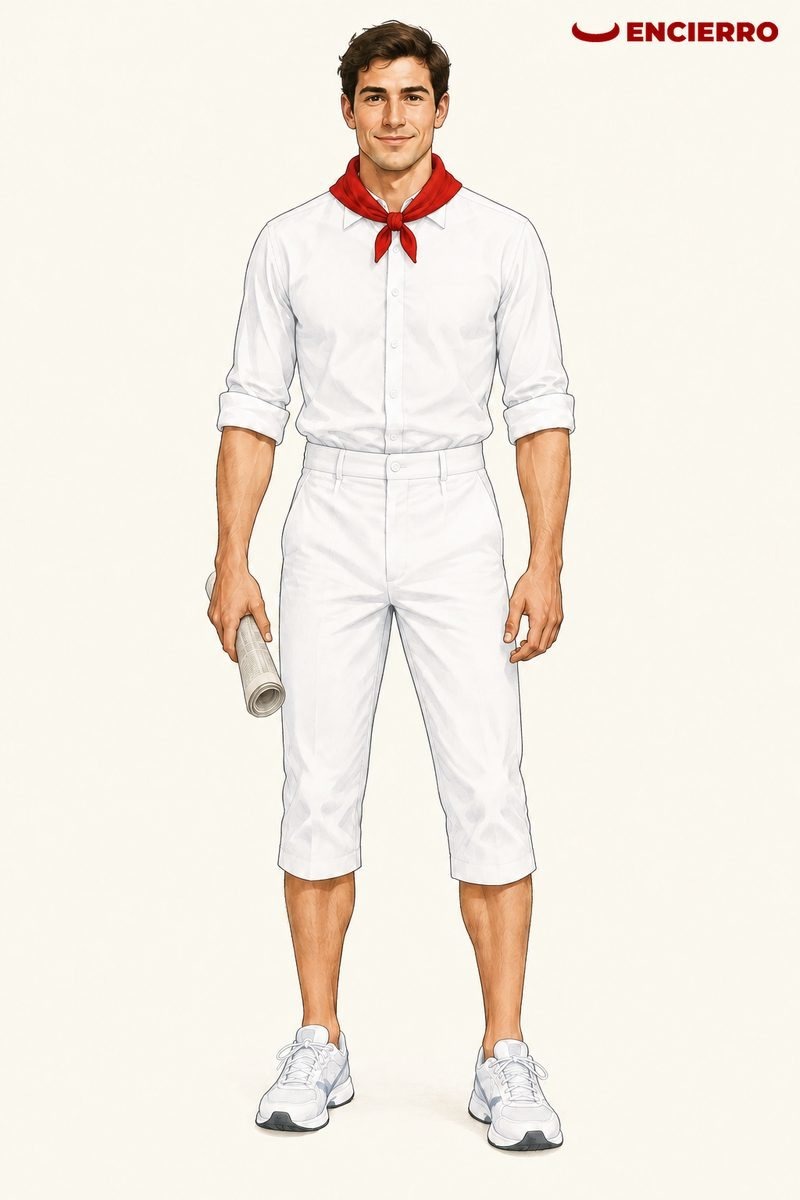
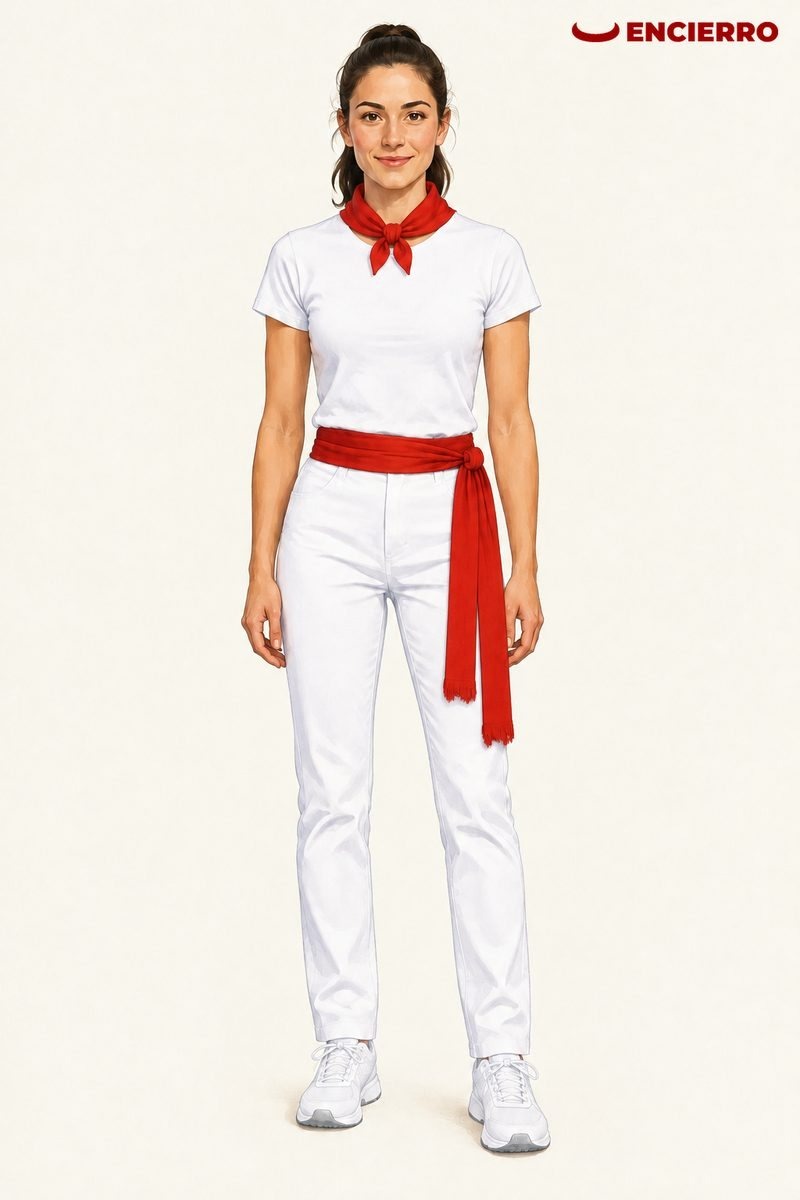
The traditional San Fermín outfit is the same for men and women, and it changes with the moment. A runner on the morning of the encierro carries less than a fiesta-goer at noon, and nobody wears good clothes to the chupinazo. Scroll through the five looks.
The runner
White shirt with the sleeves rolled, white pants, the pañuelo in a slipknot, running shoes double knotted, a rolled newspaper. A faja is optional on the run, and nothing hangs or dangles.
The runner, women
Pants or shorts, never a skirt. Hair tied back so nothing falls in your face. Hands empty.
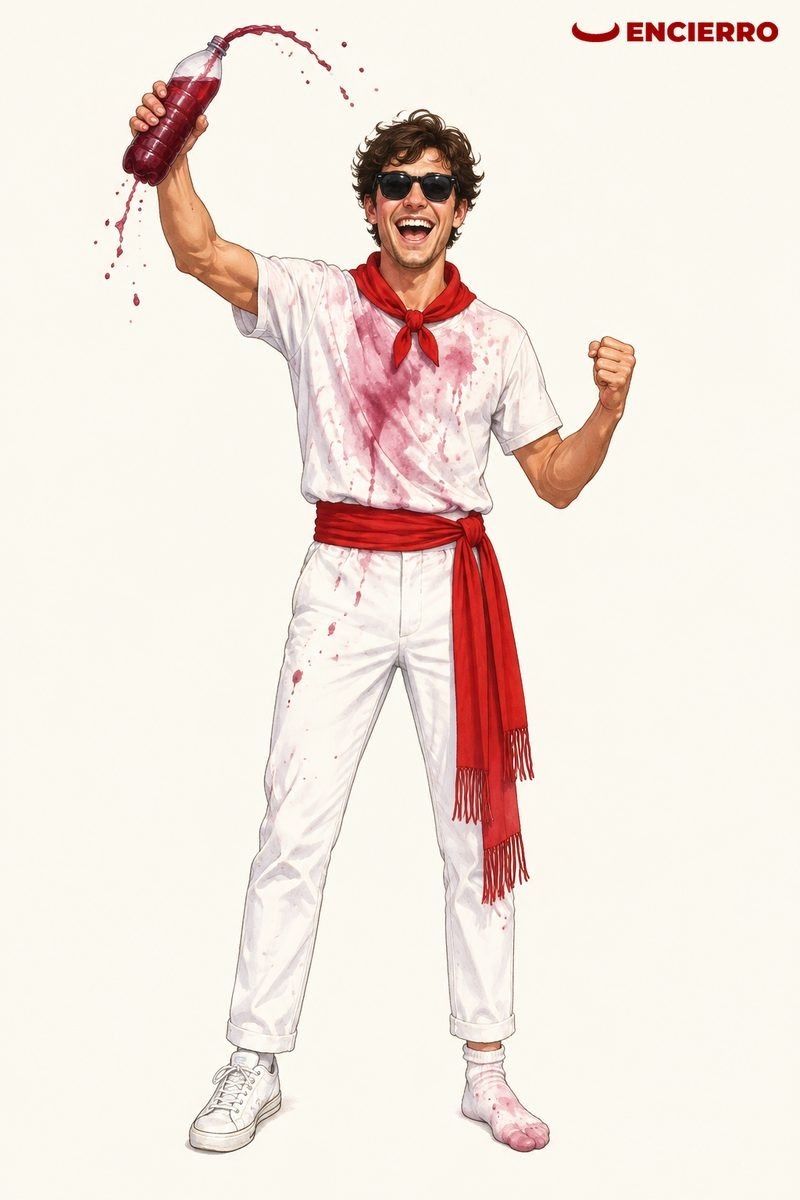
The chupinazo
Clothes you will throw away. Shoes tied tighter than ever. He lost one anyway, like many people in the plaza every July 6.
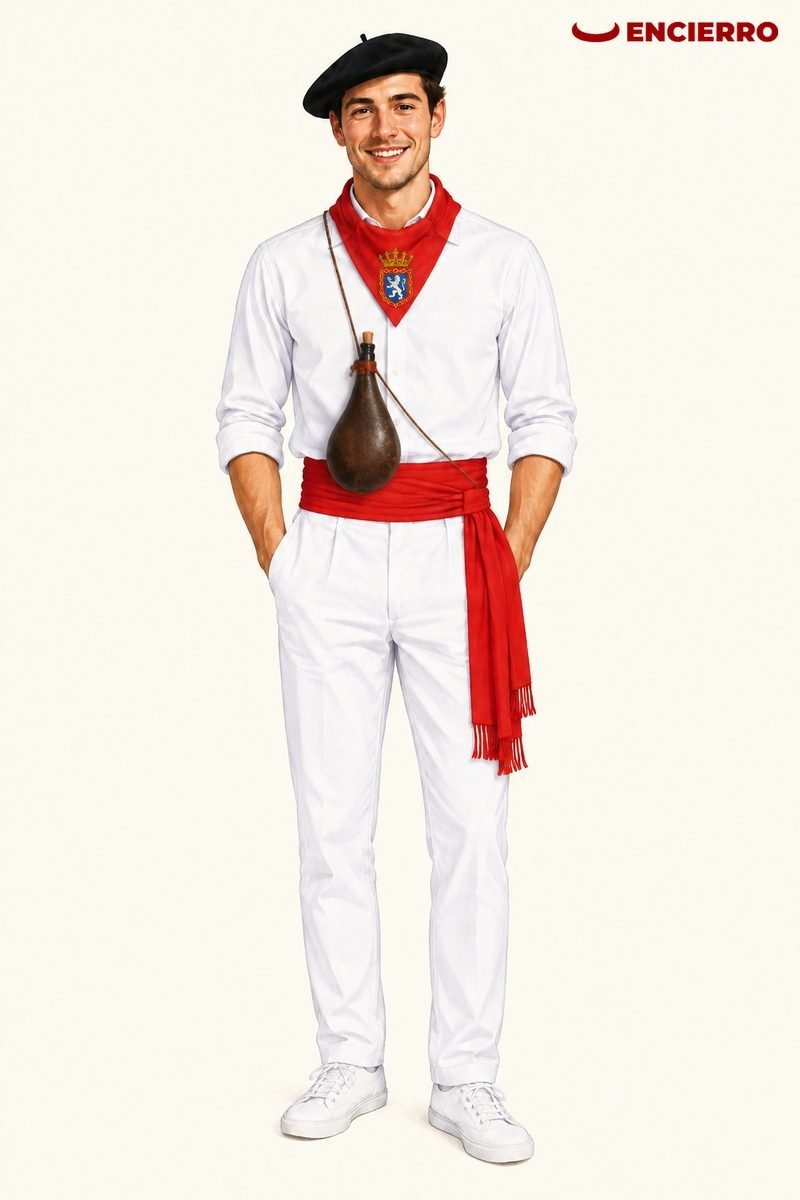
The fiesta
Whites, a black txapela, the faja knotted on the left and a leather bota of wine slung across the body.
The fiesta, women
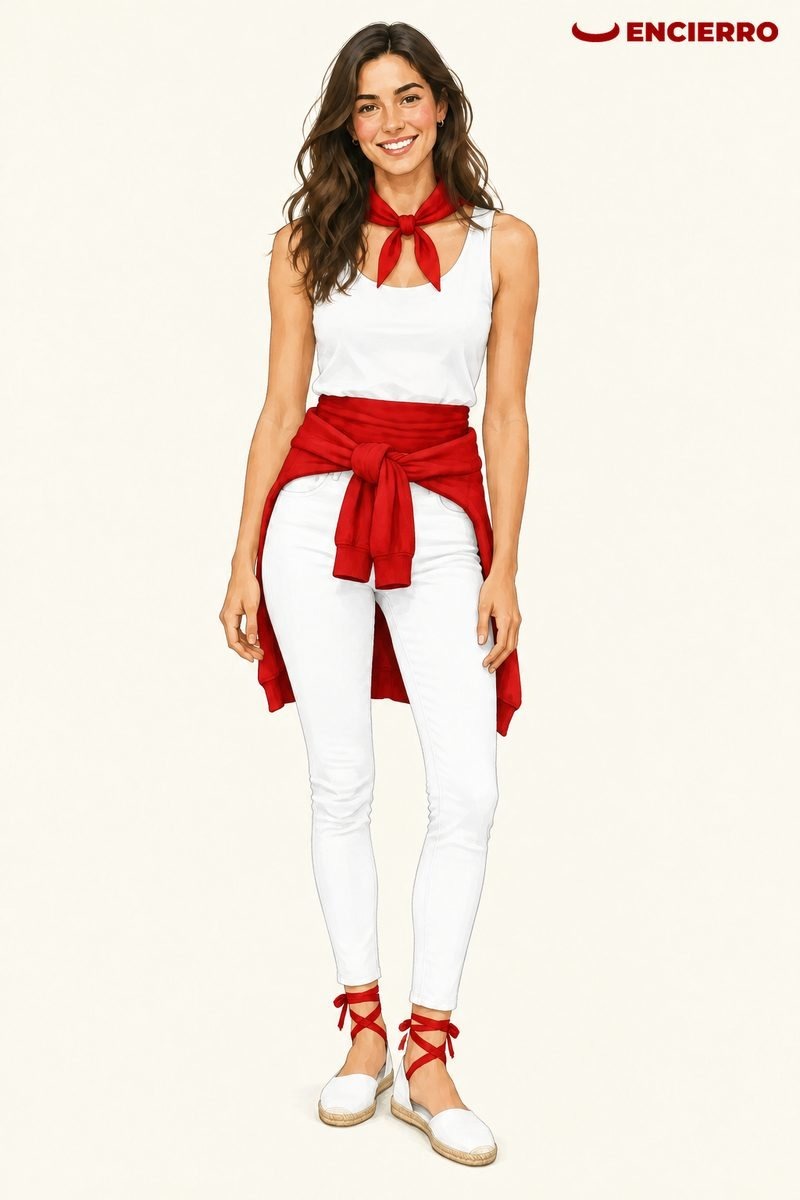
Whites, alpargatas tied with red ribbons, and a sweatshirt at the waist for the cool nights.
The Running of the Bulls Outfit, Piece by Piece
This is the running of the bulls traditional outfit, the traditional San Fermín clothes, one piece at a time, and why each one is there.
White shirt (camisa blanca)
A button-down, a plain white T-shirt or any white undershirt. By the end of the first day it will carry wine and street dust, so wear something you can ruin. "Fiesta isn't overly formal," Dennis Clancey says. "If you want to present well, just don't have wine on your shirt, which can be a challenge with chistorra and all the things we eat and drink." For after the run, our running of the bulls shirts carry the date, the ranch and the name of every bull of each morning since 2000.
White pants (pantalón blanco)
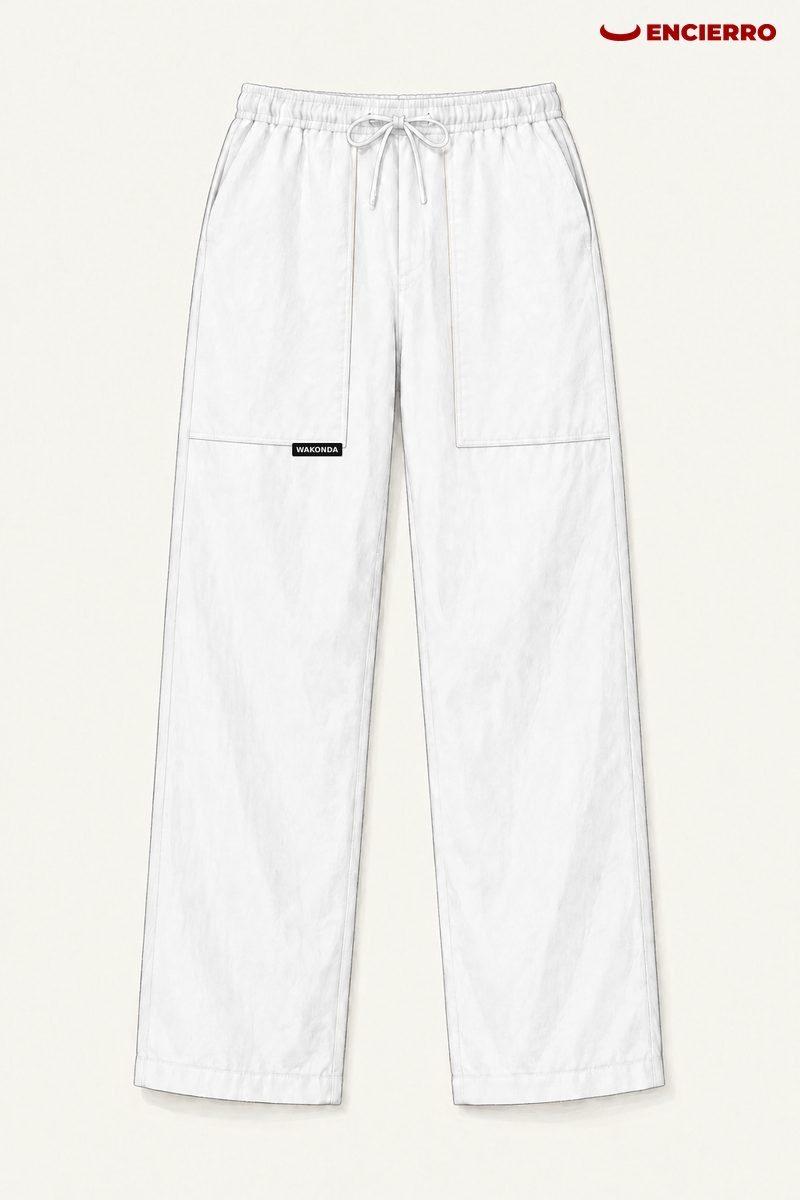
Light, loose and white. The shops along the route sell them for about 10 to 12 euros.
Dennis runs in one kind, bought in town every fiesta since 2008: white Wakonda trousers, 100 percent cotton, made in Spain, with an elastic drawstring waist, two outside patch pockets and a small black WAKONDA label just below the left pocket.1 "They're very light, airy," he says. "You get them along the run route." He buys the pairs with the black label. Their one weakness is that there are no zipped pockets, so he carries what he needs in the breast pocket of his shirt and ties his apartment keys into the drawstring with a double knot. Joe Distler, who began running in Pamplona around 1970, wears them too.2
The navy and yellow WAKONDA shield in shop photos is a cardboard hang tag. It comes off before you wear them.
Knees: pants, and pads under them
Shorts are allowed, but Dennis runs in long pants. "I like having fabric over my knees. If you fall, it stops you from scraping your knees." He goes a step further: thin padded knee sleeves under his pants, invisible from outside. "Very often that's the type of injury I'll get: a contusion to my knee, and it can be uncomfortable."
Red pañuelo (running of the bulls scarf or bandana)
It is the red scarf you see all over Pamplona. Visitors call it the running of the bulls red scarf, the San Fermín red scarf or the San Fermín bandana. It is a red neckerchief, plain or embroidered with the arms of Pamplona or Navarra, a peña's crest or the wearer's name. Children's pañuelos usually carry their name. In July 2026 they cost about 3.50 to 5 euros in the shops on the route. Dennis likes to hand them out when people arrive: "I think it's good luck if you get your pañuelo from someone else." How to wear it is below.
Red faja (running of the bulls sash)
The running of the bulls red sash is a red sash about 2.5 meters (8 feet) long and 12 centimeters (5 inches) wide, wrapped around the waist. About 5 to 6 euros. On the run it is optional; many runners who wear one tie it so a single pull undoes it, so it cannot hold them if a horn catches it. See the faja.
Blusón
The loose smock of the peñas, worn open over the whites or tied around the waist. Why people wear it: Pamplona's days are hot and its nights are cool. "It's really to meet the changes in temperature from day to night if you're out at all hours," Dennis says. "You can tie it around your waist or throw it on. It can chill down if it rains." Each peña has its own; most visitors never wear one.
Alpargatas
Canvas espadrilles with rope soles, tied with ribbons crossed up the ankle: red for most people, green for La Única.12 Why people wore them: the alpargata was cheap working footwear, a cloth upper on a sole of braided esparto, hemp or jute, plants that grow in Spain. It was the shoe of urban workers and soldiers, and it was worn across Aragón, La Rioja, Navarra and the Basque Country; its biggest center of manufacture was Mauléon, just over the Pyrenees.25 Light and cheap, it lived on as the summer shoe of the fiesta. It belongs to the fiesta, not the run: a rope sole has little grip on wet stone. In 2026 a Pamplona shoe shop on Calle Mañueta reported that handmade alpargatas led its sales, worn above all on July 7.13
Txapela
The Basque beret, black by tradition, and the one traditional running of the bulls hat (though never on the run itself). Why people wore it: a txapela is all wool, knitted and then felted, so it is warm, absorbent and sheds rain. Farmers, shepherds, fishermen and woodcutters wore it outdoors in all weather, and it spread across the Basque Country and Navarra in the 18th and 19th centuries. Spain's first beret factory opened in Azkoitia in 1847, and Elósegui's in Tolosa in 1859.26 Today musicians, older men and anyone who likes the look wear it at the fiesta. Never on the run.
Bota
The leather wine skin. Why people carry it: a bota holds wine you can take anywhere and drink on the move, without a glass. The traditional bota is goat skin sewn by hand, lined inside with pitch, with a mouthpiece of turned horn.27 At the fiesta it rides slung on a single cord across the body so it hangs in front. "You can carry booze with you throughout the city," Dennis says, "and wine slung around you is sometimes an easy way to do that." Pamplona's best-known bota maker was Las Tres ZZZ on Calle Comedias, founded in 1873 and named for the owner's triplet daughters, born in 1916. Hemingway wrote about Pamplona's botas, and Jake Barnes buys two in The Sun Also Rises.14 Never on the run: the rules ban bottles and anything in your hands.
Sweatshirt (sudadera)
Mornings are cool; see the weather. "That's why sometimes you see people early morning with sweatshirts tied around their waists," Dennis says. The shops in town sell them.
The RulesWhat the Encierro Ordinance Bans on the Run
Pamplona's Encierro Ordinance does not require white or red. It sets out what gets a runner pulled off the route and fined.3
Clothing and footwear unfit for running. The ordinance names high heels, flip-flops, sandals and clogs. A minor offense.
Backpacks, bags, bottles and cameras on the route. A minor offense.
Recording with any device, phones included, without permission. A serious offense.
Running drunk or drugged, running toward the bulls or behind them, touching or calling them, stopping on the route. Serious offenses.
Under 18s may not run.
Fines run up to 600 euros for minor offenses and from 601 to 6,000 euros for serious ones.4 During San Fermín 2026 the Policía Municipal confiscated 54 pairs of camera glasses, after a tourist filmed the second run with smart glasses and posted it online.5 The city's final count for the encierro was five fines: two for touching or calling the bulls, one for recording on the route, one for standing at the fence or in a doorway and one for leaving a doorway open.6 More on that year on our San Fermín 2026 page.
"The fastest way to get people to put their phones away is to grab one person and pull them off the run route." Dennis Clancey
Keep the phone away in the minutes before the rocket. "People that are trying to film their own run are seen as a hindrance to the natural flow of the run," Dennis says, "because you're making decisions more around trying to get the shot." Our guide to how to run with the bulls covers the rest of the morning.
ShoesWhat Shoes to Wear to Run with the Bulls
"Something comfortable, something you can run in," Dennis says. "Make sure they're tied tight. Some wear sneakers, some running shoes, some minimalist shoes. It's really having something you feel comfortable and nimble in." Closed toes, always: feet get stepped on, and the streets are filthy.

The shoes Dennis wears
Dennis Clancey runs in New Balance Minimus Trail Zero shoes, model MT00, in yellow and black. Another runner gave him his first pair in 2012. New Balance stopped making them around then, and he has kept a stack of pairs ever since. They weigh 4.7 ounces in a men's size 10, have no heel-to-toe drop and a sole about 12 millimeters (half an inch) thick.15
"I happen to wear really minimalist shoes because I like feeling the stones," he says, "the difference in the stones as I'm running." That is one runner's choice. Most people run in ordinary running or trail shoes, and that is fine.
How to Tie the Pañuelo for the Run
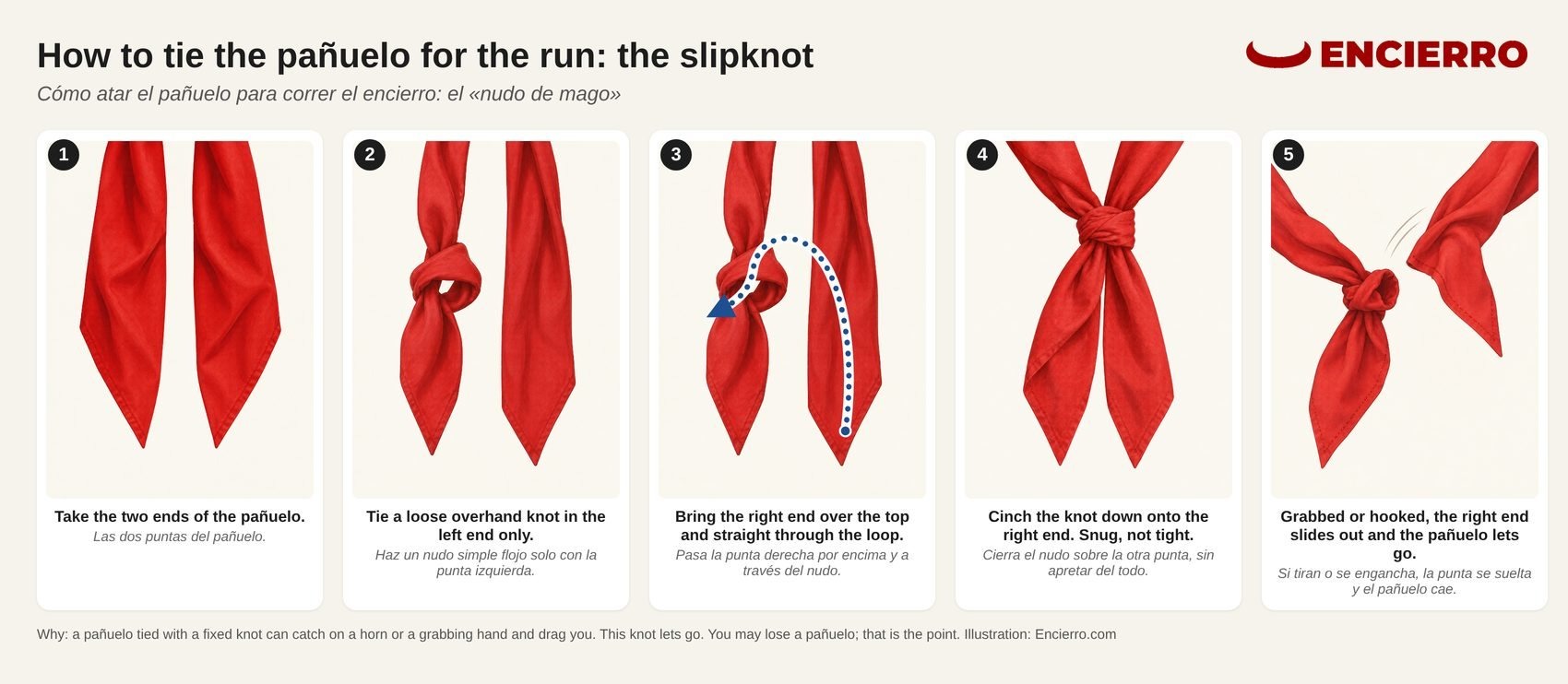
Runners tie the pañuelo in a slipknot, the knot Pamplona calls the nudo de mago, the magician's knot. If a horn or a hand catches it, the pañuelo slides off and you keep running.7 Scroll through the five steps.
Take the two ends of the pañuelo
Las dos puntas del pañuelo.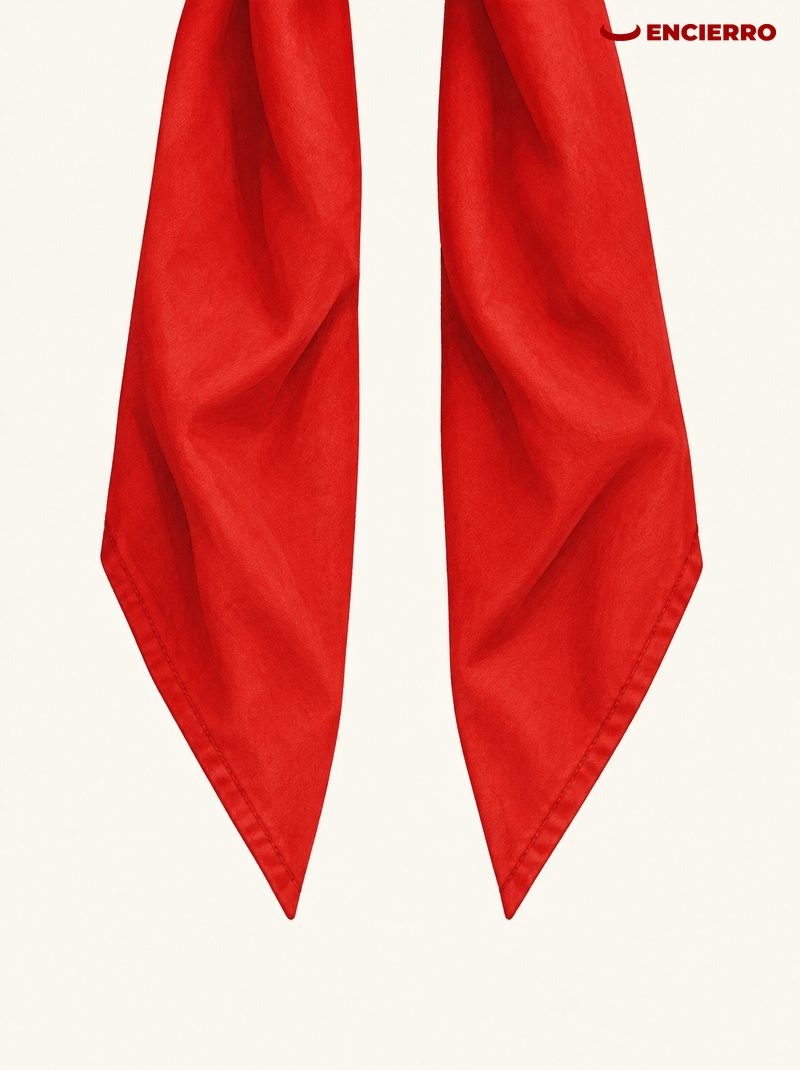
Tie a loose overhand knot in the left end only
Haz un nudo simple flojo solo con la punta izquierda.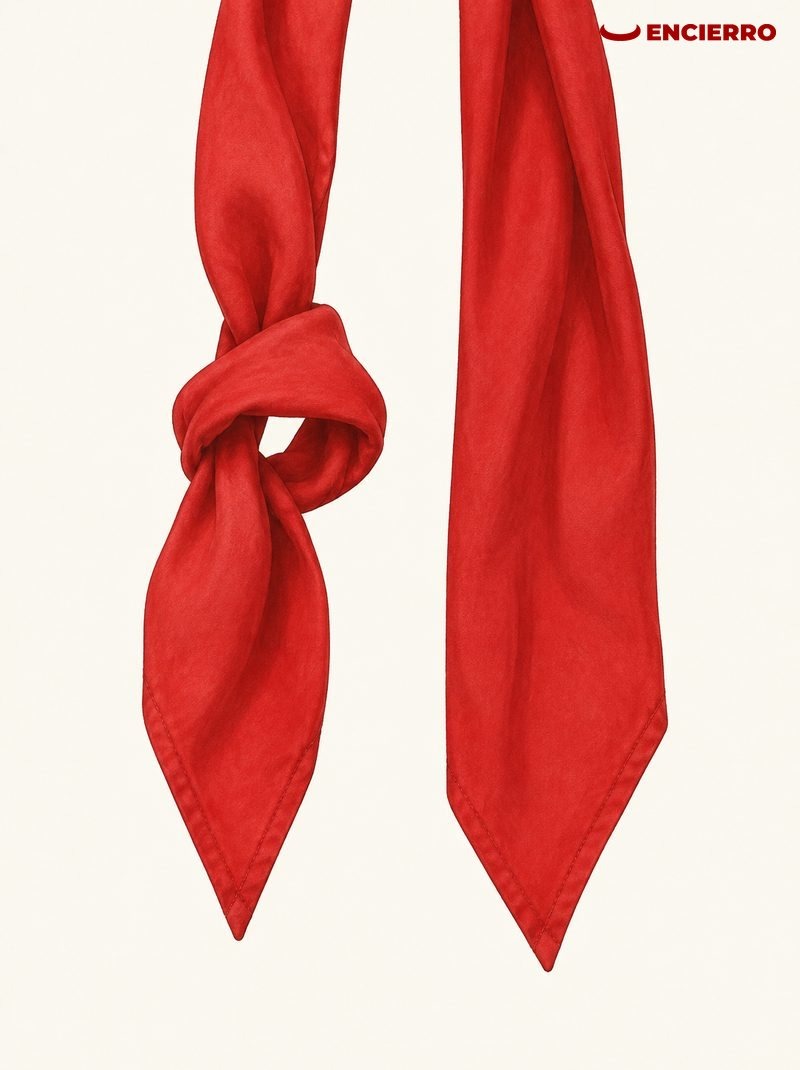
Bring the right end over the top and straight through the loop
Pasa la punta derecha por encima y a través del nudo.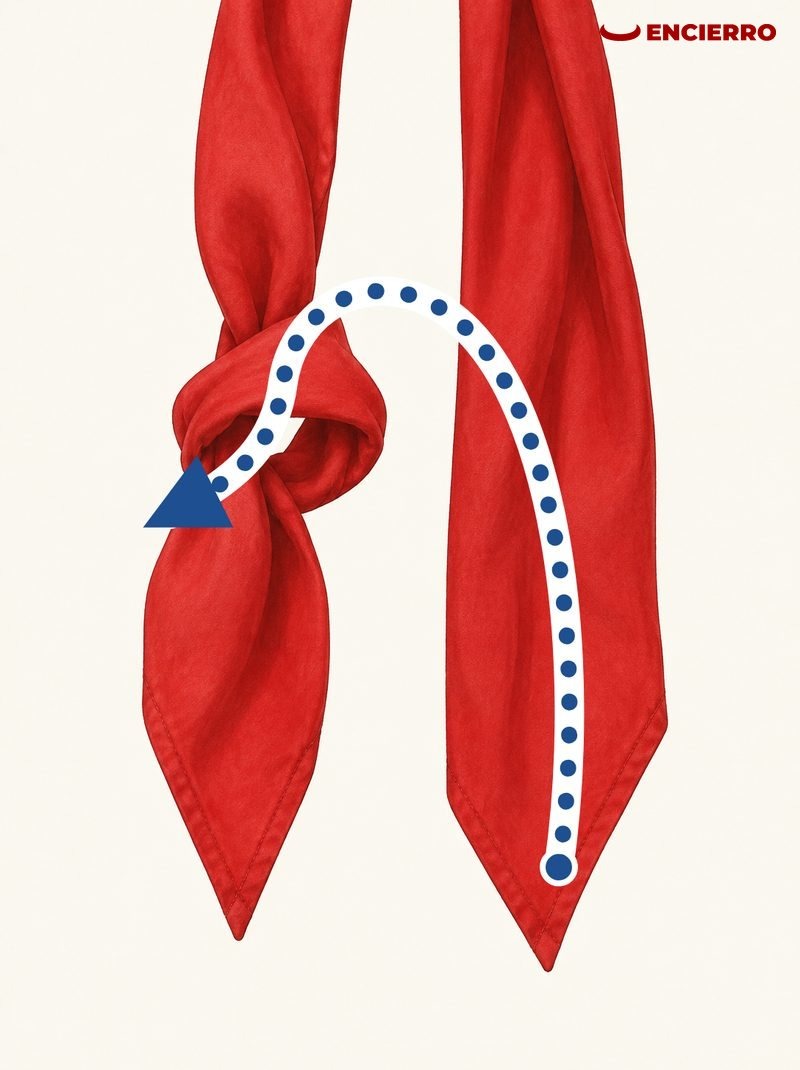
Cinch the knot down onto the right end, snug but not tight
Cierra el nudo sobre la otra punta, sin apretar del todo.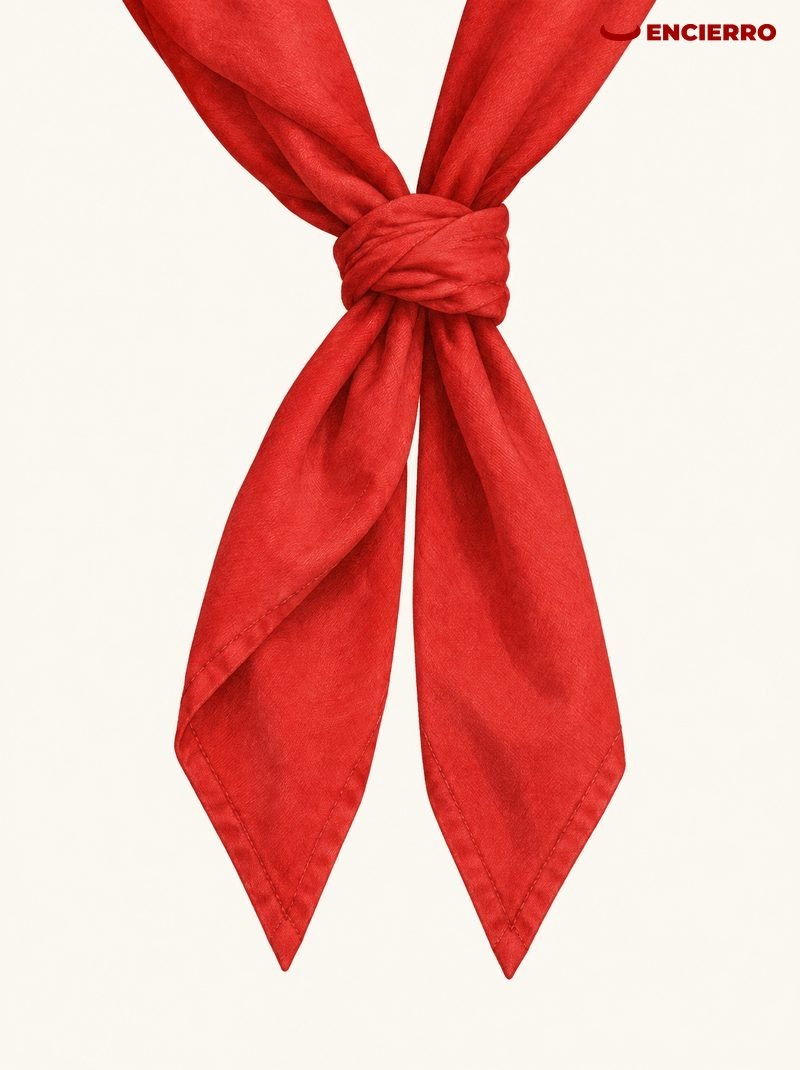
Grabbed or hooked, the right end slides out and the pañuelo lets go
Si tiran o se engancha, la punta se suelta y el pañuelo cae.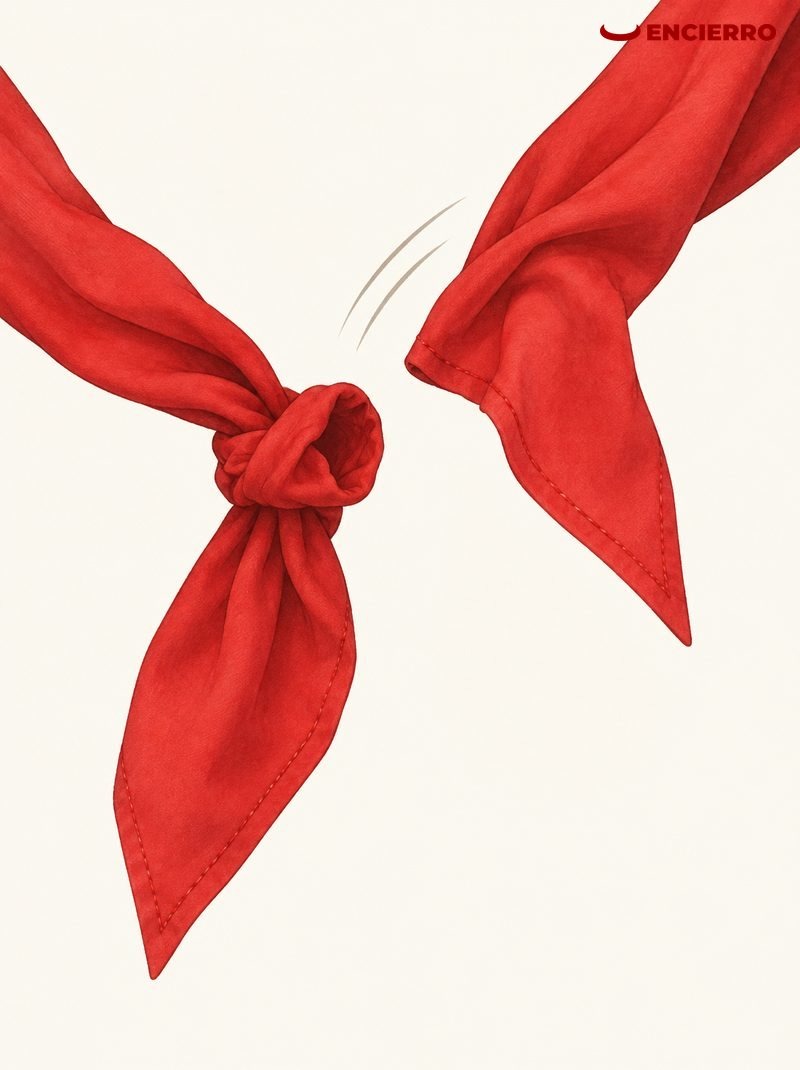
On July 7, 2012, the first run of that year, a bull caught a runner by his pañuelo and dragged him several meters.7 Dennis was there that morning:
"Before the first run in 2012, I was showing a number of first-time runners how to tie their pañuelos in a slip knot. One of them remarked that if a bull's horn got that close, they're probably in big trouble anyhow. That same day, a runner was dragged by his pañuelo at the end of Telefónica going into the callejón for a number of meters. You don't want to be that person. You want that pañuelo that cost three euros to just fall off if pulled." Dennis Clancey
Horns are not the only risk. A runner who falls grabs whatever is in front of him. Dennis lost his first pañuelo, a gift from Yolanda Barcina, then mayor of Pamplona,8 when a falling runner behind him in Mercaderes reached out and pulled it off. "My adrenaline was so strong that I didn't even realize it," he says. Tied fast, it would have pulled him down too.
When the pañuelo goes on, and when it comes off
Not when you arrive in town. You carry it until the chupinazo, the rocket that opens San Fermín at noon on July 6, and tie it on when the rocket goes off. It comes off at the Pobre de Mí, the closing song at midnight on July 14.
Some people keep their pañuelo for life; Dennis always has. Others leave it in town. On the night of the 14th the city puts temporary fencing outside the Capilla de San Fermín, the saint's chapel in the Iglesia de San Lorenzo, and after the Pobre de Mí, Dennis has seen people walk there, tie their pañuelos to it and leave candles burning below.
The FajaHow to Wear the Faja, and Do You Need One to Run?
By Pamplona custom the faja is knotted on the left, at belt height, over the pants.9 No rule requires it, but a faja tied on the right marks you as a visitor. Many young women and children thread it through the belt loops instead, and purists skip the knot and tuck the last turn in.
On the run the faja is optional. "When the faja is in a slip knot, it often ends up on the street of the route," Dennis says. If you wear one, don't knot it: "It's a coarse fabric, so you can really just loop one end on the other end like three or four times and cinch it down, and that's enough to hold it." Pulled, it comes away. "You definitely have people that have been lifted by their pañuelo, dragged by their pañuelo, dragged by their faja, lifted and flipped by their faja."
July 6, NoonWhat to Wear to the Chupinazo
If you will be down in the Plaza Consistorial when the rocket goes off, not on a balcony, dress to lose it all.
- Clothes you can throw away. "You get the 10-euro pants along the run route, and maybe bring a cheap undershirt. If that stuff's covered in wine, just throw it out and put on fresh clothes after."
- Shoes tied tighter than ever. "Imagine being in a crush of people, and someone steps on your heel. It pulls your shoe off. You cannot bend over and will not bend over." Dennis lost one there himself. When the square clears, "you find people walking around with two different shoes, just drenched in sangria."
- Closed toes. Never sandals in that crowd.
- Arrive by 10:30.
- The pañuelo in your hand until the rocket.
"You want to get drenched," Dennis says. "It's part of the alegría of being in the middle of the chupinazo." Watching from a balcony in good whites? For four or five hours after the rocket, people keep throwing wine, cava, water and sometimes eggs from the balconies of the Casco Viejo. Walk carefully.
WomenThe Running of the Bulls Outfit for Women
The San Fermín outfit for women is the same as the San Fermín outfit for men: the same whites, pañuelo and faja. For the run: "You're not going to wear skirts," Dennis says. "Pants or shorts, whatever you feel comfortable and nimble in. Tie your hair back. You don't want anything in your face." Heels are hard on Pamplona's stones at any hour, and the ordinance bans them on the route. For the fiesta, a sweatshirt or blusón at the waist and alpargatas or sneakers.
WeatherPamplona Weather in July: Pack a Layer
Pamplona sits at about 450 meters (1,480 feet) in a basin below the Pyrenees, and it is cooler than most of Spain in July. Over the last ten fiestas (July 6 to 14, 2017 to 2026), days averaged 27.3 °C (81 °F) and nights 14.9 °C (59 °F). It rained on about one fiesta day in five.10
Average night low to day high during San Fermín, July 6 to 14, 2017 to 2026. Data: Open-Meteo historical archive (ERA5). Chart: Encierro.com
Pamplona by year, 2017 to 2026
| Year | Hottest day | Coldest night | Average high | Average low |
|---|---|---|---|---|
| 2026 | 37.7 °C (100 °F) | 16.6 °C (62 °F) | 36.1 °C (97 °F) | 19.7 °C (67 °F) |
| 2025 | 31.8 °C (89 °F) | 10.7 °C (51 °F) | 26.9 °C (80 °F) | 14.4 °C (58 °F) |
| 2024 | 33.3 °C (92 °F) | 9.9 °C (50 °F) | 27.3 °C (81 °F) | 13.6 °C (56 °F) |
| 2023 | 36.8 °C (98 °F) | 14.0 °C (57 °F) | 29.8 °C (86 °F) | 15.7 °C (60 °F) |
| 2022 | 34.9 °C (95 °F) | 13.0 °C (55 °F) | 29.3 °C (85 °F) | 14.5 °C (58 °F) |
| 2021 | 34.8 °C (95 °F) | 9.5 °C (49 °F) | 22.1 °C (72 °F) | 11.8 °C (53 °F) |
| 2020 | 31.6 °C (89 °F) | 11.2 °C (52 °F) | 24.8 °C (77 °F) | 13.7 °C (57 °F) |
| 2019 | 29.9 °C (86 °F) | 12.8 °C (55 °F) | 26.3 °C (79 °F) | 15.0 °C (59 °F) |
| 2018 | 28.8 °C (84 °F) | 13.6 °C (56 °F) | 25.9 °C (79 °F) | 15.4 °C (60 °F) |
| 2017 | 31.3 °C (88 °F) | 14.3 °C (58 °F) | 24.9 °C (77 °F) | 15.4 °C (60 °F) |
Nights fell to about 10 °C (50 °F) in 2020, 2021, 2024 and 2025. Heat waves happen too: on July 7, 2026, Pamplona's airport weather station recorded 41.4 °C (106.5 °F), the hottest San Fermín day on record.11 The model figures above smooth out peaks like that one. So: whites that breathe for the afternoon, and a sweatshirt or blusón for the 8 a.m. run and the nights.
What to CarryPhones, Keys and Money: Carry Almost Nothing
"Pickpockets come to Pamplona," Dennis says. "It's tight crowds, people always looking to lift things."
- On the run: as little as possible, and everything secured. "If you were jostled or thrown, you'd still have your stuff on you." Keys tied into a drawstring with a double knot. If you bring a phone, keep it put away.
- At the fiesta: front pockets, not back pockets. Never leave your phone or wallet on a bar table. A money belt under the waistband for spare cash and cards. Go easy on jewelry.
Getting wine out of whites
Mostly, you don't. Once whites are soaked at the chupinazo, most people throw them away and buy another 10-euro pair. Laundry services are limited during the fiesta; if you have an apartment you may have a machine, or your hotel can take care of it. Bring two sets of whites, or plan to buy a second in town.
The ColorsWhy Do People Wear White and Red at San Fermín?
Why do they wear white and red in Pamplona, and why white and red at the running of the bulls? Not because it was always so. Before the 1930s the young men of Pamplona dressed as they liked at San Fermín: blue or black berets or straw hats, blue shirts and pants, and pañuelos, blusas, fajas and alpargatas in every color.16 In the 1910s and 1920s the city pushed back against costumes. The mayor's fiesta proclamations of 1917 and 1918 banned walking the streets dressed in "an extravagant, carnival-like way," and in 1922 masks and costumes were banned during the fiesta.17 By 1930 newspapers complained of "shirts of every color" and called the fiesta a carnival, and that year's proclamation banned clothing that gave "the look of a costume."16
A group of young men called La Veleta answered. Photos published in July 1930 show its members in white with a red pañuelo and faja. White itself was not new: dancers, musicians and pelota players already wore it. What was new was every member dressed the same. Gau Txori and La Jarana followed within two years,18 and the outfit became the whole city's from about the 1960s.19 The City of Pamplona says the origin of the outfit is unknown, and credits Peña La Veleta, a club that no longer exists, with making it popular in the 1930s by dressing its members in white and red to stand out from the other peñas.23
Why white?
White is simple and cheap, and it makes everyone look the same. "It's a simple color that everyone can be equal in," Dennis says, "and fiesta is a time when everyone comes together from the town." It still matters to Pamplona: "We need to be very clear on this. You wear white, you wear the red pañuelo, the red faja. White is respect."
Why red?
Red is the color of Navarra. The flag of Navarra is red, with the gold chains of its coat of arms,28 and San Fermín is the co-patron saint of Navarra, alongside San Francisco Javier, by papal decree since 1657.29 A fiesta for Navarra's saint in Navarra's color: "It's natural that the color of the fiesta would be one that marries both," Dennis says. In the city you will also hear that the red honors the blood of San Fermín, the bishop of Pamplona who died a martyr.19 "For me, it's more simple." Two other stories are legends, not history: that the white stands for the saint's faith, and that butchers who drove the bulls wore white aprons stained red.
Does red make the bulls angry?
No. That is a myth. The colors do not matter to the bulls, which are red-green color blind. They are not drawn to red or angered by it: cattle cannot tell red from green, and what a bull goes for is movement. Our page on how a bull sees explains what a bull does and does not see on the route.
The PeñasWhat the Peñas Wear: Pamplona's 16 Peñas and Their Colors
The peñas are Pamplona's fiesta clubs, each with its own band, crest and dress. Thirteen wear red pañuelos. La Jarana and El Txarko wear blue, for the blue of Pamplona's coat of arms.12 La Única, the oldest peña in Pamplona, wears green, the color of the city's flag,20 on its pañuelo, faja and alpargata ribbons. Ten peñas wear a blusón; six wear only the whites. Pick a peña:
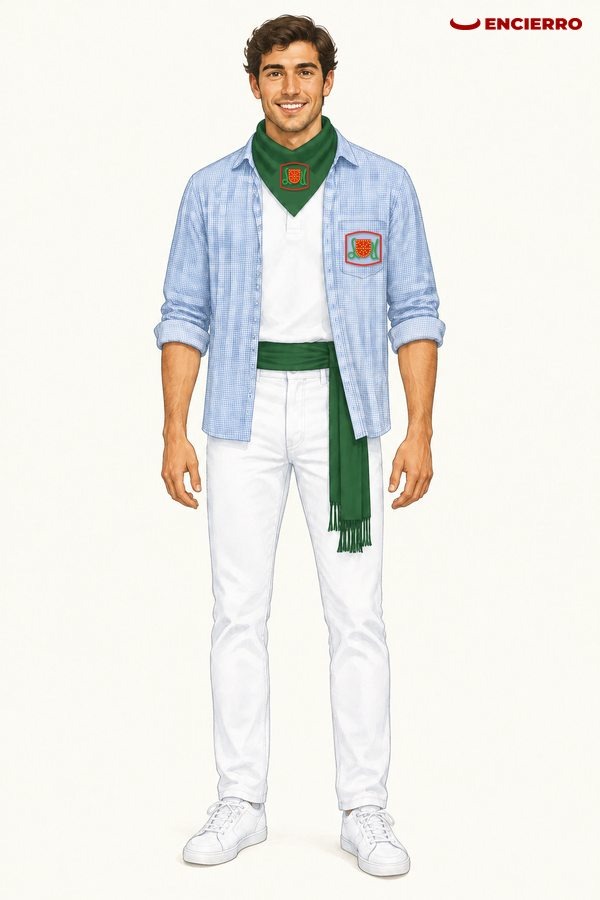
Peña La Única
The oldest peña in Pamplona, and the one Dennis Clancey belongs to. Its green is the color of the city's flag. Members wear the blusón open, over the shoulders with the sleeves knotted, or tied around the waist.
- Founded
- 1903
- Pañuelo, faja
- Green pañuelo and faja; green ribbons on the alpargatas
- Blusón
- Fine blue and white check that reads light blue
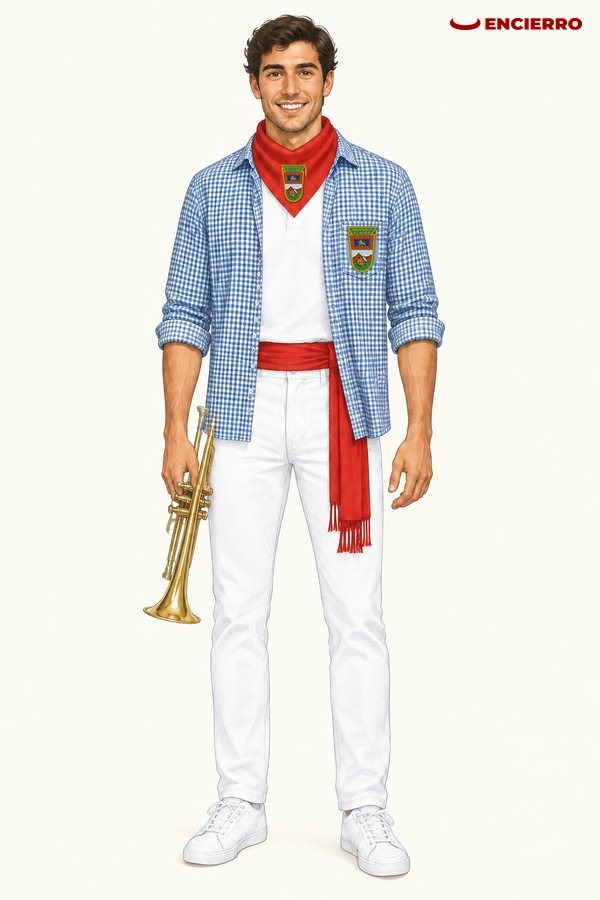
Peña Muthiko Alaiak
Its band is one of the loudest on the streets of the Casco Viejo.
- Founded
- 1931
- Pañuelo, faja
- Red, crest on the pañuelo
- Blusón
- Small blue and white check
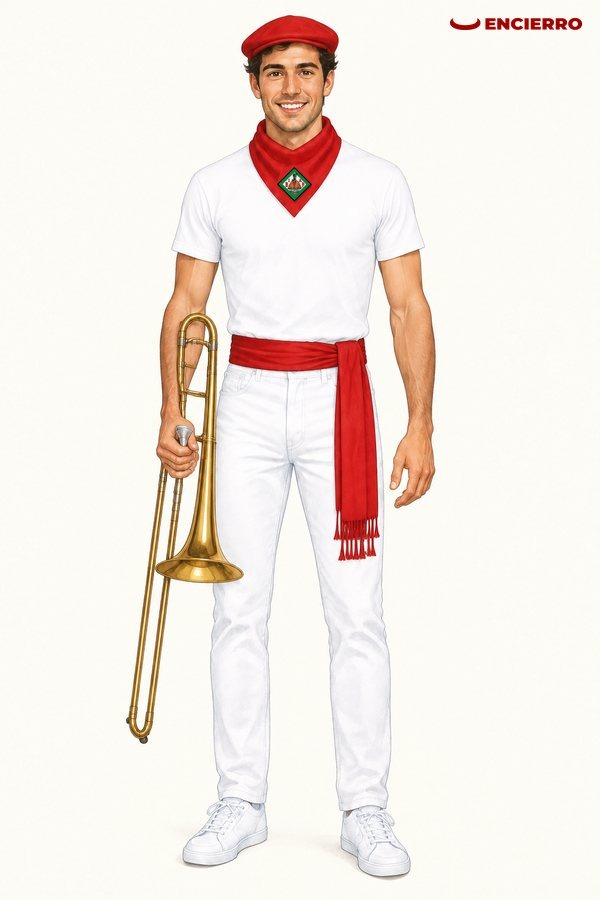
Peña El Bullicio Pamplonés
Members dress in white with no blusón, the crest embroidered on the pañuelo.
- Founded
- 1933
- Pañuelo, faja
- Red, crest on the pañuelo
- Blusón
- None
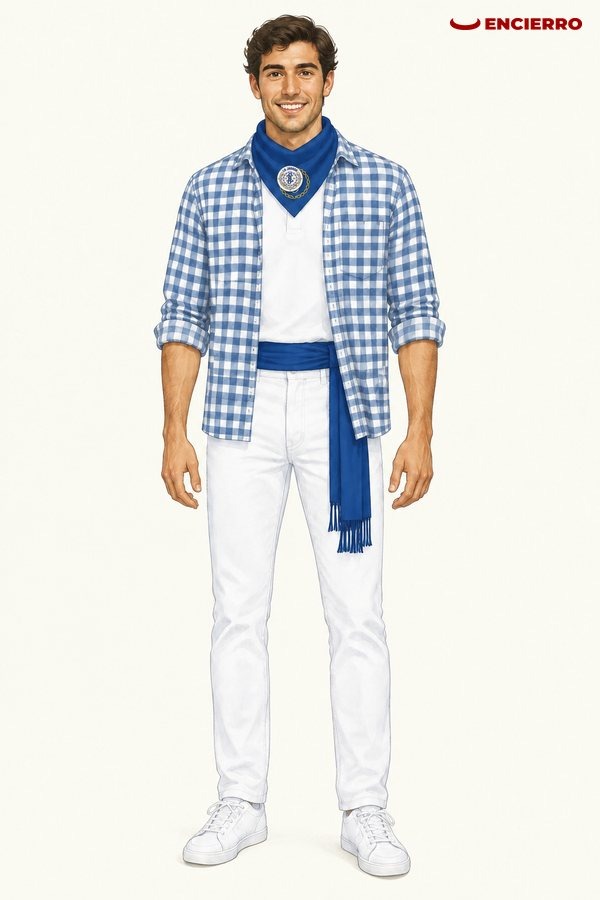
Peña La Jarana
La Jarana chose blue for its pañuelo, faja and checks because the coat of arms of Pamplona carries blue.
- Founded
- 1940
- Pañuelo, faja
- Blue
- Blusón
- Blue and white check, L and J on the back
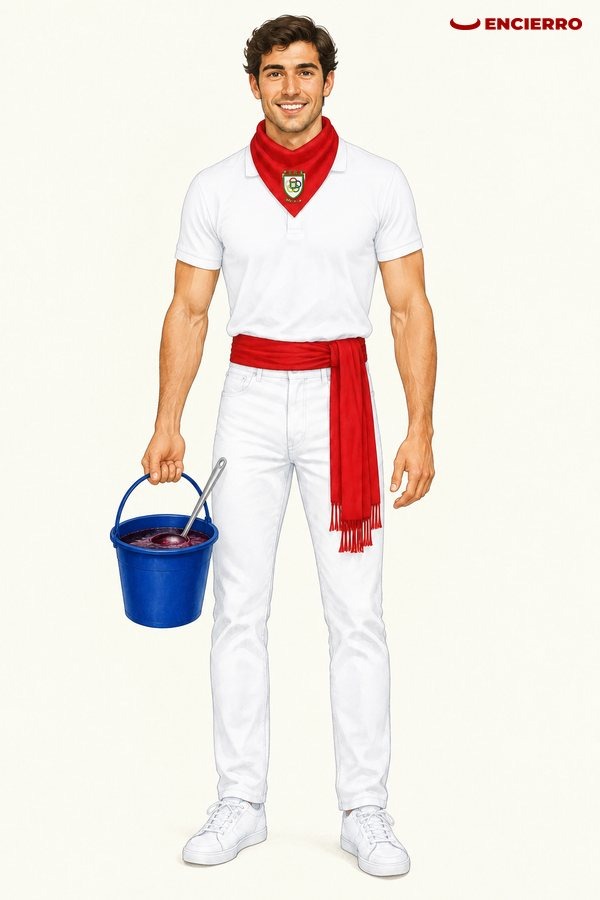
Peña Oberena
Whites with a red pañuelo and faja.
- Founded
- 1941
- Pañuelo, faja
- Red
- Blusón
- None
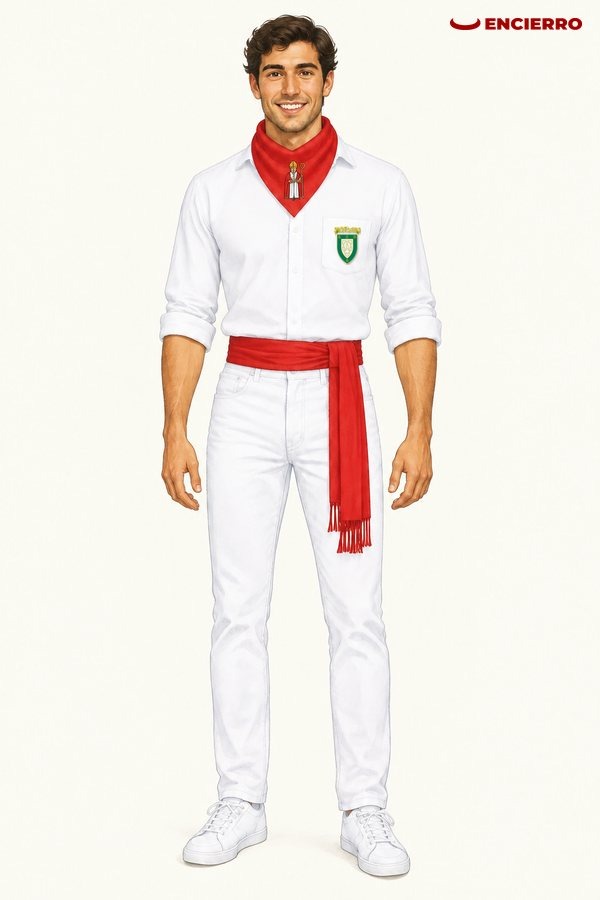
Peña Anaitasuna
The crest is embroidered on the shirt pocket rather than on a blusón.
- Founded
- 1948
- Pañuelo, faja
- Red; San Fermín on the pañuelo, crest on the shirt pocket
- Blusón
- None
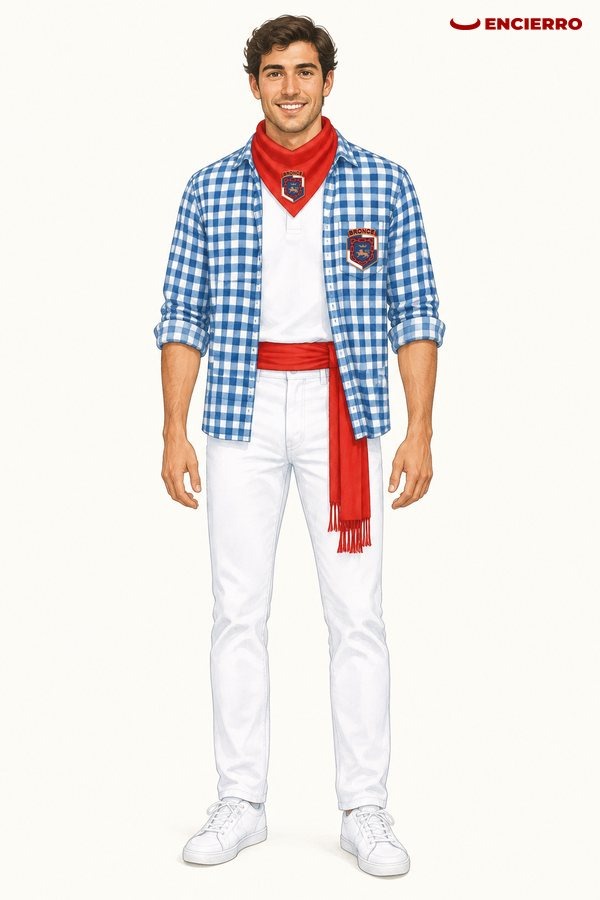
Peña Los de Bronce
The check was chosen to be recognized and because it was the cheapest. Because the blusón covered the faja, members stopped wearing one.
- Founded
- 1950
- Pañuelo, faja
- Red pañuelo with the lion crest; most leave off the faja
- Blusón
- Blue and white check, crest on the left pocket
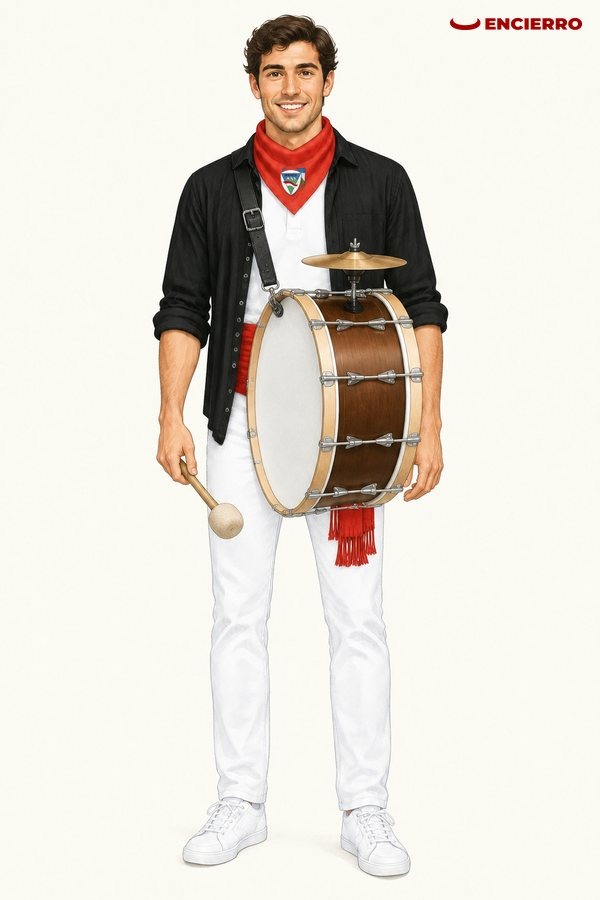
Peña Irrintzi
The black blusón stands out in any parade. The peña turned 75 in 2026.
- Founded
- 1951
- Pañuelo, faja
- Red
- Blusón
- Black
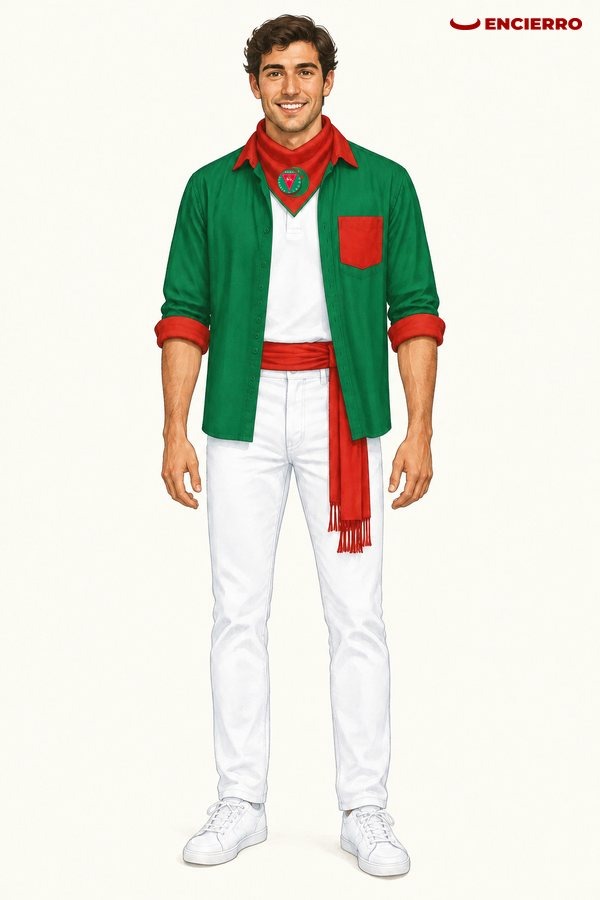
Peña Alegría de Iruña
The only peña in a green blusón.
- Founded
- 1952
- Pañuelo, faja
- Red pañuelo edged in green
- Blusón
- Green, with red collar, cuffs and pocket
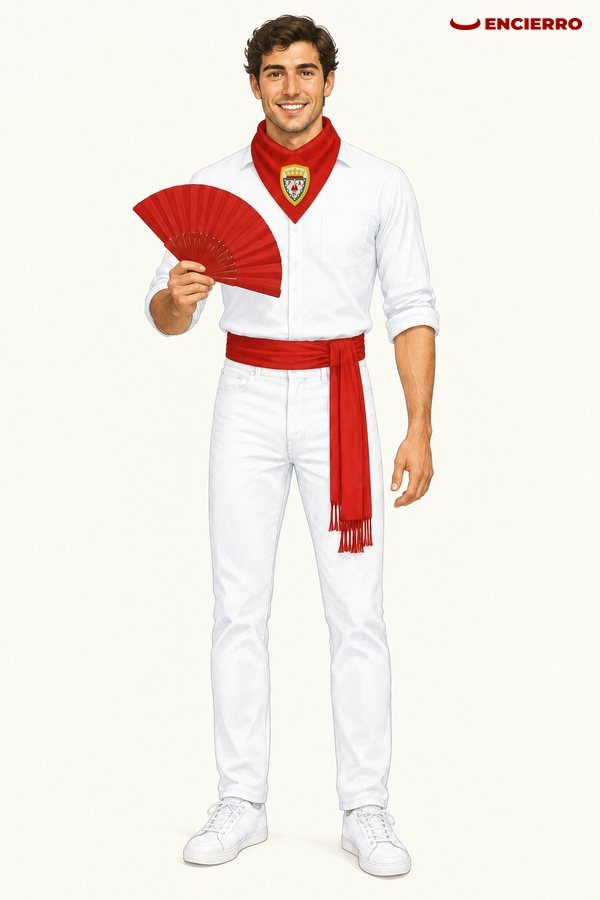
Peña Armonía Txantreana
Known by its embroidered pañuelo, the rest in white.
- Founded
- 1956
- Pañuelo, faja
- Red pañuelo with crest; red belt
- Blusón
- None
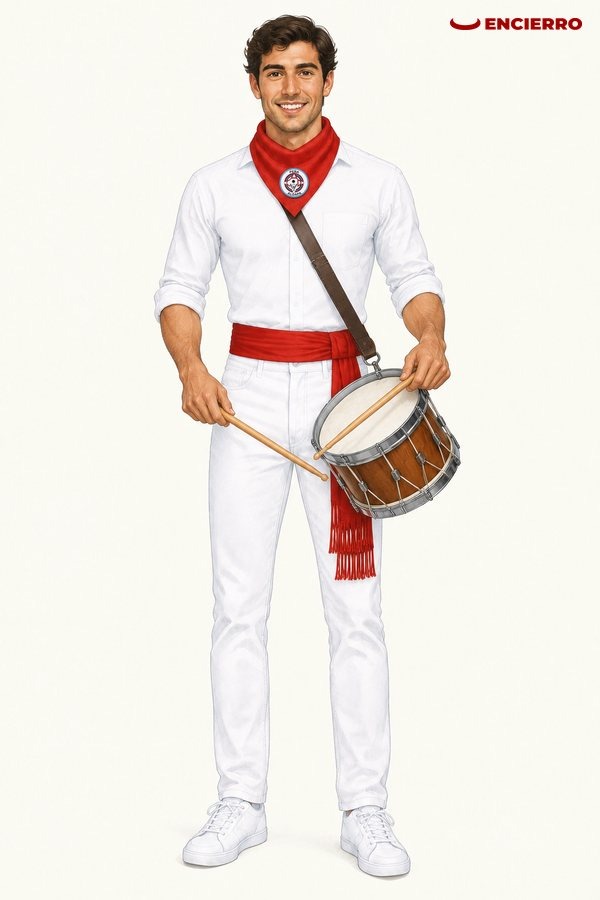
Peña Aldapa
No blusón at San Fermín; the crest goes on the pañuelo.
- Founded
- 1958
- Pañuelo, faja
- Red, crest on the pañuelo
- Blusón
- None
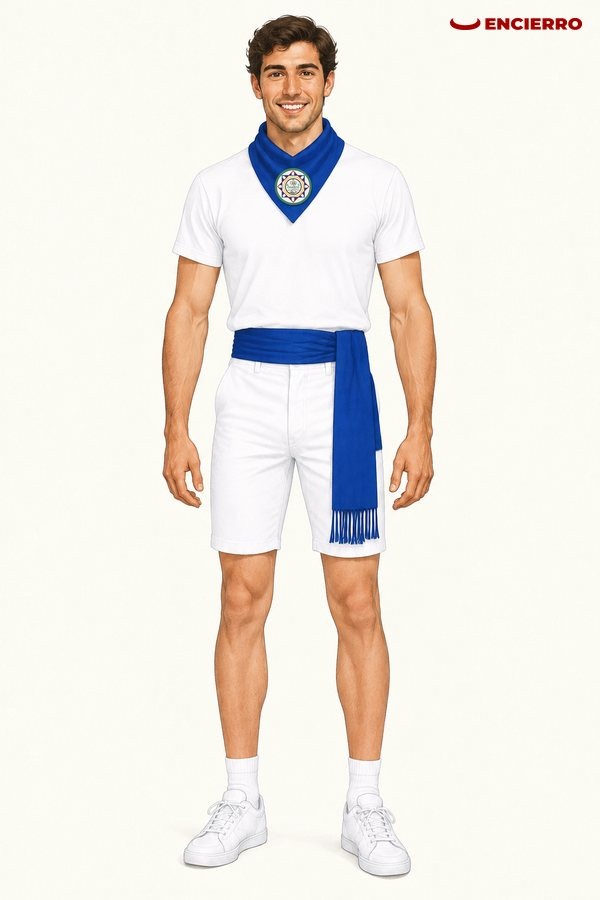
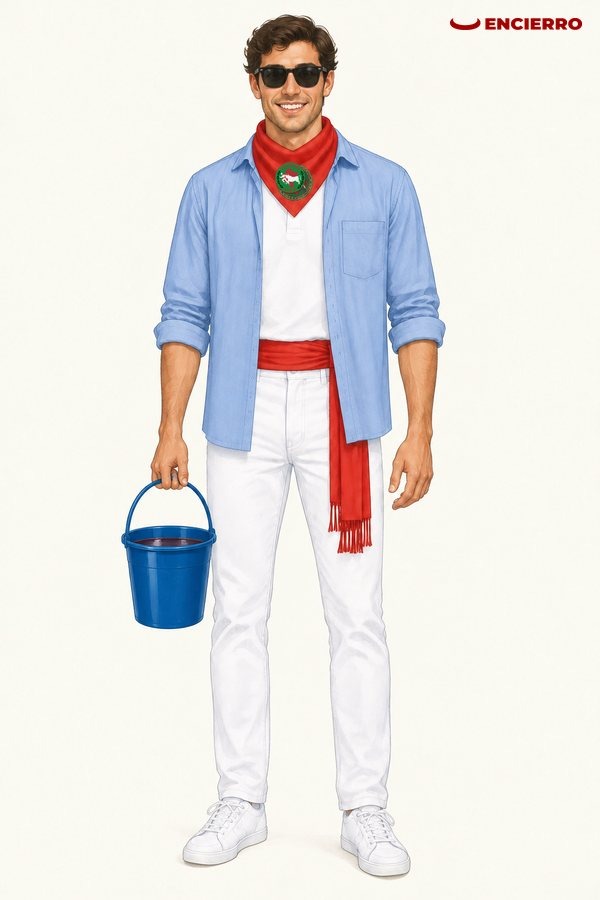
Peña El Txarko
One of two peñas in blue. Our drawing shows the whites and blue pañuelo and faja; the striped blusón is not shown.
- Founded
- 1975
- Pañuelo, faja
- Blue
- Blusón
- Blue and white stripes
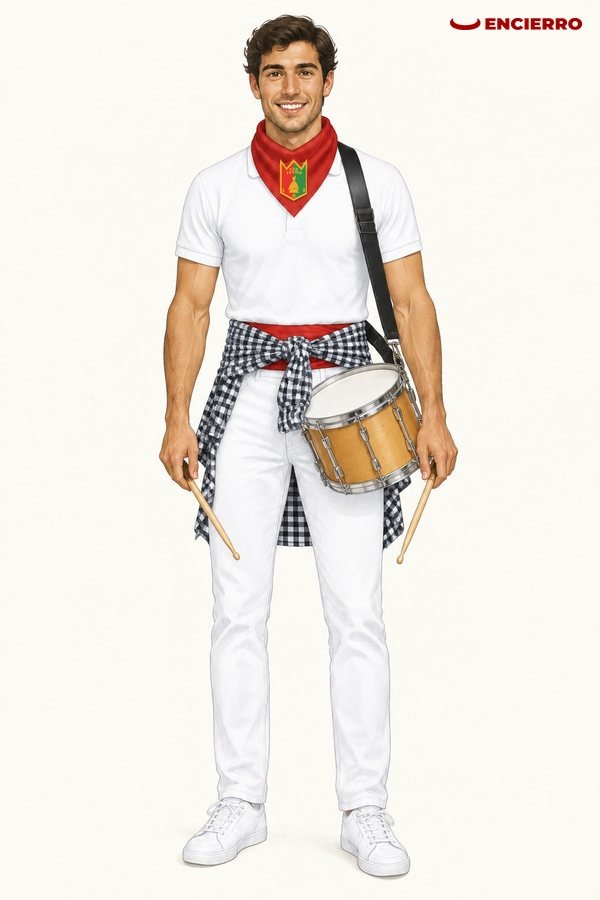
Peña Donibane
A light blue blusón over the whites.
- Founded
- 1977
- Pañuelo, faja
- Red, crest on the pañuelo
- Blusón
- Light blue
Peña San Fermín
Often worn tied around the waist on hot afternoons.
- Founded
- 1979
- Pañuelo, faja
- Red, crest on the pañuelo
- Blusón
- Black and white check
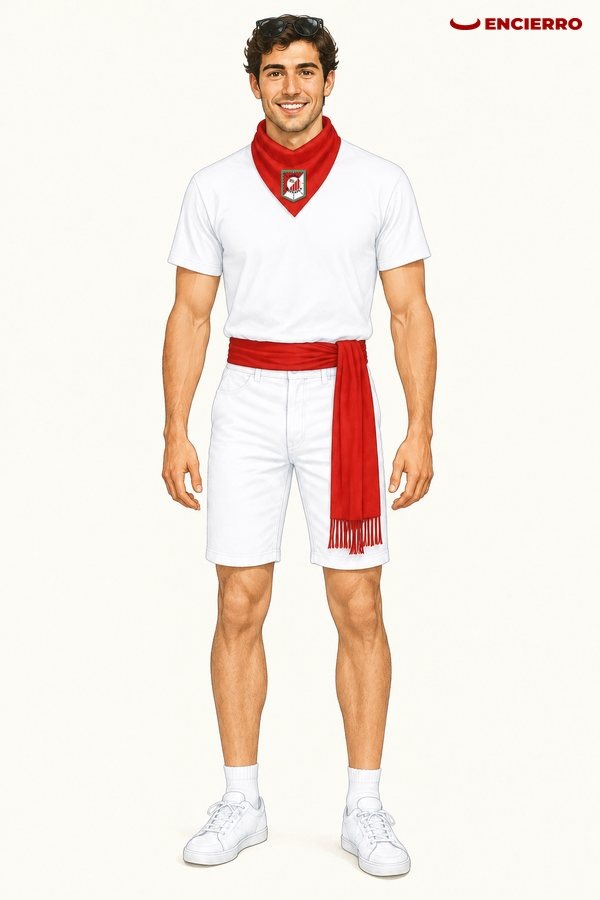
Peña Rotxapea
Whites with a red pañuelo and faja.
- Founded
- 1979
- Pañuelo, faja
- Red, crest on the pañuelo
- Blusón
- None
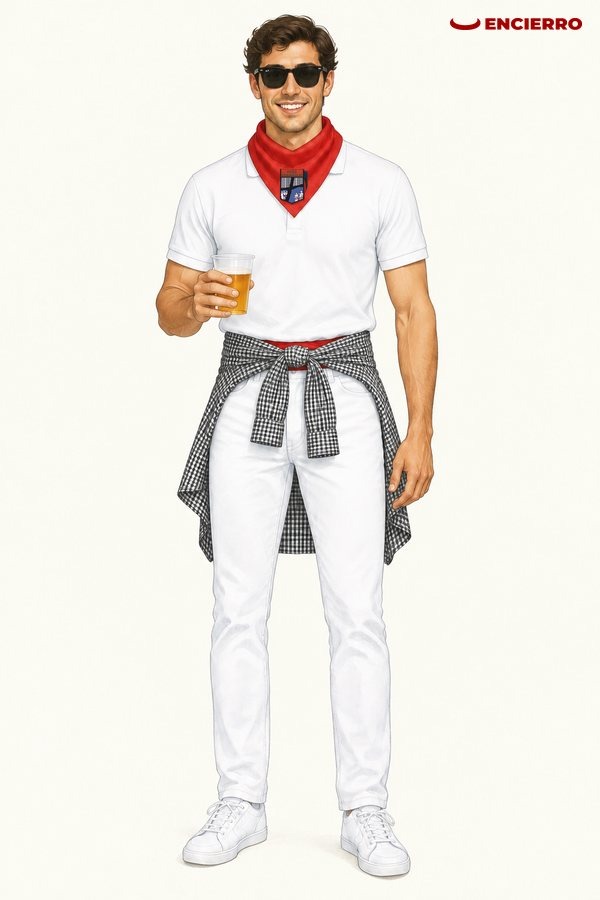
Peña Sanduzelai
It began in 1980 as the peña San Jorge.
- Founded
- 1980
- Pañuelo, faja
- Red
- Blusón
- Small white check
All 16 peñas in one table
| Peña | Founded | Pañuelo and faja | Blusón |
|---|---|---|---|
| La Única | 1903 | Green pañuelo and faja; green ribbons on the alpargatas | Fine blue and white check that reads light blue |
| Muthiko Alaiak | 1931 | Red, crest on the pañuelo | Small blue and white check |
| El Bullicio Pamplonés | 1933 | Red, crest on the pañuelo | None |
| La Jarana | 1940 | Blue | Blue and white check, L and J on the back |
| Oberena | 1941 | Red | None |
| Anaitasuna | 1948 | Red; San Fermín on the pañuelo, crest on the shirt pocket | None |
| Los de Bronce | 1950 | Red pañuelo with the lion crest; most leave off the faja | Blue and white check, crest on the left pocket |
| Irrintzi | 1951 | Red | Black |
| Alegría de Iruña | 1952 | Red pañuelo edged in green | Green, with red collar, cuffs and pocket |
| Armonía Txantreana | 1956 | Red pañuelo with crest; red belt | None |
| Aldapa | 1958 | Red, crest on the pañuelo | None |
| El Txarko | 1975 | Blue | Blue and white stripes |
| Donibane | 1977 | Red, crest on the pañuelo | Light blue |
| San Fermín | 1979 | Red, crest on the pañuelo | Black and white check |
| Rotxapea | 1979 | Red, crest on the pañuelo | None |
| Sanduzelai | 1980 | Red | Small white check |
Founding years from the Federación de Peñas; La Única's from sanfermines.net. Illustrations: Encierro.com, drawn from each peña's published dress. The crests are each peña's own, as published by the Federación de Peñas de Pamplona.
Tradition, Not UniformIs There an Official Running of the Bulls Outfit?
No. The city does not issue an official running of the bulls shirt or outfit, and there is no running of the bulls uniform; white and red are a tradition, not a uniform anyone hands out. If you searched for official running of the bulls merchandise, that is the honest answer.
The one official image each year is the San Fermín poster, which the city chooses in a public contest. Each year's poster belongs to the city and its artist, and you will find poster shirts in shops along the route. It makes a great poster. On a shirt it is one big rectangle. Ours is something else: a running of the bulls shirt for the morning you actually ran, with every bull's name.
Where to BuyWhere to Buy the Running of the Bulls Outfit in Pamplona
Buy it in Pamplona. Shops all along the route sell white shirts, white pants, pañuelos and fajas, and unless you already own whites, there is no need to buy before the trip. In Dennis Clancey's experience, the cheapest whites and the best selection are near La Curva. The easiest place is La Curva, where Calle Mercaderes meets Calle Estafeta, and the length of Estafeta. "There are numerous places right along Estafeta, and really near the curve," Dennis says. In the days before the fiesta, shops put racks outside their doors, and names change from year to year. Four that Dennis sends people to:
| Shop | Address | Phone |
|---|---|---|
| El Encierrico | Calle Mercaderes 19 | +34 649 77 91 93 |
| La Curva de Estafeta | Calle Mercaderes 23, at La Curva | Ask in the shop |
| Souvenirs Echeve, since 1978 | Calle Mercaderes 29, corner of Mañueta | +34 948 22 42 15 |
| El Pañuelico de Hemingway | Calle Estafeta 43 | +34 948 22 42 33 |
Going rates in July 2026: pañuelos 3.50 to 5 euros, fajas 5 to 6 euros, white pants 10 to 12 euros. If you lose a shoe, the same streets sell alpargatas and sneakers. Already home? Our running of the bulls shirts ship to most countries, and our Pamplona street stones, cobblestones that once paved the Old Town, ship within the United States. Our guide to the running of the bulls dress code, the San Fermín dress code as Pamplona lives it, covers what holds up on the cobblestones.
Dennis's KitWhat Dennis Clancey Wears to Run
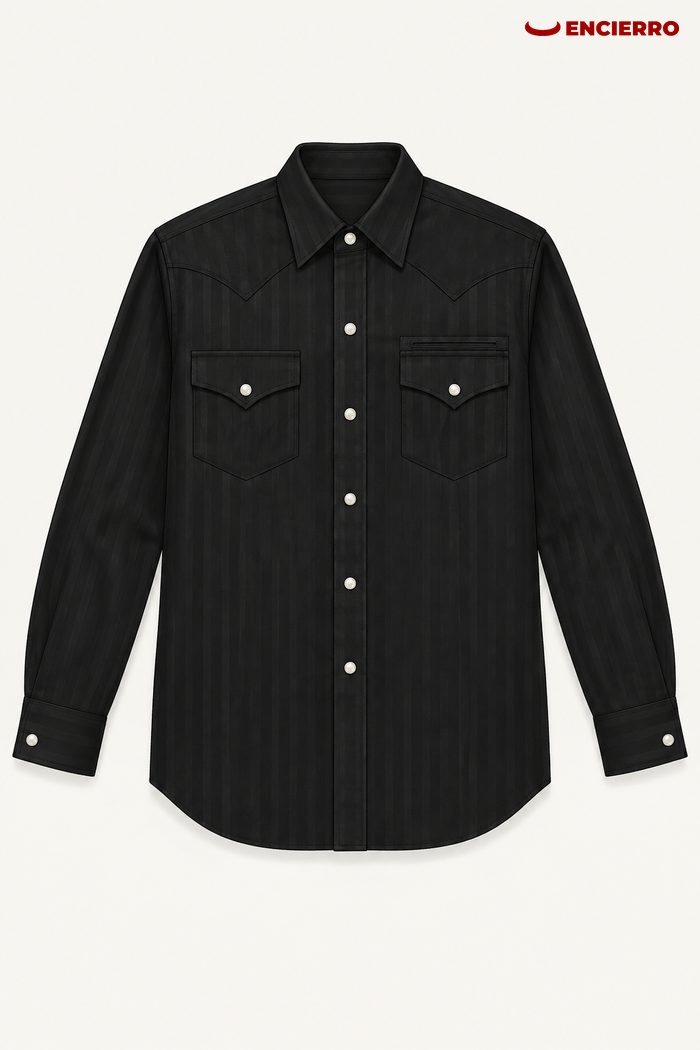
Dennis Clancey has run in Pamplona since July 7, 2007.21 His kit, top to bottom: a green pañuelo, because he is a member of La Única; a black western snap shirt; white Wakonda pants; and yellow and black New Balance MT00s. No faja on the run; sometimes his La Única blusón during the fiesta.
The black shirt is the exception, and he says so. He has worn it on every run since 2007, in Pamplona and in towns across Spain and in Mexico. It has been stitched back together and carries small burn holes from the toro de fuego. In 2016 the Spanish newspaper El Mundo called him "the American in the black shirt."21 He still tells everyone else to wear white: "White shows respect to the city."
Running of the Bulls Costume: Parties, Halloween and New Orleans
The outfit travels. The running of the bulls in New Orleans, San Fermín in Nueva Orleans, asks its crowd to come in all white with a red sash and neckerchief, while the Big Easy Rollergirls skate the streets as the bulls; the July event has run since about 2007.22 For a running of the bulls party, a San Fermín party or a running of the bulls Halloween costume, a running with the bulls costume or a San Fermín costume takes four pieces, the same red and white party outfit as a Pamplona bull run costume: white shirt, white pants, a red pañuelo at the neck and a red faja knotted on the left hip. Add a rolled newspaper for a runner, or a txapela and a bota for the fiesta. Ran it for real? Wear the shirt from your morning, or give one to someone who did, with our gifts for someone who ran with the bulls.
The Shirt from the Morning You RanA Running of the Bulls Shirt for the Morning You Ran
Each morning of San Fermín, six bulls from one ganadería (ranch) run the 848.6 meters (about 930 yards) from the corral to the bullring. Our shirts carry that morning: the date, the ranch and the name of every bull, taken from the Pamplona press of the day. They are printed to order by our print partner.
Did you run? Get the shirt Gifts for runners Meet the bulls
GlossarySan Fermín Clothing in Spanish: a Glossary
- Ir de blanco y rojo
- To dress in white and red, the fiesta outfit. Locals also say vestir de pamplonica.
- Camisa, camiseta blanca
- White shirt, white T-shirt.
- Pantalón blanco
- White pants. Pantalones cortos: shorts.
- Pañuelo, pañuelico
- The red neckerchief. Pañuelico is the Pamplona diminutive.
- Faja, fajín
- The red sash. Fajín for children.
- Blusón, blusa
- The peña smock, checked, striped or plain.
- Alpargatas
- Rope-soled canvas espadrilles, tied with ribbons (cintas).
- Zapatillas
- Sneakers, running shoes.
- Sudadera
- Sweatshirt.
- Txapela, boina
- Beret. Txapela is the Basque word.
- Bota de vino
- Leather wine skin.
- Riñonera
- Bum bag. Not allowed on the run.
- Bordado, escudo
- Embroidered; crest.
- De cuadros, de rayas
- Checked; striped.
- Nudo corredizo, nudo de mago
- Slipknot; the runners' name for the pañuelo knot that lets go.
- Peña
- A fiesta club with its own band, crest and colors.
- Mozo, moza
- Young man, young woman; in Pamplona, the runners.
- Chupinazo
- The rocket at noon on July 6 that opens the fiesta. The pañuelo goes on.
- Pobre de Mí
- The closing song at midnight on July 14. The pañuelo comes off.
Cómo Vestir para San Fermín: Ropa, Vestimenta y Traje
La vestimenta de San Fermín es la misma para hombre y para mujer: camisa o camiseta blanca, pantalón blanco, pañuelo rojo al cuello y faja roja a la cintura. Es el traje típico de San Fermín y la vestimenta de los Sanfermines, no un uniforme oficial. La ropa de San Fermín para mujer es la misma que para hombre. El pantalón blanco de San Fermín es ligero y barato. Así es cómo vestirse para San Fermín. Para el encierro, calzado cerrado y bien atado: las zapatillas para San Fermín tienen que agarrar en la piedra mojada.
El pañuelo rojo de San Fermín se anuda al cuello cuando estalla el chupinazo, a las doce del 6 de julio, y se quita en el Pobre de Mí, a medianoche del 14. Cómo se pone el pañuelo de San Fermín, o cómo poner el pañuelo para correr: con un nudo corredizo, el nudo de mago, que se suelta si tiran de él. Es el nudo del pañuelo de San Fermín que usan los corredores. Sobre el origen y el significado del pañuelo rojo: el rojo es el color de Navarra, y en la ciudad se dice también que recuerda el martirio de San Fermín. ¿En qué lado va la faja, o a qué lado se pone la faja de San Fermín? A la izquierda, a la altura del cinturón. Cómo poner la faja: se da la vuelta a la cintura y se anuda a la izquierda; en el encierro es opcional. La txapela en San Fermín es la boina vasca, negra.
¿Por qué se visten de blanco y rojo en San Fermín? En 1930, tras años de quejas porque la fiesta parecía un carnaval, el grupo La Veleta vistió a todos sus mozos de blanco con pañuelo y faja rojos. Otros lo copiaron, y desde los años sesenta lo lleva toda la ciudad.
Dónde comprar ropa para San Fermín: toda la ropa blanca de San Fermín, barata, se encuentra en las tiendas del Casco Viejo, sobre todo en la Estafeta y en la curva de Mercaderes. En julio de 2026 un pañuelo costaba de 3,50 a 5 euros, una faja de 5 a 6 euros y unos pantalones blancos de 10 a 12 euros. Para comprar el pañuelo de San Fermín y los pañuelos de San Fermín bordados, las mismas tiendas. Hay también ropa de San Fermín para bebé y para niños, con el nombre bordado en el pañuelo. Para un disfraz de San Fermín basta con las mismas cuatro piezas.
Running of the Bulls Outfit: Questions and Answers
What do you wear to the running of the bulls?
The running of the bulls outfit is a white shirt, white pants, a red pañuelo around the neck and a red faja around the waist, worn with closed shoes that grip wet stone and are tied tight. The City of Pamplona does not require it; it is the tradition of San Fermín.
Do you have to wear white to run with the bulls?
Runners in Pamplona do not have to wear white, because the Encierro Ordinance bans only clothing and footwear unfit for running. Nearly everyone wears white and red anyway: it is the tradition of San Fermín, and as runner Dennis Clancey puts it, white shows respect to the city.
When do you put on the red pañuelo at San Fermín?
The red pañuelo goes on at noon on July 6, when the chupinazo rocket opens San Fermín in Pamplona, and comes off at midnight on July 14 at the Pobre de Mí, the closing song. Until the rocket, people carry it rather than wear it.
How do you tie the pañuelo to run with the bulls?
Runners tie the pañuelo in a slipknot, the nudo de mago, so it comes off if a horn or a hand catches it. Tie a loose overhand knot in one end, pass the other end over the top and through it, and snug it down. On July 7, 2012, a bull dragged a runner several meters by his pañuelo.
Do you need a faja to run with the bulls?
The faja is optional on the run, and many runners in Pamplona leave it off. A runner who wears one should loop one end over the other three or four times instead of knotting it, so the faja pulls away if a horn or a falling runner catches it.
Which side does the faja go on?
In Pamplona the red faja is knotted on the left side, at belt height, over the pants. No rule requires it, but locals read a faja tied on the right as the mark of a visitor. Many young women and children thread it through their belt loops instead.
Why do people wear white and red at San Fermín?
Pamplona's white and red outfit dates from 1930, when the group La Veleta dressed all its members in white with a red pañuelo and faja after years of complaints that the fiesta looked like a carnival. Others copied it, and from about the 1960s the whole city wore it. Stories about martyrdom and butchers' aprons are legends.
Why is the pañuelo red at San Fermín?
The San Fermín pañuelo is red because red is the color of Navarra, whose flag is red, and San Fermín is co-patron saint of Navarra. Many in Pamplona also say the red honors the blood of San Fermín, the bishop who died a martyr. The red does not anger the bulls, which cannot tell red from green.
Is there an official running of the bulls outfit or shirt?
There is no official running of the bulls outfit or shirt: the City of Pamplona does not sell or license one, and white and red is a tradition, not a uniform. The only official image each year is the San Fermín poster, which the city chooses in a public contest.
Where can you buy the running of the bulls outfit in Pamplona?
The running of the bulls outfit is sold in the shops of Pamplona's Old Town, most of them on Calle Estafeta and around La Curva, where Calle Mercaderes meets Estafeta. In July 2026 a pañuelo cost 3.50 to 5 euros, a faja 5 to 6 euros and white pants 10 to 12 euros.
What shoes should you wear to run with the bulls?
Runners in Pamplona should wear closed shoes they feel nimble in, such as running, trail or minimalist shoes, tied tight with a double knot. The Encierro Ordinance bans high heels, flip-flops, sandals and clogs on the route, and open toes are a poor choice anywhere in the fiesta's crowded streets.
Can you film yourself running with the bulls?
Filming while running the encierro is banned: Pamplona's Encierro Ordinance makes recording on the route with any device, phones included, a serious offense, with fines of 601 to 6,000 euros. During San Fermín 2026 the Municipal Police confiscated 54 pairs of camera glasses.
Should you wear shorts or pants to run with the bulls?
Both shorts and long pants are allowed on the running of the bulls in Pamplona. Runner Dennis Clancey prefers long white pants because fabric over the knees stops scrapes in a fall on the stone, and he wears thin padded knee sleeves underneath, since a bruised knee is the injury he gets most often.
What should women wear to the running of the bulls?
Women at the running of the bulls wear the same white clothes, red pañuelo and red faja as men. For the run itself, Dennis Clancey advises pants or shorts rather than a skirt, hair tied back and no heels, which the Encierro Ordinance bans on the route.
How cold is Pamplona during San Fermín?
Pamplona is cooler than most of Spain in July. From 2017 to 2026, nights during San Fermín averaged 14.9 °C (59 °F) and fell to about 10 °C (50 °F) in four of those years, while days averaged 27.3 °C (81 °F). A sweatshirt for the early run and the nights is worth packing.
What do the peñas wear at San Fermín?
Pamplona's 16 peñas wear the whites with their own crest, and ten of them add a blusón. La Única, the oldest peña in Pamplona, wears green; La Jarana and El Txarko wear blue, for the blue of Pamplona's coat of arms; the other thirteen wear red pañuelos.
What is a running of the bulls costume for a party or Halloween?
A running of the bulls costume needs four pieces: a white shirt, white pants, a red pañuelo tied at the neck and a red faja knotted on the left hip. Add a rolled newspaper for the runner's look, or a txapela beret and a leather wine bota for the fiesta look.
Where does Encierro.com ship its running of the bulls shirts?
Encierro.com's running of the bulls shirts are printed and shipped to most countries by our print partner, one shirt for each morning of San Fermín with the names of that morning's bulls. Our Pamplona street stones ship within the United States only.
Sources
Every fact on this page, numbered as it appears in the text.
Show all 29 sources
- Bodalos, "Pantalón Wakonda Blanco, 100% Algodón Natural," product page, read November 9, 2026. Link
- CBS News, "Running With The Bulls," July 2, 1999. Link
- City of Pamplona, Ordenanza Municipal del Encierro (BON 123, June 25, 2014; BON 130, July 4, 2014); the city's encierro rules page, https://www.pamplona.es/en/node/15245. Link
- Xataka, on fines for cameras and drones at the encierro, July 6, 2015. Link
- City of Pamplona, press note, July 11, 2026; Que.es, July 9, 2026. Link
- City of Pamplona, San Fermín 2026 balance, July 15, 2026. Link
- sanfermin.com, "Nudo de Mago en el pañuelo de Sanfermin para correr el encierro," video, March 30, 2016. Link
- Wikipedia, Yolanda Barcina (Mayor of Pamplona, 1999 to 2011). Link
- Blog San Fermín, "La faja, un aliado en sanfermines."
- Open-Meteo historical weather archive (ERA5), daily maximum and minimum, July 6 to 14, 2017 to 2026, queried November 9, 2026. Link
- Onda Vasca, July 2026, on the 41.4 °C reading at Pamplona airport (AEMET) on July 7, 2026.
- sanfermin.com, "Peñas de San Fermín"; Federación de Peñas de Pamplona. Link
- Noticias de Navarra, "A la caza del dress code sanferminero," July 2, 2026. Link
- City of Pamplona, Hemingway route: Las Tres ZZZ. Link
- Runblogger (Peter Larson), New Balance Minimus Trail Zero review, May 18, 2012. Link
- Noticias de Navarra, on how the young men of Pamplona dressed in 1931, July 4, 2021. Link
- Memorias del Viejo Pamplona, "Los Sanfermines de principios del siglo XX (1900-1930)." Link
- Noticias de Navarra, "De blanco y rojo, Sanfermines de 1930," April 1, 2024. Link
- sanfermines.net, "The origin of the San Fermín attire"; El Debate, July 3, 2025. Link
- City of Pamplona, the flag of Pamplona. Link
- El Mundo, Crónica, "Dennis Clancey, el ex paracaidista de la camisa negra que corre los Sanfermines," July 12, 2016. Link
- BroadwayWorld, San Fermín in Nueva Orleans, July 6, 2015. Link
- City of Pamplona, "Suit Up: In White and Red." Link
- Dennis Clancey, interviews with Encierro.com, November 9, 2026.
- Wikipedia (Spanish), "Alpargata." Link
- Aranzadi Society of Sciences, Mitxelena monograph "La boina" (Boina 20). Link
- Wikipedia (Spanish), "Bota (recipiente)." Link
- Wikipedia, Flag of Navarre. Link
- City of Pamplona, San Fermín, co-patron of Navarra (papal decree of 1657). Link
Update Log
Last updated November 9, 2026. Every change to this page is listed here.
Show the update log
- November 9, 2026: Rebuilt as the full guide: illustrated looks, the pañuelo slipknot, the faja, the chupinazo, women, ten years of fiesta weather, the rules and 2026 enforcement, the history of white and red, the 16 peñas, where to buy with 2026 prices, Dennis Clancey's kit and a Spanish glossary.
- November 3, 2026: Rewritten as a sourced text guide.
Spot an error? Tell us and we will fix it and note it here.
How to Cite This Page
Citations in APA, MLA, Chicago and Wikipedia formats, ready to copy, and how to use our diagrams.
Show citations
APA
Clancey, D. (2026, November 9). Running of the bulls outfit: What to wear in Pamplona. Encierro.com. https://encierro.com/pamplona-uniform/
MLA
Clancey, Dennis. "Running of the Bulls Outfit: What to Wear in Pamplona." Encierro.com, 9 Nov. 2026, encierro.com/pamplona-uniform/.
Chicago
Clancey, Dennis. "Running of the Bulls Outfit: What to Wear in Pamplona." Encierro.com. Last modified November 9, 2026. https://encierro.com/pamplona-uniform/.
Wikipedia
{{cite web |last=Clancey |first=Dennis |title=Running of the Bulls Outfit: What to Wear in Pamplona |website=Encierro.com |date=2026-11-09 |url=https://encierro.com/pamplona-uniform/ |access-date=}}Use our diagrams
The illustrations and diagrams on this page are free to use on your site, in a school project or in an article, with credit and a link: Illustration: Encierro.com, linked to this page.
Experience San Fermín with Expert Guides
Want to run with the bulls yourself? Our team of experienced bull runners, including Dennis Clancey, have been guiding visitors through San Fermín since 2007.