San Fermín 2027: July 6 to 14. Tours filling fast. Book your spot  | 
ToursRunning with Bulls About Fiesta About UsShop Book Now
The Encierro archive · 1903

Running of the Bulls 1903: San Fermín in Pamplona

San Fermín 1903 was the first fiesta the Diario de Navarra covered, in its first year in print.6 The bull run (encierro) started at six in the morning; the known run days were Wednesday, July 8, Friday, July 10 and Sunday, July 12, with bulls of Muruve, the Duque de Veragua and Antonio Halcón, and the paper called the run both encierro and entrada.1, 4, 5, 6, 7

By Encierro · Last reviewed

3known run days, July 8 to 12
6:00start, a.m.
Año Ithe Diario de Navarra’s first San Fermín

How the fiesta ran in 1903

The fiestas opened on San Fermín’s day, July 7, with the procession of the saint along its usual route, and closed on Sunday, July 12, under a storm that lasted three hours.14, 7

The mayor’s bando set the encierro, by tradition, for “á las seis en punto de la mañana”. From 5:45 children and youths under 16, women, the elderly and the infirm were not to be on the streets of the course; doors of houses, shops and businesses on the course stayed shut from 5:45 until the signal that the herd was in the ring; no public was allowed between the barriers. Those who ran into the ring ahead of the herd had to go straight to the barriers and then up into the stands.1 The city even sold box seats for the encierro.2

The known run days were July 8, 10 and 12. The run on the 8th is reported in the next day’s paper, the run on the 10th is in that morning’s programme, and the run on the 12th is in both the programme and the report.4, 5, 6, 7 No one died in the 1903 encierros: the City of Pamplona’s list of encierro deaths begins in 1910.17

Every known encierro of 1903, by day and ranch

The known encierros of San Fermín 1903, from the Diario de Navarra programme and reports.
DateRunRanch (ganadería)What the paper reported
July 8Known run 1Muruve“La entrada se verificó ayer sin novedad alguna”
July 10Known run 2Duque de VeraguaProgramme: encierro at six, six bulls named
July 12Known run 3, lastAntonio HalcónFence fell at the slaughterhouse; a man tossed in the ring, unhurt

The 1903 encierros, day by day

Known run 1

· Muruve

Start6:00 a.m.
IncidentsNone

The programme announced for six in the morning “la entrada de los toros de la ganadería de Muruve”, the entry of the Muruve bulls, from Seville.3 The next day the paper reported in one line: “La entrada se verificó ayer sin novedad alguna.” The run went off without incident.4 The Muruve and Halcón bulls had reached Castejón and were to be unloaded in Pamplona on the afternoon of July 1.13

Known run 2

· Duque de Veragua

Start6:00 a.m.
Bulls6

The programme printed that morning: “Encierro. A las seis de la mañana”, with the six bulls of the Duque de Veragua, red and white colours, named one by one in the programme (see the bulls below).5 Six Veragua bulls had been unloaded in Pamplona the week before in front of a large crowd, which liked what it saw.12

Known run 3, the last

· Antonio Halcón

Start6:00 a.m.
InjuriesOne man tossed, unhurt

For Sunday the programme announced that at six “entraránlos toros de la ganadería de don Antonio Halcón”, of Seville.6 In the early hours, as the Halcón bulls were being moved from the gas works to the small corral at the Rochapea gate, part of the fence set up in front of the slaughterhouse fell; the bulls were held until it was mended, while a great many people waited to see them pass.7 The next day the paper explained that the fence had come down under the crush of onlookers.8 As the bulls entered the ring, one that had got ahead of the rest caught a man and tossed him, “sin consecuencias”, without consequences.7

The Veragua bulls of July 10, 1903

The six Veragua bulls named in the programme of July 10, the lot that ran that morning, with their coats as printed and in English.5

NameCoat (as printed)Coat in English
Toledanonegro listónblack, with a lighter stripe along the spine
Feonegro bragadoblack, with white on the belly
Condesonegro bragado, salpicado por detrásblack, white belly, flecked with white behind
Larguitonegro entrepelado, bragado, rebarboblack with white hairs mixed in, white belly, white tail tuft
Sanguijuelocárdeno, salpicado, bragadogrey (black and white hairs mixed), flecked, white belly
Querenciosoberrendo en colorado, moteado, ojo de perdizred and white pied, spotted, with red rings round the eyes

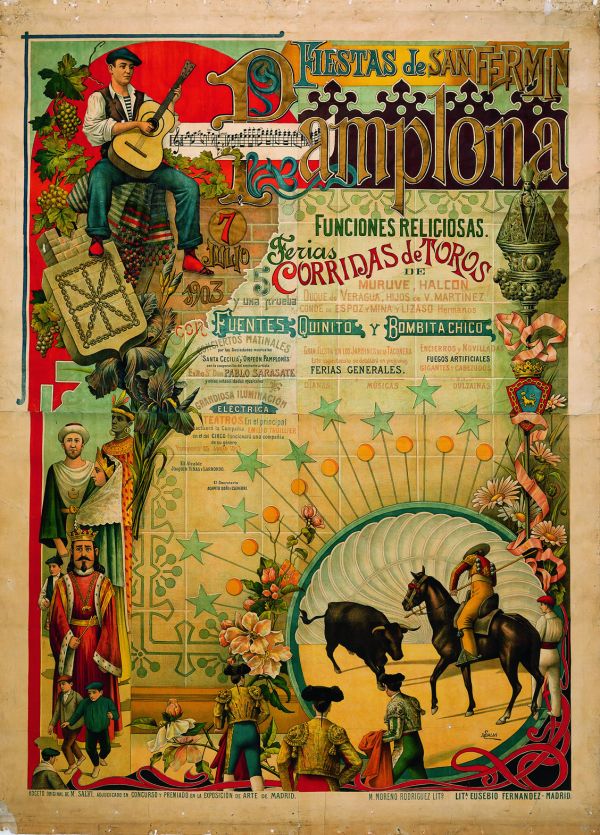
San Fermín 1903 poster (cartel)

San Fermín 1903 poster (cartel) by M. Salvi: a young man in a beret plays a guitar beside the word Pamplona, with the chains of Navarra, the giants at the left and a round medallion below
Cartel de San Fermín 1903. Poster of the fiestas of San Fermín 1903, by M. Salvi. Tap the poster to see it full size. See every San Fermín poster.16
San Fermín 1903 poster (cartel) by M. Salvi: a young man in a beret plays a guitar beside the word Pamplona, with the chains of Navarra, the giants at the left and a round medallion below
Artist
M. Salvi (credit printed on the poster)
Printed by
M. Moreno Rodríguez and Lit. Eusebio Fernández, Madrid
Date on the poster
7 julio 1903

A young man in a beret and waistcoat sits playing a guitar beside a great ornamental “Pamplona” and a sheet of music. Below him are the chains of Navarra, and on the left the giants of Pamplona. The credit at the foot reads “Boceto original de M. Salvi, adjudicado en concurso y premiado en la Exposición de Arte de Madrid”: the design won a competition.16

The poster announces the fiestas from July 7 and names the ranches whose bulls came that year: Muruve, Halcón, the Duque de Veragua, the sons of V. Martínez, the Conde de Espoz y Mina and Lizaso Hermanos. It also lists encierros, fireworks, giants and big-heads, morning concerts and the violinist Pablo Sarasate.16

Ollaquindía’s chapter on 1903 recalls a folk verse that put the encierro beside Navarra’s ancient laws: “Los Fueros son nuestra vida y el encierro nuestra fiesta”, the Fueros are our life and the encierro our fiesta.15

Pamplona in 1903

Words of 1903

Encierro or entrada

In 1903 the paper used two words for the run. The bando speaks of “el encierro del ganado”; the programme and the report of July 8 speak of la entrada, the entry of the bulls. A visitor writing in the paper on July 14 picked up the local word: “Lo que ustedes llaman entrada me parece un peligro grave”, what you call the entrada seems to me a grave danger.1, 3, 4, 9 Other words of the year: corralillo, the small corral at the Rochapea gate, and vallado, the fence.7

Getting ready

White alpargatas

A humour column of July 14 has its narrator buying white alpargatas, the rope-soled canvas shoes, “decidido á correr delante de los toros”, determined to run ahead of the bulls up calle Estafeta.10

On the roads

Bulls on the Irurzun road

Before the fiestas, the mayors of the villages on the road from Pamplona to Irurzun complained to the city about the danger when bulls bound for San Sebastián and other towns were driven along the road past their fields, and asked for the passage to be banned or announced in advance.11

Photographs

Where to see old photographs

The city’s photo archive, the Fototeca de Pamplona, holds historic photographs of the encierro, free to view online.18

San Fermín 1903: questions and answers

When were the bull runs of San Fermín 1903?

The known run days of San Fermín 1903 were Wednesday, July 8 (Muruve), Friday, July 10 (Duque de Veragua) and Sunday, July 12, 1903 (Antonio Halcón), each at six in the morning.3, 4, 5, 6, 7

What time did the running of the bulls start in 1903?

The running of the bulls of San Fermín 1903 started at six sharp in the morning, by tradition, as the mayor’s bando set it; doors on the course stayed shut from 5:45 until the herd was in the ring.1

Who was kept off the encierro course in 1903?

The mayor’s bando of 1903 kept children and youths under 16, women, the elderly and the infirm off the streets of the encierro course from 5:45 in the morning, and allowed no public between the barriers.1

What was the running of the bulls called in 1903?

The running of the bulls was called both encierro and entrada in 1903. The bando speaks of “el encierro del ganado”; the programme and the report of July 8 speak of “la entrada”, the entry of the bulls, and a visitor wrote “lo que ustedes llaman entrada”, what you call the entrada.1, 3, 4, 9

Did anyone die in the 1903 running of the bulls?

No one died in the running of the bulls of San Fermín 1903: the City of Pamplona’s list of encierro deaths begins in 1910. On July 12, 1903 a bull caught and tossed a man in the ring, without consequences.17, 7

Who made the San Fermín 1903 poster?

M. Salvi made the San Fermín 1903 poster; the credit on it says the original sketch won a competition and a prize at the Exposición de Arte in Madrid. It shows a young man in a beret playing a guitar beside the word Pamplona.16

Sources

Numbers on the page refer to this list. Diario de Navarra pages are cited from its archive (hemeroteca); quotations in Spanish are given as printed, in the spelling of the day.

Full source list
  1. Diario de Navarra, July 6, 1903, page 2: mayor’s bando on the encierro (hour, closing of doors, who may be on the course). Diario de Navarra archive
  2. Diario de Navarra, July 6, 1903, page 3: the Fomento commission sells box seats for the encierro. Diario de Navarra archive
  3. Diario de Navarra, July 7, 1903, page 2: programme for July 8, “la entrada de los toros de la ganadería de Muruve”. Diario de Navarra archive
  4. Diario de Navarra, July 9, 1903, page 2: “La entrada se verificó ayer sin novedad alguna.” Diario de Navarra archive
  5. Diario de Navarra, July 10, 1903, page 1: programme for July 10, “Encierro. A las seis de la mañana”, with the six Duque de Veragua bulls. Diario de Navarra archive
  6. Diario de Navarra, July 11, 1903, page 1: programme for Sunday, July 12, the Antonio Halcón bulls; masthead “Año I, Núm. 124”. Diario de Navarra archive
  7. Diario de Navarra, July 13, 1903, page 3: the morning of July 12: the fence at the slaughterhouse, a man tossed in the ring, the fiestas close in a storm. Diario de Navarra archive
  8. Diario de Navarra, July 14, 1903, page 3: follow-up on the fence that fell in front of the slaughterhouse. Diario de Navarra archive
  9. Diario de Navarra, July 14, 1903, page 1: a visitor’s column, “Lo que ustedes llaman entrada me parece un peligro grave”. Diario de Navarra archive
  10. Diario de Navarra, July 14, 1903, page 2: humour column, the narrator buys white alpargatas to run up Estafeta. Diario de Navarra archive
  11. Diario de Navarra, July 2, 1903, page 3: village mayors on the Irurzun road complain about bulls driven past their fields. Diario de Navarra archive
  12. Diario de Navarra, July 5, 1903, page 3: six Veragua bulls unloaded before a large crowd. Diario de Navarra archive
  13. Diario de Navarra, July 1, 1903, page 3: telegram: the Muruve and Halcón bulls reach Castejón; unloading in Pamplona that afternoon. Diario de Navarra archive
  14. Diario de Navarra, July 8, 1903, page 1: the procession of San Fermín on July 7. Diario de Navarra archive
  15. Ricardo Ollaquindía, 100 años de carteles de las fiestas y ferias de San Fermín (1882 to 1981), Pamplona, 1981, chapter “1903”. Free copy in the Biblioteca Navarra Digital (BiNaDi). binadi.navarra.es
  16. The poster of the fiestas of San Fermín 1903 itself: “Boceto original de M. Salvi, adjudicado en concurso y premiado en la Exposición de Arte de Madrid”; lithography by M. Moreno Rodríguez and Eusebio Fernández, Madrid.
  17. Ayuntamiento de Pamplona, “Pamplona recordará a los 16 fallecidos en la historia del encierro con adoquines”, December 27, 2023. pamplona.es
  18. Fototeca de Pamplona, Archivo Municipal de Pamplona (photographs of the encierro, free to view online; publication needs the archive’s permission). archivo.pamplona.es
How to cite this page

Encierro. “Running of the Bulls 1903: San Fermín in Pamplona.” Encierro.com, November 9, 2026. https://encierro.com/san-fermin-1903/

Corrections and updates
  • : questions and answers rewritten around what people search, each answer with its sources; the poster labelled with its Spanish name, cartel.
  • : page published.

Walk the route with people who run it

Book your walk