The Spanish Fighting Bull (Toro Bravo): The Animal Behind the Run
By Dennis Clancey · Last updated · 25 min read · 29 sources
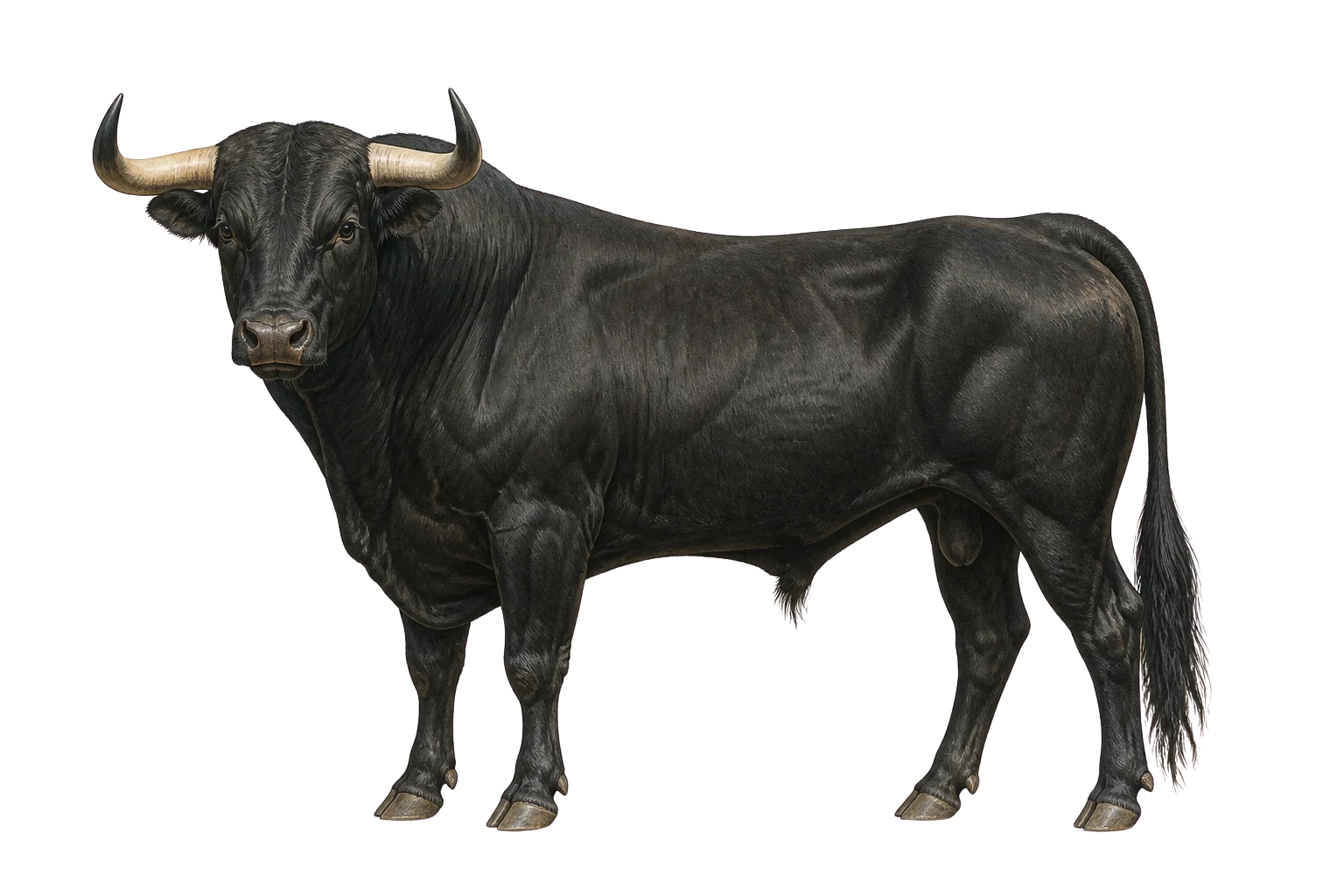
El toro bravo, Spain's Lidia cattle breed. Illustration made for Encierro.com
In short: the Spanish fighting bull (toro bravo, toro de lidia) is the Lidia breed of domestic cattle: lighter and more athletic than beef cattle, raised loose on open pasture, and bred for centuries to charge. It is red-green color blind, sees mostly to the sides, and the bulls that run in Pamplona weigh about 564 kg.
564 kgaverage Pamplona bull, 2000 to 2026
24 km/hfastest run on record, whole route
135°seen by each eye
1388first record of Navarra bulls sent to Pamplona
7founding castes
64named coats and markings
What is a Spanish fighting bull?
The Spanish fighting bull, also called the toro bravo or toro de lidia, is a distinct breed of domestic cattle, the Lidia breed, with its own herd book and a breed standard set in Spanish law in 2001.1 It is lighter and more athletic than beef cattle and has been bred for centuries for one inherited trait: the drive to charge and keep charging.
The breed standard describes an elipométrico animal, meaning lighter than the average for cattle, with marked differences between bulls and cows, a short wide head, large and slightly bulging eyes, small ears and a heavily muscled neck.1 It is born and raised loose on large open pastures, mostly the oak dehesas of western and southern Spain, and handled as little as possible.
Beef breeds are selected for meat and calm handling. The Lidia breed is selected for behavior: Spain's breeding program, renewed by the Ministry of Agriculture in May 2024, scores four traits in every breeding animal it records: bravura (bravery), fuerza (strength), movilidad (mobility) and fijeza (focus).6 The result is a breed unlike any other. In a genetic study of 79 herds, almost 20 percent of all the breed's genetic variation lay between its bloodlines, where most breeds keep their variation inside herds.3
An adult fighting bull stands about 128 cm (4 ft 2 in) at the withers and weighs about 500 kg (1,100 lb) by the breed standard; the bulls that run in Pamplona average 564 kg.2, 1, 23
Parts of the body, as in the illustration at the top of this page:
Morrillo neck crest: the thick muscle along the top of the neck, the mark of a mature bull. A smooth rise of muscle, not a hump like a zebu's.
Testuz poll: the top of the head between the horns.
Papada, badana dewlap: loose skin under the neck; heavy in some lines, almost absent in others.
Cruz withers: the top of the shoulders.
Lomo back and loin: straight in the breed standard.
Grupa, cuadril rump and hip.
Rabo, borlón tail and tail tuft: long, with a full tuft.
Pezuña hoof: small, with closed claws.
Hocico muzzle: wide in most lines, narrow and pointed in Saltillo and Albaserrada.
A measured study of 264 adult animals, aged four to six, from 21 herds and 15 bloodlines, gives the breed's real size: bulls averaged 127.8 cm at the withers and 150.2 cm in body length; cows 116.8 cm and 128.9 cm. The breed is smaller than Spain's other native cattle. Miura and Pablo Romero were the largest bloodlines measured; Navarra and Vega-Villar the smallest.2
Build and presence
The word for a bull's overall presence is trapío: the seriousness of the animal as a whole, judged from its horns, its neck crest and its hindquarters.8 Breeders describe build with a precise vocabulary:1, 14
Elipométrico, eumétrico: lighter than average, or average-framed
Brevilíneo, mediolíneo, longilíneo: short, medium or long in the body for its height
Aleonado: lion-like, heavy in front and lighter behind
Zancudo: long-legged
Carifosco, astracanado: curly-haired forehead, or curls running down the neck
The fighting bull's standard horn is a short hook: round in section, coming out from the head, then curving forward and slightly up.1 Both bulls and cows have horns, and the cows' are longer and finer for their size.1, 2
A horn shaped that way, even on both sides and of medium length, is called bien armado, well-formed. Measured bulls averaged 58.5 cm along the outer curve of the horn; cows 57.1 cm.2
Parts of the horn
The base is the cepa, the middle the pala, the solid point the pitón. Young animals carry a cap over the tip, the bellota, which comes away at about three and a half years. The horn grows over a bony core, the clavija ósea, and shows growth rings at the base.8
The five horn colors
The five horn colors named in the breed standard. Encierro.com, after Real Decreto 60/2001
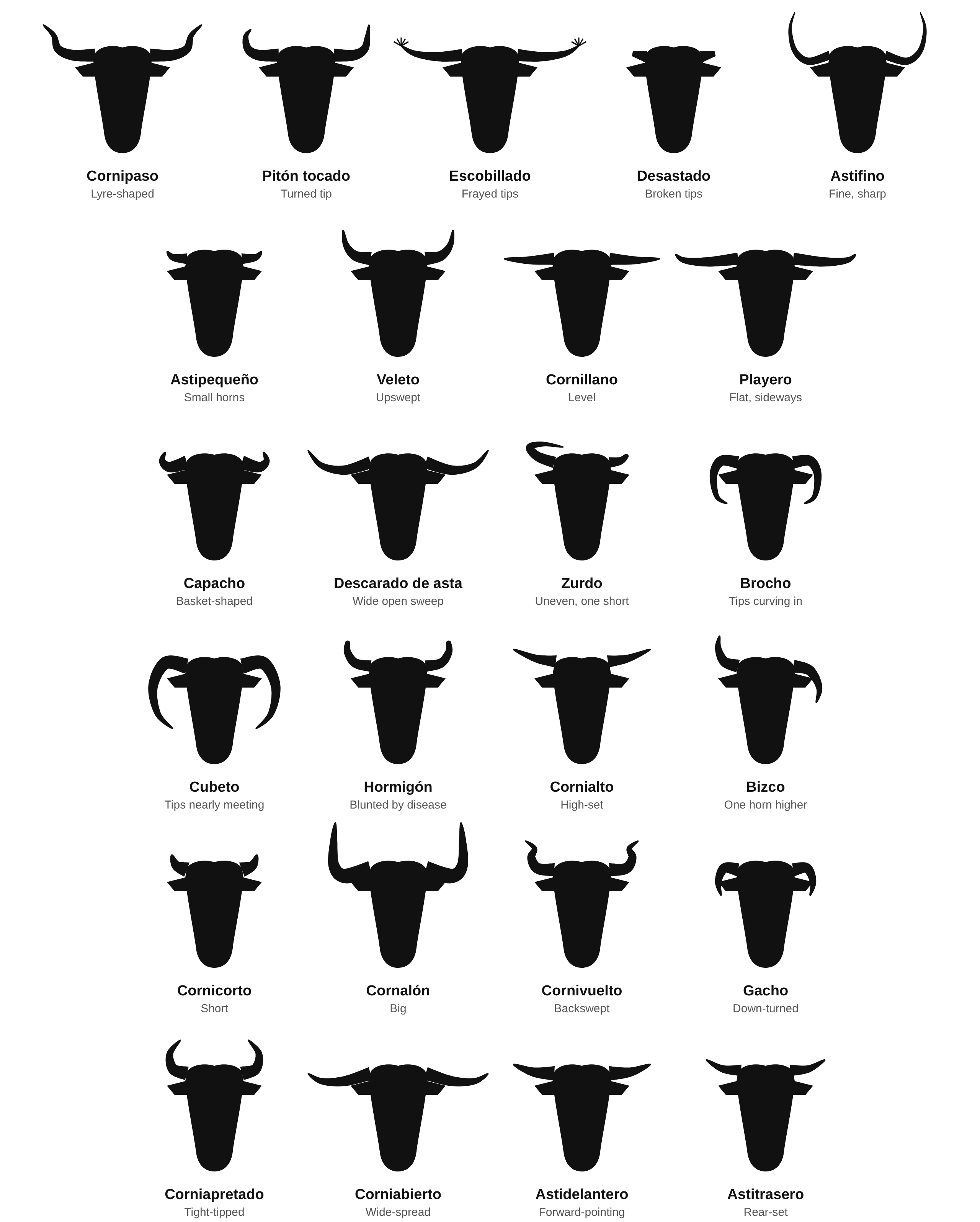
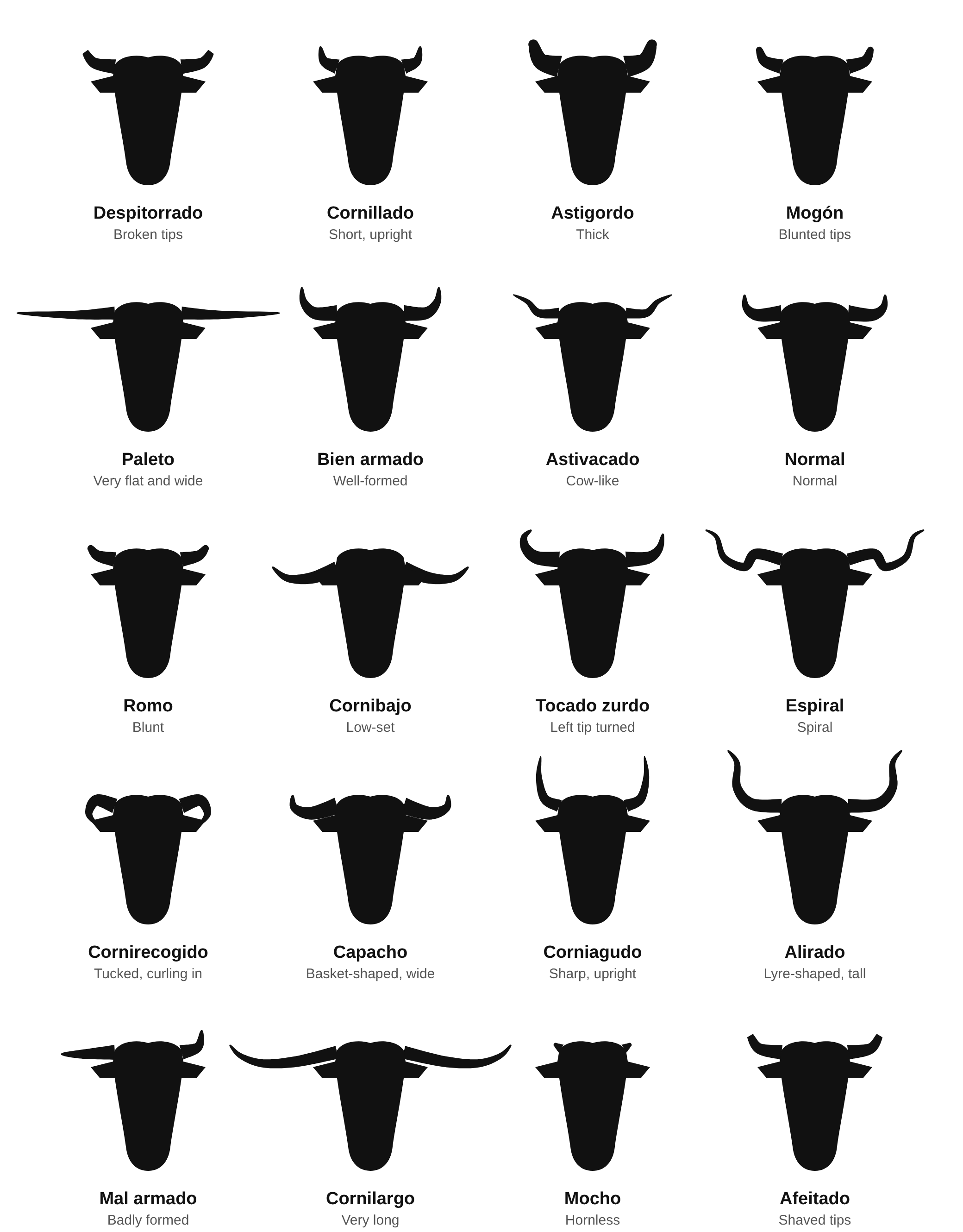
Every horn shape
Horn shapes, chart 1 of 2 (las formas del cuerno). Redrawn by Encierro.com from the horn charts by Josue piquero caso (Wikimedia Commons, CC BY-SA 4.0). We redrew every horn as a clean silhouette so each shape reads at phone size, kept his order and added Spanish and English names. Shared under CC BY-SA 4.0, like the original.Horn shapes, chart 2 of 2. Redrawn by Encierro.com after Josue piquero caso (CC BY-SA 4.0), as above.The main horn shapes in a table
Spanish
English
Shape
Veleto
Upswept
Out a little, then nearly straight up
Cornipaso
Lyre-shaped
Up, out, then back
Cornivuelto
Backswept
Up, then curving back
Brocho
Closed
Tips curving in toward each other
Corniapretado
Tight-tipped
Tips close together
Cubeto
Bucket
High horns with tips almost meeting
Capacho, acapachado
Basket-shaped
Down, then forward, up and in
Corniabierto
Wide-spread
Wide apart from a broad base
Playero, paleto
Flat
Straight out to the sides
Cornidelantero
Forward-pointing
Directed forward
Gacho
Down-turned
Growing down toward the ground
Cornalón
Big-horned
Long and heavy
Cornicorto
Short-horned
Short for the body
Cornialto, cornibajo
High-set, low-set
Where the horns leave the skull
Bizco
Cross-horned
One horn higher than the other
Astifino, astigordo
Fine, thick
Thin and sharp, or wide and blunt
Astillado, escobillado
Splintered, frayed
A split or brush-like tip from wear
Mogón, hormigón
Blunted
A rounded tip; hormigón is blunting from a horn disease
Each bloodline tends to its own horn: short and upswept in Navarra, short and forward in Saltillo, long and basket-shaped in Núñez, upswept in Atanasio Fernández, curving in or crown-shaped in Murube, thick at the base in Miura.1
Many ranches fit fiberglass covers over the horns in a bull's last year at home. A study of 55 bulls aged four to five found lower bone mineral density at the tip of covered horns, a possible weakness.17
A fighting bull sees about 135 degrees with each eye but only about 20 degrees straight ahead with both eyes together, and it is red-green color blind.10, 11
Field of vision of the toro bravo (campo visual del toro bravo). Tap to enlarge. Diagram enhanced and drawn for Encierro.com, based on the measurements of R. Martín Roldán (1976). Free to use with credit to Encierro.com and a link to this page.
The best measurements of the fighting bull's own eyes come from R. Martín Roldán, a professor of anatomy in Madrid, published in 1976:10
Each eye covers about 135 degrees.
Both eyes overlap in only about 20 degrees straight ahead, reaching about 60 degrees downward. That narrow zone is where the bull judges distance best.
Behind the bull is a blind area of about 108 to 110 degrees.
Right in front of the muzzle is a blind cone, about 90 to 125 cm long, that neither eye covers.
The retina has few cones and many rods: good in low light, weak in color. The bull is farsighted.
Grandin's work on cattle puts the total field of view above 300 degrees, and notes that cattle judge depth poorly with their heads up, which is why they stop and lower the head to look.27 Martín Roldán gave no method or sample, so his figures are one anatomist's measurements; they match the general picture.
Do bulls hate red?
No. Cattle are dichromats: two types of color receptor instead of three, so they are red-green color blind. They see color less intensely than people, and red does not stand out to them.11, 12 What draws a bull is movement and strong contrast.
The bulls that ran in Pamplona from 2000 to 2026 weighed 564 kg (1,243 lb) on average, from 460 to 695 kg, and the fastest run on record averaged about 24 km/h (15 mph) over the whole 848.6 meter route.23
Average weight of the bulls that ran in Pamplona each year. Encierro.com, Pamplona bulls database
The breed standard gives about 500 kg for an adult bull and 300 kg for a cow.1 Pamplona's bulls are four to six years old and heavier. Their weight has not climbed: yearly averages have stayed between 538 kg (2022) and 593 kg (2007).23
Ranch, 2000 to 2026
Bulls weighed
Average
Range
Bloodline
Miura
150
611 kg
510 to 695 kg
Miura
Dolores Aguirre
77
576 kg
480 to 675 kg
Atanasio Fernández, Conde de la Corte
Fuente Ymbro
115
570 kg
495 to 685 kg
Domecq
Jandilla
100
560 kg
485 to 690 kg
Domecq
Victoriano del Río
71
557 kg
500 to 645 kg
Domecq
José Escolar
48
553 kg
480 to 615 kg
Albaserrada
Cebada Gago
131
538 kg
485 to 645 kg
Domecq, Núñez
Adolfo Martín
17
522 kg
485 to 560 kg
Albaserrada
On the ranch, a calf weighs about 90 kg at weaning at seven months, about 300 kg at two years and 367 kg at thirty months, in figures from one Madrid ranch.15
How fast can a bull run?
No reliable measurement of a fighting bull's top sprint speed has been published that we can cite. What we can measure is the run. The fastest encierro on record, Miura in 2015, covered the 848.6 meter route in 2 minutes 5 seconds: about 6.8 meters a second, or 24 km/h, uphill stretch and sharp turn included. Measurements of the route differ by a few dozen meters depending on where they start and end. A typical run takes two to four minutes. See Bull Speed in the Encierro for section times.
Left alone, bulls move little. Lidia cows fitted with GPS collars walked about 3.1 km a day on a home range of about 56 hectares, most active around dawn.13
A fighting bull is bred to be bravo: to charge and keep charging. On its home pasture the breed standard calls it "generally calm" and very territorial.1, 6
Spanish
English
Meaning
Bravo, bravura
Brave, bravery
The inherited drive to charge and keep charging; the first trait scored in breeding.21, 6
Noble, nobleza
Noble
A clean, straight, predictable charge. Writers set it against ferocity: the brave bull is "noble and clear," never ferocious.25
Casta, encastado
Spirit, true to its breeding
The inherited fire of the animal, and a bull that keeps it.21
Fourth scored trait: holds its attention on one target.6
Manso
Tame
"Of an animal: not bravo." As a noun, the lead ox of a herd: the cabestro.21
Ranchers who raise cattle for street events value bravery, spirit, mobility and quick reactions (prontitud), and, for the street, sharpness (listeza), agility, getting back up and going on (reponerse) and durability.14
Why are bulls aggressive?
Three reasons. Selection: for centuries breeders have kept the mothers and fathers that charge hardest, and the breeding program still scores bravery.6 Territory: the breed standard calls them very territorial, calm at home and irritable away from it.1 Rank: bulls fight each other for position in the herd, sometimes hard enough to injure or kill.20
Every fighting bull alive today descends from a handful of founding castes, the castas fundacionales, formed between the Middle Ages and the mid-1800s; most modern herds trace to the Vistahermosa caste of about 1774.1, 3
1388 Two bulls are sent from Navarra to Pamplona. Navarra's wild cattle of the Bardenas Reales and the Ebro valley form the Navarra caste.3
16th century Morucha Castellana cattle at El Raso de Portillo, Valladolid; extinct in pure form in the 1800s.3
1598 to about 1650 The Jijona caste (Villarrubia de los Ojos) and the Toros de la Tierra (Colmenar Viejo).3
1690 Joaquín Antonio Beaumont, Marqués de Santacara, the first organized Navarra breeder with continuity; his bulls run in Pamplona that year.3
About 1740 The Cabrera caste, Utrera, from the herds of the Cartuja de Jerez.3
By 1755 The Vazqueña caste, Seville; its best herd is bought by King Fernando VII in 1831.3
1762 to 1795 The Gallardo caste, El Puerto de Santa María.3
About 1774 The Vistahermosa caste, Dos Hermanas, the source of most herds today.3
1850 to 1852 Juan Miura buys Cabrera cattle: the start of the Miura line.3
Del Campo's records of Pamplona's bulls from 1800 to 1843 describe the Navarra animals as mostly red, dark red and chestnut, small, agile, good jumpers and sharp-horned.24 A Navarra professor of animal production summed them up as "small in size and big in bravery."4
Is the toro bravo an aurochs?
No, though it is often called the closest living relative of the aurochs, the wild ox of prehistoric Europe. A study of the mitochondrial DNA of 527 Lidia animals from 29 lineages found diversity higher than most European breeds, about 17 percent of an African lineage, and closer links to prehistoric Iberian and Italian aurochs than to British ones.5 That makes it an old, genetically distinct Iberian breed, not an aurochs.
A fighting bull bloodline is called an encaste: a group of herds of known origin, kept apart from other bloodlines for at least 30 years and distinct in body and behavior.3
A branch inside an encaste is a línea. A single ranch with its own brand is a ganadería. The word casta means ancestry, "also used of animals,"21 and breeders also use it for the inherited fire of a bull.
From the founding castes to the bloodlines of today. Encierro.com, after Real Decreto 60/2001 and Cañón and Fernández (2012)
From 2000 to 2026, the Domecq and Núñez family supplied 130 of Pamplona's 200 encierros (65 percent), and Miura ran every year.23
Where the ranches whose bulls ran in Pamplona from 2000 to 2026 are. Tap to enlarge. Encierro.com, Pamplona bulls database. Locations approximate.
Domecq and Núñez family: 130 runs, from ranches such as Cebada Gago, Jandilla, Fuente Ymbro, Victoriano del Río, Núñez del Cuvillo, Torrestrella and La Palmosilla.
Miura: the only Cabrera line still running in Pamplona; 25 runs since 2000 and a run every fiesta since at least 1980.
Atanasio Fernández and Conde de la Corte lines (Dolores Aguirre, Puerto de San Lorenzo, Valdefresno, Conde de la Corte): 18 runs.
Albaserrada (José Escolar, Adolfo Martín, Victorino Martín): 16 runs. José Escolar has run every year since 2015.
Encierro's database records every run and every bull from 2000 to 2026, each fact sourced to the press of the day.23 Each year's ranches, with every bull's name, weight and coat, are on our year pages, such as San Fermín 2026.
How the toro bravo is bred, raised and fed
Fighting bulls are born in spring, weaned and branded at about seven months, and raised loose on pasture for four to six years; breeding animals are chosen by pedigree, build and a temperament test.15, 6
The ranch year
Jan to AprCalving, mid-January to mid-April
Apr to AugBreeding: each sire runs free with 20 to 40 cows
Sep to OctWeaning at about seven months, and branding (herradero)
Age 2Young cows tested for temperament; bull candidates chosen
One Madrid ranch, studied in 1990.15 On that ranch about 85 percent of cows calved each year, and 15 to 20 percent of young females were kept each year to replace older cows.
The mothers
A heifer is not bred before two. A well-fed cow stays productive to 16 to 18 years, giving about 4 liters of milk a day to her calf until weaning.16 A bull's name usually comes from its mother's name.22
How breeding animals are chosen
Males are chosen first by build, then by pedigree, then by a test.15 Spain's breeding program turns pedigrees and test scores into a genetic value for bravery, strength, mobility and focus, with an index average of 100; animals above 100 are recorded as improvers. It also works to keep the genetic variety of the smaller bloodlines, and five breeders' associations keep the herd book.6
Feeding
Pasture is the base of the diet. Calves live on milk for four to six weeks, then get hay and a protein supplement in feeders their mothers cannot reach; minerals at that age matter for horn growth, and "deficiencies at this stage can last for life."16 Cows graze in spring and autumn and eat hay in winter, about 1,350 kg a cow a year on the Madrid ranch.15 In a bull's last months at home, feeding guidance sets a limit of 180 days and no more than 500 g of gain a day, at least 8 kg of feed a day with at least 20 percent forage, and long feeders so dominant bulls cannot keep the others away.16
Exercise
Ranchers keep their bulls moving: food and water at opposite ends of a pasture, and runs on an exercise track, the corredero, with their brothers and the steers around them. One ranch's track is about 1.5 km long. At Las Monjas, near Lora del Río in Seville, the bulls swim across a lake behind the steers. Tired bulls also fight less when groups are put together.19
Land and health
The breeders' union reported 280,450 hectares of ranch land in 2015, about 800 hectares per ranch, mostly pasture and dehesa (the union's own figures).26 Because the herds live loose and are hard to handle, tuberculosis is harder to clear from them than from other cattle; its prevalence in Lidia herds is about ten times that in dairy herds.18
Before the 2008 fiesta, while researching what became the documentary Chasing Red, Dennis Clancey visited two ranches that run regularly in Pamplona.
Cebada Gago, at La Zorrera near Medina Sidonia in Cádiz, has sent bulls to Pamplona 36 times since 1985. Fuente Ymbro, at San José del Valle in Cádiz, was founded in 1996 from Jandilla stock and has run 19 times since 2005.23
"I visited with my good friend Jorge, who had arranged the visits. We were able to observe the selection of the cows and the feeding. We spent time near the bulls, though at a respectful distance, observing and filming. They had already sent their bulls to Pamplona, right before the fiesta."
Dennis Clancey, founder of Encierro
Bull or steer: what is the difference?
A bull is an intact male; a steer is a castrated male. The steers that lead fighting bulls, the cabestros or mansos, are bigger, calmer and wear a cowbell.
Cabestros are usually castrated beef-breed males, often of the white-and-red or white-and-black Berrenda breeds, heavier-boned than the bulls, with long horns and a large bell on a leather collar. In Pamplona they run beside the bulls to keep the herd together and lead it to the bullring. More in The Cabestros: the steers that guide the bulls.
A fighting bull is a becerro under one year, an añojo at one, an eral at two, a utrero at three and a toro at four and over; the bulls that run in Pamplona are four to six.22
Becerrocalf, under 1
Añojoyearling, 1
Eral2
Utrero3
Torobull, 4 and over
Breeding cows stay productive to 16 to 18 years.16 We have not found a reliable published figure for the natural lifespan of a Lidia bull, and will add one when we do.
Myths and facts about fighting bulls
Myth Bulls hate red.
Fact Cattle are red-green color blind. A bull reacts to movement and contrast, not to the color of a cape or a neckerchief.11, 12More
Myth Fighting bulls are wild animals.
Fact They are a domestic breed with a herd book, born and raised loose on open range. The breed standard calls them "generally calm" on home ground.1More
Myth It's just an angry beef bull.
Fact It is a separate breed, lighter and more athletic than beef cattle, selected for behavior rather than meat.1, 6More
Myth The toro bravo is a living aurochs.
Fact It is an old, genetically distinct Iberian breed with links to Iberian aurochs. It is not an aurochs.5More
Myth Only bulls have horns.
Fact Lidia cows have horns too, longer and finer for their size than the bulls'.1, 2More
Myth The steers are cows.
Fact Cabestros are castrated males, bigger than the bulls, wearing cowbells. More
Myth If you fall, the bulls will trample you.
Fact Trampling is less common than people assume. The bulls are athletic, run with their heads low and see the ground ahead with both eyes, and they tend to jump over a runner on the ground. "They do not want to step on anything that will trip them," says Dennis Clancey. If you fall with bulls close, stay down. Read what to do if you fall. No study counts how runners are hurt, so this is experienced runners' observation, not a measured rate.10, 7, 29More
Myth More bulls are released into the bullring after the run.
Fact The animals let into the ring after the encierro are vaquillas: young cows with padded horns, released one at a time for the public. The bulls of the run are not let loose again. See the vaquillas and recortes.28
Glossary: fighting bull terms in Spanish and English
Every Spanish word on this page, with its English meaning: 197 terms on horns, body, coats, temperament, eyesight, ages and ranching.
Horns
cepa / mazorca
horn base: wide base attached to the head; carries the growth rings
pala
blade: middle, longest part of the horn
pitón (cofia, veneno)
tip: the solid point of the horn
pico de pato
duck-bill tip: flattened, elliptical shape of an intact adult tip
rodetes córneos
horn rings: ring ridges at the base
bellota
acorn cap: sheath over the tip of a young animal; comes away at about 3.5 years
clavija ósea
bony core: bone that anchors the horn to the skull
testuz
poll / forehead: area between the horns
astinegro
black-horned: dark, uniform from base to tip
astiblanco
white-horned: white or pale from base to the start of a black tip
astiacaramelado
caramel-horned: caramel from base to tip, darker tip; goes with jabonero, colorado, salinero coats
astisucio
dirty-horned: indefinite, muddy color, no clear contrast
astiverde
green-horned: greenish at the base; the rarest
astifino
fine-horned: thin at the base and along the length, sharp tips
astigordo
thick-horned: wide base, little taper, usually short with blunt tips
cornalón
big-horned: long, voluminous horns, any direction
cornicorto
short-horned: short relative to body size
cornialto
high-set: set high above the forehead
cornibajo
low-set: set low (not the same as gacho, which is direction)
cornitrasero
rear-set: set behind the poll line
veleto (corniveleto)
weather-vane, upswept: out and forward a little, then nearly straight up
cornivuelto
backswept: rise, then curve backward
cornipaso
lyre-shaped: rise, curve outward, then back ("high lyre")
brocho (cornibrocho)
closed, bracket-shaped: tips curve in toward each other like ( )
corniapretado
tight-tipped: tips close together at about 45 degrees, slightly forward
cubeto (cornicubeto)
bucket, tips nearly touching: high horns with tips almost meeting
capacho / acapachado
basket-shaped: drop down, curve forward and up, turn in (acapachado is the mild form)
corniabierto (corniancho)
wide-spread: widely separated, broad base
playero (paleto)
flat, sideways: wide-set horns growing straight out to the sides
cornidelantero
forward-pointing: directed forward
gacho (cornigacho)
down-turned: grow down toward the ground, usually low-set
corniavacado
cow-horned: fine, rising and turning out like a cow's; seen as a defect
en gancho
hook-shaped: the breed standard's base shape: "short hook"
en corona
crown-shaped: named for Murube-Urquijo horns
astillano
level: grow at the level they are set, little deviation
bien armado / encornado
well-armed: symmetrical, medium or slightly long, forward and a little up
bizco (cornibizco)
cross-horned: one horn higher than the other; named for the lower one
tocado
slightly off: mild asymmetry
zurdo / manco / tuerto (of horns)
uneven: one horn shorter, no injury
astillado
splintered: splinters at the tip
escobillado
broomed: brush-like splintered tip
despitonado
broken-tipped: tip broken, part of the sheath lost
mogón
blunted: tip lost, rounded
hormigón
eaten horn: a mogón caused by a fungal condition (hormiguillo)
descornado / mocho
dehorned: most or all of a horn lost
Body and build
morrillo
neck hump: the big muscle on top of the neck; "developed" in males
papada
dewlap: loose skin under the neck
badana
brisket skin: lower fold of the dewlap
cruz
withers: top of the shoulders; branding site
lomo
back and loin
grupa
rump
cuadril / anca
hip, haunch: branding site
costillar
ribs: branding site
paletilla
shoulder blade: branding site
culata
hindquarters: with the morrillo, the core of the bull's "presence"
corvejón
hock
caña
cannon bone: LOM20 measures its perimeter
pezuña
hoof: "small, with closed nails"
rabo, borlón
tail, tail tuft: "abundant tuft"
hocico, morro
muzzle
meleno
forelock: smooth, abundant forehead hair
trapío
presence, seriousness: the overall impression of a bull from horns, neck hump and rump
hechuras
build, conformation
elipométrico
lighter than average for cattle: the breed standard's word for the Lidia frame
eumétrico
average-framed
brevilíneo / mediolíneo / longilíneo
short / mid / long-lined: body length relative to height
subcóncavo, recto, convexo
dished, straight, Roman-nosed profile: 58.4% of males measured were subconcave
aleonado
lion-like: heavy in front, lighter behind
ensillado
saddle-backed: dip in the back
zancudo / zanquilargo
long-legged
badanudo
heavy-dewlapped
degollado
clean-throated: barely any dewlap
carifosco
curly-faced: curly hair on the forehead
astracanado
astrakhan-coated: curly forehead hair running down the neck
chicken-rumped: small, high rump; seen more in bulls for street events
engatillado
trigger-necked: arched neck line; seen more in bulls for street events
plantado
square-standing
Coats and markings
negro
black: black coat
azabache
jet black: black with a bluish sheen
zaíno
matte black: black with no sheen
mulato (negro mulato)
brownish black: black without sheen, with a brown or reddish cast, like a mule
lombardo
black, lighter back: black coat with a lighter, brownish or tawny area over the mid back and loin
cárdeno
grey (roan): white and black hairs mixed; light (claro) and dark (oscuro)
castaño
chestnut: red and black hairs mixed; light and dark
colorado
red: red hairs
retinto
dark red, mahogany: red with mahogany hairs; also red coats that vary in strength across the body
melocotón
peach: very light red, straw yellow, like peach skin
tostado
dark reddish brown: between dark colorado and mulato black
jabonero
cream, coffee with milk: light (claro) and dirty (sucio) variants
albahío
pale straw: whitish yellow
barroso
muddy: dirty yellowish with ashy, earthy shades, like fresh mud
salinero
salt-and-pepper red: red and white hairs mixed; light and dark
sardo
mixed red, white and black: white, red and black hairs mixed
ensabanado
white: white coat (from "sábana", bedsheet)
berrendo
pied, patched: white base with large dark patches; named by the patch color: berrendo en negro, en colorado, en castaño, en cárdeno, en jabonero, en tostado, en salinero, en sardo
remendado
patched pied: berrendo with large, irregular patches like cloth patches
aparejado
pied with a white back: berrendo with a white band 20 to 25 cm wide along the spine, over the rump and under the belly
alunarado
spotted white: ensabanado or berrendo with big dark round spots, like moles
armiñado
ermine-spotted: like alunarado, smaller spots
mosqueado
fly-spotted: light coat with small dark spots like flies
carbonero
sooty light coat: light coat (cárdeno, berrendo, ensabanado) with dark skin showing under the white hair, looks dirty
anteado
rosetted: red or peach with darker, shinier round rosette spots
bragado
white-bellied: white patch on the belly
bragado corrido
white belly running forward: the belly patch runs toward the chest
aldiblanco
white underside: very large white patch on the lower body reaching chest and flanks
aldinegro
black underside: chestnut-patched coat with black lower body and legs
listón
spine stripe: narrow stripe of another color along the spine
albardado
saddle-marked: lighter hair along the back in a pack-saddle shape
chorreado
streaked: vertical bands from the spine down the flanks; en verdugo: dark bands on a light coat; en morcillo: reddish bands on black
girón (jirón)
flank-patched: one or more big irregular white patches on the trunk, usually the flank
falso girón
false flank patch: big white patch on the trunk, not at the flank
cinchado
girthed: white band around the chest or belly, like a saddle girth
burraco
white-splashed black: black with many white splashes
salpicado
splashed: dark coat with irregular white splashes
estornino
starling: black with a few small round white spots
nevado
snowflaked: dark coat with small white flecks like snow
entrepelado
grizzled: white hairs scattered through the base color, like grey hair
desteñido (lavado)
faded: base color faded on the rump, inner thighs and lower legs
axiblanco
white armpits: white patch behind the foreleg
meano
white sheath: white patch or tuft at the sheath
gargantillo
collared: white patch low on the neck rising up its sides
lunar pecho / lista en pecho
chest spot / chest stripe: white spot or stripe on the chest
capirote
dark-hooded: head and neck darker than the body
capuchino
hooded: head and neck another color, ending in a hood at the withers
codillero
colored elbows: elbows a different color
lucero
star: white mark on the forehead
estrellado
small star: small irregular white patch on the forehead
careto
white-faced: white covering the forehead and face
caribello (carinevado)
flecked face: scattered white hairs on the forehead and face
carinegro
black-faced: black face against the body color
facado
knife-marked: very thin white line on forehead or face
bociblanco
white muzzle: white hair ring around the mouth
bocidorado
golden muzzle: golden hair ring around the mouth
bocinegro
black muzzle: black patch around the mouth
ojinegro
black-eyed: black patch around the eyes
ojalado
ringed eyes: lighter band around the eyes running along the tear duct
ojo de perdiz
partridge eye: only on red, melocotón or retinto: lighter rings around the eyes
llorón
tear-marked: lighter tear-shaped patch under the eyes
calcetero
socked: white lower part of one or more legs
semicalzado
partly socked: partly white lower legs
calzón
breeched: white on the hind legs above the hocks, sometimes to the buttocks
botinero
booted: light coat with dark lower legs
coliblanco
white-tailed: white tail tuft and part of the tail
coletero / colillero
white tail tuft: white tuft
rebarbo
white tuft hairs: white hair in the tail tuft
rabicano
white-flecked tail: scattered white hairs along the tail
Temperament
bravura
bravery, fight: defensive and aggressive drive to charge; the breed's defining trait
casta
breeding, spirit: the inherited makeup; also "spirit, fire"
fuerza
strength, stamina
movilidad
mobility: agility and speed
fijeza
focus: holding attention on a target
prontitud
promptness: quick to react
listeza
sharpness, cunning: valued in bulls for street events
agilidad
agility: valued in bulls for street events
reponerse
recovery: gets back up and keeps going
durabilidad
durability: lasts through a long event
codicia
eagerness: drive to chase
acometividad
attack drive
mansedumbre / manso
tameness / tame: the opposite of bravo
rusticidad
hardiness: copes with rough ground and extreme weather
mandón
herd boss: the dominant bull
abochornado
outcast: a beaten bull driven from the herd; dangerous
bravo
brave, wild-spirited: In the general dictionary, "of an animal: fierce". In the breed, the inherited drive to charge and keep charging, defensive and aggressive at once. The breed's defining selected trait
encastado
true to its breeding: keeps its casta, charges with full commitment
noble / nobleza
noble, nobility: clean, straight, predictable charging with no treachery; writers set it against ferocity: the brave bull is "noble y claro" and "never ferocious"
fiereza / ferocidad
ferocity: distinct from bravery; old writers said ferocity comes from fear
manso
tame: "of an animal: that is not bravo"; a manso avoids or runs from a challenge
manso (noun)
lead ox, steer: "the ox that guides the rest" of the herd: the cabestro
territorial, tranquilo, irritable
territorial, calm, irritable: the breed standard's own words: very territorial, "generally calm" on home ground, hard to handle away from it
Eyesight
visión monocular
one-eye vision: what one eye sees alone; about 115 degrees on each side
visión binocular
two-eye vision: the narrow zone ahead seen by both eyes, about 20 degrees; where the bull judges distance
zona ciega
blind area: about 108 to 110 degrees behind the bull
punto ciego
blind spot: a cone about 90 to 125 cm long right in front of the muzzle
dicromático
dichromatic: two kinds of color receptor; red-green color blind
Ages
becerro / becerra
calf: under one year
añojo
yearling: one year
eral
two-year-old: two
cuatreño
four-year-old: four
toro
bull: four and over
semental
breeding bull
vaca de vientre / reproductora
breeding cow
cabestro / manso
steer, lead ox: castrated or tame male used to lead the herd
buey
ox: adult castrated male
Ranch and breeding
ganadería
ranch, herd (the breeding operation): general
ganadero
rancher, breeder: general
hierro
brand: RD145 art. 11, 12
divisa
ranch ribbon colors: RD145 art. 11; del Campo for the Pamplona history
señal
ear notch: RD145 art. 11, 12
encaste
bloodline: BOE01
casta fundacional
founding caste: BOE01 Annex II
libro genealógico
herd book: BOE01, MARM11
dehesa
oak pasture: ESWIKI, LOM20
tentadero
ranch testing ring: MARM11
Sources: Real Decreto 60/2001; Sagaón Cuetos (1996); Real Unión de Criadores de Toros de Lidia; Real Academia Española.1, 8, 9, 21 Festival words are in our running of the bulls vocabulary.
Frequently asked questions
What breed are Spanish fighting bulls?
They are the Lidia breed (raza bovina de lidia), a distinct breed of domestic cattle with its own herd book and a breed standard set in Spanish law in 2001. Within it are bloodlines called encastes, such as Domecq, Núñez, Miura, Albaserrada and Santa Coloma. Most herds descend from the Vistahermosa caste of about 1774.
Are bulls color blind?
Partly. Cattle have two types of color receptor instead of three, which makes them red-green color blind. Movement and contrast catch their eye, not color.
Why do bulls hate red?
They don't. A bull cannot pick out red the way a person does. It reacts to movement and strong contrast; any color moved in front of it draws the same reaction.
How much does a Spanish fighting bull weigh?
About 500 kg (1,100 lb) for an adult bull by the breed standard. The bulls that ran in Pamplona from 2000 to 2026 averaged 564 kg (1,243 lb), from 460 to 695 kg; Miura's averaged 611 kg.
How fast can a bull run?
No reliable top-speed measurement has been published. The fastest Pamplona run on record, Miura in 2015, averaged about 24 km/h (15 mph) over the 848.6 meter route, uphill climb and sharp turn included.
What is the difference between a bull and a steer?
A bull is an intact male and a steer is a castrated one. The steers that guide fighting bulls, cabestros, are bigger and calmer and wear cowbells.
Do female cows have horns?
In this breed, yes. Lidia cows' horns are longer and finer for their size than the bulls'; measured cows averaged 57.1 cm along the outer curve, against 58.5 cm for bulls.
Why are bulls so aggressive?
Because they are bred to be: breeders keep the parents that charge hardest, and the breeding program scores bravery. Bulls are also territorial and fight for rank. A bull separated from its herd is the most dangerous of all.
Do the bulls trample runners who fall?
Less often than people assume. The bulls tend to jump over a runner on the ground. Experienced runners advise that if you fall with bulls close, you stay down and cover your head.
How long do bulls live?
Breeding cows stay productive to 16 to 18 years. The bulls that run in Pamplona are four to six. We have not found a reliable published figure for a Lidia bull's natural lifespan.
Dennis Clancey is the founder of Encierro. He started attending San Fermín in 2007, has instructed more than 4,000 clients on how to run the encierro, and directed the documentary Chasing Red.
How this page was made: researched and written by Dennis Clancey and the Encierro team from the sources below and our Pamplona bulls database, with AI tools used in research and drafting. Ranch details come from Dennis's 2008 visits. Spot an error? Tell us and we will fix it and note it in the update log.
Sources
Spain. Real Decreto 60/2001, de 26 de enero, sobre prototipo racial de la raza bovina de lidia. BOE no. 38, February 13, 2001. boe.es↩↩↩
Lomillos, J. M. and Alonso, M. E. (2020). Morphometric Characterization of the Lidia Cattle Breed. Animals 10(7): 1180. doi:10.3390/ani10071180↩↩↩
Cañón, J. and Fernández, J. (2012). Análisis genético; Análisis histórico de las castas fundacionales. Universidad Complutense de Madrid and Unión de Criadores de Toros de Lidia. ucm.es↩↩↩
Purroy Unanua, A. (2020). Evolución del toro de lidia: el toro actual. Universidad Pública de Navarra. academica-e.unavarra.es↩
Cortés, O. et al. (2008). Ancestral matrilineages and mitochondrial DNA diversity of the Lidia cattle breed. Animal Genetics 39(6): 649 to 654. ↩↩
Ministerio de Agricultura, Pesca y Alimentación (May 31, 2024). Programa de Cría de la Raza Bovina Lidia. mapa.gob.es↩↩↩
Encierro.com (2026). What to Do If You Fall in the Running of the Bulls. encierro.com↩
Sagaón Cuetos, S. M. (1996). Descripción estereotáxica de los cuernos y su adaptación al lenguaje del exterior del toro de lidia. Thesis, UNAM. unam.mx↩↩↩
Real Unión de Criadores de Toros de Lidia. Pelajes y particularidades. ganaderosdebravo.es↩↩↩
Martín Roldán, R. (1976). Fundamentos anatomo-funcionales de la visión en el Toro de Lidia. Colegio Oficial de Veterinarios de Sevilla; reprinted by AVATMA, 2015. avatma.org↩↩↩
Roland, D. (updated October 15, 2025). Decoding Dairy Cattle Behavior for Safe Handling. Penn State Extension. extension.psu.edu↩↩↩
Jacobs, G. H., Deegan, J. F. and Neitz, J. (1998). Photopigment basis for dichromatic color vision in cows, goats, and sheep. Visual Neuroscience 15(3). ↩↩
Lomillos Pérez, J. M. et al. (2017). Monitoring lidia cattle with GPS-GPRS technology. Veterinaria México OA 4(4). doi:10.21753/vmoa.4.4.405↩
Lomillos Pérez, J. M., Alvite, A. and San José, J. (2024). Criterios de selección etológica y morfológica del ganado de lidia para festejos populares. Anales de Veterinaria de Murcia 38. revistas.um.es↩↩
González de Chabarri, E. and Aguado Ramo, J. A. (1990). El ganado de Lidia (1): aspectos productivos y económicos. Mundo Ganadero 4: 69 to 71. mapa.gob.es↩↩↩
Bartolomé Rodríguez, D. J. (May 12, 2014). Alimentación de la vacada de lidia. Engormix. engormix.com↩↩↩
Lomillos Pérez, J. M., Gonzalo, J. M. and Alonso, M. E. (2021). Análisis de la estructura del cuerno del toro de lidia mediante análisis de imagen: efecto del enfundado. Abanico Agroforestal 3. doi:10.37114/abaagrof/2021.2↩
Lomillos, J. M., Fernández, J. and Alonso, M. E. (2018). Abordaje multidisciplinar de la infección de tuberculosis en una explotación de ganado de lidia. Revista Complutense de Ciencias Veterinarias 12(1). doi:10.5209/RCCV.60466↩
López Rioboo, P. (January 1, 2023). La curiosa pero eficaz forma que la ganadería de Las Monjas tiene para entrenar sus toros. Cultoro. cultoro.es↩
El Debate (February 14, 2026). Un ganadero demuestra la bravura de los toros de lidia durante su cría. eldebate.com↩
Real Academia Española. Diccionario de la lengua española: casta, bravo, manso. dle.rae.es↩↩↩
Sánchez Belda, A. (1950). Reseña de animales. Hojas Divulgadoras 12-50, Ministerio de Agricultura. ↩↩
Encierro.com. Pamplona Encierro Bulls Database, 2000 to 2026: every run and every bull, with a source for each fact. Data as of November 2026. ↩↩↩
Del Campo, L. (1968). El Encierro de los Toros; and Toros en Pamplona, 1800 to 1843. ↩
Cabrera Bonet, R. (2011). Sobre el toro en la obra de José Bergamín. Revista de Estudios Taurinos 29. ↩
Unión de Criadores de Toros de Lidia report, as published by Agronews Castilla y León, June 10, 2015. ↩
Grandin, T. Behavioral principles of livestock handling (updated 2014 and 2016). grandin.com↩
Encierro.com (2026). Recortes in Pamplona: the vaquillas after the encierro. encierro.com↩
Encierro.com (2026). Running of the Bulls Deaths and Injuries, 2013 to 2026 (no published study counts injuries by cause). encierro.com↩
How to cite this page
APA
Clancey, D. (2026, November 7). The Spanish fighting bull (toro bravo): The animal behind the run. Encierro.com. https://encierro.com/spanish-fighting-bull/
MLA
Clancey, Dennis. "The Spanish Fighting Bull (Toro Bravo): The Animal Behind the Run." Encierro.com, 7 Nov. 2026, encierro.com/spanish-fighting-bull/.
Chicago
Clancey, Dennis. "The Spanish Fighting Bull (Toro Bravo): The Animal Behind the Run." Encierro.com. Last modified November 7, 2026. https://encierro.com/spanish-fighting-bull/.
Wikipedia
{{cite web |last=Clancey |first=Dennis |title=The Spanish Fighting Bull (Toro Bravo): The Animal Behind the Run |website=Encierro.com |date=2026-11-07 |url=https://encierro.com/spanish-fighting-bull/ |access-date=}}
Use our diagrams
The diagrams on this page are free to use on your site, in a school project or in an article, with credit and a link. Credit line: