Run 1, programmed
· Carriquiri (Bernabé Cobaleda)
Start6:00 a.m.
The programme for San Fermín’s day: “á las seis se hará el encierro de los carriquiris”.1 The old Pamplona ranch of Carriquiri now belonged to Bernabé Cobaleda of Salamanca.11

San Fermín 1908 had five known run days, with the bull run (encierro) at six in the morning: July 7, 8, 9 and 10, then a break on Saturday, July 11, with no encierro, and a last run on Sunday, July 12, the day dedicated to the violinist Pablo Sarasate. Which herd would run that Sunday was decided by drawing lots.2, 3, 6, 7, 5, 9
By Encierro · Last reviewed
Each run began the night before. Around midnight the herdsmen woke the bulls with shouts and sticks and walked them from their quarters at the gas works and the Sario, “los sacan de sus hoteles del gas y del Sario”, to the small corral at the Rochapea gate, where they slept again by the river Arga, while villagers walked in toward Pamplona from every side.1
The known run days were Tuesday, July 7, to Friday, July 10, and Sunday, July 12, each at six.2, 3, 6, 9 Saturday, July 11, had no encierro, and the paper noted that the churro stands were busier that morning because of it.7 The fiestas ended on Sunday, the 12th.7
Two ranches had bulls for Sunday, Jacinto Zalduendo of Caparroso and Manuela Lizaso, widow of Mata, of Pamplona, and only one herd could run. On July 9 lots were drawn, “para decidir cuál de las dos ganaderías ... ha de correr en el encierro del domingo”, and Lizaso won.5
| Date | Run | Ranch (ganadería) | What the paper reported |
|---|---|---|---|
| July 7 | 1 | Carriquiri, now Bernabé Cobaleda (programmed) | Programme: encierro at six |
| July 8 | 2 | José Pereira Palha Blanco (programmed) | An outside paper said the bulls escaped; DN mocked it |
| July 9 | 3 | Marqués de Guadalest (programmed) | Programme: encierro at six |
| July 10 | 4 | Murube | The bulls “corrieron de firme”; one runner run over, unhurt |
| July 11 | none | No encierro | |
| July 12 | 5, last | Lizaso (by lot) | More runners than ever; no incidents |
Run 1, programmed
The programme for San Fermín’s day: “á las seis se hará el encierro de los carriquiris”.1 The old Pamplona ranch of Carriquiri now belonged to Bernabé Cobaleda of Salamanca.11
Run 2, programmed
In the early hours of the morning the Palha bulls were to be moved from the corrals of the old gas works to the small corral of the Portal de Rochapea; “A las seis en punto se disparará el cohete de aviso” for their departure.2 Afterwards an outside newspaper reported that the bulls had escaped during the encierro and roamed the streets until the herdsmen gathered them, and that it did not know whether there were casualties. The Diario de Navarra quoted it and answered: “Es una delicia esta información.”8
Run 3, programmed
The programme set the encierro of the Guadalest bulls3, from Seville.11
Run 4
At six “salieron del corralillo del portal de Rochapea los bichos de Murube que corrieron de firme”: the Murube bulls ran hard, caught one of the young men in front and passed over him, without harm. Then, the paper adds, everyone went off to the churro stands.4, 6
Run 5, the last
Sunday was the day dedicated to Pablo Sarasate. Villagers poured into the city and by 4:30 in the morning the ring was full to the roof. At six the rocket went up and the Lizaso bulls left the small corral of the Rochapea gate. “Como último día, los corredores eran ... en mayor número que nunca”: being the last day, more runners than ever ran ahead of the bulls, with no incidents, and the bulls went straight into the toriles without stopping in the ring. Then almost the whole crowd moved on to the churro stands.9
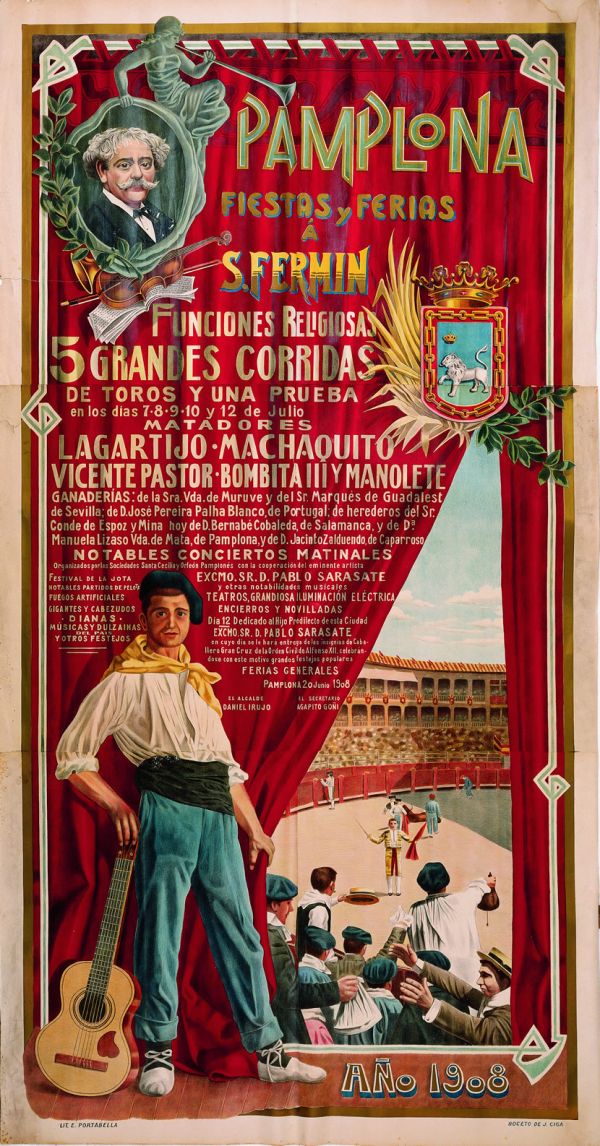
“¡El primer Ciga en carteles de San Fermín!”: Ollaquindía marks 1908 as the first San Fermín poster by Javier Ciga, the Pamplona painter. A young man with a guitar, a jota singer announcing the jota festival of July 11, raises a theatre curtain, and above the scene is a portrait of Pablo Sarasate.10, 11
1908 was an important San Fermín for Sarasate: for the first time a day of the fiesta, July 12, was officially dedicated to him, and at a concert that day he received the Grand Cross of the Civil Order of Alfonso XII. The day began, the programme said, with the “encierro del ganado en igual forma que en los días anteriores”.10
The poster names the ranches whose bulls came: the widow of Muruve and the Marqués de Guadalest of Seville, José Pereira Palha Blanco of Portugal, the heirs of the Conde de Espoz y Mina, now Bernabé Cobaleda of Salamanca, Manuela Lizaso, widow of Mata, of Pamplona, and Jacinto Zalduendo of Caparroso.11
Visitors
On the day of the lottery, 842 travellers arrived in Pamplona by train, coach and car.5
Words of 1908
The paper joked that the herdsmen took the bulls “de sus hoteles del gas y del Sario”, from their hotels at the gas works and the Sario. It used encierro for the run, corralillo for the small corral at the Rochapea gate, bichos for the bulls, and sorteo for the lottery that chose Sunday’s herd.1, 6, 5
Photographs
The city’s photo archive, the Fototeca de Pamplona, holds historic photographs of the encierro, free to view online.12
The known run days of San Fermín 1908 were Tuesday, July 7, to Friday, July 10, and Sunday, July 12, 1908, each at six in the morning; there was no encierro on Saturday, July 11.2, 3, 6, 9, 7
San Fermín 1908 had no encierro on Saturday, July 11, and the Diario de Navarra noted that the churro stands were busier that morning because there was no encierro. The fiesta resumed on Sunday, July 12, with a last run on the day dedicated to Pablo Sarasate.7
The last herd of San Fermín 1908 was chosen by lottery: two ranches, Zalduendo and Lizaso, had bulls for Sunday, July 12, and on July 9, 1908 lots were drawn to decide which would run in the encierro. Lizaso won.5
July 12, 1908 was the first day of San Fermín officially dedicated to the violinist Pablo Sarasate, and at a concert that day he received the Grand Cross of the Civil Order of Alfonso XII. The day began with the encierro, as on the days before.10
Javier Ciga, the Pamplona painter, made the San Fermín 1908 poster, marked “Boceto de J. Ciga”; Ollaquindía calls it the first Ciga poster of San Fermín. It shows a young man with a guitar raising a curtain, under a portrait of Pablo Sarasate.11, 10
Numbers on the page refer to this list. Diario de Navarra pages are cited from its archive (hemeroteca); quotations in Spanish are given as printed, in the spelling of the day.
Encierro. “Running of the Bulls 1908: San Fermín in Pamplona.” Encierro.com, November 9, 2026. https://encierro.com/san-fermin-1908/