
San Fermín 2027: July 6 to 14. Tours filling fast. Book your spot  | 
ToursRunning with Bulls About Fiesta About UsShop Book Now
The Encierro archive · 1910

Running of the Bulls 1910: San Fermín in Pamplona

San Fermín 1910 was programmed to open at noon on July 6 with church bells and rockets, and its first bull run (encierro) started at six in the morning. On the first morning, July 7, more than a hundred young men fell in layers across the ring gate in front of the bulls. The City of Pamplona counts Francisco García Gurrea, 21, of Falces, injured that day at the gates of the old bullring, as the first person to die in the history of the encierro.6, 2, 3, 7

By Encierro · Last reviewed

3known run days: July 7, 9 and 10
6:00start of the first run, a.m.
100+runners piled at the ring gate, July 7

How the fiesta ran in 1910

The 1910 programme, as Ollaquindía prints it, opened the fiesta on July 6 at twelve noon “con un repique general de campanas”, a general peal of bells, with rockets, chupinazos, fired in different parts of the city, then the vísperas and the entry of the giant Gargantúa.6

The known run days were Thursday, July 7, Saturday, July 9, and Sunday, July 10. The first started at six at the bang of a rocket fired at the Portal de Rochapea, from the small corral there; the other two followed the dawn dianas.2, 3, 4, 5

Before the fiesta the Palha and Villagodio bulls were unloaded at the corrals of the old gas works. The paper could give no details: for once it had not been invited, as it usually was. “No podemos dar al público detalles de los toros”.1

Every known encierro of 1910, by day and ranch

The known encierros of San Fermín 1910, from the Diario de Navarra programmes and reports.
DateRunRanch (ganadería)What the paper reported
July 7Known run 1Marqués de VillagodioPile-up of more than a hundred at the ring gate
July 9Known run 2MuruveThe same animation as the days before
July 10Known run 3, lastMarqués de GuadalestThe mayor clears people from danger

The 1910 encierros, day by day

Known run 1

· Marqués de Villagodio

Start6:00 a.m.
TreatedSeveral, all walking

The programme: “Al estampido del cohete que á las seis se dispare en el portal de Rochapea saldrán del corralillo los seis villagodios”.2 Villagers had walked in all night and come in by every gate except the Rochapea gate, where the bulls were. Seconds after the rocket the bulls reached the gate of the ring, where “hay tendidos en el suelo más de cien muchachos, superpuestos y formando una doble ó triple fila”: more than a hundred young men lay on the ground in two or three layers, blocking it completely. Trapped between the walls of the gateway and that wall of bodies, the bulls hooked, charged and jumped, and thousands in the ring stood up fearing many dead. Those who could got up and reached the barrier, opening a gap on the left of the gate; others who turned back into the street found a fence closed across Estafeta behind the bulls. The herdsmen, above all one very tall, thin one who was applauded, got the bulls into the pens. The city’s doctors treated the injured in the ring infirmary, all of whom walked there: bruises, a trodden ear, a hoof graze, people trampled.3
Known run 2

· Muruve

StartAfter the dianas

The programme announced the encierro of the Muruve bulls.3 It took place after the dianas, the paper reported, with the same animation as the days before.4

Known run 3, the last

· Marqués de Guadalest

Bulls6

After the dianas, the encierro of the six bulls of the Marqués de Guadalest. The mayor, Viñas, with inspectors and police at his disposal, “tomó á su cargo el trabajo de alejar á la gente de donde peligraba”: he took on himself the job of moving people away from where they were in danger.5

In memory of Francisco García Gurrea

July 7, 1910

Francisco García Gurrea, 21, of Falces

The City of Pamplona counts him as the first documented death in the history of the encierro, one of the sixteen on its list: injured on July 7, 1910 at the gates of the old bullring, he died on January 21, 1911. His name is on the city’s monument to the encierro and on a paving stone where he was caught.7, 8

That morning

The gate of the old ring

The Diario de Navarra of July 9, 1910 describes the morning of July 7 at that same gate: more than a hundred young men piled in front of the bulls, the bulls hooking and jumping among them, and thousands in the stands fearing the worst.3

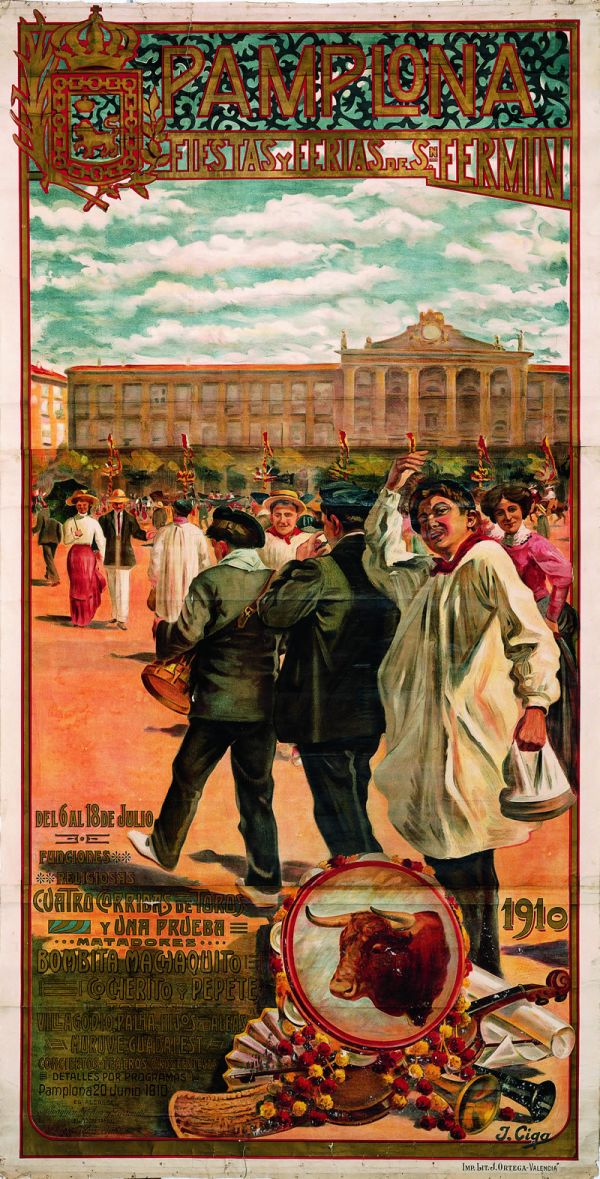
San Fermín 1910 poster (cartel)

San Fermín 1910 poster (cartel) by J. Ciga: a man in a white smock raises his arm before a crowd in the Plaza de la Constitución, with the Teatro Gayarre behind and a bull’s head in a round frame below
Cartel de San Fermín 1910. Poster of the fiestas of San Fermín 1910, by J. Ciga. Tap the poster to see it full size. See every San Fermín poster.6
San Fermín 1910 poster (cartel) by J. Ciga: a man in a white smock raises his arm before a crowd in the Plaza de la Constitución, with the Teatro Gayarre behind and a bull’s head in a round frame below
Artist
J. Ciga (Ollaquindía)
Printed by
Imp. Lit. J. Ortega, Valencia (cover)

Ollaquindía describes the 1910 cover, drawn by J. Ciga: a view of the Plaza de la Constitución, today’s Plaza del Castillo, with the Teatro Gayarre behind, and in front an old man in a white smock raising his right arm, as if greeting the viewer or inviting everyone to the fiesta; below, a medallion with a bull’s head over musical instruments, among them a violin. The cover was printed in Valencia and the inside pages in Pamplona.6

Pamplona in 1910

How the fiesta began

Bells and chupinazos at noon

In 1910 the programme had the start of the fiesta at noon on July 6 announced by bells and by rockets fired around the city, the chupinazos; the programme then gave the vísperas at 4:30 and the entry of the giant Gargantúa at 5:30.6

Words of 1910

Villagodios and the corralillo

The paper named herds by their ranch, los seis villagodios, and the start by its corral, el corralillo at the portal de Rochapea. Dianas were the dawn music before the run.2, 5

Photographs

Where to see old photographs

The city’s photo archive, the Fototeca de Pamplona, holds historic photographs of the encierro, free to view online.9

San Fermín 1910: questions and answers

Who was the first person to die in the running of the bulls?

Francisco García Gurrea, 21, of Falces, is the first death the City of Pamplona counts in the history of the encierro. He was injured on July 7, 1910 at the gates of the old bullring in Pamplona and died on January 21, 1911.7

How many people have died in the running of the bulls in Pamplona?

The City of Pamplona counts sixteen people who have died in the encierro, starting with Francisco García Gurrea, injured on July 7, 1910. In 2025 the city added all sixteen names to its monument to the encierro.7, 8

Is there a memorial to the people who died in the running of the bulls?

Pamplona’s monument to the encierro carries the names of the sixteen people the City of Pamplona counts as dead in the running of the bulls, added in 2025. Francisco García Gurrea, the first, injured in 1910, also has a paving stone where he was caught.7, 8

What happened at the gate of the bullring on July 7, 1910?

More than a hundred young men fell in two or three layers across the gate of Pamplona’s old bullring just as the Villagodio bulls arrived. The bulls hooked and jumped among them until runners opened a gap and the herdsmen got the bulls into the pens.3

When were the bull runs of San Fermín 1910?

The known run days of San Fermín 1910 were Thursday, July 7, Saturday, July 9, and Sunday, July 10, with bulls of the Marqués de Villagodio, Muruve and the Marqués de Guadalest. The first started at six in the morning; the others followed the dawn dianas.2, 3, 4, 5

How did San Fermín 1910 begin?

San Fermín 1910 began at noon on July 6, 1910, with a general peal of church bells and rockets, the chupinazos, fired in different parts of Pamplona, according to the programme printed by Ollaquindía.6

Who made the San Fermín 1910 poster?

J. Ciga made the San Fermín 1910 poster, according to Ollaquindía. It shows an old man in a white smock raising his arm in the Plaza de la Constitución, today’s Plaza del Castillo, with the Teatro Gayarre behind and a bull’s head in a medallion below.6

Sources

Numbers on the page refer to this list. Diario de Navarra pages are cited from its archive (hemeroteca); quotations in Spanish are given as printed, in the spelling of the day.

Full source list
  1. Diario de Navarra, July 5, 1910, page 3: the Palha and Villagodio bulls unloaded at the old gas works, “No podemos dar al público detalles de los toros”. Diario de Navarra archive
  2. Diario de Navarra, July 6, 1910, page 1: programme for July 7, “Al estampido del cohete que á las seis se dispare en el portal de Rochapea saldrán del corralillo los seis villagodios”. Diario de Navarra archive
  3. Diario de Navarra, July 9, 1910, page 1: the encierro of July 7, the pile-up at the ring gate, “más de cien muchachos, superpuestos”; programme for July 9, the Muruve bulls. Diario de Navarra archive
  4. Diario de Navarra, July 10, 1910, page 1: the Muruve encierro of July 9. Diario de Navarra archive
  5. Diario de Navarra, July 11, 1910, page 1: the last encierro, July 10, the six Guadalest bulls; the mayor clears the course. Diario de Navarra archive
  6. Ricardo Ollaquindía, 100 años de carteles de las fiestas y ferias de San Fermín (1882 to 1981), Pamplona, 1981, chapter “1910”. Free copy in the Biblioteca Navarra Digital (BiNaDi). binadi.navarra.es
  7. Ayuntamiento de Pamplona, “Pamplona recordará a los 16 fallecidos en la historia del encierro con adoquines”, December 27, 2023. pamplona.es
  8. Ayuntamiento de Pamplona, “El monumento al encierro acoge los nombres de las dieciséis personas fallecidas”, June 26, 2025. pamplona.es
  9. Fototeca de Pamplona, Archivo Municipal de Pamplona (photographs of the encierro, free to view online; publication needs the archive’s permission). archivo.pamplona.es
How to cite this page

Encierro. “Running of the Bulls 1910: San Fermín in Pamplona.” Encierro.com, November 9, 2026. https://encierro.com/san-fermin-1910/

Corrections and updates
  • : questions and answers rewritten around what people search, each answer with its sources; the poster labelled with its Spanish name, cartel.
  • : page published.

Walk the route with people who run it

Book your walk