
San Fermín 2027: July 6 to 14. Tours filling fast. Book your spot  | 
ToursRunning with Bulls About Fiesta About UsShop Book Now
The Encierro archive · 1913

Running of the Bulls 1913: San Fermín in Pamplona

San Fermín 1913 had six bull runs (encierros) between Monday, July 7, and Sunday, July 13, at six in the morning, with no run on Saturday, July 12. On the first morning the herd reached the ring two minutes after leaving the corral, and one bull turned back from Santo Domingo; on the last, two bulls were left behind in the alleys of the pens.2, 4, 11, 12

By Encierro · Last reviewed

6runs, July 7 to 13
0runs on July 12
2 minfirst run, corral to ring

How the fiesta ran in 1913

The programme set dianas at five and the encierro at six, and reminded readers: “La entrada al encierro es gratuita. Solo el asiento de palco se paga”. Entry to the encierro was free; only box seats in the ring were paid, at 55 céntimos.2

There were runs on July 7, 8, 9, 10 and 11, then none on Saturday, July 12: “¡No hubo encierro! No importa.” The last, with the Duque de Tovar’s bulls, came on Sunday, July 13.4, 5, 8, 9, 10, 11, 12 Three days later the paper wrote “Ya pasó el torbellino de las fiestas”: the whirlwind of the fiestas had passed.13

The Miura bulls got special care when they were unloaded at the corrals of the gas works: four steers instead of two, and the bulls “sacados de las cajas al revés, esto es, reculando”, taken out of their crates backwards.1

Every known encierro of 1913, by day and ranch

The encierros of San Fermín 1913, from the Diario de Navarra programmes and reports.
DateRunRanch (ganadería)What the paper reported
July 71Sons of Vicente MartínezTwo minutes to the ring; one bull turned back
July 82Duque de VeraguaOnly pickpockets worth noting
July 93Alaiza, of TudelaA man knocked down by a steer in the ring
July 104MiuraNo incident or accident
July 115Nothing worth noting
July 12noneNo encierro
July 136, lastDuque de TovarTwo bulls left in the alleys of the pens

The 1913 encierros, day by day

Run 1 of 6

· Sons of Vicente Martínez

Start6:00 a.m.
To the ring2 minutes

The bulls of the sons of Vicente Martínez, of Colmenar Viejo,3 were let out of the small corral at the Rochapea gate at six, and two minutes later entered the ring preceded by an avalanche of people. But one was missing, to the crowd’s delight, since it meant another encierro: “uno de los bravos se volvió desde Santo Domingo”, one of the bulls had turned back from Santo Domingo. It came into the ring later with the steers.4
Run 2 of 6

· Duque de Veragua

Start6:00 a.m.
NotablePickpockets

“A las seis se verificó el encierro de los toros de Veragua”. A man taken to the infirmary with two companions turned out to be part of a team of pickpockets: one companion was detained there too, and the other slipped away into the crowd. “Esto es lo único digno de mención que ocurrió en el encierro”, the paper wrote.5 The photographer Roldán took snapshots of the encierro from the platform over the toril, and the mayoral had a herdsman lead the one-horned steer to the callejón gate so it could be photographed.6

Run 3 of 6

· Alaiza, of Tudela

Start6:00 a.m.
CrowdHuge

The Tudela bulls ran at six with the usual ritual8 before a huge crowd.7 As they went into the callejón to the pens, a fan jumped down into the ring without noticing a steer coming behind him, and the steer knocked him down.8

Run 4 of 6

· Miura

Start6:00 a.m.
IncidentsNone

The Miura encierro at six passed with no incident or accident; “bien fuera por escarmiento ó por respeto á los miureños”, whether from lessons learned or out of respect for the Miuras, the paper wrote, nothing of the day before was repeated.8, 9

Run 5 of 6

· The fifth encierro

IncidentsNone

“Durante las dianas y el encierro ... no hubo nada que mereciera el honor de ser apuntado”: nothing in the dianas or the encierro deserved the honour of a mention.10

Run 6 of 6, the last

· Duque de Tovar

Start6:00 a.m.
Bulls left behind2

After the Saturday with no encierro, the programme announced the six bulls of the Duque de Tovar at six.11 The run had a half-dramatic ending: when everyone thought the bulls were penned, one appeared in the ring, and when the steers were let out of the other pen another bull came out instead. “quedó un toro en cada calleja entre la trampa y la puerta”: one bull had stayed in each alley between the trap door and the gate.12

The Miura bulls of July 10, 1913

Four of the six Miura bulls, in the order the paper reported them leaving their crates before the fiesta, with their numbers and coats.1

No.NameCoat (as printed)Coat in English
44Cañameronegro bragadoblack, with white on the belly
71Salinerocolorado ojo de perdizred, with brighter red rings round the eyes
63Molineroberrendo en negroblack and white pied
89Vendedornegro meanoblack, with a white sheath

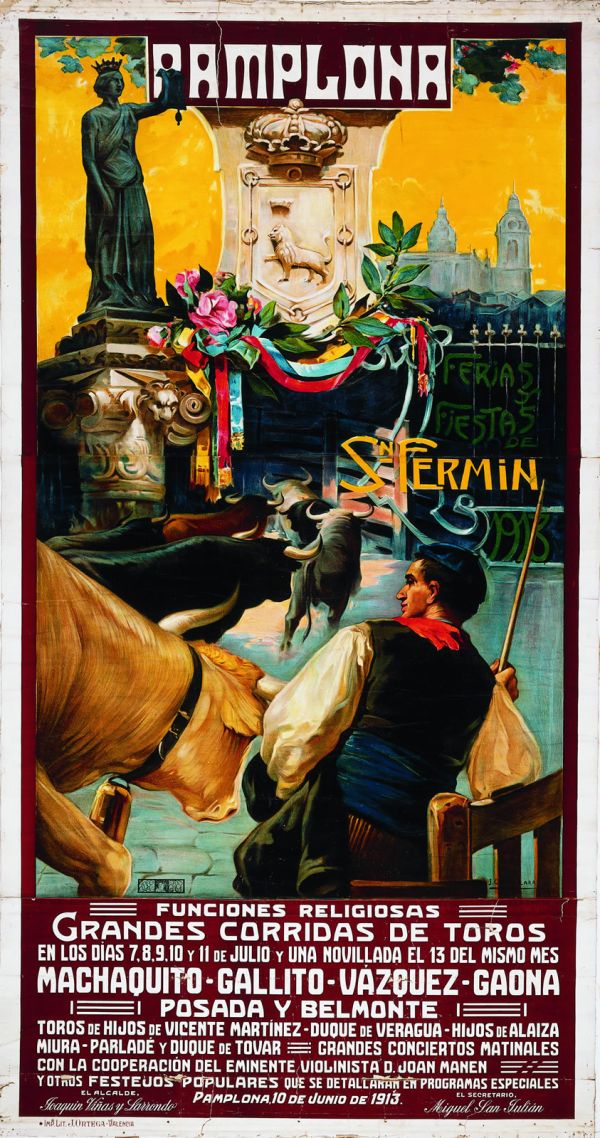
San Fermín 1913 poster (cartel)

San Fermín 1913 poster (cartel): a herdsman in a red neckerchief sits on the fence with his staff, watching bulls and a large belled steer go by below a statue and the arms of Pamplona
Cartel de San Fermín 1913. Poster of the Ferias y Fiestas de San Fermín 1913. Tap the poster to see it full size. See every San Fermín poster.15, 14
San Fermín 1913 poster (cartel): a herdsman in a red neckerchief sits on the fence with his staff, watching bulls and a large belled steer go by below a statue and the arms of Pamplona
Dated
Pamplona, June 10, 1913
Signed by
Joaquín Viñas y Larrondo, mayor; Miguel San Julián, secretary
Printed by
Imp. Lit. J. Ortega, Valencia

Ollaquindía: in the 1913 poster “aparece un pastor, con la vara en la mano, viendo tranquilamente cómo pasa la torada, entre la valla y un enorme cabestro”, a herdsman, staff in hand, calmly watching the herd go by between the fence and an enormous steer.14

He uses the poster to write about the herdsmen and their chief, the mayoral, quoting the historian Luis del Campo: it is the mayoral who directs the move of the bulls in the encierrillo, and takes the most dangerous post. By custom mayorales were known by their first names, Agustín in earlier years, Teodoro in 1968; only Moncayola was known by his surname.14

The poster names the ranches whose bulls came that year: the sons of Vicente Martínez, the Duque de Veragua, the sons of Alaiza, Miura, Parladé and the Duque de Tovar, and announces concerts with the violinist Joan Manén.15

Pamplona in 1913

Photographs

A photographer on the toril

On July 8, 1913 the photographer Roldán worked from the platform over the toril, taking snapshots of the encierro. The city’s photo archive, the Fototeca de Pamplona, holds historic photographs of the encierro, free to view online.6, 16

Words of 1913

Bravos and miureños

The paper called the bulls los bravos as against the steers, los mansos, and the Miuras los miureños. A bull that turned back was one that “se volvió”; the calleja was the alley into the pens.4, 8, 9, 12

San Fermín 1913: questions and answers

When were the bull runs of San Fermín 1913?

San Fermín 1913 had six bull runs at six in the morning: Monday, July 7, to Friday, July 11, and Sunday, July 13, 1913. There was no encierro on Saturday, July 12.4, 5, 8, 9, 10, 11, 12

How fast was the first encierro of 1913?

The bulls of the first encierro of 1913 entered the ring two minutes after leaving the small corral at the Rochapea gate on July 7, the Diario de Navarra reported, though one bull turned back from Santo Domingo and came in later, which meant another encierro.4

Was the running of the bulls free to watch in 1913?

Entry to the encierro was free in 1913, the programme said: only box seats in the ring were paid, at 55 céntimos.2

How were the Miura bulls unloaded in 1913?

The Miura bulls got special care when they were unloaded at the corrals of the gas works before San Fermín 1913: four steers instead of two, and the bulls taken out of their crates backwards.1

Which ranches’ bulls ran in 1913?

The bulls of San Fermín 1913 came from the sons of Vicente Martínez on July 7, the Duque de Veragua on July 8, Alaiza of Tudela on July 9, Miura on July 10 and the Duque de Tovar on July 13.3, 5, 8, 9, 11

Sources

Numbers on the page refer to this list. Diario de Navarra pages are cited from its archive (hemeroteca); quotations in Spanish are given as printed, in the spelling of the day.

Full source list
  1. Diario de Navarra, July 5, 1913, page 1: the Miura and Parladé bulls unloaded at the gas works, “fueron sacados de las cajas al revés, esto es, reculando”. Diario de Navarra archive
  2. Diario de Navarra, July 6, 1913, page 2: programme for July 7, “La entrada al encierro es gratuita. Solo el asiento de palco se paga”. Diario de Navarra archive
  3. Diario de Navarra, July 7, 1913, page 2: the bulls of the sons of Vicente Martínez, of Colmenar Viejo, for July 7. Diario de Navarra archive
  4. Diario de Navarra, July 8, 1913, page 2: the encierro of July 7, “uno de los bravos se volvió desde Santo Domingo”; the Veragua bulls for July 8. Diario de Navarra archive
  5. Diario de Navarra, July 9, 1913, page 1: “A las seis se verificó el encierro de los toros de Veragua”. Diario de Navarra archive
  6. Diario de Navarra, July 9, 1913, page 4: the photographer Roldán at the encierro of July 8. Diario de Navarra archive
  7. Diario de Navarra, July 10, 1913, page 1: “En el encierro hubo un gentío enorme”. Diario de Navarra archive
  8. Diario de Navarra, July 10, 1913, page 2: the encierro of the Tudela bulls, July 9; programme for July 10, the Miuras. Diario de Navarra archive
  9. Diario de Navarra, July 11, 1913, page 2: the Miura encierro of July 10, “no se repitió ningún incidente ni accidente”. Diario de Navarra archive
  10. Diario de Navarra, July 12, 1913, page 2: “Durante las dianas y el encierro ... no hubo nada que mereciera el honor de ser apuntado”. Diario de Navarra archive
  11. Diario de Navarra, July 13, 1913, page 2: “¡No hubo encierro! No importa. Hoy presenciaremos el de los del Duque de Tovar”. Diario de Navarra archive
  12. Diario de Navarra, July 14, 1913, page 1: the last encierro, July 13, “quedó un toro en cada calleja entre la trampa y la puerta”. Diario de Navarra archive
  13. Diario de Navarra, July 16, 1913, page 1: “Ya pasó el torbellino de las fiestas”. Diario de Navarra archive
  14. Ricardo Ollaquindía, 100 años de carteles de las fiestas y ferias de San Fermín (1882 to 1981), Pamplona, 1981, chapter “1913”. Free copy in the Biblioteca Navarra Digital (BiNaDi). binadi.navarra.es
  15. The poster of the Ferias y Fiestas de San Fermín 1913 itself, dated Pamplona, June 10, 1913, signed by the mayor Joaquín Viñas y Larrondo and the secretary Miguel San Julián; printed by Imp. Lit. J. Ortega, Valencia.
  16. Fototeca de Pamplona, Archivo Municipal de Pamplona (photographs of the encierro, free to view online; publication needs the archive’s permission). archivo.pamplona.es
How to cite this page

Encierro. “Running of the Bulls 1913: San Fermín in Pamplona.” Encierro.com, November 9, 2026. https://encierro.com/san-fermin-1913/

Corrections and updates
  • : questions and answers rewritten around what people search, each answer with its sources; the poster labelled with its Spanish name, cartel.
  • : page published.

Walk the route with people who run it

Book your walk