San Fermín 2027: July 6 to 14. Tours filling fast. Book your spot  | 
ToursRunning with Bulls About Fiesta About UsShop Book Now
The Encierro archive · 1923

Running of the Bulls 1923: San Fermín in Pamplona

San Fermín 1923 ran from July 6 to 18, and it was the year Ernest Hemingway first came to Pamplona. The bull runs (encierros) were at six in the morning; the known run days were July 7, 8, 9, 10 and 13. Rain upset the fiesta programme, and the last run, on Friday, July 13, with the Villar bulls, was, the paper wrote, “el más interesante de las fiestas”, the most interesting of the fiesta.11, 12, 2, 3, 4, 6, 5, 9, 10

By Encierro · Last reviewed

6:00start, a.m.
3 minVicente Martínez, July 8
8bulls programmed for July 10

How the fiesta ran in 1923

“1923 es importante en la historia de los Sanfermines”, Ollaquindía writes: that year Ernest Hemingway came to Pamplona for the first time, saw the fiestas and wrote about them for the Toronto Star. His writing later brought waves of visitors to the city. His first Sanfermines were, Ollaquindía writes, an unexpected surprise for him: groups of mozos dancing day and night and music everywhere, in Hemingway’s own phrase “endemoniadamente divertidos”, devilishly good fun.12

The programme set the encierro at six, and the second, on July 8, “en la forma que es antigua costumbre”, in the way of ancient custom.2 The known run days were July 7, 8, 9, 10 and 13; the programme for July 13 called it the last encierro.3, 4, 6, 9, 10 On July 10 heavy, constant rain suspended the outdoor events of the fiesta programme.5

The paper also looked back. An essay recalled a document cited by Gaztelu: in the encierro of old, the Abanderado del Santo, the saint’s standard-bearer, rode on horseback “hasta el toril” among the bulls, so mixed in with them that no one could tell whether he rode a bull or a horse. The scenes this caused led the council, in November 1711, to agree that the standard-bearers should no longer go in with the bulls on the morning of the encierro.7

Every known encierro of 1923, by day and ranch

The known encierros of San Fermín 1923, from the Diario de Navarra programmes and reports.
DateRunRanch (ganadería)What the paper reported
July 7Known run 1Félix Moreno (programmed)Like lambs among the oxen
July 8Known run 2Vicente MartínezBarely three minutes
July 9Known run 3VillagodioLike little lambs among the mozos
July 10Known run 4Pérez TaberneroEight bulls programmed; three steers left behind
July 13Known run 5, the lastVillarA boy hooked in Mercaderes

The 1923 encierros, day by day

Known run 1

· Félix Moreno (programmed)

Start6:00 a.m.
Ring full by5:30 a.m.

By 5:30 the ring had been taken by storm and the stands were packed. Nothing happened: “Pasaron los toros, como borregos”, the bulls went by like lambs, wrapped among the oxen, and went straight into the corrals.2, 3 The programme named the bulls of Félix Moreno, formerly Saltillo, for the run.1

Known run 2

· Vicente Martínez

Start6:00 a.m.
TimeBarely 3 minutes

“El encierro de anteayer fué con los toros de D. Vicente Martínez”: the Vicente Martínez bulls ran the course in barely three minutes, driving a big mob ahead. Two of them, a little ahead of the herd, came into the ring literally pushing the boys they had caught up with. Nothing happened. An enormous crowd also watched from the side streets, the small squares and the balconies of the course.2, 4

Known run 3

· Villagodio

Start6:00 a.m.
Ring packed by5:30 a.m.

As on the days before, the ring was packed by half past five. At six on the dot, at the bang of a rocket, the Villagodio bulls left the Rochapea corral, preceded and even surrounded by young men, “como si aquellos fueran sencillos corderillos”, as if they were little lambs. Afterwards the café terraces, the churro stalls and the Taconera filled with people.4

Known run 4

· Pérez Tabernero

Start6:00 a.m.
Bulls programmed8

An unusual run: “se encerrarán los ocho toros de Pérez Tabernero”, all eight bulls unloaded at the Gas corrals, including two being sent back for being too small.4 The bulls ran ahead the whole way, driving the last group of runners before them, and went into the corral without stopping. Some time later “aparecieron jadeantes tres respetables cabestros”: three respectable steers turned up, panting, left behind on the course.6

Known run 5, the last

· Villar

Hurt1 boy, minor horn wound

The programme called it the last encierro.9 The ring was so full it seemed too small. Halfway along, in calle Mercaderes at the corner of Estafeta, a bull running ahead went for a boy as he was trying to reach the fence, hooked him and gave him a puntazo, a minor horn wound. The Villar bulls entered the ring among a big crowd. At the corral gate one bull, a berrendo, turned and stood in the middle of the ring, not knowing whom to charge; it looked at the runners with disdain, butted the barrier once and went into the corrals with no need of the steers.10

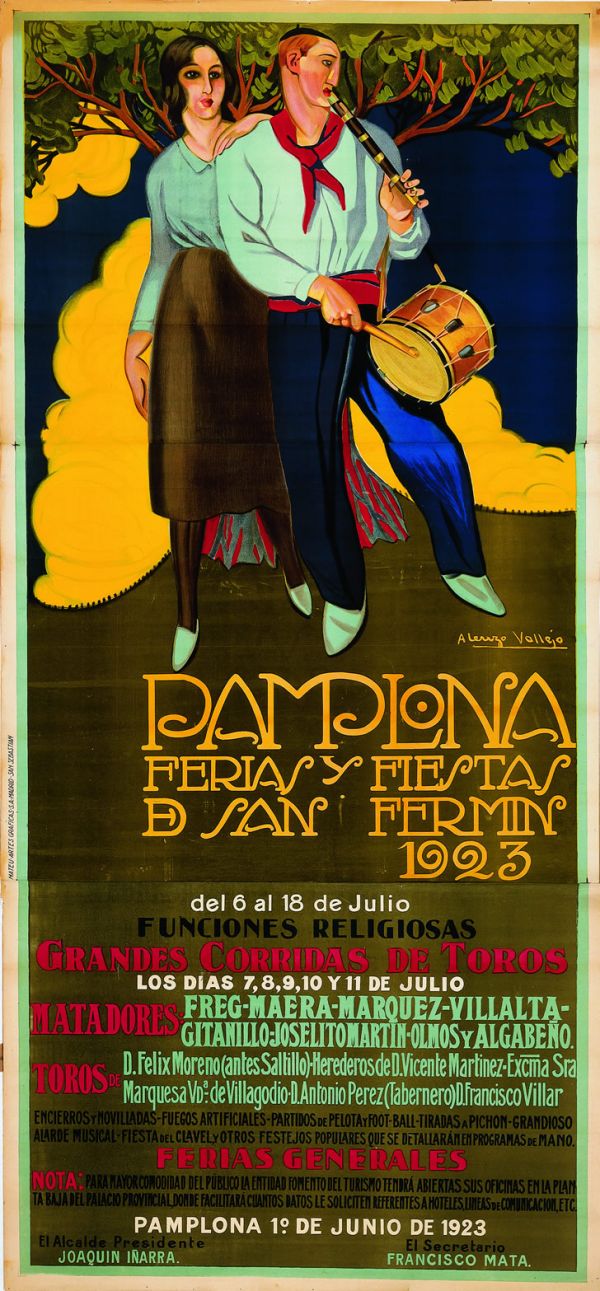
San Fermín 1923 poster (cartel)

San Fermín 1923 poster (cartel) by A. Cerezo Vallejo: a young man in a pale shirt and dark blue trousers with a red neckerchief and red sash plays a pipe and drum under a tree, a young woman in a pale blouse and brown skirt resting her hand on his shoulder, with yellow clouds behind
Cartel de San Fermín 1923. Poster of the Ferias y Fiestas de San Fermín 1923, signed A. Cerezo Vallejo. Tap the poster to see it full size. See every San Fermín poster.11
San Fermín 1923 poster (cartel) by A. Cerezo Vallejo: a young man in a pale shirt and dark blue trousers with a red neckerchief and red sash plays a pipe and drum under a tree, a young woman in a pale blouse and brown skirt resting her hand on his shoulder, with yellow clouds behind
Artist
A. Cerezo Vallejo (signature)
Fiesta on the poster
Del 6 al 18 de julio
Dated
Pamplona, June 1, 1923
Printed by
Mateu Artes Gráficas, Madrid and San Sebastián

A young man in a pale shirt and dark blue trousers, with a red neckerchief and a red sash, plays the pipe and drum under a tree, while a young woman in a pale blouse and long brown skirt leans on his shoulder; behind them, yellow clouds against a dark blue sky. The poster also announces encierros, fireworks, pelota and football, and a “Fiesta del Clavel”, a carnation festival.11

Of the 1923 programme, Ollaquindía says the back cover mattered more than the front: it printed the photograph of José María García Mina falling in calle Mercaderes in front of the herd on July 10, 1922. The picture became famous and, as J. Joaquín Arazuri recalled, inspired a sonnet by the Navarre poet Alberto Pelairea.12

Pamplona in 1923

Words of 1923

La manga

A lost-property notice in the paper asked for the return of a pipe that had fallen “desde la galería a la manga” during the encierro, from the gallery onto the course, and been picked up by a fair-haired man, with a reward for handing it in at the Gran Hotel.8 The bulls ran “como borregos” when calm, and the steers left behind were rezagados.3, 6

Photographs

Where to see old photographs

The city’s photo archive, the Fototeca de Pamplona, holds historic photographs of the encierro, free to view online.13

San Fermín 1923: questions and answers

When did Hemingway first go to Pamplona?

Ernest Hemingway first came to Pamplona for San Fermín 1923, saw the fiestas and wrote about them for the Toronto Star, as Ricardo Ollaquindía records. His writing later brought waves of visitors to the city.12

What did Hemingway think of his first San Fermín?

Ernest Hemingway found his first San Fermín, in 1923, an unexpected surprise, Ollaquindía writes: groups of mozos dancing day and night and music everywhere, in Hemingway’s own phrase “endemoniadamente divertidos”, devilishly good fun.12

When were the bull runs of San Fermín 1923?

The known run days of San Fermín 1923 were Saturday, July 7, to Tuesday, July 10, and Friday, July 13, 1923, the last, each at six in the morning. Heavy rain on July 10 suspended the outdoor events of the fiesta programme.2, 3, 4, 6, 9, 5

Was anyone hurt in the 1923 running of the bulls?

A Villar bull hooked a boy in calle Mercaderes, at the corner of Estafeta, as he tried to reach the fence on July 13, 1923, and gave him a puntazo, a minor horn wound.10

What was on the back of the 1923 programme?

The back of the 1923 San Fermín programme printed the photograph of José María García Mina falling in calle Mercaderes in front of the herd on July 10, 1922. The picture became famous and inspired a sonnet by the Navarre poet Alberto Pelairea.12

Who made the San Fermín 1923 poster?

A. Cerezo Vallejo made the San Fermín 1923 poster, signed on the poster itself: a young pipe-and-drum player with a red neckerchief and sash under a tree, and a young woman leaning on his shoulder.11

Sources

Numbers on the page refer to this list. Diario de Navarra pages are cited from its archive (hemeroteca); quotations in Spanish are given as printed, in the spelling of the day.

Full source list
  1. Diario de Navarra, July 6, 1923, page 3: programme for July 7, the bulls “de D. Félix Moreno (antes Saltillo)” from the little corral at the Rochapea gate. Diario de Navarra archive
  2. Diario de Navarra, July 7, 1923, page 5: programme for July 7, the encierro at six, and for July 8, “se verificará el segundo encierro de los toros en la forma que es antigua costumbre”. Diario de Navarra archive
  3. Diario de Navarra, July 8, 1923, page 5: the first encierro, July 7, “Pasaron los toros, como borregos”. Diario de Navarra archive
  4. Diario de Navarra, July 10, 1923, page 5: “El encierro de anteayer fué con los toros de D. Vicente Martínez”, July 8; the Villagodio encierro of July 9, “como si aquellos fueran sencillos corderillos”; programme for July 10, “se encerrarán los ocho toros de Pérez Tabernero”. Diario de Navarra archive
  5. Diario de Navarra, July 11, 1923, page 4: heavy, constant rain on July 10 that suspended the outdoor events of the fiesta programme in Pamplona. Diario de Navarra archive
  6. Diario de Navarra, July 11, 1923, page 5: the encierro of July 10, “aparecieron jadeantes tres respetables cabestros que se habían quedado rezagados”. Diario de Navarra archive
  7. Diario de Navarra, July 11, 1923, page 5: essay on the history of the encierro, the Abanderado del Santo who rode with the bulls “hasta el toril”, and the council agreement of November 1711. Diario de Navarra archive
  8. Diario de Navarra, July 12, 1923, page 6: lost property, a pipe that fell “desde la galería a la manga” in the encierro. Diario de Navarra archive
  9. Diario de Navarra, July 13, 1923, page 5: programme for July 13, the “último encierro del ganado”. Diario de Navarra archive
  10. Diario de Navarra, July 14, 1923, page 5: “El encierro de ayer fué el más interesante de las fiestas”, July 13. Diario de Navarra archive
  11. The poster of the Ferias y Fiestas de San Fermín 1923 itself, “del 6 al 18 de Julio”, dated Pamplona, June 1, 1923; signed A. Cerezo Vallejo; printed by Mateu Artes Gráficas, Madrid and San Sebastián.
  12. Ricardo Ollaquindía, 100 años de carteles de las fiestas y ferias de San Fermín (1882 to 1981), Pamplona, 1981, chapter “1923”. Free copy in the Biblioteca Navarra Digital (BiNaDi). binadi.navarra.es
  13. Fototeca de Pamplona, Archivo Municipal de Pamplona (photographs of the encierro, free to view online; publication needs the archive’s permission). archivo.pamplona.es
How to cite this page

Encierro. “Running of the Bulls 1923: San Fermín in Pamplona.” Encierro.com, November 9, 2026. https://encierro.com/san-fermin-1923/

Corrections and updates
  • : questions and answers rewritten around what people search, each answer with its sources; the poster labelled with its Spanish name, cartel.
  • : page published.

Walk the route with people who run it

Book your walk