
San Fermín 2027: July 6 to 14. Tours filling fast. Book your spot  | 
ToursRunning with Bulls About Fiesta About UsShop Book Now
The Encierro archive · 1926

Running of the Bulls 1926: San Fermín in Pamplona

San Fermín 1926 had five bull runs (encierros), every morning at seven from Wednesday, July 7, to Sunday, July 11. On July 8 the heavy Pablo Romero bulls “corrieron como gamos”, ran like deer; on July 10 several runners fell at the ring gate in front of the Conde de la Corte bulls and escaped by a miracle.2, 4, 5, 6, 7, 8, 9, 10

By Encierro · Last reviewed

5runs, July 7 to 11
7:00start, a.m.
7:30show over, July 7

How the fiesta ran in 1926

The poster announced the Ferias y Fiestas “del 6 al 18 de Julio”.12 The programmes set the encierros at seven, from July 7 to Sunday, July 11, which the paper called the last day of the fiestas: “cinco días de encierros”, five days of encierros.2, 5, 6, 7, 9, 10

The mayor ordered that anyone who held down by force the young bulls with padded horns let into the ring after the encierros would be severely punished.1 On San Fermín’s day the paper printed a poem by Baldomero Barón in the voice of an old runner promising to run “por la vez postrera”, one last time, “el recorrido de esa gran carrera”.3

The paper joked afterwards that those whom five days of encierros, songs and feasts had not killed were found dead and buried by Sunday midnight.10

Every known encierro of 1926, by day and ranch

The encierros of San Fermín 1926, from the Diario de Navarra programmes and reports.
DateRunRanch (ganadería)What the paper reported
July 71ClairacBoys fell at the ring gate; over by 7:30
July 82Pablo RomeroRan like deer; a bull stayed in the ring
July 93Cándido DíazStraight to the corral
July 104Conde de la CorteRunners fell at the ring gate
July 115, lastVillarThe last encierro, on a Sunday

The 1926 encierros, day by day

Run 1 of 5

· Clairac

Start7:00 a.m.
Over by7:30 a.m.

The programme set the first encierro for seven sharp, at the bang of a rocket.2 At the ring gate a good number of boys fell right and left. By half past seven the morning show was over, and the thousands who come to the encierro, “el espectáculo más castizo”, the most traditional show of the fiesta, poured back into the streets.4 The bulls were those of Clairac, formerly Gamero Cívico.13
Run 2 of 5

· Pablo Romero

Start7:00 a.m.

“A las siete encierro de los toros”, the programme said.5 The Pablo Romero bulls, “a pesar de su peso corrieron como gamos”: despite their weight they ran like deer, driving a big crowd ahead. They entered the ring well wrapped by the steers, but at the very mouth of the corral gate a black bull veered right and planted itself in the middle of the ring, not knowing whom to go for among all the people waving their smocks at it, until it set off after two of them.6 An amateur photographer, Sr. Lesaga, caught the bulls stopped for a moment at the fence in calle Mercaderes, spreading panic among the spectators.6

Run 3 of 5

· Cándido Díaz

Start7:00 a.m.
Ring packed by6:30 a.m.

The ring was packed by half past six. At seven sharp, at the double rocket, the Cándido Díaz bulls left the Rochapea corral, preceded and even surrounded by people as if they were peaceful lambs, entered the ring and “marcharon rectos al corral, sin que se registrara el menor incidente”, went straight to the corral without the slightest incident.6, 7

Run 4 of 5

· Conde de la Corte

Start7:00 a.m.

The programme set the encierro “A las siete en punto”.7 In the run of the Conde de la Corte bulls, “varios mozos de los que corrieron ayer delante del ganado, tuvieron la mala fortuna de caerse al entrar en la plaza”: several young men running ahead fell as they entered the ring and escaped a serious accident by a miracle, as a photograph in the next day’s paper showed.8

Run 5 of 5, the last

· Villar

Start7:00 a.m.
DaySunday

“A las siete en punto tendrá lugar el encierro”, the programme said.9 “El último encierro”: Sunday dawned noisier than any other day. “La circunstancia de ser domingo, unida a ser último día de las fiestas”, being Sunday and the last day of the fiestas, kept the night owls out in force until dawn, when the pipes, bands and cavalry trumpets came out with the dianas.10 Eight bulls of Villar were on the bill that day.13

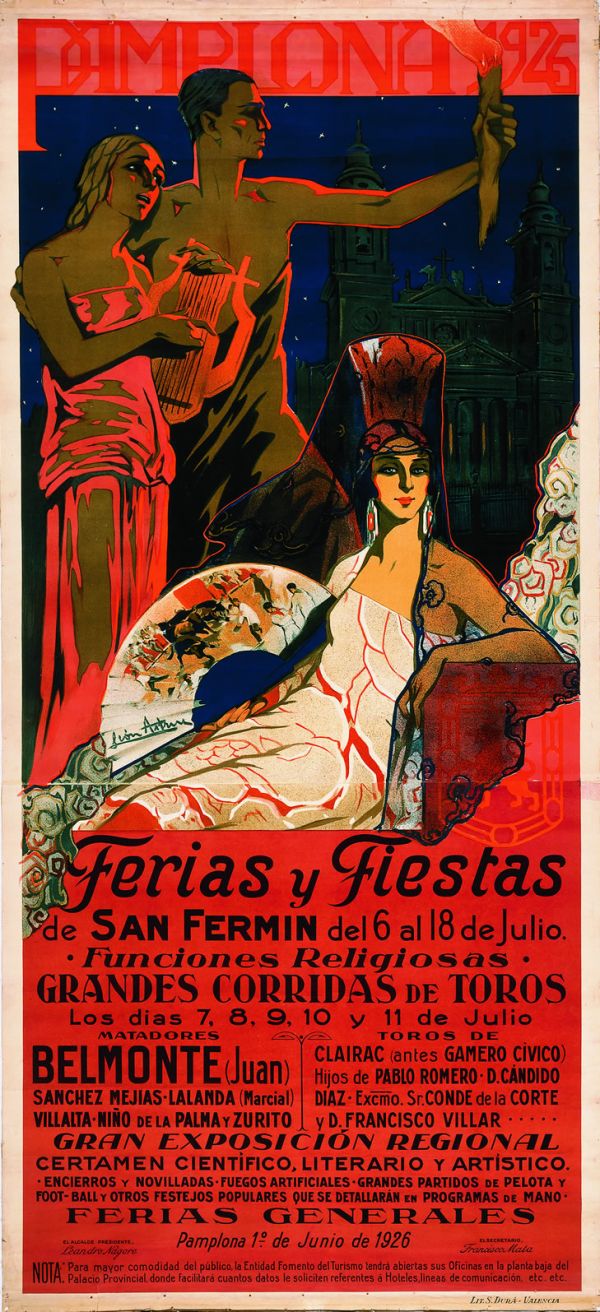
San Fermín 1926 poster (cartel)

San Fermín 1926 poster (cartel) by León Astruc: a dark-haired woman in a white dress, a tall red comb and black lace mantilla reclines with an open fan, while behind her a young man raises a torch and a young woman holds a lyre against a night sky with church towers
Cartel de San Fermín 1926. Poster of the Ferias y Fiestas de San Fermín 1926, signed León Astruc. Tap the poster to see it full size. See every San Fermín poster.12
San Fermín 1926 poster (cartel) by León Astruc: a dark-haired woman in a white dress, a tall red comb and black lace mantilla reclines with an open fan, while behind her a young man raises a torch and a young woman holds a lyre against a night sky with church towers
Artist
León Astruc (signature)
Fiesta on the poster
Del 6 al 18 de julio
Dated
Pamplona, June 1, 1926
Printed by
Lit. S. Durá, Valencia

A dark-haired woman in a white dress, with a tall red comb and a black lace mantilla, reclines with an open fan; behind her, against a night sky and church towers, a young man raises a torch and a young woman holds a lyre. The poster also announces a great regional exhibition and a scientific, literary and artistic competition.12

Ollaquindía says the 1926 programme played on contrast: on the front, solemn, hieratic figures with lyres and torches; on the back, a couple dancing the jota in the Plaza de la Constitución at the dance called “el Barato”. On its first page the Junta of the Casa de Misericordia now appeared beside the city council as organiser of the fiestas; the year before it had appeared on page 9.13

Pamplona in 1926

Another name

Mercaderes

Calle Mercaderes, where the bulls turn towards Estafeta, was also being called by another name: a notice that July gave an address in “calle de Doña Blanca de Navarra (antes Mercaderes)”, though the paper itself still wrote Mercaderes.11, 6

Words of 1926

Como gamos

Heavy bulls that ran fast went “como gamos”, like deer. The encierro was “el espectáculo más castizo”, and the start came “al estampido de un chupinazo”, at the bang of a rocket.6, 4, 2

Photographs

Where to see old photographs

The Diario de Navarra printed photographs of the 1926 encierros, among them the fall at the ring gate on July 10. The city’s photo archive, the Fototeca de Pamplona, holds historic photographs of the encierro, free to view online.8, 14

San Fermín 1926: questions and answers

What time was the running of the bulls in 1926?

The running of the bulls of San Fermín 1926 was at seven in the morning: the Diario de Navarra programmes of 1926 set every encierro at seven sharp.2, 5, 9

When were the bull runs of San Fermín 1926?

San Fermín 1926 had a bull run every morning at seven from Wednesday, July 7, to Sunday, July 11, 1926: five runs, with bulls of Clairac, Pablo Romero, Cándido Díaz, the Conde de la Corte and Villar.2, 6, 7, 9, 10, 13, 8

How fast did the Pablo Romero bulls run in 1926?

The heavy Pablo Romero bulls “corrieron como gamos”, ran like deer, despite their weight on July 8, 1926, driving a big crowd ahead of them, the Diario de Navarra reported.6

Was anyone hurt in the 1926 running of the bulls?

Runners fell in the 1926 running of the bulls: on July 10 several runners fell as they entered the ring ahead of the Conde de la Corte bulls and escaped a serious accident by a miracle, as a photograph in the next day’s paper showed.8

Who made the San Fermín 1926 poster?

León Astruc made the San Fermín 1926 poster, signed on the poster itself: a woman in a white dress, a tall red comb and a black lace mantilla, with a young man raising a torch and a young woman with a lyre behind her.12

Sources

Numbers on the page refer to this list. Diario de Navarra pages are cited from its archive (hemeroteca); quotations in Spanish are given as printed, in the spelling of the day.

Full source list
  1. Diario de Navarra, July 7, 1926, page 1: the mayor’s order to punish severely anyone who “sujetase por la fuerza a los novillos embolados” let into the ring after the encierros. Diario de Navarra archive
  2. Diario de Navarra, July 7, 1926, page 2: programme for July 7, the encierro at seven sharp, “al estampido de un chupinazo”. Diario de Navarra archive
  3. Diario de Navarra, July 7, 1926, page 3: poem by Baldomero Barón, “en estos encierros, por la vez postrera, haré el recorrido de esa gran carrera”; photograph of the Clairac bulls. Diario de Navarra archive
  4. Diario de Navarra, July 8, 1926, page 1: the first encierro, July 7, boys falling right and left at the ring gate; over by half past seven, “el espectáculo más castizo”. Diario de Navarra archive
  5. Diario de Navarra, July 8, 1926, page 3: programme for July 8, “A las siete encierro de los toros”. Diario de Navarra archive
  6. Diario de Navarra, July 9, 1926, page 1: the Pablo Romero encierro of July 8, “a pesar de su peso corrieron como gamos”; photograph by Sr. Lesaga of the bulls stopped at the fence in calle Mercaderes; programme for July 9, the encierro at seven. Diario de Navarra archive
  7. Diario de Navarra, July 10, 1926, page 1: the Cándido Díaz encierro of July 9, “marcharon rectos al corral, sin que se registrara el menor incidente”; programme for July 10, “A las siete en punto”. Diario de Navarra archive
  8. Diario de Navarra, July 11, 1926, page 3: photograph of the Conde de la Corte encierro of July 10, “varios mozos de los que corrieron ayer delante del ganado, tuvieron la mala fortuna de caerse al entrar en la plaza”. Diario de Navarra archive
  9. Diario de Navarra, July 11, 1926, page 2: programme for July 11, “A las siete en punto tendrá lugar el encierro”. Diario de Navarra archive
  10. Diario de Navarra, July 13, 1926, page 2: “El último encierro”, July 11, “La circunstancia de ser domingo, unida a ser último día de las fiestas”; “cinco días de encierros”. Diario de Navarra archive
  11. Diario de Navarra, July 13, 1926, page 7: notice giving the address “calle de Doña Blanca de Navarra (antes Mercaderes)”. Diario de Navarra archive
  12. The poster of the Ferias y Fiestas de San Fermín 1926 itself, “del 6 al 18 de Julio”, dated Pamplona, June 1, 1926; signed León Astruc; printed by Lit. S. Durá, Valencia.
  13. Ricardo Ollaquindía, 100 años de carteles de las fiestas y ferias de San Fermín (1882 to 1981), Pamplona, 1981, chapter “1926”. Free copy in the Biblioteca Navarra Digital (BiNaDi). binadi.navarra.es
  14. Fototeca de Pamplona, Archivo Municipal de Pamplona (photographs of the encierro, free to view online; publication needs the archive’s permission). archivo.pamplona.es
How to cite this page

Encierro. “Running of the Bulls 1926: San Fermín in Pamplona.” Encierro.com, November 9, 2026. https://encierro.com/san-fermin-1926/

Corrections and updates
  • : questions and answers rewritten around what people search, each answer with its sources; the poster labelled with its Spanish name, cartel.
  • : page published.

Walk the route with people who run it

Book your walk