San Fermín 2027: July 6 to 14. Tours filling fast. Book your spot  | 
ToursRunning with Bulls About Fiesta About UsShop Book Now
The Encierro archive · 1942

Running of the Bulls 1942: San Fermín in Pamplona

In 1942 the encierro began by the clock of San Cernin: “con la primera campanada del reloj de San Cernin, sonaron los dos chupinazos”, at the first stroke of seven the two rockets went off. The runs were at seven every morning from July 7 to 10 and on Sunday, July 12, the last, when Estafeta was “negra de gente”, black with people.1, 2, 3, 4, 6, 7, 9, 10

By Encierro · Last reviewed

5run days, July 7 to 10 and 12
7:00start, by the San Cernin clock
Under 3 minCarmen de Federico, July 7

How the fiesta ran in 1942

The mayor’s bando made the timing official: “la hora oficial es la marcada por el reloj de la Parroquia de San Saturnino”, the official time was the clock of the parish of San Saturnino, San Cernin. Residents and porters along the course had to shut every door by half past six, with no outsiders inside, and the Rochapea gate was closed to traffic on the nights of July 6, 7, 8, 9 and 11, the eves of the run days.1

The programme set dianas until July 10 and on July 12, and the encierro at seven sharp. The Casa de Misericordia brought in measures to protect children and women from the crushes in the stands at encierro time.2

By the ring entrance, spectators packed the balustrade on both sides of the deep trench through which runners and herd pour into the arena, by a cement cornice that people had started calling “el monumento al encierro”, the monument to the encierro.3

Every known encierro of 1942, by day and ranch

The encierros of San Fermín 1942, from the Diario de Navarra programmes and reports.
DateRunRanch (ganadería)What the paper reported
July 71Carmen de FedericoUnder three minutes, loose
July 82Concha y SierraNo incidents, bulls bunched with the steers
July 93Moreno ArdanuyOne bull ran the whole course alone
July 104José EscobarOne bull apart, penned by Moncayola
July 125, lastBuendíaEstafeta black with people

The 1942 encierros, day by day

Run 1 of 5

· Carmen de Federico

Start7:00 a.m.
TimeUnder 3 minutes

People took their places in the half-light, and by seven the ring was full. “A las siete en punto, con la primera campanada del reloj de San Cernin, sonaron los dos chupinazos”, and the six bulls of doña Carmen de Federico, of Murube blood, were let out of the little corral at Rochapea; they ran the course in under three minutes, completely loose.5, 3

Run 2 of 5

· Concha y Sierra

Start7:00 a.m.
IncidentsNone

The programme set the encierro at seven sharp.2 The Concha y Sierra bulls ran it, and the run “se efectuó sin incidentes”: the bulls kept together in a herd with the steers.5, 4

Run 3 of 5

· Moreno Ardanuy

Start7:00 a.m.
Bull aloneThe whole course

With the ring full, “se verificó ayer el tercer encierro de las fiestas con los “saltillos” de Moreno Ardanuy”, of Saltillo blood. One stayed behind in the Rochapea corral and ran the whole course alone, far behind the herd. In the ring a popular herdsman of fighting cattle from the Ribera brought it in with his smock, while a fool held the bull back by the tail; the crowd cheered the mayoral and whistled the man on the tail.2, 6

Run 4 of 5

· José Escobar

Start7:00 a.m.
IncidentsNone

The programme: as on the days before, the encierro at seven sharp, with the bulls of José Escobar.6 Five bulls ran “agrupados con el cabestraje”, bunched with the steers; one came apart, and Moncayola drew it into the corral with his smock. “Encerrados, sin incidentes”: penned, without incident. The paper printed a photograph of the run in calle Mercaderes.7, 8

Run 5 of 5, the last

· Buendía

Start7:00 a.m.
DaySunday

“tendrá lugar el último encierro de los toros”, the Sunday programme said.9 Without the thousands of tourist cars of normal times, the town was still impassable: at encierro time Estafeta was “negra de gente”, black with people, and the ring so packed it was frightening; half-suffocated boys had to be lifted out of the stands into the paid seats. The Buendía bulls, of Santa Coloma blood, ran mixed in with the runners.10

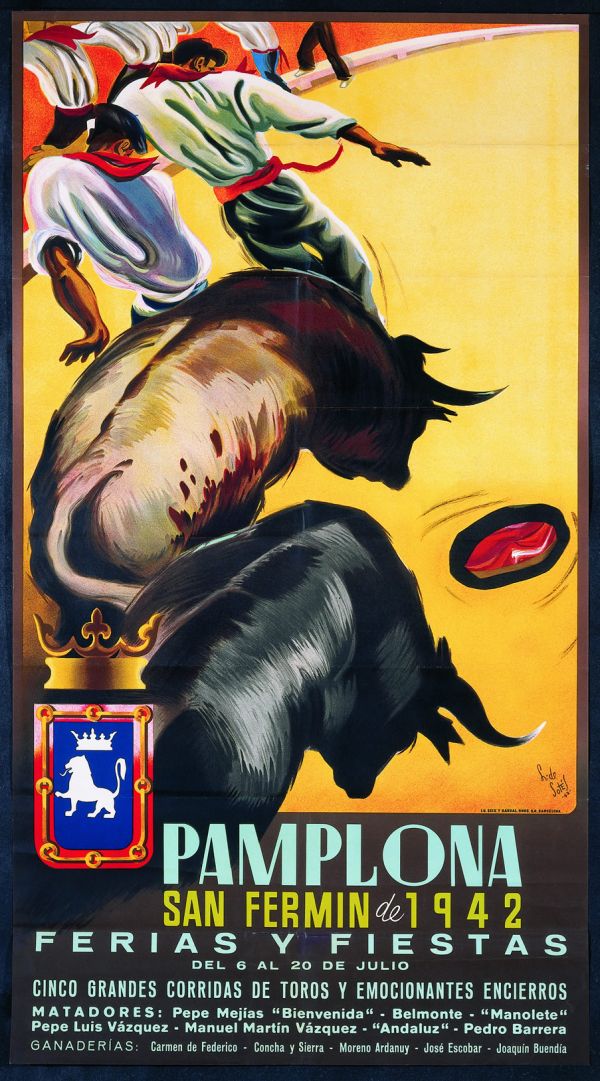
San Fermín 1942 poster (cartel)

San Fermín 1942 poster (cartel) by L. de Sotés: two bulls, one pale and one black, charge after runners in white with red sashes and neckerchiefs who leap away at the top, a red beret lying on the yellow sand, with the crowned shield of Pamplona
Cartel de San Fermín 1942. Poster of the Ferias y Fiestas de San Fermín 1942, signed L. de Sotés. Tap the poster to see it full size. See every San Fermín poster.11
San Fermín 1942 poster (cartel) by L. de Sotés: two bulls, one pale and one black, charge after runners in white with red sashes and neckerchiefs who leap away at the top, a red beret lying on the yellow sand, with the crowned shield of Pamplona
Artist
L. de Sotés (signature)
Fiesta on the poster
Del 6 al 20 de julio
Printed by
Seix y Barral, Barcelona

Two bulls, one pale and one black, charge across yellow sand after runners in white with red sashes and neckerchiefs, who leap away at the top of the picture; a red beret lies on the ground, and the crowned shield of Pamplona stands at the side. The poster promises “emocionantes encierros”.11

Ollaquindía’s chapter quotes José María Iribarren’s 1942 article on the eve of San Fermín, the best part of the fiesta, he said: the town smartening up, the bulls already at the Gas corrals, the steers from Arguedas with names like Campanero and Clavelino, and the morning of the 6th with every shop dummy wearing a scarlet neckerchief.12

Pamplona in 1942

The monument to the encierro

A cement cornice

In 1942 the paper noted that people had nicknamed the cement cornice over the trench at the ring entrance “el monumento al encierro”.3

Words of 1942

San Cernin

San Cernin is the Pamplona name of the church of San Saturnino, whose clock gave the official time for the encierro in 1942. The two rockets were the chupinazos.1, 3

Photographs

Where to see old photographs

The city’s photo archive, the Fototeca de Pamplona, holds historic photographs of the encierro, free to view online.13

San Fermín 1942: questions and answers

When were the bull runs of San Fermín 1942?

San Fermín 1942 had bull runs at seven in the morning on July 7, 8, 9 and 10, 1942, and on Sunday, July 12, the last, with bulls of Carmen de Federico, Concha y Sierra, Moreno Ardanuy, José Escobar and Buendía.1, 2, 5, 3, 4, 6, 7, 9, 10

Which clock started the running of the bulls in 1942?

The clock of the parish of San Saturnino, San Cernin, started the running of the bulls in 1942: the mayor’s bando made it the official time, and on July 7 the two rockets went off at its first stroke of seven.1, 3

What was the monument to the encierro?

The monument to the encierro was the nickname people had given by 1942 to a cement cornice over the trench at the entrance to Pamplona’s bullring, where spectators packed the balustrade to watch runners and herd pour into the arena.3

Who brought in the stray bulls in 1942?

Herdsmen with their smocks brought in the stray bulls of San Fermín 1942: on July 9 a popular herdsman from the Ribera brought in a lagging Moreno Ardanuy bull while a fool held it by the tail, and on July 10 Moncayola drew a loose José Escobar bull into the corral.6, 7

Who made the San Fermín 1942 poster?

L. de Sotés made the San Fermín 1942 poster, signed on the poster itself: two bulls, one pale and one black, charging across yellow sand after runners in white with red sashes and neckerchiefs.11

Sources

Numbers on the page refer to this list. Diario de Navarra pages are cited from its archive (hemeroteca); quotations in Spanish are given as printed, in the spelling of the day.

Full source list
  1. Diario de Navarra, July 5, 1942, page 4: bando of the mayor, Juan Echandi, on the encierros: doors on the course shut by 6:30; the Rochapea gate closed on the nights of “6, 7, 8, 9 y 11”; “la hora oficial es la marcada por el reloj de la Parroquia de San Saturnino”. Diario de Navarra archive
  2. Diario de Navarra, July 7, 1942, page 1: programme: dianas until July 10 and on July 12; the encierro at seven sharp; the Casa de Misericordia’s measures to stop children and women being hurt in the crushes in the stands. Diario de Navarra archive
  3. Diario de Navarra, July 8, 1942, page 4: “El primer encierro”, July 7, “con la primera campanada del reloj de San Cernin, sonaron los dos chupinazos”; the cement cornice called “el monumento al encierro”. Diario de Navarra archive
  4. Diario de Navarra, July 9, 1942, page 4: the encierro of July 8, “se efectuó sin incidentes. Los toros fueron agrupados en manada junto a los cabestros”. Diario de Navarra archive
  5. Diario de Navarra, July 7, 1942, page 8: the bulls of the fiesta, among them those of doña Carmen de Federico for July 7 and Concha y Sierra for July 8. Diario de Navarra archive
  6. Diario de Navarra, July 10, 1942, page 4: “se verificó ayer el tercer encierro de las fiestas con los “saltillos” de Moreno Ardanuy”, July 9; programme for July 10, the encierro at seven, the bulls of José Escobar. Diario de Navarra archive
  7. Diario de Navarra, July 11, 1942, page 1: the encierro of July 10, five bulls “agrupados con el cabestraje”, one apart penned by Moncayola; “Encerrados, sin incidentes”. Diario de Navarra archive
  8. Diario de Navarra, July 11, 1942, page 4: photograph, “El encierro de ayer en la calle Mercaderes”. Diario de Navarra archive
  9. Diario de Navarra, July 12, 1942, page 6: programme for Sunday, July 12, “tendrá lugar el último encierro de los toros”. Diario de Navarra archive
  10. Diario de Navarra, July 14, 1942, page 6: the last encierro, July 12, “con toda la calle de la Estafeta negra de gente”, the Buendía bulls. Diario de Navarra archive
  11. The poster of the Ferias y Fiestas de San Fermín 1942 itself, “del 6 al 20 de julio”, “Cinco grandes corridas de toros y emocionantes encierros”; signed L. de Sotés; printed by Seix y Barral, Barcelona.
  12. Ricardo Ollaquindía, 100 años de carteles de las fiestas y ferias de San Fermín (1882 to 1981), Pamplona, 1981, chapter “1942”. Free copy in the Biblioteca Navarra Digital (BiNaDi). binadi.navarra.es
  13. Fototeca de Pamplona, Archivo Municipal de Pamplona (photographs of the encierro, free to view online; publication needs the archive’s permission). archivo.pamplona.es
How to cite this page

Encierro. “Running of the Bulls 1942: San Fermín in Pamplona.” Encierro.com, November 9, 2026. https://encierro.com/san-fermin-1942/

Corrections and updates
  • : questions and answers rewritten around what people search, each answer with its sources; the poster labelled with its Spanish name, cartel.
  • : page published.

Walk the route with people who run it

Book your walk