
San Fermín 2027: July 6 to 14. Tours filling fast. Book your spot  | 
ToursRunning with Bulls About Fiesta About UsShop Book Now
The Encierro archive · 1948

Running of the Bulls 1948: San Fermín in Pamplona

San Fermín 1948 had six bull runs (encierros), at seven in the morning: every day from July 7 to Sunday, July 11, and an extra one on Sunday, July 18. On July 10 the bulls came in pairs, and a steer running alone ahead of them cleared the street and entered the ring “como amo y señor de la situación”, as lord and master of the scene. On the first morning a pile-up in Estafeta left many bruised, and the paper wrote that a tragedy had nearly happened; no serious accident followed.2, 5, 9, 12, 15

By Encierro · Last reviewed

6runs: July 7 to 11 and 18
7:00start, a.m.
2operating rooms in the new ring infirmary

How the fiesta ran in 1948

The programme set dianas from a quarter to six and “A las siete se celebrará, según tradicional costumbre, el encierro”: the encierro at seven, by traditional custom. A bus ran from Santesteban, in the mountains north of Pamplona, from July 7 to 11, and on Sunday, July 11 it left at half past three in the morning “para el encierro”, for the encierro.2, 3

On July 10 the peñas invited Pamplona to a Mass in the chapel of San Fermín for Casimiro Heredia and Julián Zabalza, who had died of wounds received in the encierro of July 10, 1947.4 See San Fermín 1947.

On the eve of the fiesta the bullring’s new infirmary was blessed. It had two operating rooms, and one of them was for those hurt in the encierro.1

After the first morning the acting mayor, Joaquín Ilundáin, had the causes of the jam at the start of Estafeta studied, and from the second day there was more order in the street.6, 7 An extra day with an encierro followed on Sunday, July 18, and many tickets were taken for the encierro; the Mexican actor Jorge Negrete was announced, and a house in Estafeta had been found for him to watch.13

Every known encierro of 1948, by day and ranch

The encierros of San Fermín 1948, from the Diario de Navarra programmes and reports and the poster.
DateRunRanch (ganadería)What the paper reported
July 71Samuel HermanosA pile-up in Estafeta; many bruised
July 82VillagodioMore order in Estafeta
July 93Urquijo de FedericoBruises from the cows afterwards, none bad
July 104Marqués de VillamartaThe bulls in pairs; a steer cleared the street
July 115Sobrinos de Juliana CalvoHundreds and hundreds of runners; no mishap
July 186, extraJosé María SotoOne of the most crowded runs; no mishap

The 1948 encierros, day by day

Run 1 of 6

· Samuel Hermanos

Start7:00 a.m.
HurtMany bruised

The first encierro of 1948 ran at seven with the bulls of Samuel Hermanos, of Albacete.2 At the start of Estafeta a pile-up of runners formed, something the paper could not remember ever happening in that street, and the bulls jumped over the fallen; by a miracle no one was gored, though there were “numerosas contusiones”, many bruised. “Estuvimos a punto de lamentar una tragedia”, the paper wrote: we nearly had a tragedy to mourn. It blamed the new arrangements on the course, and the acting mayor had the causes studied.5, 7
Run 2 of 6

· Villagodio

Start7:00 a.m.

The bulls were those of the Villagodio brothers, of Zamora.5, 16 “No tuvo tantas gotas de emoción como el primero, porque en la calle de la Estafeta hubo más orden”: fewer drops of emotion than the first, because there was more order in Estafeta after some well-judged corrections. It was still very interesting to watch, as this spectacle always is.6

Run 3 of 6

· Urquijo de Federico

Start7:00 a.m.

The bulls were those of don Antonio Urquijo de Federico, of Seville.6 After the run the young cows released in the ring knocked many people over, and the ring infirmary “se atiende a contusionados por patadas, pero ninguno de importancia”: treated people bruised by kicks, none of them seriously. That, the paper wrote, was how the encierros were slipping by that year, and how it hoped they would end.7

Run 4 of 6

· Marqués de Villamarta

Start7:00 a.m.

The bulls of the Marqués de Villamarta, of Seville, ran it.7 It was as normal as the day before, but with moments of emotion, because the bulls ran “primero dos, después otros dos pero escalonados, y finalmente otros dos juntos”: first two, then two more strung out, and finally two together. The one that caused alarm, hard as it is to believe, was a steer: setting off alone and at speed from the corral, it cleared the streets of runners and entered the arena “como amo y señor de la situación”, as if to say, here I am, let’s see who dares. Then came the bulls.7, 9 The paper printed Galle’s photographs of the run against the light and of the turn into Estafeta.8

Run 5 of 6

· Sobrinos de Juliana Calvo

Start7:00 a.m.
DaySunday

The programme called it “el último encierro”, the last of the regular feria, with the bulls of the nephews of doña Juliana Calvo, formerly Albaserrada.10 “¿Cuántos cientos y cientos de mozos habrían corrido en el encierro del domingo?”, the paper asked: how many hundreds and hundreds of young men ran, and how many thousands filled the ring? Nothing unpleasant happened to the boys who poured into the arena in compact masses, nor to the last ones who came in mixed with the bulls, and not one person was crushed in the stands despite the surges of the crowd.11

Run 6 of 6, extra

· José María Soto

Start7:00 a.m.
DaySunday

An extra day with an encierro, with the bulls of don José María Soto, of Seville.13, 14 It was “uno de los más nutridos de mozos corredores”, one of the most crowded runs, and the runners showed off their legs and their eye along the whole course without any mishap; at the right side of the ring entrance a small heap of boys formed. The bulls went to the pens as quietly as oxen.15

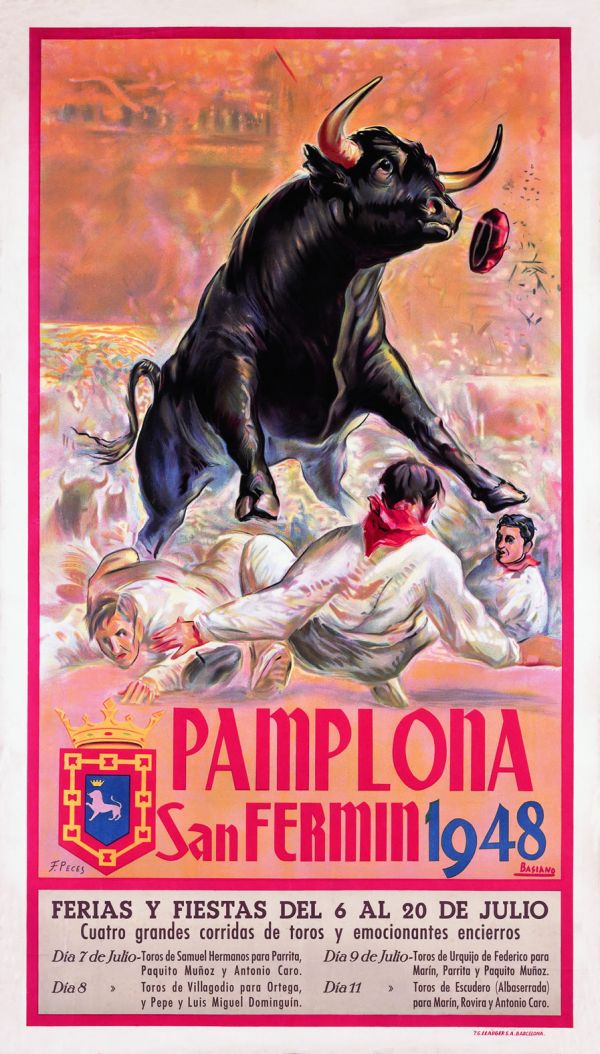
San Fermín 1948 poster (cartel)

San Fermín 1948 poster (cartel) by Basiano: a black bull leaps over runners in white with red neckerchiefs who have fallen in front of it, a red beret flying through the air
Cartel de San Fermín 1948. Poster of the Ferias y Fiestas de San Fermín 1948, signed Basiano. Tap the poster to see it full size. See every San Fermín poster.16
San Fermín 1948 poster (cartel) by Basiano: a black bull leaps over runners in white with red neckerchiefs who have fallen in front of it, a red beret flying through the air
Artist
Basiano (signature)
Fiesta on the poster
Del 6 al 20 de julio
Printed by
T. G. Llauger, Barcelona

A black bull leaps over runners in white with red neckerchiefs who have fallen in front of it, and a red beret flies through the air. The poster promises “emocionantes encierros”.16

Ollaquindía’s 1948 chapter quotes José María Iribarren on the vespers of San Fermín on the afternoon of July 6, when hundreds of young men dance ahead of the city council on its way to the chapel of San Fermín, shouting “¡Riáu, riáu!”, and, “al revés de lo que hace en el encierro”, the opposite of what they do in the encierro, move as slowly as they can.17

Pamplona in 1948

A new infirmary

Two operating rooms

The bullring infirmary blessed in July 1948 had two operating rooms, one of them for those hurt in the encierro; the paper said it looked like a sanatorium.1

Words of 1948

Amo y señor

The steer of July 10 entered the arena “como amo y señor de la situación”. On July 18 the runners “hicieron gala de sus piernas y de su vista”, showed off their legs and their eye. The bulls came “escalonados”, strung out.9, 15

Photographs

Where to see old photographs

The Diario de Navarra printed Galle’s photographs of the run of July 10, 1948. The city’s photo archive, the Fototeca de Pamplona, holds historic photographs of the encierro, free to view online.8, 18

San Fermín 1948: questions and answers

When were the bull runs of San Fermín 1948?

San Fermín 1948 had six bull runs, all at seven in the morning: every day from July 7 to Sunday, July 11, 1948, and an extra one on Sunday, July 18, 1948. The programme set the encierro at seven “according to traditional custom”.2, 13, 14

What happened in the pile-up in Estafeta on July 7, 1948?

On July 7, 1948, the first morning of San Fermín, a pile-up of runners formed at the start of Estafeta and the bulls jumped over the fallen. No one was gored, though many were bruised, and the Diario de Navarra wrote that a tragedy had nearly happened. The acting mayor, Joaquín Ilundáin, had the causes of the jam studied.5, 7

What did the steer do in the running of the bulls of July 10, 1948?

In the running of the bulls of July 10, 1948, a steer set off alone and at speed from the corral, cleared the streets of runners and entered the arena “como amo y señor de la situación”, as lord and master of the scene. The bulls of the Marqués de Villamarta followed, two, then two strung out, then two together.7, 9

Which ranches ran in the 1948 running of the bulls?

The bulls of the 1948 running of the bulls came from six ranches: Samuel Hermanos of Albacete on July 7, Villagodio of Zamora on July 8, Urquijo de Federico of Seville on July 9, the Marqués de Villamarta of Seville on July 10, the nephews of Juliana Calvo on July 11, and José María Soto of Seville on July 18.2, 5, 16, 6, 7, 10, 13, 14

What was the new bullring infirmary of 1948?

The new infirmary of Pamplona’s bullring was blessed on the eve of San Fermín 1948. It had two operating rooms, one of them for those hurt in the encierro, and the Diario de Navarra said it looked like a sanatorium.1

Who was remembered at the Mass of July 10, 1948?

On July 10, 1948, the peñas of Pamplona invited the city to a Mass in the chapel of San Fermín for Casimiro Heredia and Julián Zabalza, who had died of wounds received in the encierro of July 10, 1947.4

Who made the San Fermín 1948 poster?

Basiano made the San Fermín 1948 poster. It shows a black bull leaping over fallen runners in white with red neckerchiefs while a red beret flies through the air, and it promises “emocionantes encierros”, thrilling bull runs.16

Sources

Numbers on the page refer to this list. Diario de Navarra pages are cited from its archive (hemeroteca); quotations in Spanish are given as printed, in the spelling of the day.

Full source list
  1. Diario de Navarra, July 6, 1948, page 2: the blessing of the new infirmary of the bullring, with two operating rooms, one of them for those hurt in the encierro. Diario de Navarra archive
  2. Diario de Navarra, July 7, 1948, page 8: programme for July 7, “A las siete se celebrará, según tradicional costumbre, el encierro”; the bulls of Samuel Hermanos, of Albacete. Diario de Navarra archive
  3. Diario de Navarra, July 7, 1948, page 4: notice of the Aresoarra bus from Santesteban, July 7 to 11; on Sunday, July 11, leaving at half past three in the morning “para el encierro”. Diario de Navarra archive
  4. Diario de Navarra, July 9, 1948, page 2: the peñas invite Pamplona to a Mass on July 10 for Casimiro Heredia and Julián Zabalza, “que fallecieron a consecuencia de las heridas recibidas durante el encierro de los toros del día 10 de julio de 1947”. Diario de Navarra archive
  5. Diario de Navarra, July 8, 1948, page 6: “El primer encierro”, July 7: a pile-up in Estafeta, the bulls jumping over the runners, “numerosas contusiones”; “estuvimos a punto de lamentar una tragedia”; programme for July 8, “seis toros de los señores Villagodio Hermanos, de Zamora”. Diario de Navarra archive
  6. Diario de Navarra, July 9, 1948, page 6: “El segundo encierro”, July 8: “No tuvo tantas gotas de emoción como el primero, porque en la calle de la Estafeta hubo más orden”; programme for July 9, the bulls of don Antonio Urquijo de Federico, of Seville. Diario de Navarra archive
  7. Diario de Navarra, July 10, 1948, page 3: the morning of July 9: after the encierro the young cows knocked many people over; in the ring infirmary “se atiende a contusionados por patadas, pero ninguno de importancia”; the acting mayor, Joaquín Ilundáin, on the causes of the jam at the start of Estafeta on July 7; programme for July 10, the encierro at seven, six bulls of the Marqués de Villamarta, of Seville. Diario de Navarra archive
  8. Diario de Navarra, July 11, 1948, page 1: photograph, “Del encierro de ayer”, the contre-jour and the turn into Estafeta (Fotos Galle). Diario de Navarra archive
  9. Diario de Navarra, July 11, 1948, page 6: “El cuarto encierro”, July 10: “primero dos, después otros dos pero escalonados, y finalmente otros dos juntos”; a steer that entered the ring “como amo y señor de la situación”. Diario de Navarra archive
  10. Diario de Navarra, July 11, 1948, page 3: programme for Sunday, July 11, “se correrá el último encierro de los toros”; the bulls of the Sobrinos de doña Juliana Calvo (formerly Albaserrada). Diario de Navarra archive
  11. Diario de Navarra, July 13, 1948, page 3: “El quinto encierro”, Sunday, July 11: “¿Cuántos cientos y cientos de mozos habrían corrido en el encierro del domingo?”; nothing unpleasant happened. Diario de Navarra archive
  12. Diario de Navarra, July 14, 1948, page 2: the acting mayor satisfied, “sin que hayan ocurrido accidentes sensibles ni en los encierros”. Diario de Navarra archive
  13. Diario de Navarra, July 15, 1948, page 2: an extraordinary day for Sunday, July 18, with encierro; many tickets taken for the encierro; the Mexican actor Jorge Negrete announced, with a house found for him in Estafeta to watch the encierro. Diario de Navarra archive
  14. Diario de Navarra, July 18, 1948, page 3: programme for July 18, the encierro at seven; the bulls of don José María Soto, of Seville. Diario de Navarra archive
  15. Diario de Navarra, July 20, 1948, page 4: “El encierro” of July 18, “uno de los más nutridos de mozos corredores”, without mishap; a small heap of boys at the right side of the ring entrance. Diario de Navarra archive
  16. The poster of the Ferias y Fiestas de San Fermín 1948 itself, “del 6 al 20 de julio”, “emocionantes encierros”, with the bulls of July 7 Samuel Hermanos, July 8 Villagodio, July 9 Urquijo de Federico and July 11 Escudero (Albaserrada); signed Basiano; printed by T. G. Llauger, Barcelona.
  17. Ricardo Ollaquindía, 100 años de carteles de las fiestas y ferias de San Fermín (1882 to 1981), Pamplona, 1981, chapter “1948”. Free copy in the Biblioteca Navarra Digital (BiNaDi). binadi.navarra.es
  18. Fototeca de Pamplona, Archivo Municipal de Pamplona (photographs of the encierro, free to view online; publication needs the archive’s permission). archivo.pamplona.es
How to cite this page

Encierro. “Running of the Bulls 1948: San Fermín in Pamplona.” Encierro.com, November 9, 2026. https://encierro.com/san-fermin-1948/

Corrections and updates
  • : questions and answers rewritten around what people search, each answer with its sources; the poster labelled with its Spanish name, cartel.
  • : page published.

Walk the route with people who run it

Book your walk