
San Fermín 2027: July 6 to 14. Tours filling fast. Book your spot  | 
ToursRunning with Bulls About Fiesta About UsShop Book Now
The Encierro archive · 1950

Running of the Bulls 1950: San Fermín in Pamplona

San Fermín 1950 had five bull runs (encierros), every day from July 7 to July 11, “a las SIETE en punto de la mañana, hora de San Cernin”, at seven sharp by the San Cernin clock. On the course, from half past six, no women or children were allowed. The last run was the most exciting of the year, “con atisbos de tragedia”, with glimpses of tragedy, but nobody died.1, 11

By Encierro · Last reviewed

5runs, July 7 to 11
7:00start, by the San Cernin clock
767 mthe course, by Iribarren’s count

How the fiesta ran in 1950

The mayor’s bando, agreed with the civil governor, set the encierros “a las SIETE en punto de la mañana, hora de San Cernin, de los días 7, 8, 9, 10 y 11”, on the course from the Rochapea gate by Santo Domingo, the Plaza Consistorial, Doña Blanca de Navarra and Estafeta to the ring. From six in the morning no vehicles or horses could use those streets, and from half past six no women or children.1

Ollaquindía’s 1950 chapter quotes José María Iribarren on the encierro: “esa carrera alucinante de 767 metros”, that dizzying race of 767 metres through two streets and two squares, which the bulls cover in two to three minutes and which once took a minute and a half. The risk grew every year with the number of runners, he wrote, and yet, against what many believed, the number of victims in its long history barely passed half a dozen.13

Every known encierro of 1950, by day and ranch

The encierros of San Fermín 1950, from the bando and the Diario de Navarra programmes and reports.
DateRunRanch (ganadería)What the paper reported
July 71Atanasio FernándezA lone bull ahead; a small heap of runners
July 82Fermín BohórquezOne bull far ahead the whole way
July 93Salvador GuardiolaBulls loose on the course; nothing serious
July 104Sánchez FabrésWatched by the Foreign Minister
July 115, lastViuda de GalacheThe most exciting; a young man tossed in the ring

The 1950 encierros, day by day

Run 1 of 5

· Atanasio Fernández

Start7:00 a.m.

The first encierro was “muy bonito”, very fine to watch, with its drops of emotion: one handsome bull ran alone at the front up the cuesta de Santo Domingo and then, in the Plaza del Ayuntamiento, began hooking left and right, without harm to the runners; and at the start of Estafeta, by the Hotel Maisonnave, a small heap of fallen young men formed, which the bulls left alone. The bulls entered the ring in two groups, first two wrapped by the steers and then the other four, also sheltered by them.3, 5
Run 2 of 5

· Fermín Bohórquez

Start7:00 a.m.

The second was also very fine and had its moments of emotion, because “un toro se adelantó bastante de sus compañeros y fué durante todo el trayecto dando sustos”: one bull got well ahead of the others and frightened the runners the whole way. It entered the ring first, well wrapped by the steers, and went straight to the corrals; the other five followed, and one veered to the right, causing a few moments of alarm.5, 6

Run 3 of 5

· Salvador Guardiola

Start7:00 a.m.
DaySunday

The programme gave the bulls of don Salvador Guardiola, of Seville.7 The boxes were packed. The Sunday run was very exciting, because “los toros vinieron sueltos tanto por el trayecto como al entrar en la plaza”, the bulls came loose along the course and into the ring, spreading alarm among the runners. Despite the huge number who ran and some very dangerous falls, “nada sensible ocurrió”: nothing serious happened.8

Run 4 of 5

· Sánchez Fabrés

Start7:00 a.m.
DayMonday

The bulls of the day were those of the Sánchez Fabrés brothers, of Salamanca.2 The Foreign Minister, who had come to Pamplona for the fiesta, watched the run, first from the balcony over the passage into the ring and then from the town hall’s box, before leaving for Madrid at about half past nine.4, 9

Run 5 of 5, the last

· Viuda de Galache

Start7:00 a.m.
DeadNone

“a las siete, tendrá lugar el último encierro de toros de las Fiestas”, the programme said.10 Many young men ran, and the emotion peaked in the ring “con atisbos de tragedia”, with glimpses of a tragedy that, thanks to God and San Fermín, did not happen the way the horrified crowd imagined. The bulls ran the course apart, hooking here and there near the runners without catching them. In the arena four bulls stayed behind, and reckless people called them on; one young man called a bull with his smock and was caught and tossed spectacularly, without fatal consequences. The paper, which had praised the runners’ good conduct in the earlier runs, censured them for this one.11

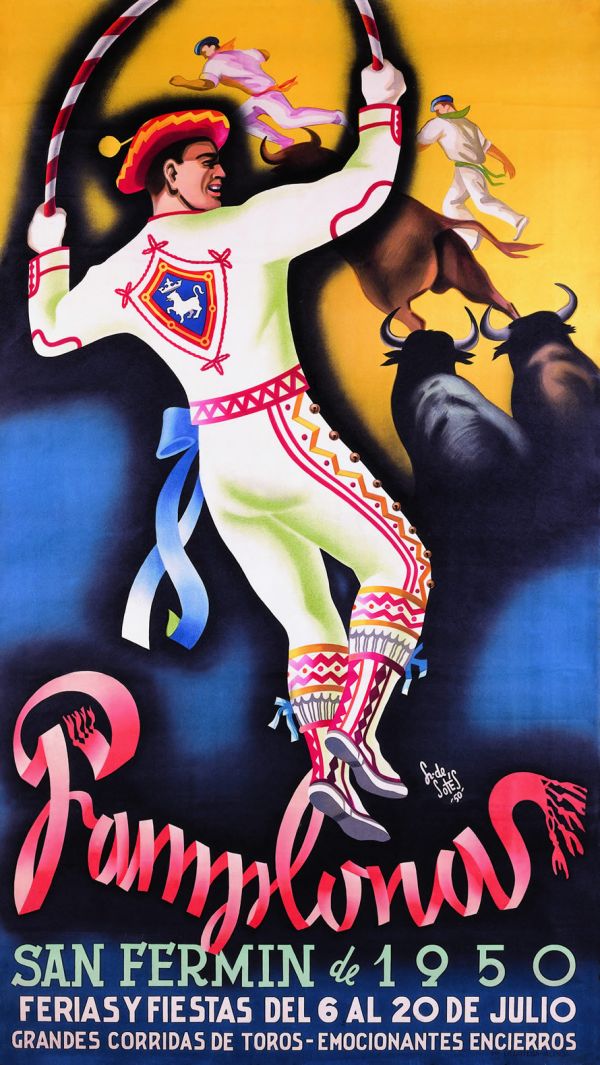
San Fermín 1950 poster (cartel)

San Fermín 1950 poster (cartel) by L. de Sotés: a dancer in white with embroidered trimmings, a red beret and blue ribbons leaps with a striped hoop over his head, while runners and bulls race past behind him
Cartel de San Fermín 1950. Poster of the Ferias y Fiestas de San Fermín 1950, signed L. de Sotés. Tap the poster to see it full size. See every San Fermín poster.12
San Fermín 1950 poster (cartel) by L. de Sotés: a dancer in white with embroidered trimmings, a red beret and blue ribbons leaps with a striped hoop over his head, while runners and bulls race past behind him
Artist
L. de Sotés (signature)
Fiesta on the poster
Del 6 al 20 de julio

A dancer in white with embroidered trimmings, a red beret and blue ribbons leaps with a striped hoop over his head, while runners and bulls race past behind him. The poster promises “emocionantes encierros”.12

Pamplona in 1950

767 metres

Iribarren’s measure

In the text Ollaquindía quotes for 1950, José María Iribarren put the course at 767 metres, run by the bulls in two to three minutes, once in a minute and a half.13

Words of 1950

Hora de San Cernin

The bando timed the run by “hora de San Cernin”, the clock of the church of San Saturnino. A bull that runs alone ahead goes “dando sustos”, giving frights.1, 6

Photographs

Where to see old photographs

The city’s photo archive, the Fototeca de Pamplona, holds historic photographs of the encierro, free to view online.14

San Fermín 1950: questions and answers

When were the bull runs of San Fermín 1950?

San Fermín 1950 had five bull runs, every day from July 7 to July 11, 1950, “a las SIETE en punto de la mañana, hora de San Cernin”: at seven sharp by the clock of the church of San Saturnino, as the mayor’s bando set them.1

Was anyone hurt in the 1950 running of the bulls?

A young man was hurt in the 1950 running of the bulls, without fatal consequences. The last run, on July 11, 1950, had “atisbos de tragedia”, glimpses of tragedy: in the ring he called a bull with his smock and was caught and tossed spectacularly. No one died.11

Who was kept off the encierro course in 1950?

In 1950 the mayor’s bando kept vehicles and horses off the encierro course from six in the morning and women and children from half past six. The course ran from the Rochapea gate by Santo Domingo, the Plaza Consistorial, Doña Blanca de Navarra and Estafeta to the ring.1

How long did José María Iribarren say the running of the bulls course was?

José María Iribarren put the running of the bulls course at 767 metres, through two streets and two squares, covered by the bulls in two to three minutes and once in a minute and a half. Ollaquindía quotes him in his chapter on the San Fermín 1950 poster.13

Which ranches ran in the 1950 running of the bulls?

The bulls of the 1950 running of the bulls came from Atanasio Fernández on July 7, Fermín Bohórquez on July 8, Salvador Guardiola of Seville on July 9, the Sánchez Fabrés brothers of Salamanca on July 10, and the widow of Galache on July 11.5, 7, 2, 10

Who watched the running of the bulls of July 10, 1950?

The Foreign Minister, who had come to Pamplona for San Fermín 1950, watched the running of the bulls of July 10, 1950, first from the balcony over the passage into the ring and then from the town hall’s box, and left for Madrid at about half past nine.4, 9

Who made the San Fermín 1950 poster?

L. de Sotés made the San Fermín 1950 poster: a dancer in white with a red beret and blue ribbons leaps with a striped hoop over his head while runners and bulls race past behind him. It promises “emocionantes encierros”, thrilling bull runs.12

Sources

Numbers on the page refer to this list. Diario de Navarra pages are cited from its archive (hemeroteca); quotations in Spanish are given as printed, in the spelling of the day.

Full source list
  1. Diario de Navarra, July 5, 1950, page 4: bando of the mayor with the civil governor: the encierros “a las SIETE en punto de la mañana, hora de San Cernin, de los días 7, 8, 9, 10 y 11”; the course from the Rochapea gate by Santo Domingo, the Plaza Consistorial, Doña Blanca de Navarra and Estafeta to the ring; from six no vehicles or horses on the course, and from half past six no women or children. Diario de Navarra archive
  2. Diario de Navarra, July 7, 1950, page 3: the bulls of each day of the fiesta, among them, for July 10, “seis toros de los señores Sánchez Fabrés Hermanos de Salamanca”. Diario de Navarra archive
  3. Diario de Navarra, July 8, 1950, page 1: “El primero”, the encierro of July 7, “muy bonito”, a bull alone ahead on the cuesta de Santo Domingo; a small heap of runners by the Hotel Maisonnave; the bulls entered in two groups. Diario de Navarra archive
  4. Diario de Navarra, July 8, 1950, page 1: “Hoy es esperado en nuestra ciudad el Ministro de Asuntos Exteriores”. Diario de Navarra archive
  5. Diario de Navarra, July 8, 1950, page 8: the bulls of the first day, those of don Atanasio Fernández, of Salamanca; programme for July 8, the encierro at seven, the bulls of don Fermín Bohórquez, of Seville. Diario de Navarra archive
  6. Diario de Navarra, July 9, 1950, page 1: “El segundo encierro”, July 8: “un toro se adelantó bastante de sus compañeros y fué durante todo el trayecto dando sustos”. Diario de Navarra archive
  7. Diario de Navarra, July 9, 1950, page 8: programme for Sunday, July 9, “Dianas, encierro de los toros” at the usual hour; the bulls of don Salvador Guardiola, of Seville; programme for July 10, the encierro at the same hour. Diario de Navarra archive
  8. Diario de Navarra, July 11, 1950, page 1: “El encierro del domingo”, July 9: “los toros vinieron sueltos tanto por el trayecto como al entrar en la plaza”; “nada sensible ocurrió”. Diario de Navarra archive
  9. Diario de Navarra, July 11, 1950, page 1: “También ayer asistió el señor Ministro al encierro”, Monday, July 10, watching first from the balcony over the passage into the ring and then from the town hall box. Diario de Navarra archive
  10. Diario de Navarra, July 11, 1950, page 8: programme for July 11, “a las siete, tendrá lugar el último encierro de toros de las Fiestas”; the animals of the Viuda de Galache. Diario de Navarra archive
  11. Diario de Navarra, July 12, 1950, page 1: “El último encierro fue el más emocionante”, July 11: “con atisbos de tragedia”; a young man tossed in the ring; “Terminaron ayer los Sanfermines”. Diario de Navarra archive
  12. The poster of the Ferias y Fiestas de San Fermín 1950 itself, “del 6 al 20 de julio”, “emocionantes encierros”; signed L. de Sotés ’50.
  13. Ricardo Ollaquindía, 100 años de carteles de las fiestas y ferias de San Fermín (1882 to 1981), Pamplona, 1981, chapter “1950”. Free copy in the Biblioteca Navarra Digital (BiNaDi). binadi.navarra.es
  14. Fototeca de Pamplona, Archivo Municipal de Pamplona (photographs of the encierro, free to view online; publication needs the archive’s permission). archivo.pamplona.es
How to cite this page

Encierro. “Running of the Bulls 1950: San Fermín in Pamplona.” Encierro.com, November 9, 2026. https://encierro.com/san-fermin-1950/

Corrections and updates
  • : questions and answers rewritten around what people search, each answer with its sources; the poster labelled with its Spanish name, cartel.
  • : page published.

Walk the route with people who run it

Book your walk