
San Fermín 2027: July 6 to 14. Tours filling fast. Book your spot  | 
ToursRunning with Bulls About Fiesta About UsShop Book Now
The Encierro archive · 1952

Running of the Bulls 1952: San Fermín in Pamplona

San Fermín 1952 had seven bull runs (encierros), at seven in the morning on July 7, 8, 9, 10, 12, 13 and 18; the bando announced the release of the bulls with two rockets. The first was one of intense emotion: “los ocho toros se desunieron y fueron sembrando el pánico entre la inmensa multitud de mozos”, the eight bulls split up and spread panic through the huge crowd of runners, yet the ring infirmary treated only about twenty people for small bruises.1, 3

By Encierro · Last reviewed

7runs, July 7 to 18
7:00start, San Cernin time
2rockets for the release

How the fiesta ran in 1952

The mayor’s bando set the runs at seven sharp, by the San Cernin clock, “de los días 7, 8, 9, 10, 12, 13 y 18 del corriente”, on the course from the Rochapea gate by Santo Domingo, the Plaza Consistorial, Doña Blanca de Navarra and Estafeta to the ring. From six no vehicles or horses could use those streets, and from half past six no women or children. “La salida de los toros de la puerta de la Rochapea, se anunciará con el disparo de dos cohetes”: the release of the bulls would be announced by two rockets.1

Ollaquindía notes that in 1952 the town hall was temporarily in the school of arts and crafts in calle Estella, and that the programme gave the course of the encierros: “partiendo del corralillo, por la Cuesta de Santo Domingo, Plaza Consistorial, calles de Doña Blanca de Navarra y Estafeta, hasta la Plaza de Toros”, at seven.12

Every known encierro of 1952, by day and ranch

The encierros of San Fermín 1952, from the bando and the Diario de Navarra programmes and reports.
DateRunRanch (ganadería)What the paper reported
July 71Antonio Martínez (8 bulls)Panic in the crowd; about 20 bruised
July 82Sánchez FabrésThe herd in two groups of three
July 93DomecqFewer runners, running well
July 104VillamartaLuis Miguel Dominguín among the runners
July 125Francisco RamírezRunners tripped in the passage; nothing happened
July 136Heirs of María MontalvoPerhaps the biggest crowd in the ring
July 187, lastRamos HermanosThe last encierro

The 1952 encierros, day by day

Run 1 of 7

· Antonio Martínez

Start7:00 a.m.
Bulls8
TreatedAbout 20, small bruises

Eight bulls of don Antonio Martínez, of Tudela, ran.2 The ring was packed to the roof. Almost from the start “los ocho toros se desunieron y fueron sembrando el pánico entre la inmensa multitud de mozos”, and more and more young men ran ahead of the horns; a tragedy seemed about to happen at every moment among those who fell and those who threw themselves to the ground to escape the charges. Despite rumours of serious wounded, the ring infirmary treated about twenty people for small bruises, painted with iodine.2, 3
Run 2 of 7

· Sánchez Fabrés

Start7:00 a.m.

Many young men ran again, though fewer than on the first day, which helped everything go more normally, even though “la manada de toros se separó en dos lotes iguales, tres en el primero y otros tres en el segundo”: the herd split into two equal groups of three. There were the usual scrapes and frights along the course and at the ring entrance.4, 5

Run 3 of 7

· Domecq

Start7:00 a.m.

A very fine and emotional run, “con menos corredores que los dos días anteriores, pero que supieron avanzar muy bien delante de los toros”: fewer runners than on the two days before, but they knew how to move well ahead of the bulls without getting in each other’s way. There were dangerous falls, with the bulls’ breath overhead and the horns close, but only frights. In the ring two Domecq bulls stayed behind and chased the young men for several minutes, without consequences, until two men known as the Chico de Olite and the Chico del Matadero, with the herdsmen, steered them into the corrals. One thing was missing, the paper complained: the gaita that plays a tune for each young cow.5, 6

Run 4 of 7

· Villamarta

Start7:00 a.m.

The encierro “fué muy bonito y normal”, very fine and normal, with the bulls of the Marqués de Villamarta, of Seville. Among the runners was Luis Miguel Dominguín, dressed like a Pamplona young man in a white shirt, rope-soled shoes and a red neckerchief. He waited at seven on the cuesta de Santo Domingo for the bulls to leave the corral and, mixed in with the local runners, ran “delante de los villamartas”, ahead of the Villamarta bulls, entering the ring holding on to the last of them.7

Run 5 of 7

· Francisco Ramírez

Start7:00 a.m.

“No hay quinto malo”, the paper headed it: there is no bad fifth. The young bulls of don Francisco Ramírez, of Ávila, gave frights from the corral onwards. The emotion came in the passage at the ring entrance, where several runners tripped with the bulls almost on top of them. In the ring five went straight to the pens and the sixth stayed behind for a while; nothing happened.8

Run 6 of 7

· María Montalvo

Start7:00 a.m.
DaySunday

“La plaza de toros registró un lleno imponente en el encierro, acaso el mayor”: perhaps the biggest crowd of the fiesta filled the ring, with constant surges in the stands. The six bulls of the heirs of doña María Montalvo ran behind a mass of runners; some were caught, “sin causar lesiones de importancia”, without serious injury.9

Run 7 of 7, the last

· Ramos Hermanos

Start7:00 a.m.

The last encierro of the year: “Los toros de Ramos hermanos, de Salamanca, salvaron muy bien el trayecto desde el corralillo a todo lo largo de las calles de Mercaderes y Estafeta”, the Ramos brothers’ bulls covered the course well from the corral the whole length of Mercaderes and Estafeta.1, 10

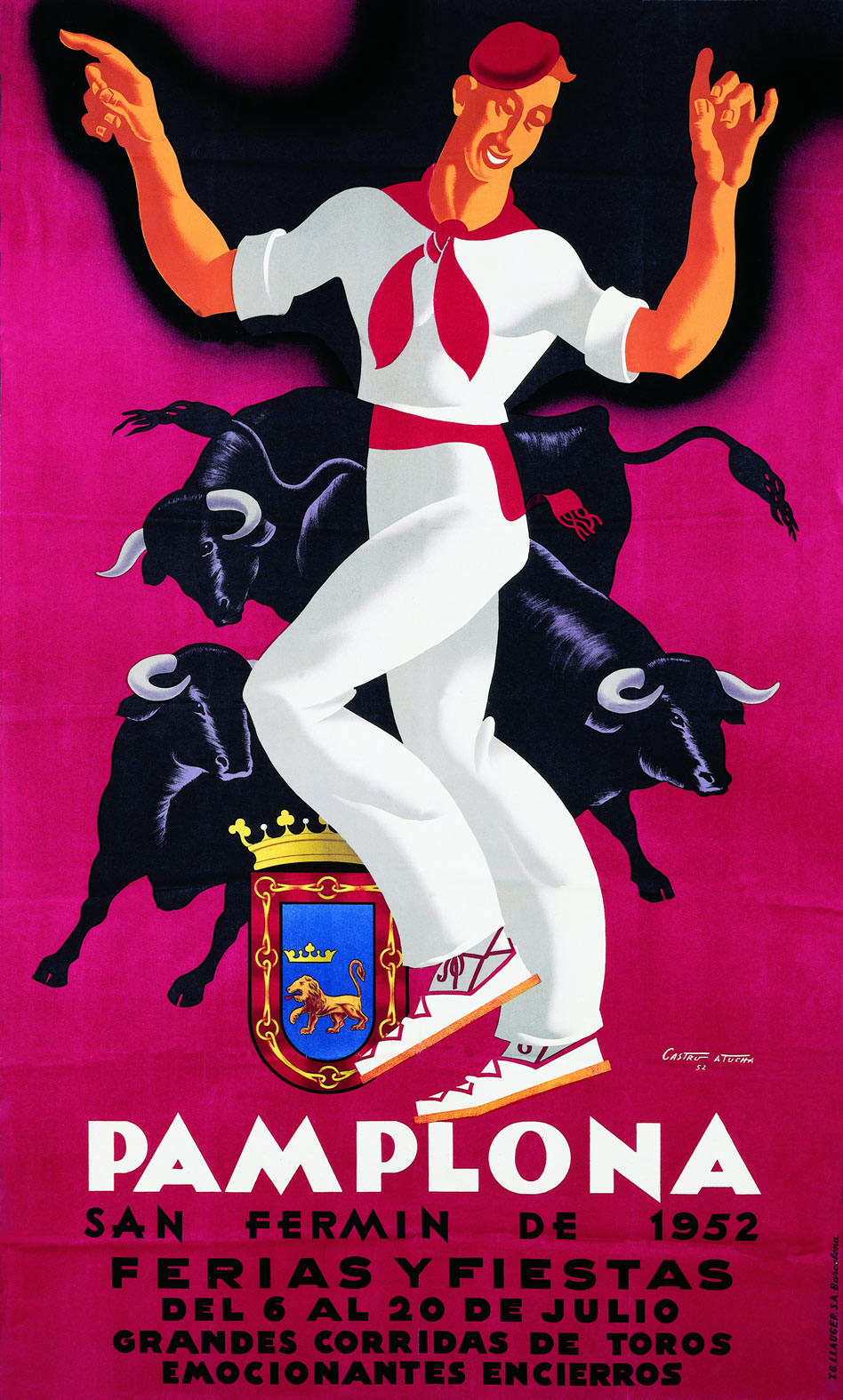
San Fermín 1952 poster (cartel)

San Fermín 1952 poster (cartel) by Castro Atucha: a smiling young man in white with a red neckerchief, sash and beret dances with his arms raised in front of a group of black bulls, beside the crowned shield of Pamplona
Cartel de San Fermín 1952. Poster of the Ferias y Fiestas de San Fermín 1952, signed Castro Atucha. Tap the poster to see it full size. See every San Fermín poster.11, 12
San Fermín 1952 poster (cartel) by Castro Atucha: a smiling young man in white with a red neckerchief, sash and beret dances with his arms raised in front of a group of black bulls, beside the crowned shield of Pamplona
Artist
Castro Atucha (signature)
Fiesta on the poster
Del 6 al 20 de julio
Printed by
T. G. Llauger, Barcelona

Ollaquindía describes the 1952 poster as a young man in big espadrilles and a little beret dancing, heedless, in front of a group of loose bulls, “un tema de ficción”, a scene of fiction.12 The poster promises “emocionantes encierros”.11

Pamplona in 1952

Two rockets

The signal for the release

The 1952 bando announced that the release of the bulls from the Rochapea gate would be signalled by two rockets of the kind called “bomba”.1

Words of 1952

Lotes

A herd that splits runs in “lotes”, groups. A bull that kept its distance was “desunido”, apart from the rest.3, 5

Photographs

Where to see old photographs

The city’s photo archive, the Fototeca de Pamplona, holds historic photographs of the encierro, free to view online.13

San Fermín 1952: questions and answers

When were the bull runs of San Fermín 1952?

San Fermín 1952 had seven bull runs, at seven sharp by the San Cernin clock, on July 7, 8, 9, 10, 12, 13 and 18, 1952, as the mayor’s bando set them. The bando also said two rockets would announce the release of the bulls from the Rochapea gate.1

Did Luis Miguel Dominguín run with the bulls in 1952?

Luis Miguel Dominguín ran with the bulls in Pamplona on July 10, 1952. Dressed like a Pamplona young man in a white shirt, rope-soled shoes and a red neckerchief, he waited on the cuesta de Santo Domingo, ran ahead of the Villamarta bulls among the local runners, and entered the ring holding on to the last of them.7

Was anyone hurt in the 1952 running of the bulls?

The 1952 running of the bulls left no one seriously hurt, as far as the Diario de Navarra reported. On July 7, 1952 the eight bulls of Antonio Martínez split up and spread panic through a huge crowd of runners, yet the ring infirmary treated only about twenty people for small bruises.2, 3

How was the release of the bulls signalled in 1952?

In 1952 the mayor’s bando announced that the release of the bulls from the Rochapea gate would be signalled by two rockets of the kind called “bomba”.1

Which ranches ran in the 1952 running of the bulls?

The bulls of the 1952 running of the bulls came from Antonio Martínez of Tudela, Sánchez Fabrés, Domecq, the Marqués de Villamarta of Seville, Francisco Ramírez of Ávila, the heirs of María Montalvo, and the Ramos brothers of Salamanca on the last run, July 18.2, 4, 6, 7, 8, 9, 10

Where was Pamplona’s town hall in 1952?

In 1952 Pamplona’s town hall was temporarily in the school of arts and crafts in calle Estella, Ollaquindía notes, and the programme gave the encierro course from the corral by the cuesta de Santo Domingo, the Plaza Consistorial, Doña Blanca de Navarra and Estafeta to the ring.12

Who made the San Fermín 1952 poster?

Castro Atucha made the San Fermín 1952 poster: a young man in big espadrilles and a little beret dances, heedless, in front of a group of loose bulls, “un tema de ficción”, a scene of fiction, as Ollaquindía calls it.12, 11

Sources

Numbers on the page refer to this list. Diario de Navarra pages are cited from its archive (hemeroteca); quotations in Spanish are given as printed, in the spelling of the day.

Full source list
  1. Diario de Navarra, July 6, 1952, page 8: bando of the mayor: the encierros at seven sharp, San Cernin time, “de los días 7, 8, 9, 10, 12, 13 y 18 del corriente”; from six no vehicles or horses on the course and from half past six no women or children; “La salida de los toros de la puerta de la Rochapea, se anunciará con el disparo de dos cohetes”. Diario de Navarra archive
  2. Diario de Navarra, July 6, 1952, page 12: programme for July 7, dianas at a quarter to six “como anuncio del encierro”, held “en la forma tradicional, a las siete”; “Ocho toros de la ganadería de don Antonio Martínez, de Tudela (Navarra)”. Diario de Navarra archive
  3. Diario de Navarra, July 8, 1952, page 1 and 3: “Intensa emoción en el primer encierro”, July 7: “los ocho toros se desunieron y fueron sembrando el pánico entre la inmensa multitud de mozos”; about twenty treated for small bruises. Diario de Navarra archive
  4. Diario de Navarra, July 8, 1952, page 3: programme for July 8; the bulls of don Antonio Sánchez Fabrés, of Salamanca. Diario de Navarra archive
  5. Diario de Navarra, July 9, 1952, page 1: “El segundo encierro”, July 8: “la manada de toros se separó en dos lotes iguales, tres en el primero y otros tres en el segundo”; programme for July 9, the third encierro at seven sharp. Diario de Navarra archive
  6. Diario de Navarra, July 10, 1952, page 1: “El tercer encierro”, July 9, “con menos corredores que los dos días anteriores, pero que supieron avanzar muy bien delante de los toros”; two Domecq bulls left in the ring; the gaita missing. Diario de Navarra archive
  7. Diario de Navarra, July 11, 1952, page 1: the encierro of July 10, “fué muy bonito y normal”, the bulls of Villamarta; Luis Miguel Dominguín, dressed in white with a red neckerchief, ran among the young men “delante de los villamartas”. Diario de Navarra archive
  8. Diario de Navarra, July 13, 1952, page 1: “No hay quinto malo”, the fifth encierro, July 12, “con los novillos de don Francisco Ramírez, de Avila”; several runners tripped in the passage at the ring entrance; nothing happened. Diario de Navarra archive
  9. Diario de Navarra, July 15, 1952, page 8: the encierro of Sunday, July 13: “La plaza de toros registró un lleno imponente en el encierro, acaso el mayor”; “los seis ejemplares de los herederos de doña María Montalvo”; some runners caught “sin causar lesiones de importancia”. Diario de Navarra archive
  10. Diario de Navarra, July 19, 1952, page 3: “El último encierro”, July 18: “Los toros de Ramos hermanos, de Salamanca, salvaron muy bien el trayecto desde el corralillo a todo lo largo de las calles de Mercaderes y Estafeta”. Diario de Navarra archive
  11. The poster of the Ferias y Fiestas de San Fermín 1952 itself, “del 6 al 20 de julio”, “emocionantes encierros”; signed Castro Atucha ’52; printed by T. G. Llauger, Barcelona.
  12. Ricardo Ollaquindía, 100 años de carteles de las fiestas y ferias de San Fermín (1882 to 1981), Pamplona, 1981, chapter “1952”. Free copy in the Biblioteca Navarra Digital (BiNaDi). binadi.navarra.es
  13. Fototeca de Pamplona, Archivo Municipal de Pamplona (photographs of the encierro, free to view online; publication needs the archive’s permission). archivo.pamplona.es
How to cite this page

Encierro. “Running of the Bulls 1952: San Fermín in Pamplona.” Encierro.com, November 9, 2026. https://encierro.com/san-fermin-1952/

Corrections and updates
  • : questions and answers rewritten around what people search, each answer with its sources; the poster labelled with its Spanish name, cartel.
  • : page published.

Walk the route with people who run it

Book your walk