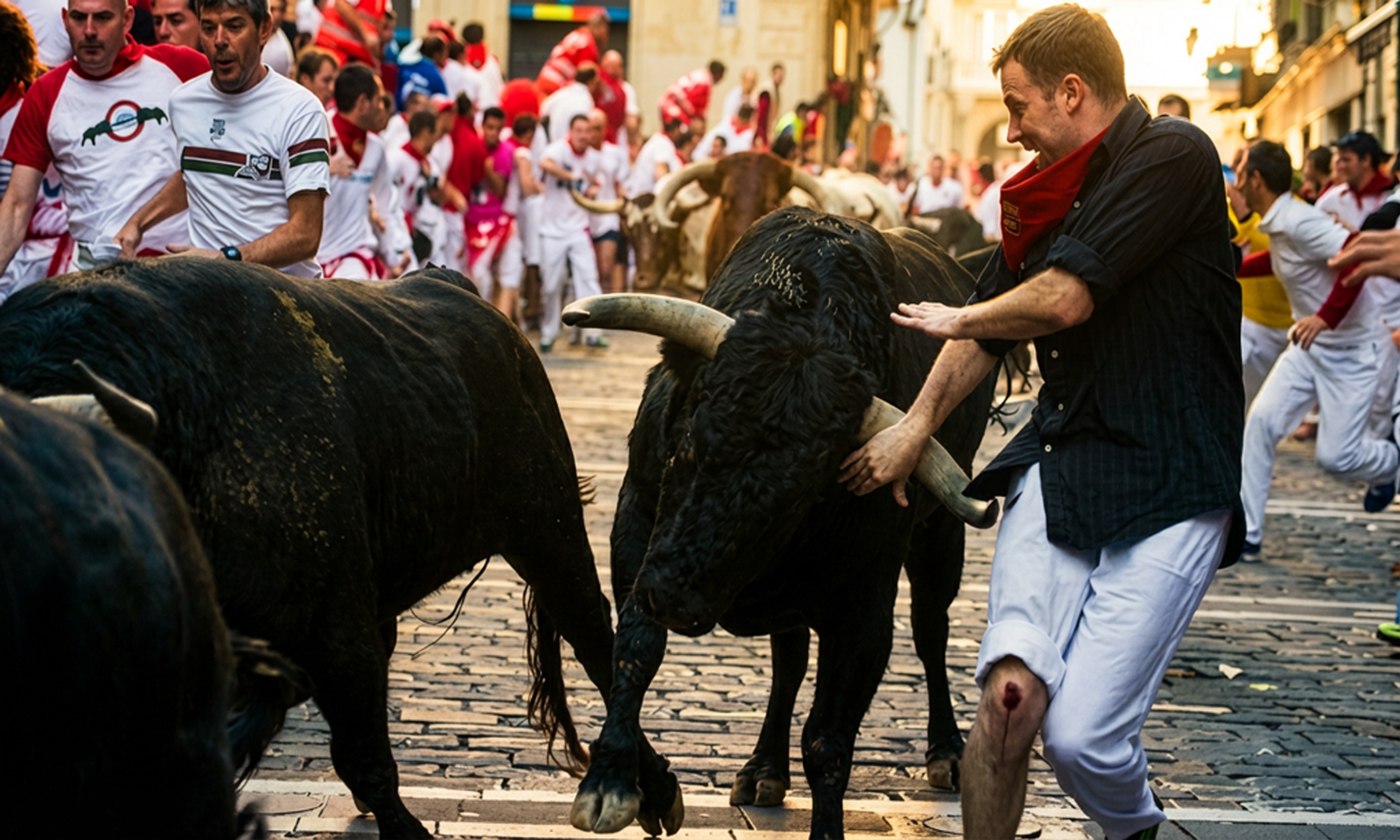
San Fermín 1960: The Running of the Bulls
July 6 to 14, 1960. A fiesta opening to the world. Eight encierros, a serious pile-up on Estafeta, and Hemingway’s long shadow over a city still finding its footing in a new era of international attention.
Looking Back at 1960
Looking back at 1960, it is clear that the fiesta was at a turning point that few living through it could have fully recognised. The encierros were still running at seven in the morning, a start time that would not shift to eight until 1974, and the crowds were growing faster than the city’s infrastructure had been built to absorb. The pile-up on Estafeta on July 7, the very first morning of the fiesta, was a sign of that pressure: a serious montón near the bajada de Javier, many runners injured, though no one killed. A reminder that the course does not grade on a curve for the inexperienced.
Ernest Hemingway was still alive in 1960. ‘The Sun Also Rises’ had been in print for thirty-four years by then, and its effect on the fiesta was already structural, not incidental. International visitors were arriving in numbers Pamplona had not seen before, drawn by a novel written by a man who had first come to the city in the 1920s. Spain itself was in a different moment too, the stabilisation plan of 1959 having opened the country to foreign investment and tourism in ways that were only beginning to show. The Feria del Toro programme, formalised in 1959, brought new rigour to the selection of bulls. What was happening in 1960 was not yet visible as history, but it was history being made.
Looking back, 1960 also marked the year Pamplona signed its twinning agreement with Bayonne, a gesture toward a broader European identity that matched the outward turn the fiesta was already making in practice. The camping at the Estadio Ruiz de Alda that summer was a small sign of a city learning, awkwardly, to host what it had always been.
Dennis Clancey, Founder, Encierro
A Festival Opening to the World
The 1960 fiesta opened on July 6 with the traditional chupinazo and ran its eight encierros through July 14. The runs took place at 7 a.m., the start time that had been in place since 1924, more than a decade before it would be moved to 8 a.m. in 1974. The city was under the governance of Mayor Miguel Javier Urmeneta, and the fiesta was operating in an atmosphere shaped by Spain’s early ‘desarrollismo’ phase, the economic opening that followed the stabilisation plan of 1959.
The first run of the fiesta, on July 7, produced a serious pile-up on calle Estafeta near the bajada de Javier. The montón brought down many runners; there were significant injuries, though no deaths. It was an early demonstration of the crowd pressures that were building as international attendance expanded. Around 100,000 visitors came to Pamplona for the fiesta that year, a figure that reflected the combined effect of Hemingway’s literary legacy and Spain’s new openness to foreign tourism.
In 1960, the encierro ran at seven in the morning, the city was signing its first twin-town agreement, and Hemingway was still alive. The fiesta was becoming something it had never quite been before.
Every 1960 Encierro, Day by Day
Eight runs, July 7–14, 1960. The route runs approximately 849 metres from Santo Domingo to the bull ring. Ganadería assignments for each day have not been preserved in the digitized historical record.
Run 1
The opening run of the 1960 fiesta. A serious pile-up, or montón, formed in calle Estafeta near the bajada de Javier: many runners went down together, with significant injuries. There were no deaths.
Run 2
The second morning of the 1960 fiesta. The Feria del Toro programme, formalised in 1959, meant that bull selection was already subject to quality criteria, but individual ranch assignments have not been preserved in accessible archives.
Run 3
The third morning of the 1960 fiesta. Ganadería assignments are not in the digitized historical record.
Run 4
The fourth morning of the 1960 fiesta. Ganadería assignments are not in the digitized historical record.
Run 5
The fifth morning of the 1960 fiesta. Ganadería assignments are not in the digitized historical record.
Run 6
The sixth morning of the 1960 fiesta. Ganadería assignments are not in the digitized historical record.
Run 7
The seventh morning of the 1960 fiesta. Ganadería assignments are not in the digitized historical record.
Run 8
The final run of the 1960 fiesta. A crush formed on the course producing significant injuries; no one died. By 1960 the crowds were growing faster than the tradition had experience to manage, and the encierro was no longer an event that Pamplona alone attended.
Official Poster of San Fermín 1960
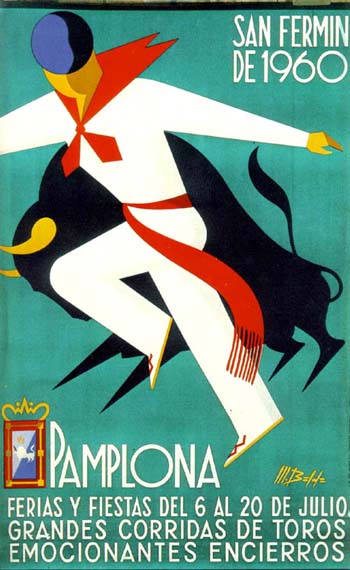
Cartel 1960 by Pedro Martín Balda.
Pedro Martín Balda was a Pamplona-born graphic artist whose bold, festive compositions became closely associated with the Sanfermines. The 1960 San Fermín official poster was selected through the annual concurso de carteles. The 1960 San Fermín official poster, selected through the annual concurso de carteles held by Pamplona each year.
The 1960 Encierro on Film
Archival footage of the July 7, 1960 encierro, the opening run of that year’s San Fermín festival.