
San Fermín 1961: The Running of the Bulls
July 6 to 14, 1961. The fiesta Hemingway made famous opened four days after his death. One runner died on the Cuesta de Santo Domingo. Eight encierros in the shadow of a legend.
Looking Back at 1961
Looking back at 1961, the San Fermín fiesta carries a weight no other year quite matches. Ernest Hemingway died on July 2, four days before the chupinazo was fired from the balcony of the Pamplona town hall. The man who had made this fiesta a destination for the international literary and artistic world since 1926 was gone before the rockets went up. The international press that gathered in Pamplona that July wrote as much about his absence as about the runs. A fiesta he had made world-famous would now go on, as it always had, without him.
Looking back at July 9, 1961, the record is specific and hard. Vicente Urrizola Isturiz, 30 years old, a Pamplona resident employed by the Ayuntamiento, was gored by a bull from the Álvaro Domecq ganaderiía on the Cuesta de Santo Domingo. He was taken to the Hospital de Navarra, operated on, and died the following day. He was the first runner killed in the encierro since 1947. The fiesta continued. It always does. Orson Welles and Deborah Kerr were among the international visitors that year, drawn by the same current that Hemingway had channeled decades earlier – a current that did not stop with his death.
Dennis Clancey, Founder, Encierro
Four Days After Hemingway
On July 2, 1961, Ernest Hemingway died at his home in Ketchum, Idaho. He was 61 years old. The chupinazo that opened San Fermín 1961 was fired four days later. Between his first visit to Pamplona in 1923 and his last in 1959, Hemingway had shaped how the English-speaking world understood the fiesta. The Sun Also Rises, published in 1926, had sent a generation of readers to Pamplona in search of the same raw energy he had described. In July 1961, many of them arrived to find the man himself gone.
Spain in 1961 was entering the early years of the desarrollismo, the technocrat-driven economic growth program that would transform the country across the 1960s. Pamplona was still a compact Navarran city with a clear boundary between the old walled town and the farmland beyond. International tourism was growing, partly on the strength of Hemingway’s legacy, but the fiesta had not yet reached the mass attendance of later decades. The runners who took to the streets of the old city in July 1961 did so in a more contained, local atmosphere than the one that tourists encounter today. Explore the full record in the year-by-year archive.
The fiesta does not stop for the death of a writer, even one who made it famous. It does not stop for the death of a runner either. It opens, it runs, and it closes. That continuity is the thing Hemingway understood before anyone else did.
Every 1961 Encierro, Day by Day
Eight runs from July 7 to 14, 1961, starting at 7 a.m. each morning. Ganaderiía assignments for the July 9 run are confirmed as Álvaro Domecq. Assignments for the remaining seven days are not in the digitized historical record.
Run 1
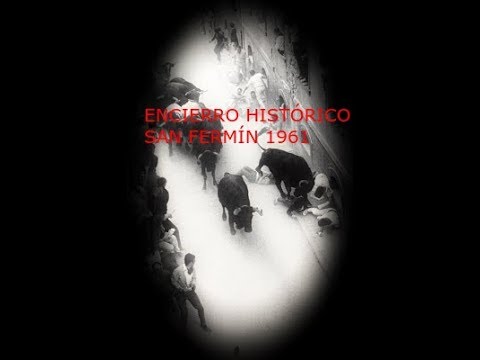
The first run of the 1961 fiesta, four days after the death of Hemingway. The international press presence was heavier than in a typical year. A historical compilation of the 1961 encierros, “Encierro Historico San Fermin 1961,” has been preserved on YouTube by the channel Encierros San Fermin (video above).
Run 2
The second run proceeded without incident. The ganaderiía assignment for this day is not in the digitized historical record.
Álvaro Domecq
The third run with Álvaro Domecq bulls is the only day with a confirmed ganaderiía for 1961. A bull from this herd gored Vicente Urrizola Isturiz, 30, on the Cuesta de Santo Domingo at the level of the old Hospital Militar. The wound to his cervical region proved fatal; he died the following day at the Hospital de Navarra. It was the first encierro death since 1947.
Run 4
The fourth run, the morning after Urrizola died at hospital. The ganaderiía assignment for this day is not in the digitized historical record.
Run 5
The fifth run of the 1961 fiesta. The ganaderiía assignment for this day is not in the digitized historical record.
Run 6
The sixth run of the 1961 fiesta. The ganaderiía assignment for this day is not in the digitized historical record.
Run 7
The seventh run of the 1961 fiesta. The ganaderiía assignment for this day is not in the digitized historical record.
Run 8
The eighth and final encierro of 1961. The Pobre de Mí at midnight closed the fiesta. The ganaderiía assignment for this day is not in the digitized historical record.
What the Record Remembers
Vicente Urrizola Isturiz
On July 9, 1961, Vicente Urrizola Isturiz, 30 years old, was gored by a bull from the Álvaro Domecq ganaderiía on the Cuesta de Santo Domingo, at the level of the old Hospital Militar. He ran regularly in the zone between the old Military Hospital and the Plaza del Mercado (now Plaza de Santiago).
The wound to his cervical region did not appear immediately life-threatening at the scene. He was transported to the Hospital de Navarra, where he underwent surgery. He died the following day, July 10, 1961.
Urrizola was a Pamplona resident, employed by the Ayuntamiento. His death was the encierro’s first fatality since 1947 and came in a year already marked by the death of the writer who had made the fiesta world-famous.
San Fermín 1961: Official Cartel
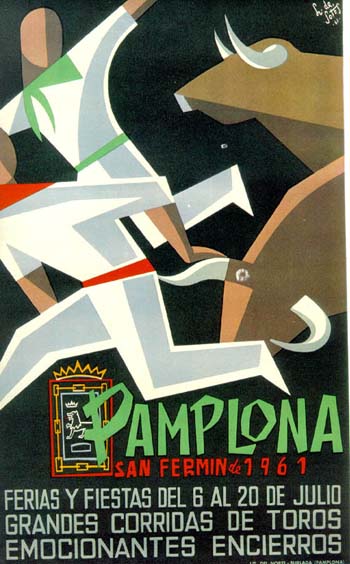
Cartel 1961 by Pedro Lozano de Sotes.
Pedro Lozano de Sotes was one of the leading Navarran graphic artists of his generation. His 1961 cartel for San Fermín follows the visual traditions of Pamplona festival posters: bold use of the fiesta’s defining colors, a central image grounded in the ritual of the encierro or the corrida, and lettering that carries the formal confidence of mid-century Spanish graphic design. Lozano de Sotes brought a regional sensibility to the commission, rooted in Navarran artistic tradition rather than the influence of the Madrid or Barcelona avant-garde.
Source: Ayuntamiento de Pamplona, cartel archive
Winner of the annual cartel contest and the official San Fermín 1961 poster for Sanfermines.
The City in 1961
The chupinazo fired at noon on Thursday, July 6, 1961, opening a fiesta that would carry an unusually heavy overlay of international attention. The first encierro followed on the morning of July 7 at 7 a.m., as it always does. The press that gathered in Pamplona that week was larger than usual, drawn partly by the encierro itself and partly by the desire to record the first fiesta without Hemingway alive to attend it.
The Peña El Estruendo de Iruña debuted in 1961, one of the peñas that would become part of the living fabric of the fiesta. The peñas – the clubs that provide so much of the music, the colour, and the organized energy of San Fermín – were growing in number and influence across the 1960s. Pamplona’s old city was still the compact, walled space that Hemingway had walked, and the crowd filling its streets for the fiesta was still largely Navarran and Spanish, with an international fringe that was growing but had not yet overwhelmed the local character. The Pobre de Mí at midnight on July 14 closed the 1961 fiesta.
1961, As the World Saw It
The 1961 fiesta drew wider international press coverage than a typical year because of Hemingway’s death four days before the chupinazo. Archive links for research into the 1961 fiesta are listed below.
How 1961 Came Together
Key facts in the 1961 fiesta, kept on the record.
Ernest Hemingway died at his home in Ketchum, Idaho, four days before the chupinazo. The international press noted the death of the man who had made San Fermín a global event through The Sun Also Rises in 1926.
The chupinazo opened San Fermín 1961. Peña El Estruendo de Iruña debuted. Orson Welles and Deborah Kerr were among the international visitors present for the fiesta.
Third run with Álvaro Domecq bulls. Vicente Urrizola Isturiz, 30, was gored on the Cuesta de Santo Domingo and died the following day at the Hospital de Navarra. The first encierro fatality since 1947.
Eighth and final encierro closed the 1961 fiesta. Pobre de Mí at midnight ended the week. Eight runs, one death, the first fiesta without Hemingway alive to attend it.
San Fermín 1961, Answered
Was anyone killed in the 1961 San Fermín encierro?
Yes. Vicente Urrizola Isturiz, a 30-year-old Pamplona resident and Ayuntamiento employee, was gored on the Cuesta de Santo Domingo during the July 9 run with Álvaro Domecq bulls. He died the following day at the Hospital de Navarra.
Did Ernest Hemingway attend San Fermín 1961?
No. Hemingway died on July 2, 1961, four days before the chupinazo opened the fiesta. He had attended San Fermín many times across the 1920s and 1950s; his 1926 novel The Sun Also Rises made the fiesta internationally famous. His death was noted across the international press covering the 1961 fiesta.
Which ganaderiía caused the death in 1961?
The bull that gored Vicente Urrizola was from the Álvaro Domecq ganaderiía, which ran on July 9. The ganaderiía assignments for the other seven encierros of 1961 are not in the digitized historical record.
Who attended San Fermín 1961 as celebrity visitors?
Orson Welles and Deborah Kerr were among the notable international visitors in 1961. Welles was a recurring Pamplona presence across the 1960s.
Explore More of the Encierro Archive
For what followed in 1962, see the year the pre-run prayer tradition was born. Or return to 1960 to see the fiesta Hemingway still attended.