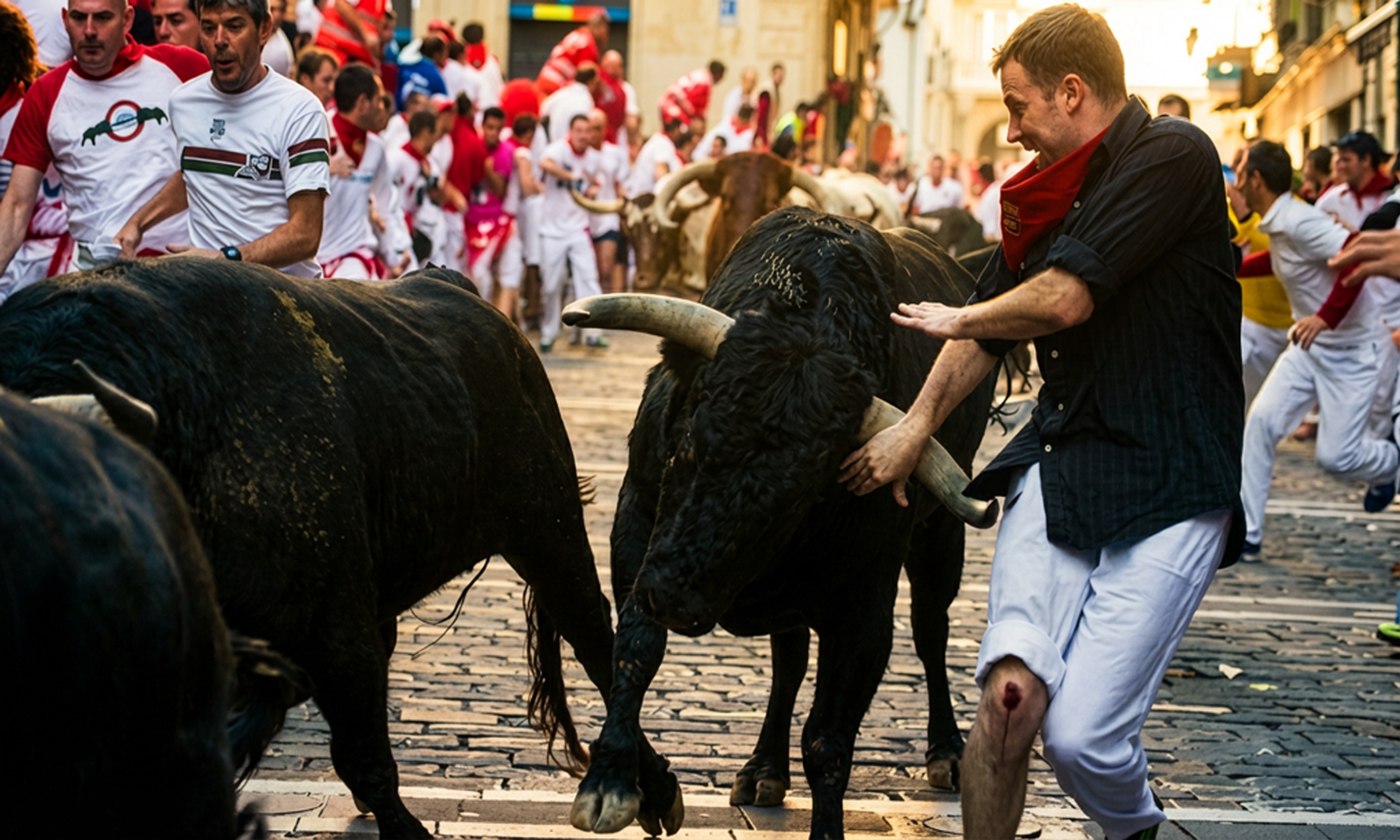
San Fermín 2012: The Running of the Bulls
July 6 to 14, 2012. Eight encierros, only four runners gored, the lowest total of the decade, and the year Dennis Clancey shot the documentary Chasing Red on the route.
The Year We Shot Chasing Red
San Fermín 2012 was the primary production year for Chasing Red, my documentary about the running of the bulls. The full production crew was working the route during those eight mornings, on the street, at the fence, in the ring. We were there to capture the encierro as it actually is, not as it’s mythologized, and the fiesta cooperated by being one of the fastest and statistically safest in recent memory.
Four gorings across eight days is a low number by any measure. The Cebada Gago run on July 9 was the most serious morning, with the loose bull ‘Fugado’ catching two runners on Telefónica. But the overall character of 2012 on the route was speed and cohesion, six of the eight runs finished under three minutes. It was not a quiet fiesta; it was a fast one, and for a documentary production, that speed set the visual rhythm of what we were trying to show.
Dennis Clancey, Founder, Encierro
The Safest Fiesta of the Decade
San Fermín 2012 produced only four gorings across all eight encierros, the joint-lowest total in the decade and well below the historical average of around eight per fiesta. The eight runs recorded a collective average of 2 minutes 43 seconds, making 2012 the fourth-fastest set of encierros in the history of officially recorded times. Six of the eight mornings finished under three minutes.
The single exception to the safety of the week was the Cebada Gago run on July 9, when the bull ‘Fugado’ separated from the herd at Santo Domingo and ran the route alone, goring two British runners on Telefónica. The remaining seven mornings produced just two gorings between them. The debut ranch Torrehandilla-Torreherberos closed the fiesta on July 14 without injury. Read the full decade in the year archive, or compare with 2011 and 2013.
Four gorings in eight runs. The fastest average time in years. And a documentary crew running the route alongside the bulls every morning.
Every 2012 Encierro, Day by Day
Each run with its ganadía, time, horn injuries, and the video record. The route runs approximately 849 meters from Santo Domingo to the ring; see the route map.
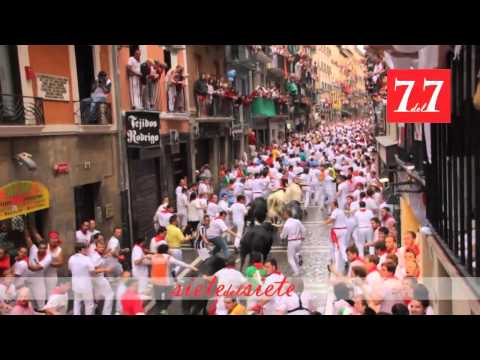
Dolores Aguirre
The opening run on a Saturday drew a large, festive crowd to the streets. The Dolores Aguirre bulls ran with nobility. One runner, a 73-year-old from Peralta, was gored in the right leg on Santo Domingo, receiving a 25 cm wound. A Japanese runner was also dragged briefly by his scarf in the cajetón but not gored.
Miura
An unusually disciplined Miura morning. The bull ‘Navajito’ ran ahead of the herd at great speed and knocked over several runners without cornering them. Two pile-ups formed in the cajetón, requiring medical attention for 52 runners. No horn gorings recorded despite the intensity in the ring entrance.
Cebada Gago
The most dangerous morning of the fiesta. The bull ‘Fugado’ fell at the start on Santo Domingo, separated from the herd, and ran much of the route alone. He gored two British runners on Telefónica and a third runner in the cajetón. The run stretched to 3 minutes 37 seconds, the longest of the week by over a minute.
El Pilar
A fast and impressive run from El Pilar, completing the course in 2 minutes 22 seconds, just 11 seconds above their own record-setting time from 2011. Forty-eight runners received medical attention, largely from falls and being knocked down by the speed of the herd. No horn gorings, but five runners were hospitalised from a pile-up on Estafeta.
Fuente Ymbro
A fast Fuente Ymbro morning with an unusual finish: the bull ‘Infundio’ arrived at the ring and fell repeatedly, requiring patient work by the dobladores to guide him to the corrals. A steer slipped on the Javier slope and briefly split the herd. Forty-two runners received medical attention; two hospitalised by falls. No gorings.
Victoriano del Río
The fastest run of the fiesta, completed in 2 minutes 20 seconds. The bull ‘Cóndor’ pushed against a fallen runner in the Ayuntamiento square, tearing his shirt but not goring him. Sixty-one runners received medical attention; five were hospitalised from falls. A clean run by the clock.
Juan Pedro Domecq
Another quick and clean morning. The bulls ‘Demagogo’ and ‘Vaticano’ ran ahead of the rest of the herd from near the start, leading into the ring at speed. The cajetón produced the most danger of the morning. Fifty-seven runners treated medically; five hospitalised for contusions. No horn injuries.
Torrehandilla–Torreherberos Debut
The debutant Torrehandilla-Torreherberos ranch closed the fiesta in a fast, clean run. In the ring, a runner taunted the bull ‘Viñista’, which charged but did not gore. The doblador Manolo de los Reyes intervened before the animal could cause damage. A clean debut and a no-goring finish to the week.
The Stories the Numbers Leave Out
Official Sanfermines Poster, 2012
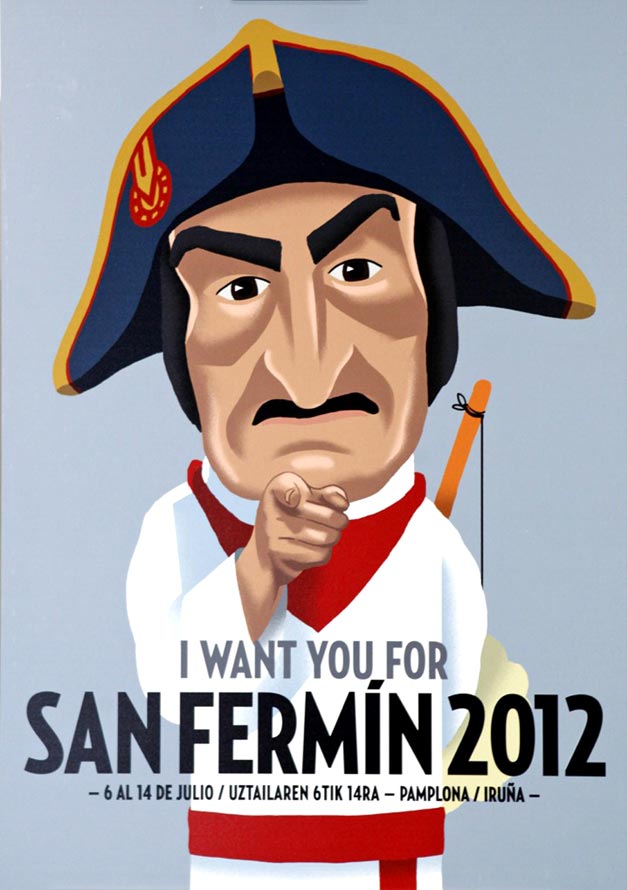
Cartel by David Alegría.
The 2012 San Fermín poster was designed by David Alegría, a graphic designer from Pamplona. His work was chosen from 511 entries submitted to the public competition, with a jury selecting eight finalists that were then put to a popular vote by citizens of Pamplona. The poster went on to win a Silver Medal at the Graphis Poster Annual 2014 competition in New York, one of the most prestigious international graphic design awards.
The Graphis recognition made the 2012 San Fermín cartel one of the most internationally decorated in the history of the competition, bringing Alegría’s work to audiences well beyond Navarra.
Source: Ayuntamiento de Pamplona, cartel archive
Pamplona’s annual concurso de carteles selected this as the official Sanfermines poster for 2012.
The City in 2012
The chupinazo opened the fiesta at noon on Saturday, July 6, 2012, fired from the balcony of the Pamplona town hall by the mayor. The 2012 fiesta marked the return of Miura to the closing slot, a position the Lora del Río ranch had held for much of the previous decade, while the debut of Torrehandilla-Torreherberos on July 14 brought a new name to the Pamplona record.
The Concurso Internacional de Fuegos Artificiales continued its annual presence in the Ciudadela, with each night’s fireworks display drawing crowds across Navarra to the old fortress. Nine days after the chupinazo, the candlelit Pobre de Mí at midnight on July 14 closed a fiesta that had been, by every statistical measure, among the safest of the modern era.
2012, As the World Saw It
Selected international coverage of San Fermín 2012.
Find Your 2012 Run
The Pamplona photographers and the Navarra press shoot every morning. These links go to the 2012 galleries.
How 2012 Came Together
The planning and key dates, kept on the record.
The poster competition selected David Alegría’s design as the winner from 511 entries. The eight ganaderías were confirmed: Dolores Aguirre, Miura, Cebada Gago, El Pilar, Fuente Ymbro, Victoriano del Río, Juan Pedro Domecq, and the debuting Torrehandilla-Torreherberos.
The chupinazo opened the fiesta at noon. The full production crew for Chasing Red took positions across the route in preparation for eight mornings of filming.
The Cebada Gago run produced the most dangerous morning of the fiesta. ‘Fugado’ separated and gored three runners, the only multiple-goring morning of the week. The run lasted 3 minutes 37 seconds, the longest of the fiesta.
Torrehandilla-Torreherberos completed their debut in a clean final run. At midnight, Pobre de Mí closed the fiesta with four total gorings, among the lowest of any San Fermín in the modern record.
San Fermín 2012, Answered
How many runners were gored in San Fermín 2012?
Four runners were gored by horn across all eight encierros, the joint-lowest total of the decade, compared to a historical average of around eight per fiesta. Three of the four gorings occurred in a single run, the Cebada Gago morning on July 9. The bull ‘Fugado’ separated from the herd and ran most of the route alone, catching all three in Telefónica and the cajetón.
Which ganadía ran in each encierro in 2012?
Dolores Aguirre on July 7, Miura on July 8, Cebada Gago on July 9, El Pilar on July 10, Fuente Ymbro on July 11, Victoriano del Río on July 12, Juan Pedro Domecq on July 13, and Torrehandilla-Torreherberos on July 14.
What was the fastest encierro of San Fermín 2012?
Victoriano del Río on July 12, at 2 minutes 20 seconds, also the fastest run of the fiesta overall. The collection of eight runs averaged 2 minutes 43 seconds, making 2012 the fourth-fastest set of encierros in the history of officially recorded times.
Was anyone killed in San Fermín 2012?
No. The last death in the Pamplona encierro was Daniel Jimeno Romero on July 10, 2009. No runners died in 2012. The most serious injury of the fiesta was from the July 9 Cebada Gago run, when three runners received horn wounds; none were life-threatening.
Planning your own run?
2012 is in the record. For the years on either side, see San Fermín 2011 and San Fermín 2013, or learn the route with the runners who have studied it longest.