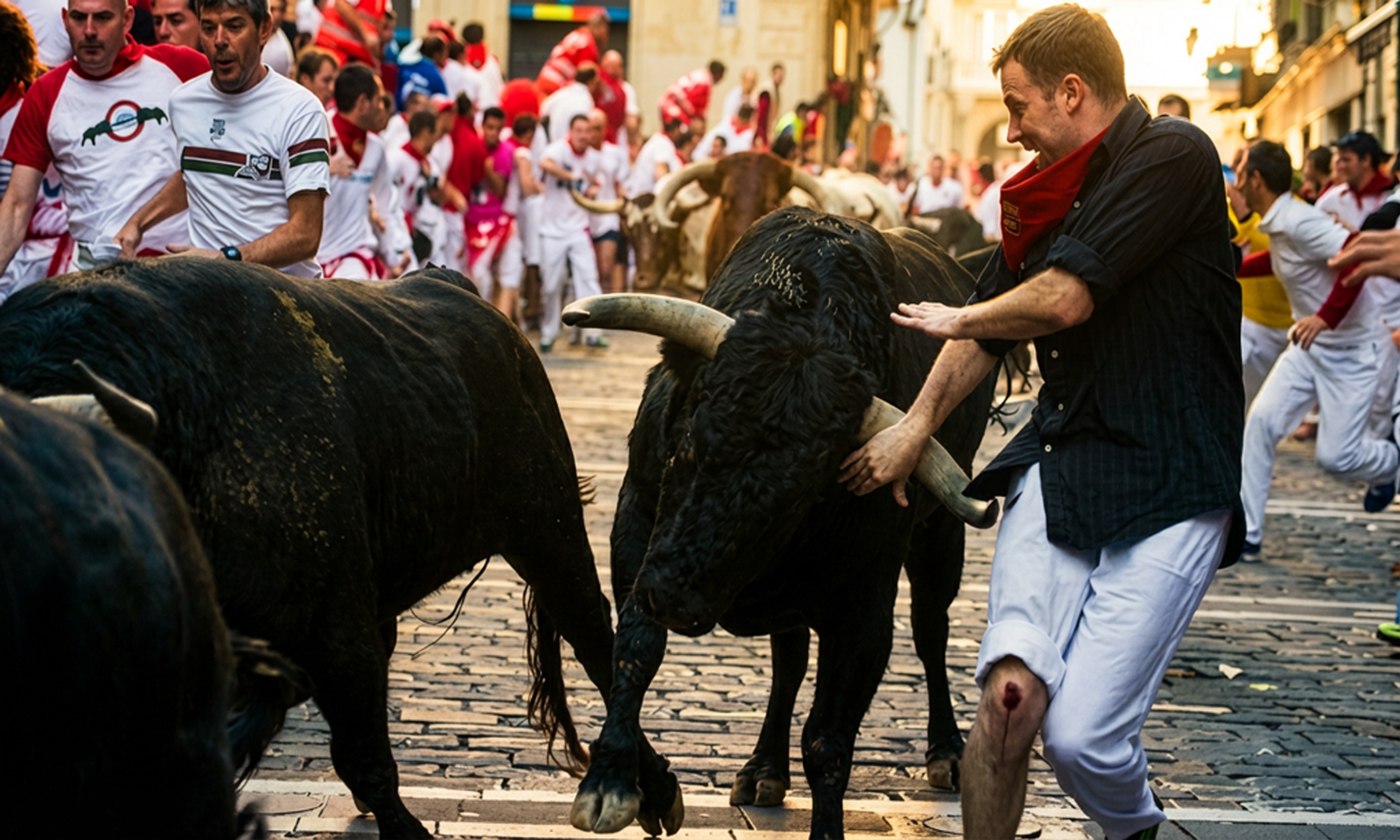
San Fermín 2021: A City Between Two Cancellations
July 6 to 14, 2021. No chupinazo. No encierros. No official fiesta. And Dennis Clancey was there anyway.
What It Was Really Like to Be There
I was in Pamplona that week. Not many people from anywhere were.
There was a kind of exhausted grief about it. The bars were quieter than even a normal off-season Tuesday. You could walk down Estafeta at noon and hear your own footsteps.
What I remember most from that week is the soccer. Italy was playing England in the Euro final on July 11th. I watched it at a friend’s apartment, Tom Gowen’s place. It was still fairly quiet. Italy won on penalties, which was something.
On the 6th, a handful of people gathered around noon outside the Town Hall. Some had their red pañuelos. Someone threw confetti. A couple of rockets went off somewhere in the city. The city had put together a programme they called Sinfermines, a play on Sanfermines, with sin meaning without in Spanish. But it was not the fiesta.
And then on the night of the 14th, a small group went to the Plaza Consistorial for something like a Pobre de Mí. Fewer than a hundred people. Journalists outnumbered civilians. But at midnight someone shouted “Gora San Fermín,” and people raised their pañuelos, and they sang four minutes of Pobre de Mí for a fiesta that never happened. It was one of the more moving things I have seen in all my years coming to Pamplona. A farewell to nothing. A promise that they would return.
Dennis Clancey · Founder, Encierro
The Second Year Without a Fiesta
On Monday, 26 April 2021, Pamplona Mayor Enrique Maya stood before the press and said the words no one wanted to hear for the second straight year: “Muy a mi pesar, me veo obligado a suspender oficialmente las fiestas de San Fermín de este año 2021.” To his very despair, he was forced to officially suspend the festival. The San Fermín fiesta and every one of its eight encierros were cancelled.
The last time the fiesta had been cancelled two years in a row was during the Spanish Civil War, between 1936 and 1938. To lose it once to a pandemic was shocking. To lose it twice was something harder to name. Mayor Maya himself acknowledged that when he announced the 2020 suspension he had not imagined he would be standing in the same place a year later delivering the same news. And yet here he was.
In some ways the second cancellation was harder than the first. The first arrived with the shock of the pandemic itself. The second arrived after a year of waiting, of rising hopes, of vaccination programmes that were running behind schedule. The public-health numbers at the time of the announcement were stark: Navarra had one of the highest COVID incidence rates in Spain, at 432 cases per 100,000 inhabitants over two weeks, with 199 people hospitalised and 39 in intensive care. Vaccination was at only 20 doses per 100 people for both doses. The city could not safely hold a fiesta that draws 1.4 million visitors from around the world.
The last time San Fermín had been cancelled two years running was during the Spanish Civil War. Losing it once to a pandemic was shocking. Losing it twice was something harder to name.
COVID, Vaccination, and the Delta Wave
By the time the would-be fiesta dates arrived in July 2021, the picture in Spain had changed significantly from the cancellation announcement in April. Vaccination was accelerating rapidly, with Spain moving from one of the slower rollouts in Europe to one of the fastest by summer. Roughly half of the Spanish population had received at least one dose by mid-July, and the full-vaccination rate was climbing toward 40 percent.
But the Delta variant arrived at exactly the wrong moment. Cases among young people, who had not yet been widely vaccinated, surged sharply through June and into July. Navarra was at alert level 4 when the cancellation was announced in April, and though the health situation had improved by the fiesta dates, the Delta wave introduced fresh uncertainty. Authorities in multiple Spanish regions took cautionary steps, and the mood among health officials was one of watchful concern rather than confidence.
The city of Pamplona did not cancel only the fiesta. It redirected much of the San Fermín budget into an alternative summer programme called Viva Pamplona Viva, roughly 1.5 million euros of concerts, sporting events and about 400 cultural and leisure activities running from June through September. The stated purpose was to keep the city moving without creating the mass-gathering effect the fiesta would have produced. A chess tournament featuring world champion Magnus Carlsen and an equestrian Grand Prix were among the highlights. It was a valiant effort. It was not San Fermín.
The economic toll was severe. The annual economic impact of San Fermín on Pamplona and its region is typically estimated at over 140 million euros. Across the two cancelled years, the city forewent an estimated 280 million euros in fiesta-related income. Hotels estimated that up to 40 percent of their number faced technical bankruptcy. Bars and restaurants lost the single week of the year that accounts for 15 to 20 percent of their annual revenue, two years in a row.
What Happened in Pamplona, July 6 to 14
The official word was unambiguous. Mayor Maya repeated it clearly: “No hay fiestas de San Fermín”. There was no fiesta. No chupinazo, no procession, no gigantes, no encierros, no Pobre de Mí as an official act. The council stood up a substantial policing operation with an Advanced Command Post coordinating Municipal Police, Foral Police, National Police and Civil Guard from the City Hall, with screens linked to surveillance cameras and the authority to seal off streets in the Old Town if crowds built. Street drinking was prohibited under prevailing health rules.
And yet the city did not fall entirely silent. On the morning of July 6, people in white and red drifted into the centre, fewer than had gathered in 2020, but they came. Several dozen people gathered before the City Hall in the minutes before noon. On one of the statues at the City Hall door, someone placed a large loaf of bread with the words “Volveremos San Fermín”: we will return, San Fermín. At noon, the hour the chupinazo would have fired, red pañuelos went up, rockets and firecrackers went off at different points around the city, confetti fell, and people called out “Viva San Fermín” and “Gora San Fermín.” It lasted a few minutes. The city had organized an alternative programme called Sinfermines, a play on Sanfermines, with sin meaning without in Spanish, but the moments at the Town Hall belonged to people who could not stay away.
The council made one deliberate change from 2020: they did not hang a pañuelo banner on the City Hall façade this time. In 2020 they had unfurled the large kerchief with the “#LosViviremos” message. In 2021, with cases rising again among young people, the decision was made to avoid any signal that could be read as an invitation to gather.
On the night of July 14 at midnight, the hour the Pobre de Mí traditionally closes the fiesta, fewer than a hundred people gathered in the Plaza Consistorial for a symbolic farewell. Police, journalists and photographers outnumbered the handful of civilians. At midnight, someone shouted “Gora San Fermín,” and the small crowd responded. Pañuelos went up. For about four minutes, they sang the Pobre de Mí for a fiesta that had never happened. The Spanish press captured the moment in a piece that called it, accurately, a Pobre de Mí with nothing to bid farewell to. The lingering fear of Delta, and outbreaks linked to summer destinations like Salou and Mallorca, kept most people home.
Italy, England, and the July 11 Final
In the middle of the week that was not a fiesta, there was one night that felt like something close to one. On Sunday, July 11, 2021, Italy and England played the final of UEFA Euro 2020, a tournament that had been delayed a full year by the pandemic and was finally being staged across eleven European cities. The match was at Wembley in London.
England scored in the second minute through Luke Shaw, the fastest goal in a European Championship final, and held the lead into the second half. Leonardo Bonucci equalised in the 67th minute, and the match went to extra time and then to penalties. Italy’s goalkeeper Gianluigi Donnarumma was the hero, saving the penalties from Jadon Sancho and Bukayo Saka while Marcus Rashford struck the post. Italy won 3-2 on spot kicks. It was Italy’s first major international title since the 2006 World Cup, their first European Championship since 1968.
Dennis Clancey watched the match in Pamplona that night, at the apartment of a friend, Tom Gowen. Spain still had restrictions in place, and the city stayed quiet. There was no mass gathering, no bars filling with crowds. But the match was real, the tension was real, and the result landed.
It was a brief and borrowed celebration. But in a week that had very little to celebrate, it mattered.
Italy won on penalties. Pamplona stayed quiet. But it was still the most alive the city felt that week.
Those Who Came Anyway
The 12th Anniversary at Post 66
On July 10, 2021, twelve years passed since the death of Daniel Jimeno Romero. The 27-year-old from Alcála de Henares was gored at post 66 on the Telefónica barrier during the encierro of July 10, 2009, caught by a Jandilla bull named Capuchino. He is the last runner to have died in the Pamplona running of the bulls. Sixteen runners have died in the encierro across more than a century of recorded history.
Every July 10, whether or not there is a fiesta, his family makes the journey to Pamplona and places flowers at post 66, together with a San Fermín neckerchief bearing the names and dates of every runner who has died in the encierro. In 2020, when the encierro was cancelled for the first time, friends and fellow runners laid flowers in place of his parents, who could not travel. The ritual held. It always holds.
In 2021, on the 12th anniversary, the route along Telefónica stood empty of runners for the second straight year. No encierro passed through. No crowd pressed against the fence. The flowers at post 66 were the only thing that marked the fact that this stretch of cobblestone had been the centre of something, and the loss of it.
The 2021 Sanfermines Official Cartel
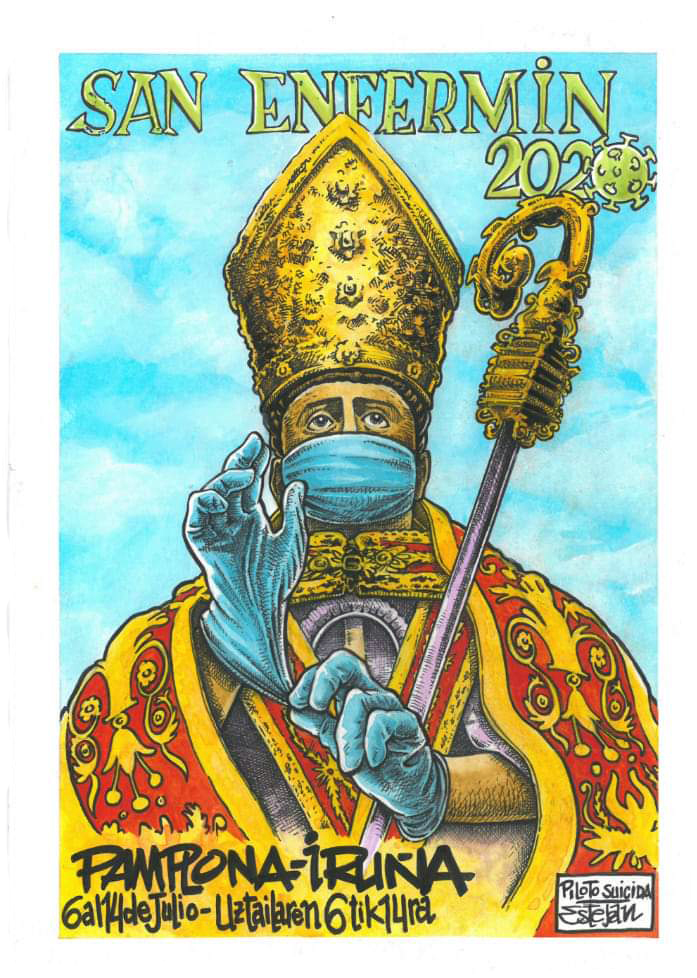
Winner of the annual cartel contest and the official San Fermín 2021 poster for Sanfermines.
The Eight Ganaderías That Never Ran
The same eight ranches that had been confirmed for the cancelled 2020 fiesta were carried forward as the planned 2021 lineup, pending a return that would not come until 2022. They finally ran their scheduled encierros when the fiesta returned that year.
- MiuraLora del Río, Sevilla. The oldest ganadería in the encierro; would have been their 55th Pamplona encierro.
- Cebada GagoMedina Sidonia, Cádiz. A fixture since 1985; second only to Miura in total appearances.
- JandillaMérida, Badajoz. Annual fixture since 2014; carries the weight of July 10, 2009.
- Fuente YmbroSan José del Valle, Cádiz. Known for clean and fast runs; debuted 2005.
- Núñez del CuvilloVejer de la Frontera, Cádiz. Invited back on merit after a strong 2019 performance in the encierro.
- Victoriano del RíoGuadalix de la Sierra, Madrid. Eleven consecutive confirmed years in the lineup since debuting in 2010.
- José Escolar GilLanzahíta, Ávila. The Albaserrada-line bulls; sixth confirmed San Fermín appearance.
- La PalmosillaTarifa, Cádiz. The sensation of their 2019 debut; had been invited back immediately for 2020.
Note: the 2021 lineup was not formally re-announced by the Casa de Misericordia before the April 26 suspension. The ranches above are those confirmed for 2020 and understood to have remained the working lineup for 2021. All eight ultimately ran in the 2022 encierros when the fiesta returned. When it did, the 849-meter encierro route came back to life.
The Second Cancellation, as the World Saw It
The April 26 suspension announcement moved as a Reuters wire story worldwide within hours. Every international outlet that had covered the 2020 cancellation returned to the story.
Key Dates of 2021
The timeline of the second cancellation, kept on the record.
Regional President María Chivite states publicly that San Fermín will not be held. Mayor Maya declines to confirm at this stage, noting the final decision rests with the City Council.
Mayor Enrique Maya formally suspends the 2021 fiesta at a press conference. Navarra is at alert level 4: 432 COVID cases per 100,000 inhabitants over two weeks, 199 hospitalised, 39 in intensive care. The decision is carried internationally the same day by Reuters.
The Junta Local de Seguridad agrees a policing and crowd-control plan for the would-be fiesta dates. The council launches the Viva Pamplona Viva alternative summer programme (approx. 1.5 million euros, 400-plus activities).
The day the chupinazo would have fired. No official act. A grey, rainy morning. Several dozen people gather informally before the City Hall at noon; pañuelos raised, rockets fired around the city, confetti thrown. The council does not hang the pañuelo banner this year. The Delta wave is rising.
12th anniversary of the death of Daniel Jimeno Romero at post 66 on Telefónica. The encierro route stands empty. Flowers are laid at the barrier.
Italy beats England 3-2 on penalties in the UEFA Euro 2020 final at Wembley. Dennis Clancey watches the match at the Pamplona apartment of his friend Tom Gowen. The city stays quiet, Spain still has restrictions, but the result is felt.
The hour of the Pobre de Mí. Fewer than a hundred people gather in the Plaza Consistorial. Police and journalists outnumber civilians. At midnight, pañuelos go up and four minutes of Pobre de Mí is sung for a fiesta that never happened.
San Fermín 2021, Answered
Why was San Fermín 2021 cancelled?
Mayor Enrique Maya announced the suspension on April 26, 2021, citing the COVID-19 health situation in Navarra: 432 cases per 100,000 inhabitants over two weeks, 199 hospitalised, 39 in intensive care, and a vaccination rate that was running well behind projections. The decision was taken at a city council level, as in 2020. The Delta variant then complicated the summer further.
How was 2021 different from the 2020 cancellation?
The 2020 cancellation was the first in over 40 years and arrived with the initial shock of the pandemic. The 2021 cancellation came after a year of waiting and rising expectations. Vaccination was underway but behind schedule. There was no pañuelo banner on the City Hall facade in 2021, as a deliberate step to avoid signalling a gathering. Turnout on July 6 was lower than in 2020. The informal Pobre de Mi drew fewer than a hundred people, with journalists outnumbering civilians.
What actually happened in Pamplona during July 6 to 14, 2021?
The city organized an alternative programme called Sinfermines, a play on Sanfermines, with sin meaning without in Spanish. On July 6, a few dozen people in white and red gathered before the City Hall at noon, raised their pañuelos, and set off rockets and confetti. On the night of July 14, fewer than a hundred people sang the Pobre de Mi in the Plaza Consistorial. Italy won the Euro soccer final on July 11; Dennis Clancey watched it at a friend’s apartment in Pamplona. The city stayed quiet throughout.
When did San Fermín return after the two-year break?
San Fermín returned in July 2022, with eight encierros running from July 7 to 14. It was the first time the running of the bulls had taken place since 2019. The eight ranches that had been held over from 2020 and 2021 finally ran their scheduled encierros. See the full 2022 recap here, or visit the how to run with the bulls guide to prepare.
Was a poster made for San Fermín 2021?
No. The annual cartel competition was not held in 2020 or 2021. The official pamplona.es archive goes directly from the 2019 poster by Edurne Taintra Balda to the 2022 poster selected when the fiesta returned. There is no official San Fermin image for 2021.
San Fermín returned in 2022
Two years of silence. Then on July 6, 2022, the chupinazo fired again. Read the full account of the return, or see how to run with the runners who teach it.