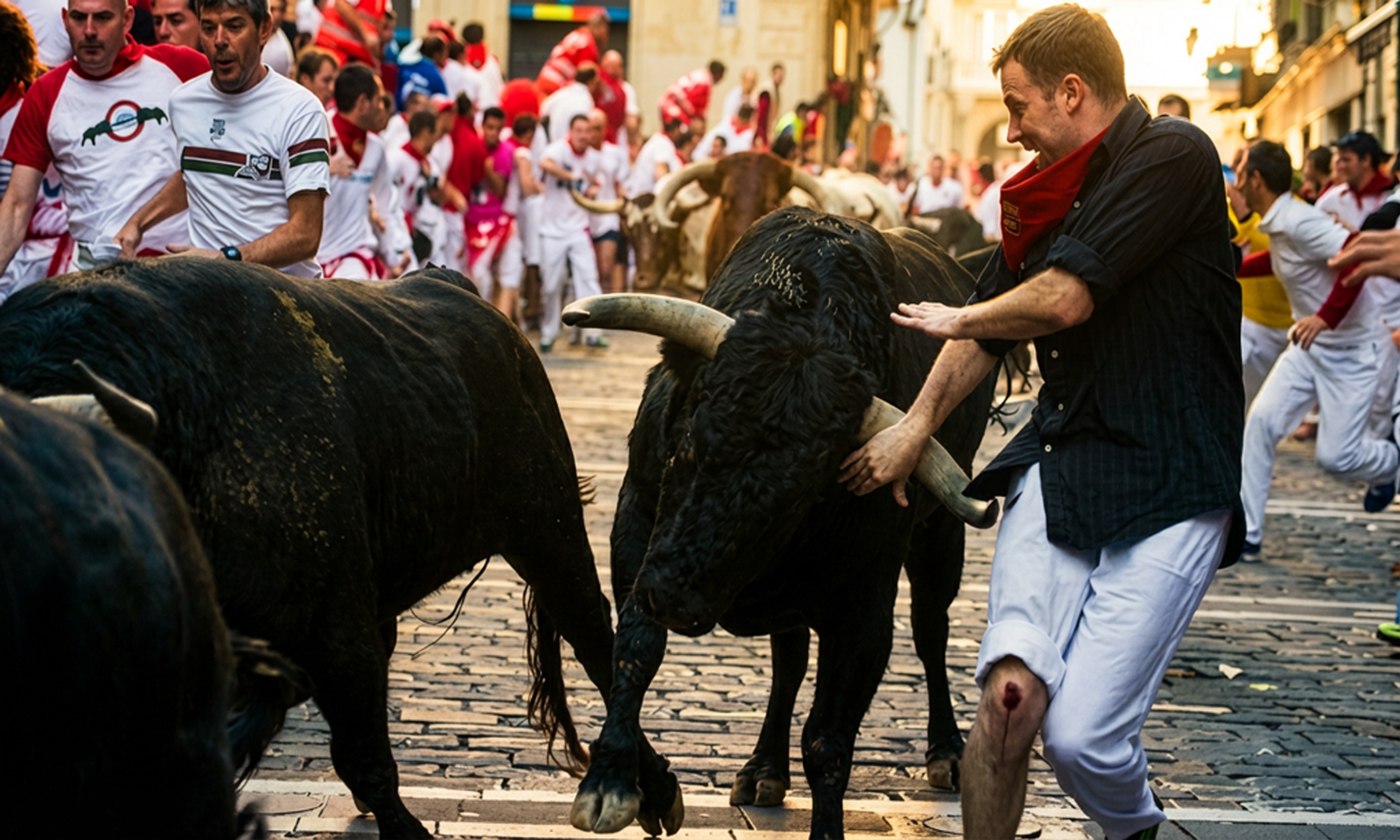
San Fermín 2020: The Year the Fiesta Stopped
July 6 to 14, 2020. No chupinazo. No encierros. No crowds on Estafeta. The first full cancellation since 1978, and the first year with no running of the bulls since 1938.
Looking Back on the Year It Went Quiet
I remember the moment I read that they had cancelled it. I knew Spain was in serious trouble with the pandemic, and I knew the odds were not good, but there was still a part of me that thought they would find a way. They always had. Through wars. Through political violence. Through plague and unrest across more than a century. The fiesta had always gone on.
When the announcement came on April 21, a Saturday morning, I sat with it for a while. Not just because we had no business to run that July, but because of what it meant: no Estafeta, no pens opening, no one singing the prayer at the statue. The streets I know better than most streets in my own city were going to be empty on the morning of July 7. No bulls. No runners. No sound except the police patrols and the wind.
What I kept coming back to was what a veteran runner named Carmelo Buttini Echarte said at the time. He had not missed a run in 40 years. He said he could not hold back his tears when he heard the news. I understood that completely. There is a community of people around the encierro for whom those nine July mornings in Pamplona are not a bucket list moment but a way of life, and in 2020 that way of life was taken away. Not by choice, but by a virus that had already killed tens of thousands of people in Spain by the time the decision was made.
I watched the clips from July 6 and 7 from afar. The 400 people in the Plaza Consistorial at noon. The small group in white and red on the running of the bulls route chanting the prayer on an empty street. It was hard to watch, and in a way it mattered to watch it. San Fermín 2020 was not nothing. It was a year the city grieved a tradition, and it grieved it out loud.
Dennis Clancey, Founder, Encierro
The Weight of What Was Lost
The Fiesta de San Fermín had run through the Spanish Flu of 1918. It had run, in diminished form, through the early years of Francisco Franco. It had survived the assassination of a politician in its streets and the political violence of the 1970s. The tradition of the encierro in Pamplona is documented back to the 14th century, and the modern unbroken run of the nine-day fiesta stretches well into the 19th. For well over a century, the chupinazo had fired from the Town Hall balcony at noon on July 6 and the first bull runners had stepped onto the cobblestones of Santo Domingo on the morning of July 7.
In 2020 none of that happened. On 21 April 2020, acting mayor Ana Elizalde stepped to a Pamplona microphone and announced that the fiesta was suspended. She described the decision as “hard and sad” but said it had been reached “with the consensus of all municipal groups.” Mayor Enrique Maya was not at the press conference: he was at home recovering from COVID-19 himself. Spain had been under a national lockdown since March 14, and by the time the announcement came, the country had recorded the highest pandemic death rate in the world. The fiesta that draws 1.45 million visitors to Pamplona every July could not happen.
It was the first full cancellation of San Fermín in 42 years and the first year with no encierros since 1938.
The chupinazo had fired every July 6 for more than a century. On the morning of July 6, 2020, the balcony was empty.
COVID in Spain and Navarra: The Timeline
Spain’s first wave of the pandemic was one of the most severe in Europe. By late April 2020 the country had recorded the world’s highest COVID-19 mortality rate: 544 deaths per million people, higher than Italy, France, and Germany. Navarra was among the regions hit in the first phase of the outbreak.
Navarra confirmed its first case on 29 February 2020. By the end of the first wave (June 2020), the region of roughly 650,000 people had recorded 10,358 confirmed cases, nearly 2,000 hospitalisations, and 529 confirmed COVID-19 deaths. Excess deaths in Navarra during the peak weeks were estimated at 613. Fifty-eight per cent of those deaths occurred in nursing homes.
On 14 March 2020, the Spanish government declared the estado de alarma (state of alarm). Citizens were ordered to remain at home except for essential purposes. All non-essential businesses closed. On 2 April, Spain recorded 950 deaths in a single 24-hour period: at that moment the highest single-day toll of any country in the world. On 25 March, Spain’s official death toll had already surpassed that of mainland China.
The government announced a four-phase de-escalation plan on 28 April. The estado de alarma finally ended on 21 June 2020 after 98 days. Spain entered what it called “new normality.” But no normality could restore the fiesta. The announcement of cancellation had come two months earlier, in April, when it was already clear that gathering 1.45 million people in a medieval city centre in July was not possible.
Navarra’s first confirmed COVID-19 case. The region would go on to record some of the earliest and sharpest case growth in Spain.
Spain declares the estado de alarma. A strict national lockdown begins: residents confined to their homes, all non-essential businesses closed. It would last 98 days.
Spain’s official COVID-19 death toll surpasses that of mainland China. The full weight of the first wave is beginning to be understood.
Spain records 950 deaths in 24 hours, then the highest single-day toll of any country in the world. Hospitals in Madrid and Navarra are operating under severe pressure.
Acting mayor Ana Elizalde announces the cancellation of San Fermín 2020 at a Pamplona press conference. Mayor Enrique Maya is at home with COVID-19. The decision is described as “hard and sad” but unanimous across all political groups. The announcement is heard around the world.
Spain announces its four-phase de-escalation plan. Navarra advances to Phase 1 on 11 May.
The estado de alarma expires after 98 days. Spain enters “new normality” two weeks before the dates on which San Fermín would have been held. The cancellation stands.
The hour of the chupinazo passes in near-silence. About 400 people in the Plaza Consistorial wave red kerchiefs. City Hall unfurls the #LosViviremos banner: “We will live them.” The first encierro date, 7 July, passes with a small group gathering on the empty route to chant the traditional prayer.
A Century Unbroken, and Then 2020
The Fiesta de San Fermín is older than the modern Spanish state. The tradition of running cattle through the streets of the Old Town to move them to the bullring has medieval roots, and the formalised nine-day celebration has been continuous since at least the late 19th century. In the 20th century the fiesta found a global audience through writers and travellers, and the July dates on Estafeta became one of the most recognisable street events in the world.
That continuity had been broken before, but rarely and for grave reasons. The Spanish Civil War caused two full cancellations, in 1937 and 1938. No chupinazo, no encierros. The country was at war with itself. When the fiesta resumed in 1939 it did so in a Spain that had changed beyond recognition.
The next full cancellation came in 1978, when violent clashes between police and demonstrators during the fiesta itself left a young man dead. The city called off the remainder of the events out of respect and in the face of ongoing disorder. In 1997, following the ETA assassination of town councillor Miguel Ángel Blanco on July 13, one afternoon’s corrida was suspended as a mark of national mourning, but the encierros that year all ran: 1997 was a partial suspension, not a full cancellation.
So what made 2020 different from every year since 1938 was the absence of the encierros themselves. No bulls. No runners. No morning sprint down Santo Domingo and Estafeta. Eight ganaderías had been confirmed. The route would have been the same 849 metres it always is. The fence would have gone up. And then the pandemic made all of it impossible, and the streets that had carried bulls every July for decades went quiet.
Eight ranches had been confirmed. The fence would have gone up. The morning of July 7 came and went in silence.
Empty Streets, and Those Who Still Came
The city did not simply close its doors. Bars opened their terraces. A few thousand residents put on white clothes and red scarves out of habit, out of grief, out of the sense that July 6 demanded some acknowledgement even if there was nothing to celebrate. Cuadrillas of friends gathered on Estafeta and San Nicolás and in the Plaza del Castillo for morning almuerzos that were quieter than any normal July weekend, let alone any fiesta day.
The Municipal Police mounted an operation to control crowd density in the Old Town: 14 checkpoints at the entry and exit points of the key streets, with six capacity-control zones in the bar-heavy areas. The Plaza Consistorial was capped at 400 people. Electronic signs warned passers-by when the main squares had filled. Loudspeakers facing the street were banned. Establishments were asked not to play traditional fiesta music on July 6 and 7. No street lunches were authorised. Indoor venues were capped at 75 per cent capacity.
At noon on 6 July, about 400 people stood in the Plaza Consistorial and waited for a chupinazo that did not come. Some of them waved red kerchiefs. Some chanted “San Fermín, San Fermín.” One citizen called out the traditional balcony words: “Pamplonesas, pamploneses, Viva San Fermín! Gora San Fermín!” The City Council had unfurled a large banner on the Town Hall facade in the shape of a kerchief, reading #LosViviremos: “We will live them.” The message was in Spanish, Basque, French, and English.
On the morning of 7 July, the date the first encierro would have run, a small group dressed in the traditional white and red gathered at the assembly point on the route and chanted the oración a San Fermín, the prayer that runners sing to the image of the saint before every run. The streets were otherwise empty. RTVE, the national broadcaster, aired archive footage of past encierros each morning in place of live coverage.
Mayor Enrique Maya had said beforehand that it would “be strange for everyone” but hoped the city could be “proud of our behaviour.” The evidence from that July suggests it was both: strange beyond what most people expected, and carried with a kind of dignity that matched the gravity of the moment.
What the Community Lost
The 2020 Ganadería Lineup
Eight ranches had been announced and confirmed for the 2020 encierros before the cancellation. None of them ran.
Would have been their 54th encierro in San Fermín, a record. The Zahariche ranch was approaching 178 years of history. No other ganadería has run more times in Pamplona.
A fixture since their 1985 debut, the second most appearances in the history of the encierro after Miura. They have run at San Fermín more years than any other active ranch except Miura.
Had marked 20 years at the fiesta in 2019. A regular presence since returning in 1997, without a gap since 2014.
Debuted in 2005 and had become one of the ranches most associated with clean, fast runs. Returning after a one-year rest in 2019.
Won the prize for best corrida at San Fermín 2019 and was returning on merit. Their tenth overall appearance at the fiesta.
Would have been 11 consecutive years at the encierro, running every year since their 2010 debut, matched only by Miura for unbroken recent consistency.
Would have been their sixth San Fermín since debuting in 2015. The Albaserrada-line bulls had produced memorable moments in earlier encierros.
The sensation of 2019, their debut year, running fast and clean. They were returning to build on that first impression. Instead, they would have to wait until 2022.
On the official cartel (poster): No official poster was selected for San Fermín 2020. The public voting competition, which has been held every year since 2008, was suspended along with the fiesta. The Pamplona city archive of carteles (pamplona.es/turismo/sanfermin/carteles) lists no poster for 2020 or 2021, moving directly from the 2019 work by Edurne Taínta Balda to the 2022 poster by Olaia Merino. The blank in the archive is itself part of the record.
Official Poster: San Fermín 2020
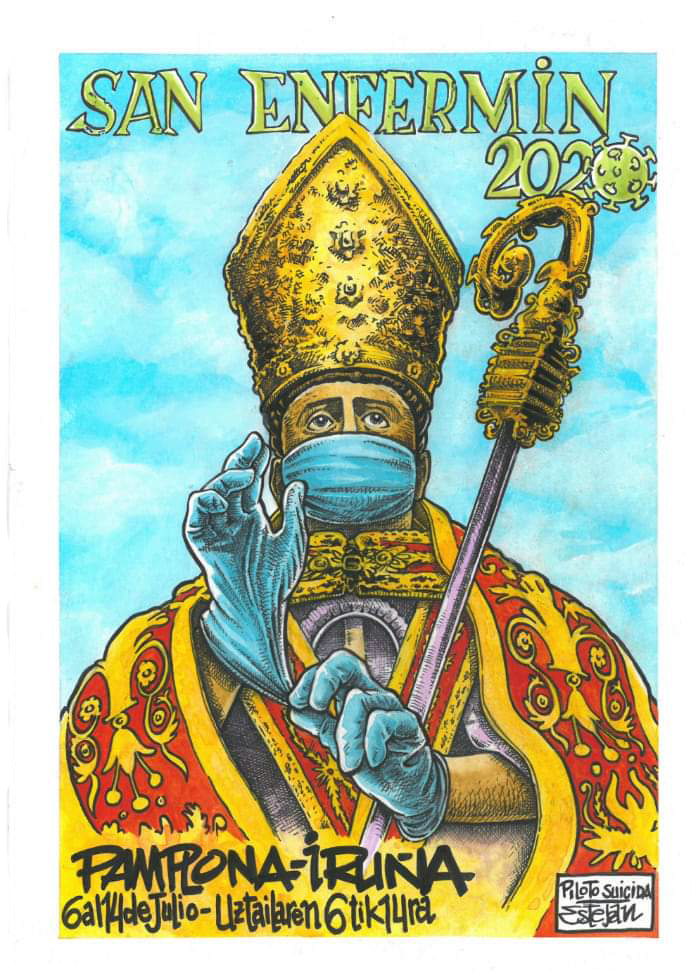
The 2020 San Fermín official poster, selected through the annual concurso de carteles held by Pamplona each year.
2020, As the World Saw It
The cancellation was covered by international media as a marker of how severe the pandemic had become. These are the primary sources and coverage pieces.
Key Dates in 2020
The sequence of events, kept on the record.
Navarra’s first COVID-19 case confirmed. The first wave of infections is beginning to accelerate across Spain.
Spain declares the estado de alarma. Nationwide lockdown: all residents confined, all non-essential businesses closed. It will last 98 days.
San Fermín 2020 officially cancelled by acting mayor Ana Elizalde. Mayor Enrique Maya is at home with COVID-19. The decision is unanimous across all municipal groups.
The estado de alarma expires after 98 days. The cancellation of the fiesta stands.
The chupinazo hour passes in silence. The #LosViviremos banner goes up on the City Hall facade. About 400 people gather in the Plaza Consistorial and wave red kerchiefs. No street celebrations, no chupinazo, no official events.
The first encierro date. No bulls, no runners. A small group in white and red gathers at the assembly point and chants the prayer to San Fermín. RTVE airs archive footage. Pamplona’s streets are otherwise quiet.
The last of the nine fiesta days. No Pobre de mí. No closing candles in the Plaza Consistorial. The encierro community looks forward, as the banner said, to living it again.
San Fermín 2020, Answered
Why was San Fermín 2020 cancelled?
The Fiesta de San Fermín was cancelled because of the COVID-19 pandemic. Spain was one of the hardest-hit countries in the world during the first wave, recording the highest death rate globally by late April 2020. Gathering 1.45 million visitors in the narrow streets of Pamplona’s Old Town for a nine-day fiesta was impossible under those conditions. The cancellation was announced on 21 April 2020 by acting mayor Ana Elizalde, with the consensus of all political groups on the city council.
Had San Fermín ever been cancelled before 2020?
The fiesta was fully cancelled in 1937 and 1938 during the Spanish Civil War, and again in 1978 following violent clashes during the fiesta that left a protester dead. In 1997, one afternoon corrida was suspended following the ETA assassination of Miguel Ángel Blanco, but all eight encierros ran that year. The 2020 cancellation was therefore the first full cancellation since 1978 and the first year with no encierros at all since 1938.
Did anything happen in Pamplona during the fiesta dates in 2020?
Yes, but on a very reduced scale. About 400 people gathered in the Plaza Consistorial at noon on July 6, the moment the chupinazo would normally fire. They waved red kerchiefs and called out the traditional greeting. The city put up a banner reading #LosViviremos (“We will live them”). On July 7, a small group in white and red gathered at the encierro assembly point and chanted the traditional prayer to San Fermín on otherwise empty streets. RTVE broadcast archive footage of past encierros each morning.
Was a poster made for San Fermín 2020?
No official poster was selected. The Pamplona city council’s annual public vote for the fiesta poster, held every year since 2008, was not held in 2020 or 2021. The official pamplona.es archive of carteles shows no entry for 2020 or 2021, moving directly from the 2019 poster by Edurne Taínta Balda to the 2022 poster by Olaia Merino.
When did San Fermín return after the 2020 cancellation?
The fiesta was also cancelled in 2021, making it the first back-to-back cancellation since the Spanish Civil War era. San Fermín returned in full in 2022, with eight encierros running from July 7 to 14. The poster that year was by Olaia Merino. The encierro community that had been waiting for two years ran again on the morning of July 7, 2022.
Which ganaderías were scheduled to run in the 2020 encierros?
Eight ranches had been confirmed before the cancellation: Miura, Cebada Gago, Jandilla, Fuente Ymbro, Núñez del Cuvillo, Victoriano del Río, José Escolar, and La Palmosilla. Miura would have run their record 54th encierro in Pamplona. None of these runs took place.
The Fiesta Came Back
After two cancelled years, the running of the bulls returned to the streets of Pamplona in 2022. See how it came back, or plan your own run with the people who run it every year.