
San Fermín 2027: July 6 to 14. Tours filling fast. Book your spot  | 
ToursRunning with Bulls About Fiesta About UsShop Book Now
The Encierro archive · 1917

Running of the Bulls 1917: San Fermín in Pamplona

San Fermín 1917 had five bull runs (encierros) from Saturday, July 7, to Wednesday, July 11, at six in the morning, and then, after three days without bulls, one more on Sunday, July 15: “un día completo de San Fermín”. About ten thousand people were in the ring by six on July 11.1, 3, 11, 12, 14

By Encierro · Last reviewed

6runs: July 7 to 11 and 15
6:00start, a.m.
10,000in the ring by six, July 11

How the fiesta ran in 1917

The programme set the encierro at six, and “La entrada al encierro es gratuita”: entry to the encierro was free, only box seats in the ring were paid.1 Soldiers could leave barracks from 4:15 with their commanders’ leave but were forbidden to run ahead of the bulls.2

There was a run every morning from July 7 to 11, at six on the programmes.1, 3, 9, 7, 8 There were no bulls from July 12 to 14, “tres días sin toros”;6 then a Sunday with bulls on July 15 gave Pamplona, the paper said, “un día completo de San Fermín, con dianas, encierro”: a full San Fermín day, with dianas and encierro.12, 14

Every known encierro of 1917, by day and ranch

The encierros of San Fermín 1917, from the Diario de Navarra programmes and reports.
DateRunRanch (ganadería)What the paper reported
July 71Marqués de GuadalestA wall of runners at the ring gate
July 82Gregorio CamposA bull ran alone and knocked down barriers; 2 hurt
July 93Viuda de Felipe Salas (programmed)Programme: encierro at six
July 104MurubeOne bull left behind in Santo Domingo
July 115Vicente MartínezAbout 10,000 in the ring
July 12 to 14noneNo encierro
July 156, lastVillar HermanosAn extra Sunday with bulls

The 1917 encierros, day by day

Run 1 of 6

· Marqués de Guadalest

Start6:00 a.m.
Out by sevenAbout 5,000

One Guadalest bull, broken-horned and blind in one eye since it was unloaded, had to be put down in the corrals of the ring and replaced. The encierro itself ran without incident, though an immense crowd ran ahead, pushed by the herd. At the mouth of the ring the bulls had to stop: “el enorme murallón de mozos prensados les impedía avanzar”, a huge wall of packed-in young men blocked them; then they crossed the ring and went into the corrals without stopping. By seven about five thousand people were leaving the ring.1, 3
Run 2 of 6

· Gregorio Campos

Start6:00 a.m.
Hurt2

The programme: “A las seis, encierro de los toros de don Gregorio Campos”.3 The run “fué como pocas veces accidentado”, eventful as few have been. One Campos bull refused to leave the Rochapea corral and then ran alone, knocking down three barriers; at the entrance to Estafeta it threw a barrier onto a municipal guard, who was badly bruised and kept to his bed. A runner dislocated his right knee and was taken from the ring infirmary to the civil hospital. The bull entered the ring alone.5 Among those the police reported to the mayor that weekend was one man “por hostigar á un toro durante el encierro”, for harassing a bull during an encierro.4

Run 3 of 6, programmed

· Viuda de Felipe Salas

Start6:00 a.m.

“A las seis, encierro de los toros de la señora Viuda de don Felipe Salas”, the programme announced.9

Run 4 of 6

· Murube

EnteredIn two goes: 5, then 1

The Murube bulls entered the ring in two goes: first five, and soon after the missing one, which “se había quedado rezagado al comienzo de la cuesta de Santo Domingo”, had lagged at the start of the cuesta de Santo Domingo and been shut in there until the herdsmen went for it with the steers.10

Run 5 of 6

· Vicente Martínez

In the ring by sixAbout 10,000

“nos congregamos en la plaza de toros para las seis de la mañana unas diez mil almas”: some ten thousand people were in the ring by six. The six Vicente Martínez bulls ran amid shouting, with a huge crowd ahead and alongside, and went through the ring into the corrals without stopping.11

Run 6 of 6, the last

· Villar Hermanos

Start6:00 a.m.
WeatherFine

The programme set the encierro at six, “en la forma tradicional”, with six bulls of Villar Hermanos.13 It was like a full San Fermín again: fine weather, dianas, and at six “el tradicional encierro de los toros que llevó á la plaza el enorme contingente acostumbrado”, the ring almost over capacity. The bulls ran the usual course without incident right up to the gates of the pens.14

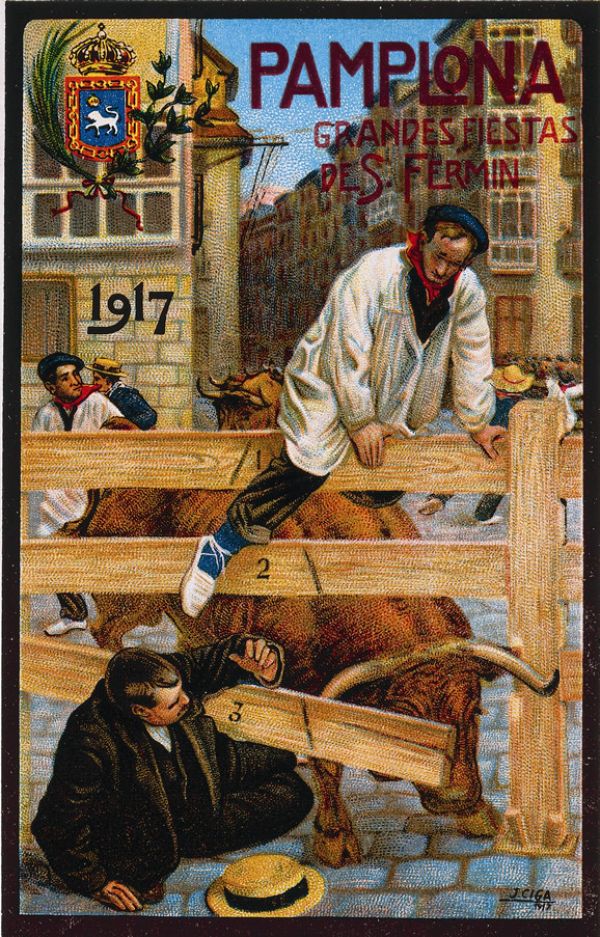
San Fermín 1917 poster (cartel)

San Fermín 1917 poster (cartel) by Javier Ciga: a runner in white with a red neckerchief climbs over the wooden fence as a bull below breaks through one of its boards
Cartel de San Fermín 1917. Poster of San Fermín 1917, from a painting by Javier Ciga. Tap the poster to see it full size. See every San Fermín poster.15
San Fermín 1917 poster (cartel) by Javier Ciga: a runner in white with a red neckerchief climbs over the wooden fence as a bull below breaks through one of its boards
Artist
Javier Ciga (Ollaquindía)

Ollaquindía: the 1917 cover reproduces a painting by Javier Ciga of a rare moment in the encierro, rare but full of danger when it happens: a bull, failing to reach the runner it is chasing, charges the fence and breaks one of its boards. He notes that such accidents have happened only a few times.15

Pamplona in 1917

Words of 1917

Murallón de mozos

The paper’s picture of the crowd at the ring gate on July 7 was “el enorme murallón de mozos prensados”, a huge wall of packed-in young men. A bull left behind was rezagado; the encierro was tradicional.3, 10, 14

Photographs

Where to see old photographs

The city’s photo archive, the Fototeca de Pamplona, holds historic photographs of the encierro, free to view online.16

San Fermín 1917: questions and answers

When were the bull runs of San Fermín 1917?

San Fermín 1917 had five bull runs at six in the morning from Saturday, July 7, to Wednesday, July 11, 1917, and one more on Sunday, July 15, after three days without bulls.1, 3, 9, 7, 8, 6, 13

Why was there an encierro on July 15, 1917?

An extra Sunday with the bulls of Villar Hermanos on July 15, 1917 gave Pamplona, in the Diario de Navarra’s words, a full San Fermín day, with dianas and encierro, after three days without bulls from July 12 to 14.6, 12, 13, 14

How many people watched the running of the bulls in 1917?

About ten thousand people were in Pamplona’s bullring by six on July 11, 1917, the Diario de Navarra reported, and about five thousand were leaving the ring by seven on July 7.11, 3

What happened in the encierro of July 8, 1917?

The encierro of July 8, 1917 was eventful as few have been: one Gregorio Campos bull refused to leave the Rochapea corral and then ran alone, knocking down three barriers, the Diario de Navarra reported.5

Who made the San Fermín 1917 poster?

The San Fermín 1917 cover reproduces a painting by Javier Ciga, according to Ollaquindía: a bull, failing to reach the runner it is chasing, charges the fence and breaks one of its boards.15

Sources

Numbers on the page refer to this list. Diario de Navarra pages are cited from its archive (hemeroteca); quotations in Spanish are given as printed, in the spelling of the day.

Full source list
  1. Diario de Navarra, July 6, 1917, page 1: programme for July 7, “A las seis de la mañana se verificará el encierro de los toros de Guadalest”; “La entrada al encierro es gratuita”. Diario de Navarra archive
  2. Diario de Navarra, July 6, 1917, page 2: garrison order, soldiers forbidden to run ahead of the bulls. Diario de Navarra archive
  3. Diario de Navarra, July 8, 1917, page 1: the first encierro, “el enorme murallón de mozos prensados les impedía avanzar”; programme for July 8, the Gregorio Campos bulls. Diario de Navarra archive
  4. Diario de Navarra, July 9, 1917, page 2: reports to the mayor, “uno por hostigar á un toro durante el encierro”. Diario de Navarra archive
  5. Diario de Navarra, July 9, 1917, page 1: the encierro of July 8, “fué como pocas veces accidentado”. Diario de Navarra archive
  6. Diario de Navarra, July 12, 1917, page 1: “Que quedan de por medio tres días sin toros”. Diario de Navarra archive
  7. Diario de Navarra, July 10, 1917, page 1: programme for July 10, the encierro at six. Diario de Navarra archive
  8. Diario de Navarra, July 11, 1917, page 1: programme for July 11, the encierro at six. Diario de Navarra archive
  9. Diario de Navarra, July 9, 1917, page 1: programme for July 9, “A las seis, encierro de los toros de la señora Viuda de don Felipe Salas”. Diario de Navarra archive
  10. Diario de Navarra, July 11, 1917, page 1: the Murube encierro of July 10, “el toro que faltaba ... se había quedado rezagado al comienzo de la cuesta de Santo Domingo”. Diario de Navarra archive
  11. Diario de Navarra, July 12, 1917, page 1: the Vicente Martínez encierro of July 11, “unas diez mil almas”. Diario de Navarra archive
  12. Diario de Navarra, July 13, 1917, page 1: “el domingo tendremos un día completo de San Fermín, con dianas, encierro”. Diario de Navarra archive
  13. Diario de Navarra, July 14, 1917, page 1: programme for Sunday, July 15, the encierro at six of six bulls of Villar Hermanos. Diario de Navarra archive
  14. Diario de Navarra, July 16, 1917, page 1: the encierro of Sunday, July 15, “el tradicional encierro de los toros que llevó á la plaza el enorme contingente acostumbrado”. Diario de Navarra archive
  15. Ricardo Ollaquindía, 100 años de carteles de las fiestas y ferias de San Fermín (1882 to 1981), Pamplona, 1981, chapter “1917”. Free copy in the Biblioteca Navarra Digital (BiNaDi). binadi.navarra.es
  16. Fototeca de Pamplona, Archivo Municipal de Pamplona (photographs of the encierro, free to view online; publication needs the archive’s permission). archivo.pamplona.es
How to cite this page

Encierro. “Running of the Bulls 1917: San Fermín in Pamplona.” Encierro.com, November 9, 2026. https://encierro.com/san-fermin-1917/

Corrections and updates
  • : questions and answers rewritten around what people search, each answer with its sources; the poster labelled with its Spanish name, cartel.
  • : page published.

Walk the route with people who run it

Book your walk