
San Fermín 2027: July 6 to 14. Tours filling fast. Book your spot  | 
ToursRunning with Bulls About Fiesta About UsShop Book Now
The Encierro archive · 1918

Running of the Bulls 1918: San Fermín in Pamplona

In 1918 the programme set the bull run (encierro) of San Fermín at seven in the morning; the year before it had been at six.1, 12 There was a run every morning from Sunday, July 7, to Thursday, July 11. On the first day some sixteen thousand people could not fit into the ring, and one young man entered it “suspendido del cuerno de un toro”, hanging from a bull’s horn, without serious consequences; on the second the Cándido Díaz bulls ran the course in under two minutes.1, 2, 3, 10

By Encierro · Last reviewed

7:00new start, a.m.
5runs, July 7 to 11
Under 2 minCándido Díaz, July 8

How the fiesta ran in 1918

The 1918 programme set dianas at six and “A las siete de la mañana se verificará el encierro”: the encierro at seven in the morning, an hour later than the 1917 programme’s six.1, 12 The runs followed every morning at seven from July 7 to July 11.6, 3, 4, 7

The crowds grew. On July 7 the gates and passages of the ring were jammed from 6:30 and no fewer than sixteen thousand people were left outside, many watching from the streets.2 Of July 10 the paper wrote that never before had the fourth day of the fiestas seen such a full ring at encierro time; in other years the full houses came on the first and last days.9

After the fiesta an essay called it “ese brutal y españolísimo espectáculo del encierro”, rough as it is, the vivid picture that carries the bold soul of Navarre to outsiders.11

Every known encierro of 1918, by day and ranch

The encierros of San Fermín 1918, from the Diario de Navarra programmes and reports.
DateRunRanch (ganadería)What the paper reported
July 71Heirs of Vicente MartínezA young man carried in on a horn; 16,000 left outside
July 82Cándido DíazUnder two minutes
July 93Hijos de AlaizaA packed ring from 6:30
July 104Gamero CívicoThe fullest fourth day yet
July 115, lastPablo RomeroFive bulls and a steer, then one more bull

The 1918 encierros, day by day

Run 1 of 5

· Heirs of Vicente Martínez

Start7:00 a.m.
Left outside the ring16,000 or more

At seven sharp, after a rocket, the six bulls of the heirs of Vicente Martínez left the small corral of Rochapea with the steers. It was eventful but without serious consequences: the immense crowd on the course could neither move forward nor turn back, many threw themselves to the sides of the street and a few were tossed. At the ring gate, with no room to pass, the bulls charged to clear a way; boys fell in heaps on both sides of the gate, and “uno de estos entró suspendido del cuerno de un toro”, one of them entered hanging from a bull’s horn.1, 2
Run 2 of 5

· Cándido Díaz

TimeUnder 2 minutes
IncidentsNone

The ring was as full as on the first day, and fewer ran ahead. The six fine Navarre bulls of Cándido Díaz, sheltered by their steers, “hicieron el recorrido en menos de dos minutos y entraron en la plaza como borregos”: they ran the course in under two minutes and entered the ring like lambs, straight into the corrals.3

Run 3 of 5

· Hijos de Alaiza

Start7:00 a.m.

“A las siete encierro de los toros de los señores Hijos de Alaiza”, the programme said.3 The ring was packed from 6:30, a couple of thousand over capacity, with a huge crowd of boys running in ahead of the Navarre bulls.4 One man was reported for calling the bulls’ attention during the run.5

Run 4 of 5

· Gamero Cívico

Start7:00 a.m.

“A las siete, encierro de los toros de Gamero Cívico”.4 Never before, the paper wrote, had the fourth day of the fiestas seen such a full ring at encierro time.9 One bull came back out of the corrals and ran along the barrier without reaching anyone.8

Run 5 of 5, the last

· Pablo Romero

Entered5 bulls and a steer, then 1

Thousands filled the ring as on the first day. The six Pablo Romero bulls of Seville ran the course, and “entraron en la plaza cinco toros y un cabestro”: five bulls and a steer entered first, then at some distance one more bull with the other steers. All went into the corrals without stopping.10

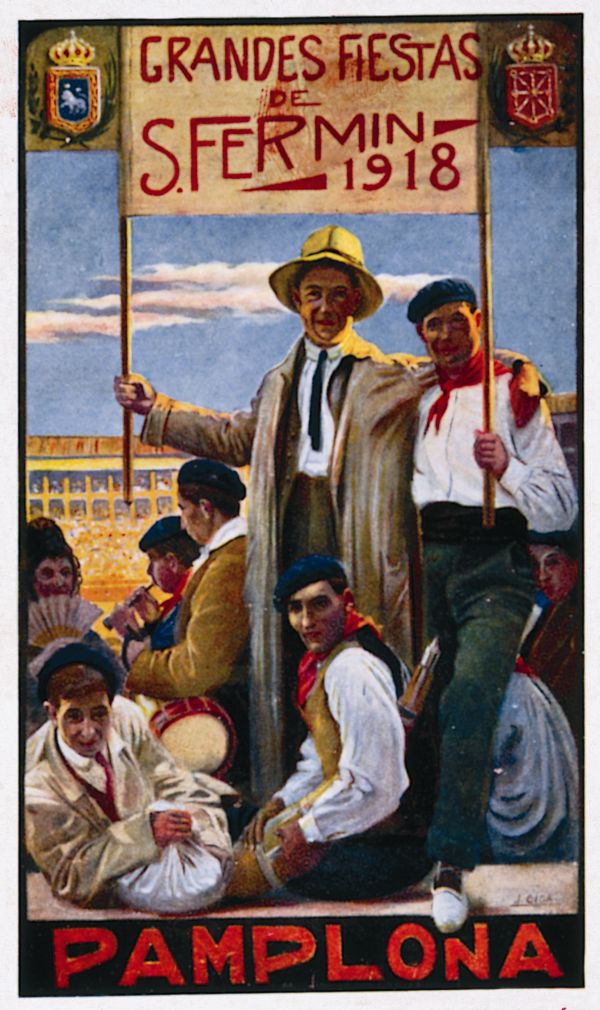
San Fermín 1918 poster (cartel)

San Fermín 1918 poster (cartel) by Javier Ciga: a group of mozos with a gaitero and a drummer, two of them holding up a banner reading Grandes Fiestas de S. Fermín 1918, watched by a woman behind a fan
Cartel de San Fermín 1918. Poster of San Fermín 1918, from a painting by Javier Ciga. Tap the poster to see it full size. See every San Fermín poster.13
San Fermín 1918 poster (cartel) by Javier Ciga: a group of mozos with a gaitero and a drummer, two of them holding up a banner reading Grandes Fiestas de S. Fermín 1918, watched by a woman behind a fan
Artist
Javier Ciga (Ollaquindía)
Back cover
Portrait of the kiliki “Bigotes”

Ollaquindía: the cover reproduces a painting by Javier Ciga of a group of six mozos, with music, a gaitero and a drummer; a woman watches them, covering her mouth with an open fan. Two of the mozos, arm in arm, hold up a banner reading “Grandes Fiestas de S. Fermín 1918”. On the back, Ciga drew a portrait of the kiliki “Bigotes”, “una pequeña obra de arte”, a small work of art.13

Pamplona in 1918

Giants and big-heads

Who made the giants

In his 1918 chapter Ollaquindía quotes José Luis Ollo: according to Benito Iribertegui, Pamplona’s giants were made in 1860 by a painter named Tadeo Amorena, who proposed noble figures to represent the four parts of the world.13

Words of 1918

Como borregos

Bulls that ran calmly with their steers entered the ring “como borregos”, like lambs. A runner carried on a horn entered “suspendido del cuerno”. The start was the corralillo of Rochapea.2, 3

Photographs

Where to see old photographs

The city’s photo archive, the Fototeca de Pamplona, holds historic photographs of the encierro, free to view online.14

San Fermín 1918: questions and answers

When did the running of the bulls move to seven in the morning?

The running of the bulls of San Fermín moved to seven in the morning in 1918: the programme for July 7, 1918 set the encierro at seven, an hour later than the six of the 1917 programme.1, 12

When were the bull runs of San Fermín 1918?

San Fermín 1918 had a bull run every morning at seven from Sunday, July 7, to Thursday, July 11, 1918: five runs, with bulls of the heirs of Vicente Martínez, Cándido Díaz, the sons of Alaiza, Gamero Cívico and Pablo Romero.1, 6, 3, 4, 7

How fast did the Cándido Díaz bulls run in 1918?

The Cándido Díaz bulls ran the course in under two minutes on July 8, 1918, sheltered by their steers, and entered the ring like lambs, the Diario de Navarra reported.3

How many people were left outside the bullring in 1918?

No fewer than sixteen thousand people were left outside Pamplona’s bullring at the first encierro of July 7, 1918, the Diario de Navarra reported, with the gates and passages of the ring jammed from 6:30.2

Was anyone hurt in the 1918 running of the bulls?

The first run of 1918, on July 7, was eventful but had no serious consequences: a few runners were tossed and one young man entered the ring hanging from a bull’s horn. On July 10 a bull came back out of the corrals and ran along the barrier without reaching anyone.2, 8

Who made the San Fermín 1918 poster?

Javier Ciga painted the San Fermín 1918 cover, according to Ollaquindía: a group of six mozos with a gaitero and a drummer, two of them holding up a banner reading “Grandes Fiestas de S. Fermín 1918”.13

Sources

Numbers on the page refer to this list. Diario de Navarra pages are cited from its archive (hemeroteca); quotations in Spanish are given as printed, in the spelling of the day.

Full source list
  1. Diario de Navarra, July 6, 1918, page 1: programme for July 7, “A las siete de la mañana se verificará el encierro de los toros de Herederos de D. Vicente Martínez”. Diario de Navarra archive
  2. Diario de Navarra, July 8, 1918, page 1: the first encierro, July 7, “uno de estos entró suspendido del cuerno de un toro”. Diario de Navarra archive
  3. Diario de Navarra, July 9, 1918, page 1: the Cándido Díaz encierro of July 8, “hicieron el recorrido en menos de dos minutos”; programme for July 9, the sons of Alaiza. Diario de Navarra archive
  4. Diario de Navarra, July 10, 1918, page 1: the encierro of July 9; programme for July 10, “A las siete, encierro de los toros de Gamero Cívico”. Diario de Navarra archive
  5. Diario de Navarra, July 10, 1918, page 4: a man reported “por llamar la atención de los toros en el encierro de ayer”, July 9. Diario de Navarra archive
  6. Diario de Navarra, July 8, 1918, page 1: programme for July 8, “A las siete encierro de los toros de don Cándido Díaz”. Diario de Navarra archive
  7. Diario de Navarra, July 11, 1918, page 1: programme for July 11, “A las siete, encierro de los toros de don Felipe de Pablo Romero”. Diario de Navarra archive
  8. Diario de Navarra, July 11, 1918, page 1: a bull came back out of the corrals on July 10 and ran along the barrier, “sin alcanzar a nadie”. Diario de Navarra archive
  9. Diario de Navarra, July 11, 1918, page 1: the encierro of July 10, the fullest ring ever seen on a fourth day. Diario de Navarra archive
  10. Diario de Navarra, July 12, 1918, page 1: the Pablo Romero encierro of July 11, “entraron en la plaza cinco toros y un cabestro”. Diario de Navarra archive
  11. Diario de Navarra, July 14, 1918, page 1: essay, “ese brutal y españolísimo espectáculo del encierro”. Diario de Navarra archive
  12. Diario de Navarra, July 6, 1917, page 1: programme for July 7, 1917, “A las seis de la mañana se verificará el encierro”. Diario de Navarra archive
  13. Ricardo Ollaquindía, 100 años de carteles de las fiestas y ferias de San Fermín (1882 to 1981), Pamplona, 1981, chapter “1918”. Free copy in the Biblioteca Navarra Digital (BiNaDi). binadi.navarra.es
  14. Fototeca de Pamplona, Archivo Municipal de Pamplona (photographs of the encierro, free to view online; publication needs the archive’s permission). archivo.pamplona.es
How to cite this page

Encierro. “Running of the Bulls 1918: San Fermín in Pamplona.” Encierro.com, November 9, 2026. https://encierro.com/san-fermin-1918/

Corrections and updates
  • : questions and answers rewritten around what people search, each answer with its sources; the poster labelled with its Spanish name, cartel.
  • : page published.

Walk the route with people who run it

Book your walk