San Fermín 2027: July 6 to 14. Tours filling fast. Book your spot  | 
ToursRunning with Bulls About Fiesta About UsShop Book Now
The Encierro archive · 1921

Running of the Bulls 1921: San Fermín in Pamplona

San Fermín 1921 ran from July 6 to 18. The known run days of the bull run (encierro) were Thursday, July 7, to Monday, July 11, the last two from the programmes, with the encierro set at six. After one of the runs a writer asked for jail for “esos valientes de oficio”, the show-offs who called the bulls at the ring gate.8, 1, 2, 3, 5, 6

By Encierro · Last reviewed

5run days programmed, July 7 to 11
6:00start, a.m.
5:30ring packed, July 9

How the fiesta ran in 1921

The poster announced the Feria y Fiestas “del 6 al 18 de julio”.8 On July 7 the dulzainas, bands and trumpets played dianas at dawn, and “A las seis se verificará el encierro de los toros”: the encierro at six, then young bulls with padded horns let loose for the amateurs, and “Después... a las churrerías”, afterwards, to the churro stalls.1

The paper reported the runs of July 7 and 9, and its July 9 report says the ring had been just as full on the first and second days. Its programmes for July 8, 10 and 11 set the encierro at six.2, 3, 5 The programme named bulls for each day: Villar Hermanos on July 7, Félix Moreno Ardanuy (formerly the Marqués del Saltillo) on July 8, Cándido Díaz of Funes on July 9, the Marqués de Guadalest on July 10 and the Conde de Santa Coloma on July 11.7

In “Aspectos de San Fermín” José Asenjo wrote about “esos valientes de oficio que abundan siempre entre las multitudes”, the professional braves found in every crowd. As the bulls entered the ring, guided by the herdsmen towards the pens, one young man would step out from the runners taking refuge at the barrier and call to a bull, which turned restless at the shout; the whole ring condemned him. A runner fleeing up Estafeta was hurt at the fence because of such a clown. Asenjo asked for an exemplary punishment for such braves.6

Every known encierro of 1921, by day and ranch

The encierros of San Fermín 1921, from the Diario de Navarra programmes and reports and the fiesta programme.
DateRunRanch (ganadería)What the paper reported
July 71Villar Hermanos (programme)Course too small for the runners; a man jailed
July 82Félix Moreno (programme)Ring packed, as on the first day
July 93Cándido Díaz (programme)Ring packed by 5:30
July 104Marqués de Guadalest (programmed)Programme: encierro at six
July 115, lastConde de Santa Coloma (programmed)Programme: encierro at six

The 1921 encierros, day by day

Run 1 of 5

· Villar Hermanos (programme)

Start6:00 a.m.

Dianas at dawn and the encierro at six.1 The course was too small for the several hundred young men who ran in ahead of the herd, and some came in almost hanging from the horns; “Total, que no pasó nada”, in the end, nothing happened.2 The next day the paper reported that a man had been taken to the municipal lock-up “por estorbar en el encierro de ayer al entrar los toros en los corrales”, for getting in the way in the encierro as the bulls entered the corrals.4 The programme named the bulls of Villar Hermanos for the day.7

Run 2 of 5

· Félix Moreno (programme)

Start6:00 a.m.
CrowdRing packed

“A las seis encierro de los toros”, the programme said.3 Reporting on July 9, the paper said the ring had been just as full on the first and second days.5 The programme named the bulls of Félix Moreno Ardanuy, formerly the Marqués del Saltillo.7

Run 3 of 5

· Cándido Díaz (programme)

Ring packed by5:30 a.m.

In other years, the paper wrote, the second and third encierros drew thinner crowds, with gaps in the stands; that was history. By five on July 9 Pamplona people and visitors were already walking together to the plaza, and by half past five the ring was “pletórica de gente”, packed, as on the days before.5 The programme named the bulls of Cándido Díaz of Funes.7

Run 4 of 5, programmed

· Marqués de Guadalest

Start6:00 a.m.

“A las seis encierro de los toros del marqués de Guadalest”, the programme said, after dianas by the dulzainas, bands and trumpets.5

Run 5 of 5, programmed

· Conde de Santa Coloma

Start6:00 a.m.

The programme printed the day before set dianas at five and the encierro at six.5 The fiesta programme named the bulls of the Conde de Santa Coloma.7

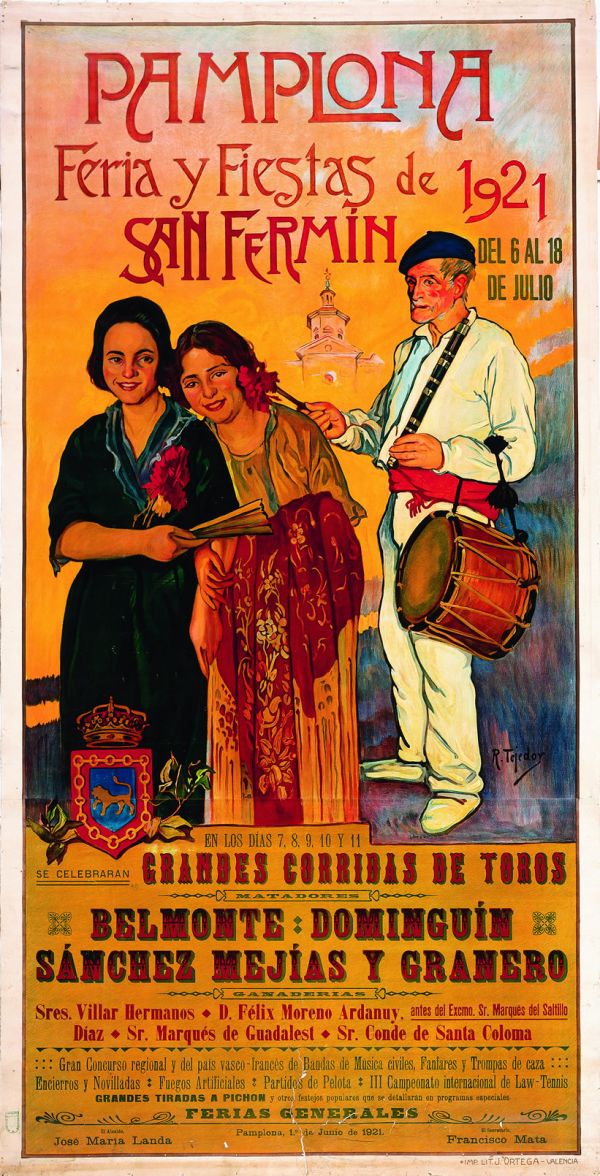
San Fermín 1921 poster (cartel)

San Fermín 1921 poster (cartel) by R. Tejedor: two smiling young women, one in a dark dress holding a fan and red carnations, the other wrapped in a red embroidered shawl with a red flower in her hair, beside an old drummer in white with a red sash and a black beret, a church tower behind them
Cartel de San Fermín 1921. Poster of the Feria y Fiestas de San Fermín 1921, signed R. Tejedor. Tap the poster to see it full size. See every San Fermín poster.8
San Fermín 1921 poster (cartel) by R. Tejedor: two smiling young women, one in a dark dress holding a fan and red carnations, the other wrapped in a red embroidered shawl with a red flower in her hair, beside an old drummer in white with a red sash and a black beret, a church tower behind them
Artist
R. Tejedor (signature)
Fiesta on the poster
Del 6 al 18 de julio
Printed by
Imp. Lit. J. Ortega, Valencia

Two young women smile out of the 1921 poster, one in a dark dress with a fan and red carnations, the other wrapped in a red embroidered shawl, while an old drummer in white with a red sash and a black beret stands beside them; a church tower rises behind. The crowned shield of Pamplona sits at the foot of the picture.8

The poster also announces a regional band competition, fireworks, pelota and the third international lawn tennis championship, and names the ranches whose bulls came that year.8

Ollaquindía found two programmes for 1921 with different covers. One broke with custom by carrying advertising: a full page for the Banco Hispano Americano and half pages for the Bazar Ostiz, a paper-bag maker in Villava, a foundry and the Dena-Ona bar, “con todos los adelantos modernos”. Both programmes printed photographs, including the giants and big-heads.7

Pamplona in 1921

Words of 1921

Valientes de oficio

Asenjo’s name for the show-offs was “valientes de oficio”, braves by trade. The herdsmen were pastores, and after the run the crowd went “a las churrerías”.6, 1

Photographs

Where to see old photographs

The city’s photo archive, the Fototeca de Pamplona, holds historic photographs of the encierro, free to view online.9

San Fermín 1921: questions and answers

When were the bull runs of San Fermín 1921?

The known run days of San Fermín 1921 were Thursday, July 7, to Monday, July 11, 1921, with the encierro set at six. The Diario de Navarra reported the runs of July 7 and 9 and printed programmes for July 8, 10 and 11.1, 2, 3, 5

Which ranches’ bulls ran in 1921?

The fiesta programme of 1921 named Villar Hermanos for July 7, Félix Moreno Ardanuy, formerly the Marqués del Saltillo, for July 8, Cándido Díaz for July 9, the Marqués de Guadalest for July 10 and the Conde de Santa Coloma for July 11.7, 5

Who were the valientes de oficio of 1921?

The valientes de oficio, braves by trade, were the show-offs José Asenjo condemned in the Diario de Navarra in 1921: runners who stepped out from the barrier to call to a bull as the herd entered the ring. A runner fleeing up Estafeta was hurt at the fence because of one, and Asenjo asked for exemplary punishment.6

Was anyone arrested in the 1921 running of the bulls?

A man was taken to the municipal lock-up on July 7, 1921 for getting in the way as the bulls entered the corrals, the Diario de Navarra reported the next day.4

Who made the San Fermín 1921 poster?

R. Tejedor made the San Fermín 1921 poster, signed on the poster itself: two young women, one in a red embroidered shawl, beside an old drummer in white with a red sash and a black beret.8

Sources

Numbers on the page refer to this list. Diario de Navarra pages are cited from its archive (hemeroteca); quotations in Spanish are given as printed, in the spelling of the day.

Full source list
  1. Diario de Navarra, July 7, 1921, page 2: programme for July 7, “A las seis se verificará el encierro de los toros”. Diario de Navarra archive
  2. Diario de Navarra, July 8, 1921, page 1: the first encierro, July 7, the course too small for the several hundred who ran ahead of the herd; “Total, que no pasó nada”. Diario de Navarra archive
  3. Diario de Navarra, July 8, 1921, page 2: programme for July 8, “A las seis encierro de los toros que se han de lidiar por la tarde”. Diario de Navarra archive
  4. Diario de Navarra, July 8, 1921, page 3: a man taken to the municipal lock-up “por estorbar en el encierro de ayer al entrar los toros en los corrales”. Diario de Navarra archive
  5. Diario de Navarra, July 10, 1921, page 1: the encierro of July 9, the ring “pletórica de gente” by 5:30, as on the days before; programmes for July 10, “A las seis encierro de los toros del marqués de Guadalest”, and for July 11, the encierro at six. Diario de Navarra archive
  6. Diario de Navarra, July 10, 1921, page 4: José Asenjo, “Aspectos de San Fermín”, on “esos valientes de oficio que abundan siempre entre las multitudes”. Diario de Navarra archive
  7. Ricardo Ollaquindía, 100 años de carteles de las fiestas y ferias de San Fermín (1882 to 1981), Pamplona, 1981, chapter “1921”. Free copy in the Biblioteca Navarra Digital (BiNaDi). binadi.navarra.es
  8. The poster of the Feria y Fiestas de San Fermín 1921 itself, “del 6 al 18 de julio”; signed R. Tejedor; printed by Imp. Lit. J. Ortega, Valencia.
  9. Fototeca de Pamplona, Archivo Municipal de Pamplona (photographs of the encierro, free to view online; publication needs the archive’s permission). archivo.pamplona.es
How to cite this page

Encierro. “Running of the Bulls 1921: San Fermín in Pamplona.” Encierro.com, November 9, 2026. https://encierro.com/san-fermin-1921/

Corrections and updates
  • : questions and answers rewritten around what people search, each answer with its sources; the poster labelled with its Spanish name, cartel.
  • : page published.

Walk the route with people who run it

Book your walk