
San Fermín 2027: July 6 to 14. Tours filling fast. Book your spot  | 
ToursRunning with Bulls About Fiesta About UsShop Book Now
The Encierro archive · 1920

Running of the Bulls 1920: San Fermín in Pamplona

In 1920 the programme set the bull run (encierro) of San Fermín at six in the morning. The known run days were Wednesday, July 7, to Sunday, July 11; on the first the course was too narrow for the hundreds running ahead, and on July 10 the Cándido Díaz bulls ran it in two minutes.5, 6, 7, 9, 10, 3

By Encierro · Last reviewed

5known run days, July 7 to 11
6:00start, a.m.
2 minCándido Díaz, July 10

How the fiesta ran in 1920

The 1920 programme set the encierro at six: “A las seis se verificará el encierro de los toros”, after dawn music by dulzainas, bands and cavalry trumpets.5 The known run days were July 7, 8, 9, 10 and 11.6, 7, 8, 9, 10, 3

On July 10 the paper noted that the second and third days used to draw smaller crowds, but that was history: “nuestra vetusta plaza está á prueba de llenazos”, our old ring was proof against packed houses, and it was full by 5:30.9

Before the runs began, an essay complained that “Son pocos los valientes que hoy van á corto trecho de las reses”: few brave runners now ran close to the bulls, and many galloped along at a respectful distance.1

Every known encierro of 1920, by day and ranch

The known encierros of San Fermín 1920, from the Diario de Navarra programmes and reports.
DateRunRanch (ganadería)What the paper reported
July 7Known run 1Conde de Santa ColomaToo many runners for the course; a bull stopped in the Plaza Consistorial
July 8Known run 2Manuel AlbarránSeveral thousand in the ring by 5:30
July 9Known run 3Villar HermanosA steer tossed two boys
July 10Known run 4Cándido DíazTwo minutes
July 11Known run 5Félix MorenoNo incidents despite the crowd

The 1920 encierros, day by day

Known run 1

· Conde de Santa Coloma

Start6:00 a.m.
Bull stopped15 minutes or more

The programme: at six, at the bang of a rocket, the Andalusian bulls of the Conde de Santa Coloma would leave the little corral at the Rochapea gate.2 Dulzainas played from 4:30 and the bands from five. “el trayecto que recorren los toros era insuficiente para dar cabida a los varios cientos” who ran ahead: the course could not hold them, and many, right on the horns or even mixed in with the herd, had to throw themselves to the sides. In the ring, bull number 37 veered away from the pens, drawn off by a reckless young man; the paper said the authorities should be the first to forbid such dangers. Then word spread that another bull had stayed behind in the little plaza of the Casa Consistorial; it stood there more than a quarter of an hour until it was fetched with three oxen and went into the pens without harming anyone.5, 6
Known run 2

· Manuel Albarrán

Start6:00 a.m.
In the ring by 5:30Several thousand

By 5:30 several thousand people filled the old ring. At six sharp, at the bang of a rocket, “salieron de los corrales de Rochapea los seis toros de Albarrán”, and they ran almost the whole course ahead of the steers.7

Known run 3

· Villar Hermanos

Start6:00 a.m.
Ring full by5:30

“A las seis encierro de los toros de los señores Villar Hermanos”.8 The ring was full by 5:30, with an immense group of boys running in ahead. A steer that seemed tired of being a good steer tossed two boys high into the air.9

Known run 4

· Cándido Díaz

Start6:00 a.m.
Time2 minutes

The fourth encierro: the ring could hold no more and many stayed outside. “Los toros navarros de don Cándido Díaz, á pesar de sus arrobas hicieron el recorrido acostumbrado en dos minutos”: despite their weight, the Navarre bulls of Cándido Díaz ran the usual course in two minutes, with huge crowds ahead and behind.9, 10

Known run 5

· Félix Moreno

Start6:00 a.m.
IncidentsNone

“A las seis encierro de los toros de don Félix Moreno (antes Saltillo)”, the programme said: the bulls of Félix Moreno, formerly Saltillo.3 The next paper, on July 13, reported that “El encierro de los toros se verificó sin incidentes”, without incident, despite the huge crowd that entered the ring ahead of the bulls and even mixed in with them.4

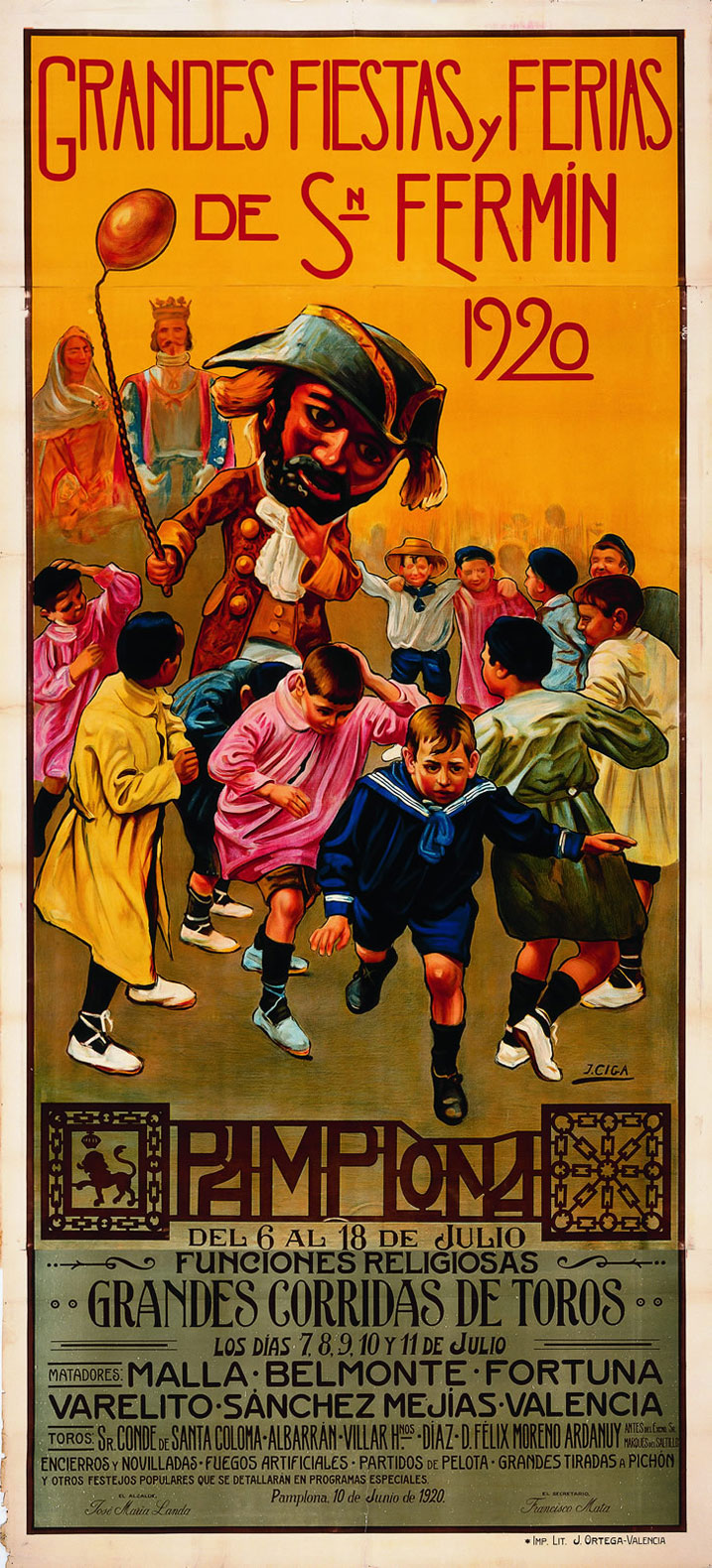
San Fermín 1920 poster (cartel)

San Fermín 1920 poster (cartel) by Javier Ciga: a kiliki with a huge painted head chases a group of children in smocks and alpargatas, one boy in a sailor suit running out of the frame, while the giants of Pamplona look on
Cartel de San Fermín 1920. Poster of San Fermín 1920, by Javier Ciga. Tap the poster to see it full size. See every San Fermín poster.11
San Fermín 1920 poster (cartel) by Javier Ciga: a kiliki with a huge painted head chases a group of children in smocks and alpargatas, one boy in a sailor suit running out of the frame, while the giants of Pamplona look on
Artist
Javier Ciga (Ollaquindía)

“Otra obra de arte”, another work of art, Ollaquindía says of Ciga’s 1920 poster: a group of children in smocks and alpargatas running round a kiliki, one of the big-headed figures, while the pair of giants looks on kindly. One boy, the most frightened and the fastest, dressed as a sailor, runs out of the frame.11

“Los kilikis son los toros de los chiquillos”, he writes: the kilikis are the children’s bulls, chasing them through the streets and landing blows left and right.11

Pamplona in 1920

Words of 1920

Vetusta plaza

The paper called the old ring “nuestra vetusta plaza”, the herd las reses, and the runners close to the horns los valientes. The bulls left from the corrales de Rochapea.7, 9, 1

Photographs

Where to see old photographs

The city’s photo archive, the Fototeca de Pamplona, holds historic photographs of the encierro, free to view online.12

San Fermín 1920: questions and answers

What time was the running of the bulls in 1920?

The running of the bulls of San Fermín 1920 was set for six in the morning: the programme of July 7, 1920 set the encierro at six, after dawn music by dulzainas, bands and cavalry trumpets.5

When were the bull runs of San Fermín 1920?

The known run days of San Fermín 1920 were Wednesday, July 7, to Sunday, July 11, 1920, with bulls of the Conde de Santa Coloma on July 7, on the programme, Manuel Albarrán on July 8, Villar Hermanos on July 9, Cándido Díaz on July 10 and Félix Moreno on July 11.2, 7, 8, 10, 3

How long did a run take in 1920?

The Cándido Díaz bulls ran the usual course in two minutes on July 10, 1920, despite their weight, the Diario de Navarra reported.10

Were there fewer brave runners in 1920?

An essay in the Diario de Navarra complained before the runs of 1920 that few brave runners now ran close to the bulls, and that many galloped along at a respectful distance.1

Who made the San Fermín 1920 poster?

Javier Ciga made the San Fermín 1920 poster, according to Ollaquindía: children in smocks and alpargatas running round a kiliki while the giants look on, with one boy in a sailor suit running out of the frame.11

Sources

Numbers on the page refer to this list. Diario de Navarra pages are cited from its archive (hemeroteca); quotations in Spanish are given as printed, in the spelling of the day.

Full source list
  1. Diario de Navarra, July 6, 1920, page 2: essay, “Son pocos los valientes que hoy van á corto trecho de las reses”. Diario de Navarra archive
  2. Diario de Navarra, July 6, 1920, page 1: programme for July 7, “saldrán del corralillo de puerta de Rochapea los toros andaluces del señor Conde de Santa Coloma”. Diario de Navarra archive
  3. Diario de Navarra, July 11, 1920, page 1: programme for July 11, “A las seis encierro de los toros de don Félix Moreno (antes Saltillo)”. Diario de Navarra archive
  4. Diario de Navarra, July 13, 1920, page 1: “El encierro de los toros se verificó sin incidentes á pesar de la gran muchedumbre de gente que entró en la plaza precediéndolos”. Diario de Navarra archive
  5. Diario de Navarra, July 7, 1920, page 1: programme for July 7, “A las seis se verificará el encierro de los toros”. Diario de Navarra archive
  6. Diario de Navarra, July 8, 1920, page 1: the first encierro, July 7, “el trayecto que recorren los toros era insuficiente para dar cabida a los varios cientos”. Diario de Navarra archive
  7. Diario de Navarra, July 9, 1920, page 1: the encierro of July 8, “salieron de los corrales de Rochapea los seis toros de Albarrán”. Diario de Navarra archive
  8. Diario de Navarra, July 9, 1920, page 1: programme for July 9, “A las seis encierro de los toros de los señores Villar Hermanos”. Diario de Navarra archive
  9. Diario de Navarra, July 10, 1920, page 1: the encierro of July 9, “nuestra vetusta plaza está á prueba de llenazos”; programme for July 10, the Cándido Díaz bulls at six. Diario de Navarra archive
  10. Diario de Navarra, July 11, 1920, page 1: the encierro of July 10, “hicieron el recorrido acostumbrado en dos minutos”. Diario de Navarra archive
  11. Ricardo Ollaquindía, 100 años de carteles de las fiestas y ferias de San Fermín (1882 to 1981), Pamplona, 1981, chapter “1920”. Free copy in the Biblioteca Navarra Digital (BiNaDi). binadi.navarra.es
  12. Fototeca de Pamplona, Archivo Municipal de Pamplona (photographs of the encierro, free to view online; publication needs the archive’s permission). archivo.pamplona.es
How to cite this page

Encierro. “Running of the Bulls 1920: San Fermín in Pamplona.” Encierro.com, November 9, 2026. https://encierro.com/san-fermin-1920/

Corrections and updates
  • : questions and answers rewritten around what people search, each answer with its sources; the poster labelled with its Spanish name, cartel.
  • : page published.

Walk the route with people who run it

Book your walk