San Fermín 2027: July 6 to 14. Tours filling fast. Book your spot  | 
ToursRunning with Bulls About Fiesta About UsShop Book Now
The Encierro archive · 1929

Running of the Bulls 1929: San Fermín in Pamplona

San Fermín 1929 had bull runs (encierros) at seven in the morning; the known run days were July 7 to 10 and Sunday, July 14, the last. The steers of the Navarre ranch of Alaiza guided the herds, and on July 10 a Pablo Romero bull named Dormido, Sleepy, lived up to its name and stayed in the corral, so that there were “dos encierros”, two encierros, that morning.2, 7, 6, 8, 10, 5, 14, 15

By Encierro · Last reviewed

7:00start, a.m.
2encierros on July 10
62Dormido, the bull that slept in

How the fiesta ran in 1929

The Alaiza bulls came to Pamplona, “la única de Navarra”, the paper said, the only Navarre ranch still keeping the brave breed of the land: with the cows and steers, thirty-seven head in all, eight herdsmen and their mayoral.1 Those Alaiza steers wrapped the herds in the encierros; after the fiesta the paper called the encierros the strong point of the fiesta, handled so admirably by “los pastores y cabestraje de la ganadería de Alaiza”.6, 15

The programme set the encierro at seven, with free entry to the ring except the stands and boxes.2 Before the fiesta an essay reminded readers that the encierros “suponen una costumbre tradicional de muchos siglos”, a tradition of many centuries, with generations of young men behind today’s runners.3

Every known encierro of 1929, by day and ranch

The known encierros of San Fermín 1929, from the Diario de Navarra programmes and reports.
DateRunRanch (ganadería)What the paper reported
July 7Known run 1José Luis EncinasMusic from 5:30; crowds to the ring
July 8Known run 2Moreno ArdanuyNo incident; Alaiza steers
July 9Known run 3AlaizaBulls broke loose
July 10Known run 4Pablo RomeroTwo encierros: Dormido stayed behind
July 14Known run 5, the lastManuel BlancoRing full by 6:30; no incident

The 1929 encierros, day by day

Known run 1

· José Luis Encinas

Start7:00 a.m.

The bulls of José Luis Encinas, of Salamanca, were photographed for the paper before the day.4 At half past five the dulzainas played the dawn music, soon after the garrison bands and La Pamplonesa, and rivers of people from the town and outside streamed to the ring for “El primer encierro”, the first encierro.7

Known run 2

· Moreno Ardanuy

IncidentsNone

With the ring full, “se verificó el segundo encierro con los toros andaluces de Moreno Ardanuy” without the slightest incident. The bulls ran the course and entered the corrals “arropados por los cabestros de Alaiza”, wrapped by the Alaiza steers, which showed in two encierros that not even the bulls could outlast them.6

Known run 3

· Alaiza

BullsBroke loose

The ring filled for the Navarre herd of Alaiza. Against those who think a herd runs better with its own steers, it was “el único encierro de los tres hasta ahora celebrados en que los toros se salieron sueltos”, the only one of the three so far in which the bulls broke loose, driving the runners headlong. One bull far ahead entered the ring loose and nervous, hooking at the air; a boy fell and it put its head down to him several times without touching a thread of his clothes.8

Known run 4

· Pablo Romero

Start7:00 a.m.
Encierros2

“A las siete, en punto, encierro del ganado”, the programme said.9 The crowd was huge, with as many runners as on other days or more. Bull number 62, a berrendo named Dormido, Sleepy, “quiso hacer honor a su nombre”, lived up to its name and did not wake up when the rocket went off at the corral of the Rochapea gate: five bulls left with the steers, it started, thought better of it and went back to the corral, where it was held until the rest were penned. “Hubo, pues, dos encierros”: a few minutes later it made its triumphal entry into the ring, preceded by many runners, and went straight to the corral.5, 10 The paper printed a photograph of this second encierro.11

Known run 5, the last

· Manuel Blanco

Start7:00 a.m.
Ring full by6:30 a.m.

“A las siete en punto de la mañana tendrá lugar el último encierro de toros”, the Sunday programme said, with the bulls of Manuel Blanco, formerly Parladé.12, 13 By half past six the ring was full, and with the crowd that came in before and after the bulls through the gate there were people enough for another ring; many could not get in and watched the bulls rush past from the fences of the streets.14

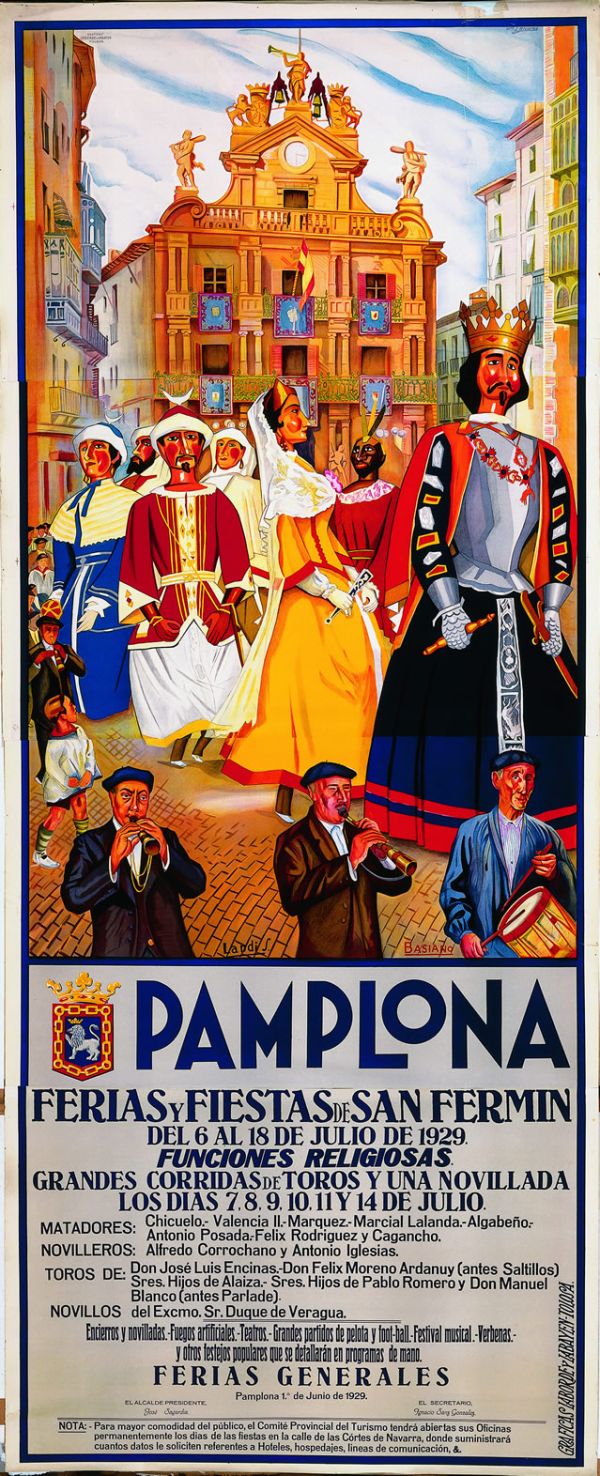
San Fermín 1929 poster (cartel)

San Fermín 1929 poster (cartel) by Basiano: the giants of Pamplona, a crowned king in armour and queens in long dresses, dance across the square in front of the ornate town hall, with two pipers and a drummer in berets in the foreground
Cartel de San Fermín 1929. Poster of the Ferias y Fiestas de San Fermín 1929, signed Basiano. Tap the poster to see it full size. See every San Fermín poster.16
San Fermín 1929 poster (cartel) by Basiano: the giants of Pamplona, a crowned king in armour and queens in long dresses, dance across the square in front of the ornate town hall, with two pipers and a drummer in berets in the foreground
Artist
Basiano (signature); a second signature at lower left is not legible
Fiesta on the poster
Del 6 al 18 de julio de 1929
Dated
Pamplona, June 1, 1929

The giants of Pamplona dance across the cobbled square in front of the ornate town hall, a crowned king in armour and queens in long dresses, with two pipers and a drummer in berets in front of them.16

Ollaquindía’s copy of the 1929 programme was a French edition, probably for visitors from Lower Navarre, with the cover printed in Tolosa. Some words passed into the French untouched; one photo caption read “ENCIERRO. Les taureaux traversant les rues”, the bulls crossing the streets. Its cover showed the giants dancing before the town hall on their way to the vespers of July 6.17

Pamplona in 1929

The end of the 1920s

Silent films and a bock

Ollaquindía closes the decade with Antonio Ayestarán’s memories: public cinema in front of the old Gayarre theatre, not yet pulled down, with the silent films of Chaplin and Valentino; carousels in the Ensanche among the smell of churro oil; a bock at the Ros beer hall for 20 céntimos; petrol at 60 céntimos and a Ford for 4,800 pesetas.17

Words of 1929

Arropados

Bulls running inside the steers went “arropados”, wrapped up. Bulls that broke away “se salieron sueltos”. The steers as a group were the cabestraje.6, 8, 15

Photographs

Where to see old photographs

The Diario de Navarra printed a photograph of the second encierro of July 10, 1929, with bull 62. The city’s photo archive, the Fototeca de Pamplona, holds historic photographs of the encierro, free to view online.11, 18

San Fermín 1929: questions and answers

When were the bull runs of San Fermín 1929?

The known run days of San Fermín 1929 were Sunday, July 7, to Wednesday, July 10, and Sunday, July 14, 1929, the last, each at seven in the morning.2, 4, 7, 6, 8, 9, 12

Why were there two encierros on July 10, 1929?

A Pablo Romero bull, number 62, named Dormido, Sleepy, lived up to its name on July 10, 1929: it did not wake when the rocket went up and stayed in the Rochapea corral while the other five ran, then came in a few minutes later, preceded by many runners, so that morning had two encierros.10, 5

Which steers guided the 1929 running of the bulls?

The steers of the Alaiza ranch of Tudela, the only Navarre ranch still keeping the brave breed of the land, guided the herds of San Fermín 1929, and the Diario de Navarra praised how the Alaiza herdsmen and steers handled the encierros.1, 6, 15

Did the bulls run better with their own steers in 1929?

The Alaiza bulls ran the only encierro of the first three in 1929 in which the bulls broke loose, on July 9, the Diario de Navarra noted, against those who think a herd runs better with its own steers.8

Who made the San Fermín 1929 poster?

Basiano made the San Fermín 1929 poster, signed on the poster itself: the giants of Pamplona dancing across the cobbled square in front of the town hall, with two pipers and a drummer in berets.16

Sources

Numbers on the page refer to this list. Diario de Navarra pages are cited from its archive (hemeroteca); quotations in Spanish are given as printed, in the spelling of the day.

Full source list
  1. Diario de Navarra, July 5, 1929, page 2: arrival of the Alaiza bulls, “la única de Navarra” keeping the brave breed of the land, 37 head with the cows and steers, eight herdsmen and the mayoral. Diario de Navarra archive
  2. Diario de Navarra, July 6, 1929, page 1: programme, the encierro at seven, “entrada libre y gratuita” in the ring “a excepción de los pisos de gradas y palcos”. Diario de Navarra archive
  3. Diario de Navarra, July 6, 1929, page 1: essay, the encierros “suponen una costumbre tradicional de muchos siglos”. Diario de Navarra archive
  4. Diario de Navarra, July 7, 1929, page 3: photograph of the bulls of José Luis Encinas, of Salamanca, for July 7. Diario de Navarra archive
  5. Diario de Navarra, July 10, 1929, page 3: the Pablo Romero bulls for July 10, among them “62, Dormido, berrendo, capirote y botinero”. Diario de Navarra archive
  6. Diario de Navarra, July 9, 1929, page 2: “se verificó el segundo encierro con los toros andaluces de Moreno Ardanuy”, July 8, “arropados por los cabestros de Alaiza”. Diario de Navarra archive
  7. Diario de Navarra, July 9, 1929, page 1: “El primer encierro”, July 7, the dawn music from 5:30 and the crowds streaming to the ring. Diario de Navarra archive
  8. Diario de Navarra, July 10, 1929, page 1: the Alaiza encierro of July 9, “el único encierro de los tres hasta ahora celebrados en que los toros se salieron sueltos”. Diario de Navarra archive
  9. Diario de Navarra, July 10, 1929, page 2: programme for July 10, “A las siete, en punto, encierro del ganado”. Diario de Navarra archive
  10. Diario de Navarra, July 11, 1929, page 1: the Pablo Romero encierro of July 10, “quiso hacer honor a su nombre”; “Hubo, pues, dos encierros”. Diario de Navarra archive
  11. Diario de Navarra, July 11, 1929, page 3: photograph, “El segundo encierro de ayer con el toro 62 que se quedó rezagado” (Foto Galle). Diario de Navarra archive
  12. Diario de Navarra, July 14, 1929, page 2: programme for July 14, “A las siete en punto de la mañana tendrá lugar el último encierro de toros”. Diario de Navarra archive
  13. Diario de Navarra, July 14, 1929, page 3: the bulls of Manuel Blanco (formerly Parladé) for July 14. Diario de Navarra archive
  14. Diario de Navarra, July 16, 1929, page 3: the last encierro, Sunday, July 14, the ring full by 6:30, many left outside watching from the fences. Diario de Navarra archive
  15. Diario de Navarra, July 16, 1929, page 3: review of the fiestas, the encierros, “el punto fuerte y de compromiso que tan admirablemente han realizado los pastores y cabestraje de la ganadería de Alaiza”. Diario de Navarra archive
  16. The poster of the Ferias y Fiestas de San Fermín 1929 itself, “del 6 al 18 de julio de 1929”, dated Pamplona, June 1, 1929; signed Basiano.
  17. Ricardo Ollaquindía, 100 años de carteles de las fiestas y ferias de San Fermín (1882 to 1981), Pamplona, 1981, chapter “1929”. Free copy in the Biblioteca Navarra Digital (BiNaDi). binadi.navarra.es
  18. Fototeca de Pamplona, Archivo Municipal de Pamplona (photographs of the encierro, free to view online; publication needs the archive’s permission). archivo.pamplona.es
How to cite this page

Encierro. “Running of the Bulls 1929: San Fermín in Pamplona.” Encierro.com, November 9, 2026. https://encierro.com/san-fermin-1929/

Corrections and updates
  • : questions and answers rewritten around what people search, each answer with its sources; the poster labelled with its Spanish name, cartel.
  • : page published.

Walk the route with people who run it

Book your walk