
San Fermín 2027: July 6 to 14. Tours filling fast. Book your spot  | 
ToursRunning with Bulls About Fiesta About UsShop Book Now
The Encierro archive · 1930

Running of the Bulls 1930: San Fermín in Pamplona

San Fermín 1930 had six bull runs (encierros), at seven in the morning on July 7, 8, 9, 10, 12 and 13, with no run on Friday, July 11, which the paper called a bridge day with no encierro. The Antonio Pérez bulls ran the course in under three minutes on July 12, and the paper reported no incident all week.3, 4, 6, 7, 8, 9, 10

By Encierro · Last reviewed

6runs, July 7 to 13
7:00start, a.m.
0incidents reported

How the fiesta ran in 1930

Ollaquindía notes that in 1930 the encierros were at seven sharp in the morning.12 The bando set six: July 7, 8, 9 and 10, then a day off on Friday, July 11, and two more on July 12 and 13, the last; all six were run.1, 7, 9, 10

The mayor issued a second bando that year, because the fiestas, he said, were being distorted year by year by thoughtlessness and showing off: clothes “cuyo carácter claramente estrafalario o de tono de disfraz”, clearly outlandish or fancy dress, were banned, and the parade of the mozos’ groups through the town was regulated.2

Every known encierro of 1930, by day and ranch

The encierros of San Fermín 1930, from the Diario de Navarra programmes and reports.
DateRunRanch (ganadería)What the paper reported
July 71Manuel BlancoNo incident; in like lambs
July 82Concha y SierraHerd split in two by runners
July 93Carmen de FedericoA smaller crowd
July 104EncinasOne bull loose for a moment
July 11noneA bridge day, no encierro
July 125Antonio PérezUnder three minutes
July 136, lastPablo RomeroSunny; no incident

The 1930 encierros, day by day

Run 1 of 6

· Manuel Blanco

Start7:00 a.m.
IncidentsNone

At seven sharp, with the ring packed, the huge bulls of Manuel Blanco, of Salamanca, ran the course “sin que hubiera que lamentar el más insignificante incidente”, without the slightest incident. Preceded, surrounded and followed by dense crowds, they went into the ring’s corrals like lambs. Then came very lively padded-horn cows of the Navarre ranch of Alaiza, mobbed by amateurs to the protests of the public.3
Run 2 of 6

· Concha y Sierra

Entered3, then 3

Crowds came from Aragón, La Rioja, Gipuzkoa, Álava and Bizkaia. The Concha y Sierra bulls entered the ring “cortados por la gente”, cut through by the crowd running mixed in with them: first three bulls, then a thick pack of people, then the other three. A photograph showed the herd split in two by daring runners.4

Run 3 of 6

· Carmen de Federico

IncidentsNone

The bulls were those of doña Carmen de Federico.5 “El encierro de los toros antiguos de Murube”, the encierro of the old Murube bulls, drew an enormous crowd to the ring, though not as large as on other days, so that, a rare thing, there were some empty seats. It went without incident, though the bulls entered in two groups.6

Run 4 of 6

· Encinas

IncidentsNone

The Encinas bulls carried a thick pack of runners ahead of them in their headlong run. One got slightly loose as it entered the ring and was held for a moment until a couple of steers fetched it. “Y no pasó nada; como no debe pasar”: nothing happened, as nothing should.7

Run 5 of 6

· Antonio Pérez

Start7:00 a.m.
TimeUnder 3 minutes

After the day off, “A las siete en punto se verificará el encierro de los toros, según antigua costumbre”.8 A cold wind and drizzle thinned the upper seats, but the lower stands overflowed like a bay in a storm. At seven sharp, at the bang of the rocket, the Antonio Pérez bulls “hicieron el recorrido en menos de tres minutos”, ran the course in under three minutes, surrounded by countless boys who lost all respect for them, and crossed the ring wrapped by the steers into the corral.9

Run 6 of 6, the last

· Pablo Romero

WeatherThe best of the fiesta
IncidentsNone

On the clearest, sunniest day of the fiesta, with the ring bursting, “se verificó el último encierro, que lo hicieron los toros de Pablo Romero”, mixed in with several hundred runners. Two bulls and two steers came in first and, with people in between, the other three bulls with three steers, without the least incident.10

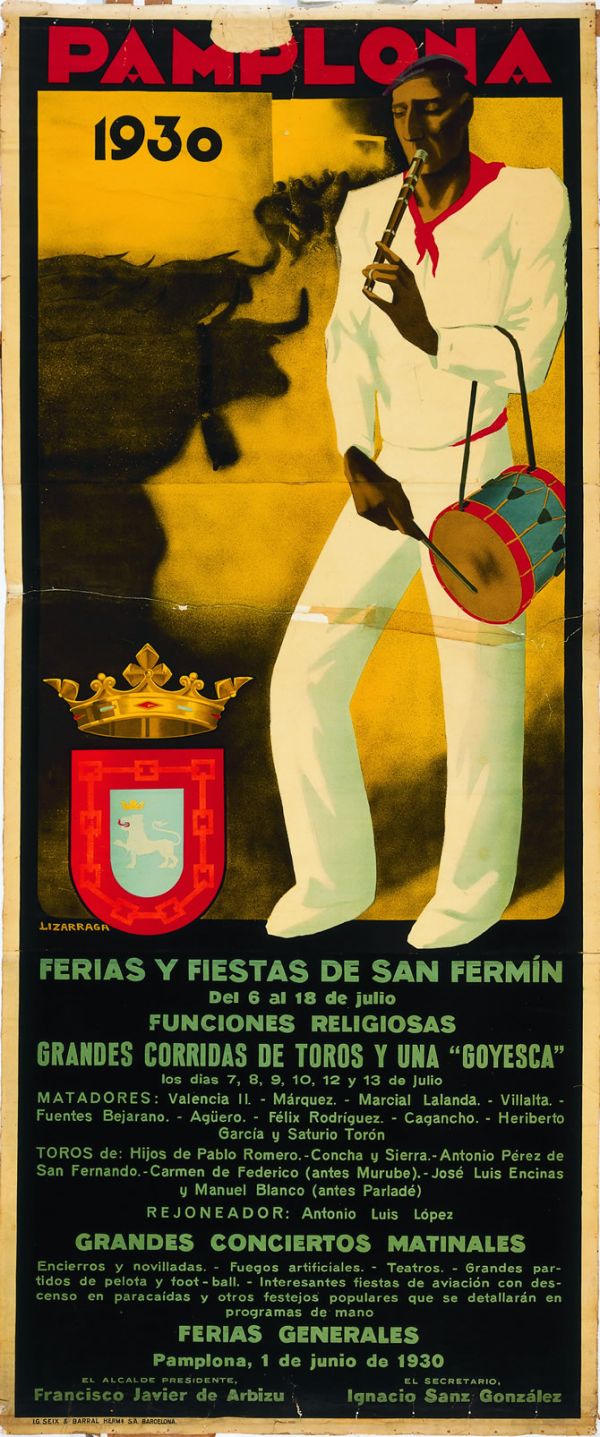
San Fermín 1930 poster (cartel)

San Fermín 1930 poster (cartel) by Lizarraga: a txistulari all in white with a red neckerchief and sash plays the pipe and drum against a yellow ground, the dark shadow of the bulls behind him, beside the crowned shield of Pamplona
Cartel de San Fermín 1930. Poster of the Ferias y Fiestas de San Fermín 1930, signed Lizarraga. Tap the poster to see it full size. See every San Fermín poster.11, 12
San Fermín 1930 poster (cartel) by Lizarraga: a txistulari all in white with a red neckerchief and sash plays the pipe and drum against a yellow ground, the dark shadow of the bulls behind him, beside the crowned shield of Pamplona
Artist
Lizarraga (signature)
Fiesta on the poster
Del 6 al 18 de julio
Dated
Pamplona, June 1, 1930
Printed by
Seix y Barral, Barcelona

“en fuerte contraste de luz y sombras”: in strong contrast of light and shadow, Ollaquindía writes, the 1930 poster shows a chistulari all in white and the encierro entering the dark alley.12 The piper plays pipe and drum, a red neckerchief and sash on his white clothes, while the dark shadows of the bulls rise behind him; the crowned shield of Pamplona stands at his side.11

The programme also promised flying shows on July 11 and 12, with acrobatics and a parachutist jumping from 700 metres and falling 200 before opening his parachute.12

Pamplona in 1930

Words of 1930

Día puente

A day off in the middle of the fiesta was a “día puente”, a bridge day. A herd split by runners was “partido por gala en dos”. The steers as a group were the cabestraje.7, 4, 9

Photographs

Where to see old photographs

The Diario de Navarra printed photographs of the 1930 encierros, among them the Blanco bulls at the ring gate and the Concha y Sierra herd split in two. The city’s photo archive, the Fototeca de Pamplona, holds historic photographs of the encierro, free to view online.3, 4, 13

San Fermín 1930: questions and answers

When were the bull runs of San Fermín 1930?

San Fermín 1930 had six bull runs at seven in the morning, on July 7, 8, 9, 10, 12 and 13, 1930. There was no encierro on Friday, July 11, which the Diario de Navarra called a bridge day.12, 1, 7, 9, 10

How fast was the running of the bulls in 1930?

The Antonio Pérez bulls ran the course in under three minutes on July 12, 1930, the Diario de Navarra reported.9

Was anyone hurt in the 1930 running of the bulls?

The Diario de Navarra reported no incidents in any of the six runs of 1930; on July 10 a bull stopped for a moment in the ring, and nothing happened, “como no debe pasar”, as nothing should.4, 7

Why did Pamplona ban fancy dress in 1930?

Pamplona’s mayor issued a second bando in 1930 because the fiestas, he said, were being distorted year by year by thoughtlessness and showing off, and banned clearly outlandish clothes or fancy dress.2

Who made the San Fermín 1930 poster?

Lizarraga made the San Fermín 1930 poster, signed on the poster itself: a chistulari all in white playing pipe and drum, and the encierro entering the dark alley behind him, in strong contrast of light and shadow, as Ollaquindía puts it.11, 12

Sources

Numbers on the page refer to this list. Diario de Navarra pages are cited from its archive (hemeroteca); quotations in Spanish are given as printed, in the spelling of the day.

Full source list
  1. Diario de Navarra, July 4, 1930, page 1: general bando on the encierros, for the days 7, 8, 9, 10, 12 and 13 of July. Diario de Navarra archive
  2. Diario de Navarra, July 5, 1930, page 1: second bando of the mayor: the use of clothes “cuyo carácter claramente estrafalario o de tono de disfraz” banned, and rules for the parade of the cuadrillas of mozos. Diario de Navarra archive
  3. Diario de Navarra, July 8, 1930, page 3: the Blanco encierro of July 7, “sin que hubiera que lamentar el más insignificante incidente”; photographs (Galle, Roldán). Diario de Navarra archive
  4. Diario de Navarra, July 9, 1930, page 1: the Concha y Sierra encierro of July 8, the bulls “cortados por la gente”; photograph, “El encierro de los toros de Concha y Sierra, partido por gala en dos” (Foto Galle). Diario de Navarra archive
  5. Diario de Navarra, July 9, 1930, page 1: programme for July 9, the bulls of doña Carmen de Federico. Diario de Navarra archive
  6. Diario de Navarra, July 10, 1930, page 1: “El encierro de los toros antiguos de Murube”, July 9, “aunque no tanta como en días anteriores”. Diario de Navarra archive
  7. Diario de Navarra, July 11, 1930, page 1: the Encinas encierro of July 10, “Y no pasó nada; como no debe pasar”; July 11, a bridge day “sin encierro”. Diario de Navarra archive
  8. Diario de Navarra, July 12, 1930, page 1: programme for July 12, “A las siete en punto se verificará el encierro de los toros, según antigua costumbre”. Diario de Navarra archive
  9. Diario de Navarra, July 13, 1930, page 1: the Antonio Pérez encierro of July 12, “hicieron el recorrido en menos de tres minutos”. Diario de Navarra archive
  10. Diario de Navarra, July 15, 1930, page 1: “se verificó el último encierro, que lo hicieron los toros de Pablo Romero”, July 13. Diario de Navarra archive
  11. The poster of the Ferias y Fiestas de San Fermín 1930 itself, “del 6 al 18 de julio”, dated Pamplona, June 1, 1930; signed Lizarraga; printed by Seix y Barral, Barcelona.
  12. Ricardo Ollaquindía, 100 años de carteles de las fiestas y ferias de San Fermín (1882 to 1981), Pamplona, 1981, chapter “1930”. Free copy in the Biblioteca Navarra Digital (BiNaDi). binadi.navarra.es
  13. Fototeca de Pamplona, Archivo Municipal de Pamplona (photographs of the encierro, free to view online; publication needs the archive’s permission). archivo.pamplona.es
How to cite this page

Encierro. “Running of the Bulls 1930: San Fermín in Pamplona.” Encierro.com, November 9, 2026. https://encierro.com/san-fermin-1930/

Corrections and updates
  • : questions and answers rewritten around what people search, each answer with its sources; the poster labelled with its Spanish name, cartel.
  • : page published.

Walk the route with people who run it

Book your walk