
San Fermín 2027: July 6 to 14. Tours filling fast. Book your spot  | 
ToursRunning with Bulls About Fiesta About UsShop Book Now
The Encierro archive · 1932

Running of the Bulls 1932: San Fermín in Pamplona

San Fermín 1932 had four bull runs (encierros), at seven in the morning from Thursday, July 7, to Sunday, July 10. On the last, “Nunca jamás, sin género de duda, se ha dado reventón de público semejante”: never had the ring seen such a crush, and two men were caught, through their own fault, the paper said. The herdsmen of the Navarre ranch of Alaiza and their mayoral, Moncayola, saved the day more than once.3, 4, 6, 7, 9, 8

By Encierro · Last reviewed

4runs, July 7 to 10
7:00start, a.m.
2men caught, July 10

How the fiesta ran in 1932

The encierro was at seven every day, with free entry to the ring except the stands and boxes.2 The night before each run the paper described the other encierro: “Encierro de noche. Encierro preliminar”, the night encierro, when the bulls were moved from the Gas corrals to the corral at the Rochapea gate, in an air of mystery and silence, deep in the night.1

After the fiesta a councillor praised the work of the Alaiza mayoral, Moncayola, in the encierros, “y muy especialmente en el encierro del domingo”, above all in the Sunday encierro, and the council agreed to thank him in writing.8, 4, 7 A columnist who would miss the fiesta that year wrote of “El espectáculo magno de los encierros, único en barbarie y belleza”: the great spectacle of the encierros, unique in its wildness and beauty.5

Every known encierro of 1932, by day and ranch

The encierros of San Fermín 1932, from the Diario de Navarra programmes and reports.
DateRunRanch (ganadería)What the paper reported
July 71BlancoJust over two minutes; a pile-up at the gate
July 82Santa ColomaA bull left behind for nearly twenty minutes
July 93VillamartaA bull provoked at the corral gate
July 104, lastEncinasBiggest crush ever; two men caught

The 1932 encierros, day by day

Run 1 of 4

· Blanco

Start7:00 a.m.
TimeJust over 2 minutes

By seven the ring had been taken by storm. The Blanco bulls ran from the little corral at the Rochapea gate to the ring’s corrals and “hicieron el recorrido en poco más de dos minutos”, ran the course in just over two minutes, with big packs of runners ahead and behind. One runner was caught in Estafeta, with no worse result than a mighty tumble and two teeth lost when he fell head first against the kerb. At the ring gate a dozen and a half boys fell in a tangle, and bulls and steers passed over them without touching them.3
Run 2 of 4

· Santa Coloma

Bull left behindNearly 20 minutes
Out of the ring by8:00 a.m.

A Santa Coloma bull that stayed behind gave the Alaiza herdsmen, for nearly twenty minutes, more work than a whole herd of Miuras. Neither waving at it nor sticks would move it, “¡qué valiente es Moncayola el mayoral de Alaiza!”, how brave the Alaiza mayoral was, until at last it went meekly into the corral, having harmed no one, though some came close. It was eight before the crowd left the ring.4

Run 3 of 4

· Villamarta

IncidentsNone

Runners and bulls came into the ring together. As the bulls headed for the corral gate, a fool, who the paper said should have been locked up on the spot, provoked one of them, and it turned and scattered the people in the ring. Luckily nothing happened: a local man known as Ohele led the bull into the corral passage, and the amateurs in the ring carried him shoulder-high round the arena. The bulls were those of the Marqués de Villamarta.6

Run 4 of 4, the last

· Encinas

Caught2 men
DaySunday

The Taconera danced until dawn so people could go straight, without sleeping, “al último encierro de las fiestas”, to the last encierro of the fiesta.6 An hour before the run the ring could not hold the crowd; the doormen of the boxes and stands were swept aside, and “Nunca jamás, sin género de duda, se ha dado reventón de público semejante”: never, without doubt, had there been such a crush. The young Encinas bulls were cut apart on the way by the sheer mass of boys around them, and at the mouth of Estafeta one was left isolated among them; Moncayola, the Alaiza mayoral, seized it and brought it down.7 Two men were caught, through their own fault, the paper said: a fairground worker from Portugalete, who left hospital after four days, and a soldier from a garrison elsewhere.9

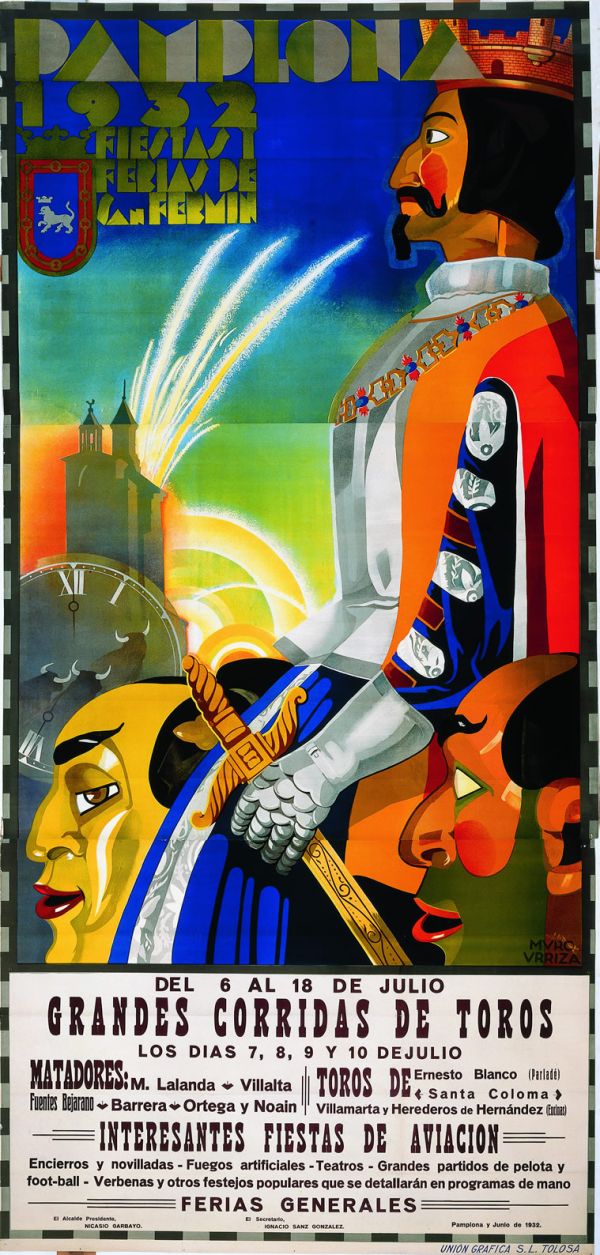
San Fermín 1932 poster (cartel)

San Fermín 1932 poster (cartel) by Muro Urriza: the crowned king giant of Pamplona in armour with a sword, the heads of two big-heads at his feet, fireworks rising over a church tower and a clock face
Cartel de San Fermín 1932. Poster of the Fiestas y Ferias de San Fermín 1932, signed Muro Urriza. Tap the poster to see it full size. See every San Fermín poster.10, 11
San Fermín 1932 poster (cartel) by Muro Urriza: the crowned king giant of Pamplona in armour with a sword, the heads of two big-heads at his feet, fireworks rising over a church tower and a clock face
Artist
Muro Urriza (signature)
Fiesta on the poster
Del 6 al 18 de julio
Dated
Pamplona, June 1932
Printed by
Unión Gráfica, Tolosa

The king giant of Pamplona fills the 1932 poster, crowned and in armour, a sword at his side, with two big-heads at his feet and fireworks rising behind a church tower and a clock face.10

Ollaquindía notes the changes the new politics brought to the 1932 programme. The words saying the fiesta was held to honour San Fermín were dropped from the first page, and so were the religious services the council used to attend: the vespers of July 6 became a parade of bands and giants, and the procession of July 7 disappeared from the programme. Entry to the encierro, box or stand, cost one peseta.11

Pamplona in 1932

Words of 1932

Encierro de noche

The “encierro de noche”, or “encierro preliminar”, was the night move of the bulls to the Rochapea corral. The Alaiza herdsmen’s chief was the mayoral.1, 8

Photographs

Where to see old photographs

Ollaquindía notes that the 1932 programme carried four photographs by Rupérez, three of the encierro. The city’s photo archive, the Fototeca de Pamplona, holds historic photographs of the encierro, free to view online.11, 12

San Fermín 1932: questions and answers

When were the bull runs of San Fermín 1932?

San Fermín 1932 had four bull runs at seven in the morning, Thursday, July 7, to Sunday, July 10, 1932, the last, with bulls of Blanco, Santa Coloma, Villamarta and Encinas.2, 3, 4, 6, 7

Was anyone hurt in the 1932 running of the bulls?

A runner caught in Estafeta lost two teeth in his fall on July 7, 1932. In the last encierro, on July 10, two men were caught, through their own fault according to the Diario de Navarra: a fairground worker from Portugalete, who left hospital after four days, and a soldier.3, 9

What was the night encierro in 1932?

The night encierro, encierro de noche or encierro preliminar, was the move of the bulls deep in the night from the Gas corrals to the corral at the Rochapea gate where the morning run began, as the Diario de Navarra described it in 1932.1

Why did Pamplona thank the mayoral Moncayola in 1932?

Pamplona’s council agreed to thank Moncayola, the mayoral of the Alaiza ranch, in writing after San Fermín 1932 for his work in the encierros, above all in the Sunday run of July 10, when he seized a bull left isolated among the runners at the mouth of Estafeta.8, 7

Who made the San Fermín 1932 poster?

Muro Urriza made the San Fermín 1932 poster, signed on the poster itself: the king giant of Pamplona, crowned and in armour, with two big-heads at his feet and fireworks behind a church tower.10

Sources

Numbers on the page refer to this list. Diario de Navarra pages are cited from its archive (hemeroteca); quotations in Spanish are given as printed, in the spelling of the day.

Full source list
  1. Diario de Navarra, July 8, 1932, page 6: “Apuntes de San Fermín. Nocturno”: “Encierro de noche. Encierro preliminar”, the bulls moved from the Gas corrals to the corral at the Rochapea gate. Diario de Navarra archive
  2. Diario de Navarra, July 7, 1932, page 4: programme, the encierro at seven, “entrada libre y gratuita” except “los pisos de gradas y palcos”. Diario de Navarra archive
  3. Diario de Navarra, July 8, 1932, page 6: the Blanco encierro of July 7, “hicieron el recorrido en poco más de dos minutos”; a runner caught in Estafeta; a dozen and a half boys fallen at the ring gate. Diario de Navarra archive
  4. Diario de Navarra, July 9, 1932, page 4: the Santa Coloma encierro of July 8, a bull left behind for nearly twenty minutes, “¡qué valiente es Moncayola el mayoral de Alaiza!”. Diario de Navarra archive
  5. Diario de Navarra, July 9, 1932, page 4: a visitor’s column, “El espectáculo magno de los encierros, único en barbarie y belleza”. Diario de Navarra archive
  6. Diario de Navarra, July 10, 1932, page 7: the encierro of July 9, “Los toros que se encerraron ayer eran los del marqués de Villamarta”; a bull provoked in the ring at the corral gate; “al último encierro de las fiestas que se celebra hoy”. Diario de Navarra archive
  7. Diario de Navarra, July 12, 1932, page 5: the Sunday encierro of July 10: “Nunca jamás, sin género de duda, se ha dado reventón de público semejante”; the Encinas bulls from the Rochapea corral; Moncayola, mayoral of Alaiza, and the isolated bull. Diario de Navarra archive
  8. Diario de Navarra, July 14, 1932, page 2: council session, a councillor’s praise for the work of the mayoral of Alaiza in the encierros, “y muy especialmente en el encierro del domingo”; the council agreed to thank him in writing. Diario de Navarra archive
  9. Diario de Navarra, July 17, 1932, page 9: one of the two men caught “por su culpa, en el último encierro”, a fairground worker from Portugalete, out of hospital after four days; the other a soldier from a garrison elsewhere. Diario de Navarra archive
  10. The poster of the Fiestas y Ferias de San Fermín 1932 itself, “del 6 al 18 de julio”, dated Pamplona, June 1932; signed Muro Urriza; printed by Unión Gráfica, Tolosa.
  11. Ricardo Ollaquindía, 100 años de carteles de las fiestas y ferias de San Fermín (1882 to 1981), Pamplona, 1981, chapter “1932”. Free copy in the Biblioteca Navarra Digital (BiNaDi). binadi.navarra.es
  12. Fototeca de Pamplona, Archivo Municipal de Pamplona (photographs of the encierro, free to view online; publication needs the archive’s permission). archivo.pamplona.es
How to cite this page

Encierro. “Running of the Bulls 1932: San Fermín in Pamplona.” Encierro.com, November 9, 2026. https://encierro.com/san-fermin-1932/

Corrections and updates
  • : questions and answers rewritten around what people search, each answer with its sources; the poster labelled with its Spanish name, cartel.
  • : page published.

Walk the route with people who run it

Book your walk