
San Fermín 2027: July 6 to 14. Tours filling fast. Book your spot  | 
ToursRunning with Bulls About Fiesta About UsShop Book Now
The Encierro archive · 1933

Running of the Bulls 1933: San Fermín in Pamplona

In 1933 Pamplona tried splitting the fiesta in two. There were bull runs (encierros) at seven in the morning on July 7, 8 and 9, then a break, and two more on July 15 and 16. On Sunday, July 9, the Alaiza mayoral Moncayola brought in a stray bull with nothing but his smock, and the paper told him: “Tú has hecho por la supervivencia del encierro lo que nadie”.1, 3, 7, 10, 11, 12

By Encierro · Last reviewed

5runs, in two series
7:00start, a.m.
1 boxbull 41 went to the ring in a crate

How the fiesta ran in 1933

The programme set the encierros at seven, with tickets for the stands at one peseta and the boxes at two, sold the day before each encierro at the windows of the plaza de la República.1, 2 The bulls ran on July 7, 8 and 9, the first three days, and on July 15 and 16, with a gap in between; the paper later listed the takings of four encierros of the regular season, plus the run of July 15.3, 7, 10, 11, 12

The experiment did not please the paper: “este nuevo sistema de partir las fiestas en dos trozos o series”, this new system of splitting the fiesta into two parts, had no atmosphere; people cooled off and struggled to start again. The encierro of July 15 was held almost among family, as in the old days when the morning run was for the locals.11

Sundays were the problem. On Sunday encierros, the paper complained, no precautions were taken at all: the avalanche of people burst through every door, ignoring the porters, and paying ticket holders lost their seats.9

Every known encierro of 1933, by day and ranch

The encierros of San Fermín 1933, from the Diario de Navarra programmes, reports and receipts.
DateRunRanch (ganadería)What the paper reported
July 71Pablo RomeroFive bulls ran; one went by crate
July 82BlancoTakings recorded; no report
July 93VillamartaMoncayola and the stray bull
July 154Arturo Sánchez CobaledaAlmost among family; a runner on a horn
July 165, lastSánchez de CoquillaThe last encierro

The 1933 encierros, day by day

Run 1 of 5

· Pablo Romero

Start7:00 a.m.
Bulls that ran5

At seven sharp, the programme said, “se verificará el encierro de los toros de Pablo Romero”.1 The bulls ran the course preceded, followed and even surrounded by an immense crowd, without incident. Only five ran: “faltó a la cita el 41 que fué transportado en una caja antes del encierro”, number 41 missed the appointment and was taken to the ring in a crate before the run. The five crossed the ring scorning the crowd that surrounded and pestered them.3
Run 2 of 5

· Blanco

DaySaturday

The bulls of the day were those of Manuel Blanco, formerly Parladé.3 No report of the run survives in the paper, only an aside a few days later about “lo que se ha dicho del encierro del sábado”, what had been said about Saturday’s encierro, and the takings of a second encierro of the regular season.6, 12

Run 3 of 5

· Villamarta

Start7:00 a.m.
DaySunday

“A las siete en punto, encierro del ganado”, the programme said.4 After a Saturday that brought an enormous crowd, more people stayed up all night than went to bed. The ring could not hold them, the streets of the course were covered with onlookers and there was no room to run; the bulls entered the ring mixed in with the runners and nothing happened, except that one bull stayed behind, loose. Moncayola, the Alaiza mayoral, astonished everyone: with heart and strong legs, his black smock his best weapon, and helped by the professional handlers of the encierro, he led the stray bull into the ring and the corrals, the two of them entering one after the other, to a great ovation. Ignacio Rodríguez Sola wrote him a tribute: “Tú has hecho por la supervivencia del encierro lo que nadie”, you have done more than anyone for the survival of the encierro.7

Run 4 of 5

· Arturo Sánchez Cobaleda

Start7:00 a.m.

“A las 7 en punto se verificará el encierro de los toros de don Arturo Sánchez Cobaleda”.10 After the break the lower stands were packed, but there were big gaps in the boxes and upper stands; still a great crowd ran ahead. The boys entered mixed in with the bulls, which had to push more than charge to get through, and one runner was carried on a bull’s horn like a coat on a hanger across three quarters of the ring, from the entrance almost to the corral gate.11

Run 5 of 5, the last

· Sánchez de Coquilla

DaySunday

The paper later listed the takings of a fourth encierro of the regular season.12 The cows let out after “el último encierro” wore a new invention from Tudela, rubber balls on their horns, which those who tried them said were almost gentle.13 The bulls of the day were eight of Sánchez de Coquilla.8

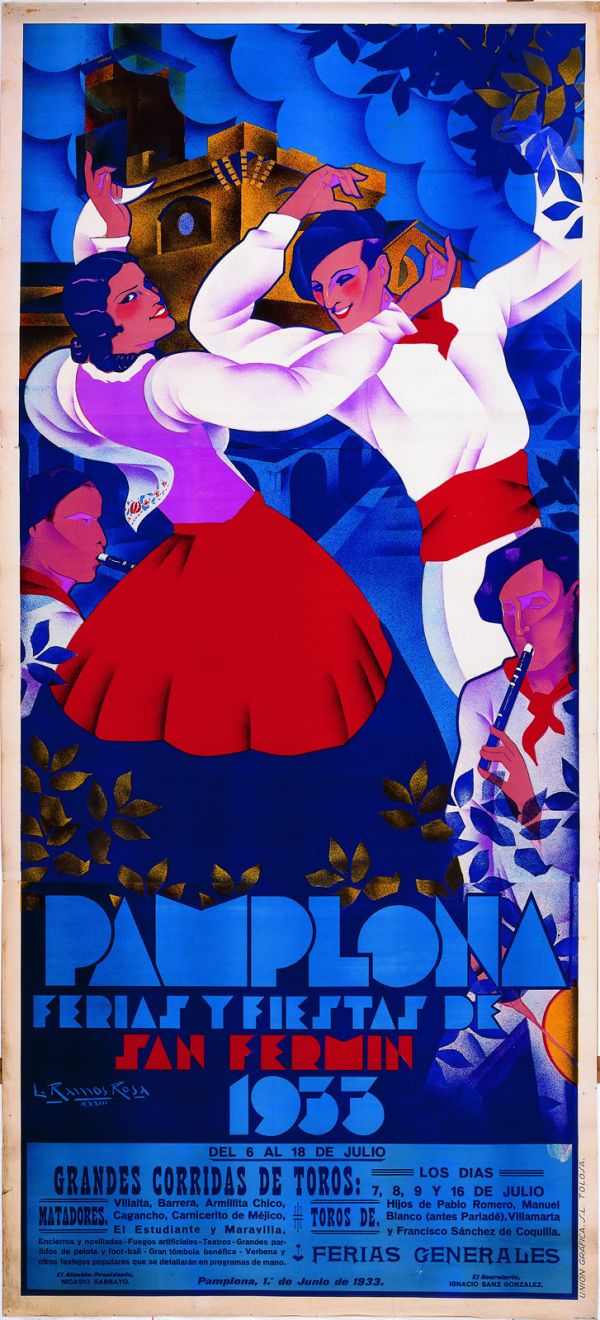
San Fermín 1933 poster (cartel)

San Fermín 1933 poster (cartel) by Ramos Rosa: a young woman in a red skirt and a young man in white with a red sash and neckerchief dance the jota, arms raised, while two chistularis play beside them under a blue night sky
Cartel de San Fermín 1933. Poster of the Ferias y Fiestas de San Fermín 1933, signed Ramos Rosa. Tap the poster to see it full size. See every San Fermín poster.14, 15
San Fermín 1933 poster (cartel) by Ramos Rosa: a young woman in a red skirt and a young man in white with a red sash and neckerchief dance the jota, arms raised, while two chistularis play beside them under a blue night sky
Artist
Ramos Rosa (signature)
Fiesta on the poster
Del 6 al 18 de julio
Dated
Pamplona, June 1, 1933

A young woman in a red skirt and a young man in white, with a red sash and neckerchief, dance the jota with their arms raised, while two chistularis play beside them under a deep blue sky.14

Ollaquindía notes that the 1933 poster went back to naming the fiestas of “SAN FERMIN” as two words, after the year before, and that the programme listed the price of entry to the encierro: two pesetas for a box, one for the stands.15

Pamplona in 1933

Moncayola

The Alaiza mayoral

Moncayola, the mayoral of the Navarre ranch of Alaiza, brought in the stray bull of July 9, and the paper printed his photograph with his herdsmen from the Ribera.7, 5

Words of 1933

En familia

The paper said the July 15 run was held “casi en familia”, almost among family. On July 9 the bulls came in “revueltos con los corredores”, mixed in with the runners.11, 7

Photographs

Where to see old photographs

The city’s photo archive, the Fototeca de Pamplona, holds historic photographs of the encierro, free to view online.16

San Fermín 1933: questions and answers

When were the bull runs of San Fermín 1933?

San Fermín 1933 had bull runs at seven in the morning on July 7, 8 and 9, 1933, and, after a break, on July 15 and 16: that year Pamplona split the fiesta into two series.1, 3, 4, 7, 10, 11

Who was Moncayola in the running of the bulls of 1933?

Moncayola was the mayoral, or head herdsman, of the Navarre ranch of Alaiza. On Sunday, July 9, 1933 he led a stray bull into the ring and the corrals with his black smock, to a great ovation, and Ignacio Rodríguez Sola wrote that he had done more than anyone for the survival of the encierro.7, 5

Did splitting the fiesta in two work in 1933?

Splitting San Fermín 1933 into two series did not please the Diario de Navarra: the new system had no atmosphere, people cooled off and struggled to start again, and the encierro of July 15 was held almost among family.11

Why did only five bulls run on July 7, 1933?

Only five Pablo Romero bulls ran on July 7, 1933, because bull number 41 was taken to the ring in a crate before the encierro.3

Who made the San Fermín 1933 poster?

Ramos Rosa made the San Fermín 1933 poster, signed on the poster itself: a young woman in a red skirt and a young man in white dancing the jota beside two chistularis under a deep blue sky.14

Sources

Numbers on the page refer to this list. Diario de Navarra pages are cited from its archive (hemeroteca); quotations in Spanish are given as printed, in the spelling of the day.

Full source list
  1. Diario de Navarra, July 6, 1933, page 5: programme for July 7, at seven sharp “se verificará el encierro de los toros de Pablo Romero”; tickets for the stands one peseta and boxes two. Diario de Navarra archive
  2. Diario de Navarra, July 7, 1933, page 8: tickets for the encierro sold “la víspera de cada encierro” at the windows of the plaza de la República. Diario de Navarra archive
  3. Diario de Navarra, July 8, 1933, page 4: the Pablo Romero encierro of July 7, five bulls, “faltó a la cita el 41 que fué transportado en una caja antes del encierro”; the Blanco bulls for July 8. Diario de Navarra archive
  4. Diario de Navarra, July 9, 1933, page 3: programme for July 9, “A las siete en punto, encierro del ganado”. Diario de Navarra archive
  5. Diario de Navarra, July 11, 1933, page 3: photograph of Moncayola with his herdsmen of the Ribera (Foto Galle). Diario de Navarra archive
  6. Diario de Navarra, July 11, 1933, page 4: an aside on “lo que se ha dicho del encierro del sábado”, July 8. Diario de Navarra archive
  7. Diario de Navarra, July 11, 1933, page 4: the Sunday encierro of July 9, the bulls “revueltos con los corredores”; the Alaiza mayoral Moncayola and the stray bull; Ignacio Rodríguez Sola, “Tú has hecho por la supervivencia del encierro lo que nadie”. Diario de Navarra archive
  8. Diario de Navarra, July 14, 1933, page 3: the eight bulls of Sánchez de Coquilla for Sunday, July 16. Diario de Navarra archive
  9. Diario de Navarra, July 13, 1933, page 8: complaint, “aquí en los encierros de los domingos no se toman” precautions. Diario de Navarra archive
  10. Diario de Navarra, July 15, 1933, page 8: programme for July 15, “A las 7 en punto se verificará el encierro de los toros de don Arturo Sánchez Cobaleda”. Diario de Navarra archive
  11. Diario de Navarra, July 16, 1933, page 3: “este nuevo sistema de partir las fiestas en dos trozos o series”; the encierro of July 15 “casi en familia”. Diario de Navarra archive
  12. Diario de Navarra, July 18, 1933, page 5: “Nota curiosa”, receipts of the four encierros of the abono: 10,891 pesetas (with the unloading), 5,454, 8,824 and 8,151; and the encierro of July 15. Diario de Navarra archive
  13. Diario de Navarra, July 19, 1933, page 7: rubber balls for the horns of the cows let out after “el último encierro”, made in Tudela. Diario de Navarra archive
  14. The poster of the Ferias y Fiestas de San Fermín 1933 itself, “del 6 al 18 de julio”, dated Pamplona, June 1, 1933; signed Ramos Rosa.
  15. Ricardo Ollaquindía, 100 años de carteles de las fiestas y ferias de San Fermín (1882 to 1981), Pamplona, 1981, chapter “1933”. Free copy in the Biblioteca Navarra Digital (BiNaDi). binadi.navarra.es
  16. Fototeca de Pamplona, Archivo Municipal de Pamplona (photographs of the encierro, free to view online; publication needs the archive’s permission). archivo.pamplona.es
How to cite this page

Encierro. “Running of the Bulls 1933: San Fermín in Pamplona.” Encierro.com, November 9, 2026. https://encierro.com/san-fermin-1933/

Corrections and updates
  • : questions and answers rewritten around what people search, each answer with its sources; the poster labelled with its Spanish name, cartel.
  • : page published.

Walk the route with people who run it

Book your walk