San Fermín 2027: July 6 to 14. Tours filling fast. Book your spot  | 
ToursRunning with Bulls About Fiesta About UsShop Book Now
The Encierro archive · 1940

Running of the Bulls 1940: San Fermín in Pamplona

San Fermín 1940 had bull runs (encierros), set for seven in the morning, in two series: July 7, 8, 9 and 10, then July 13 and 14. On the first morning everything came down to “dos puntazos, bien repartidos”, two minor horn wounds; on July 8 the Pablo Romero bulls went into the corral “rectos como flechas”, straight as arrows.3, 4, 5, 7, 6, 9, 11, 12

By Encierro · Last reviewed

6runs, in two series
7:00start, a.m.
3 a.m.cattle driven in, July 5

How the fiesta ran in 1940

Before dawn on July 5, about a dozen and a half enthusiasts watched what the paper called “el primer encierro de la serie”, the first encierro of the series: at three in the morning the steers, cows, spare bulls and young bulls for the fiesta were driven from the soto del Sario through the streets to the bullring, among the herdsmen’s shouts and the clang of cowbells.2

The fiesta ran in two parts. The bulls ran on July 7, 8, 9 and 10, then “el segundo y último periodo de las fiestas” began on July 13, with runs on the 13th and 14th.1, 9, 11 For the last Sunday a special train on the Plazaola line left Leitza at 4:45 in the morning.10

Ollaquindía’s chapter quotes José María Iribarren on Estafeta, the street through which the encierro flows, he wrote, seven times a year: the balconies packed, the guards at the crossing with the bajada de Javier unable to hold back the first group, the rocket, the long cry from the balconies as the horns appear at the corner of the square, and, when the last rocket goes, the street opening again to the town at a quarter past seven.14

Every known encierro of 1940, by day and ranch

The encierros of San Fermín 1940, from the Diario de Navarra programmes and reports.
DateRunRanch (ganadería)What the paper reported
July 71Carmen de FedericoTwo minor horn wounds
July 82Pablo RomeroStraight as arrows
July 93VillamartaGuards and herdsmen applauded
July 104Sánchez CobaledaNo accidents; two bulls loose ahead
July 135OrtegaThe weakest crowd of the fiesta
July 146, lastBuendíaBulls and steers in a tight bunch

The 1940 encierros, day by day

Run 1 of 6

· Carmen de Federico

Start7:00 a.m.
Hurt2 minor horn wounds

The programme set the encierro at seven.3 The bulls were the heavy ones of doña Carmen de Federico, and the Sunday run came close to misfortune when fools in the ring cut two bulls off from the herd: “Todo se redujo a dos puntazos, bien repartidos”, it all came down to two minor horn wounds, well shared out, and the fright when the Chico de Olite, gathering the stray bulls, was caught in serious danger among them.4

Run 2 of 6

· Pablo Romero

IncidentsNone

The Pablo Romero encierro passed without incident: wrapped by the steers, the bulls went into the corral “rectos como flechas”, straight as arrows.4 The paper printed a photograph of a runner who would not give up his shoe, with Olympian scorn for his own life.5

Run 3 of 6

· Villamarta

Start7:00 a.m.

After dianas from a quarter to six, “a las siete, el encierro de los toros de Villamarta”, the programme said.5 Rascals in the ring cut off three loose bulls, and guards cleared the arena and arrested two men; the crowd cheered the guards for their firm stand, the herdsmen and above all Moncayola for their hard work, and two helpers, Mann and the Chico de Olite, for the risks they ran. The Chico de Olite was seen in and out of danger three times, and the young men carried him shoulder-high round the ring.7

Run 4 of 6

· Sánchez Cobaleda

IncidentsNone

“el cuarto encierro de los toros de feria”, with the bulls of Arturo Sánchez Cobaleda, “se verificó sin accidentes”: two bulls ran loose far ahead and were turned in the ring without consequences.6 A notice later asked the young woman who picked up a wallet “en el encierro del día 10” to hand it in.8

Run 5 of 6

· Ortega

Start7:00 a.m.

The second part of the fiesta opened with the encierro at seven; the young bulls of the day were those of Ortega.9 “el espectáculo matutino del encierro fué el más flojo de las fiestas”, the morning encierro was the weakest of the fiesta in crowd and runners; the runners were mixed in with the herd all the way, part of it far ahead, the last a lost young bull that seemed to be thinking what a mess it had got into.11

Run 6 of 6, the last

· Buendía

Start7:00 a.m.
IncidentsNone

The programme set the encierro at seven sharp.11 The last encierro passed without incident. On the course two of the Buendía bulls, of Santa Coloma blood, went ahead driving the runners, but at the ring they all came together, bulls and steers, “en apretado haz”, in a tight bunch, crossed the arena and went straight in.12

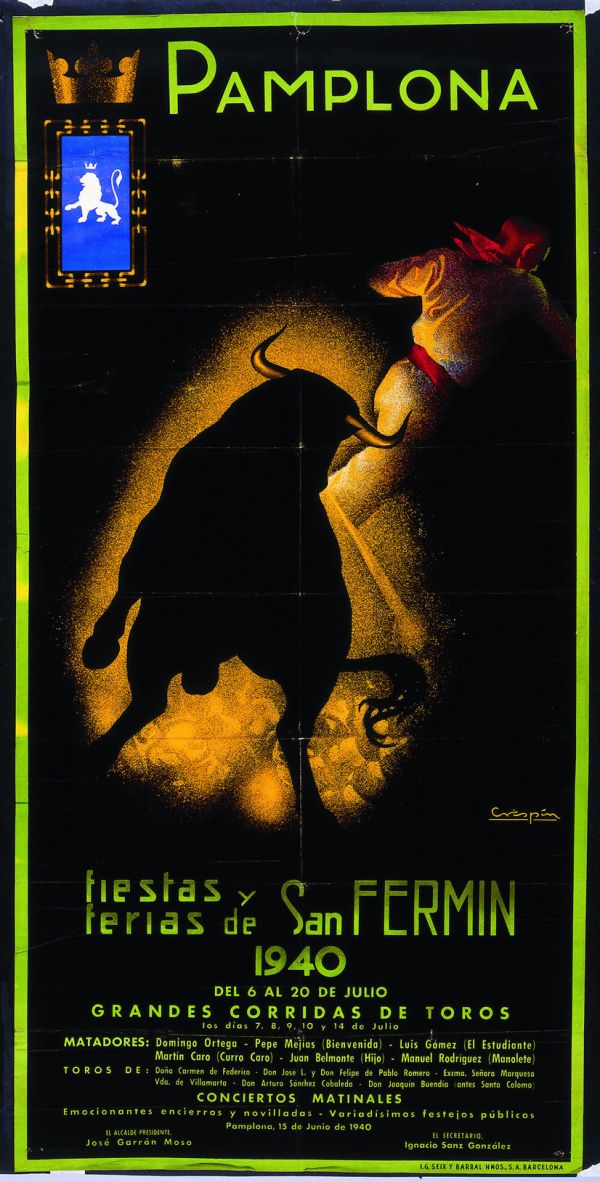
San Fermín 1940 poster (cartel)

San Fermín 1940 poster (cartel) by Crispín: the black silhouette of a charging bull in a golden glow against a dark ground, a runner in white with a red sash and neckerchief fleeing ahead of it, the crowned shield of Pamplona above
Cartel de San Fermín 1940. Poster of the Fiestas y Ferias de San Fermín 1940, signed Crispín. Tap the poster to see it full size. See every San Fermín poster.13
San Fermín 1940 poster (cartel) by Crispín: the black silhouette of a charging bull in a golden glow against a dark ground, a runner in white with a red sash and neckerchief fleeing ahead of it, the crowned shield of Pamplona above
Artist
Crispín (signature)
Fiesta on the poster
Del 6 al 20 de julio
Dated
Pamplona, June 15, 1940
Printed by
Seix y Barral, Barcelona

The black silhouette of a charging bull rises out of a golden glow on a dark ground, and a runner in white with a red sash and neckerchief flees ahead of it; the crowned shield of Pamplona hangs above. The poster promises “Emocionantes encierros”.13

Pamplona in 1940

Estafeta

Iribarren’s street

In the passage Ollaquindía quotes, Iribarren writes of the waiters lining up in their white jackets outside the café, a herdsman from Valtierra straightening his stick against his knee, and a young gentleman astride the fence unfolding his Kodak.14

Words of 1940

Puntazos

A puntazo is a minor horn wound, a jab with the tip of the horn. Bulls running inside the steers went “arropados”.4

Photographs

Where to see old photographs

The Diario de Navarra printed a photograph of a runner keeping hold of his shoe in the encierro of July 8, 1940. The city’s photo archive, the Fototeca de Pamplona, holds historic photographs of the encierro, free to view online.5, 15

San Fermín 1940: questions and answers

When were the bull runs of San Fermín 1940?

San Fermín 1940 had bull runs set for seven in the morning in two series: July 7, 8, 9 and 10, 1940, and then July 13 and 14, the last.3, 4, 5, 7, 6, 9, 11, 12

Was anyone hurt in the 1940 running of the bulls?

The first encierro of 1940, on July 7, came down to “dos puntazos, bien repartidos”, two minor horn wounds, the Diario de Navarra wrote, and the helper known as the Chico de Olite was in serious danger gathering bulls cut off in the ring.4

Who was the Chico de Olite in 1940?

The Chico de Olite was a helper in the ring during the encierros of 1940: on July 9 he was seen in and out of danger three times gathering loose bulls, and the young men carried him shoulder-high round the ring.7

What was the first encierro of the series in 1940?

The Diario de Navarra called “el primer encierro de la serie” the drive at three in the morning of July 5, 1940, when the steers, cows, spare bulls and young bulls for the fiesta were brought from the soto del Sario through the streets to the bullring.2

Who made the San Fermín 1940 poster?

Crispín made the San Fermín 1940 poster, signed on the poster itself: the black silhouette of a charging bull rising out of a golden glow, with a runner in white and red fleeing ahead of it.13

Sources

Numbers on the page refer to this list. Diario de Navarra pages are cited from its archive (hemeroteca); quotations in Spanish are given as printed, in the spelling of the day.

Full source list
  1. Diario de Navarra, July 5, 1940, page 2: society programme, dances “después de los encierros y de los toros los días 7, 8, 9, 10 y 14”. Diario de Navarra archive
  2. Diario de Navarra, July 6, 1940, page 2: “presenciamos ayer de madrugada a las 3 el primer encierro de la serie”: the steers, cows, spare bulls and young bulls driven from the soto del Sario to the bullring. Diario de Navarra archive
  3. Diario de Navarra, July 7, 1940, page 8: programme for July 7, the encierro at seven. Diario de Navarra archive
  4. Diario de Navarra, July 9, 1940, page 1: the Sunday encierro of July 7, the bulls of doña Carmen de Federico, two bulls cut from the herd in the ring, “Todo se redujo a dos puntazos, bien repartidos”, and the Chico de Olite in danger; the Pablo Romero encierro of July 8, “rectos como flechas”. Diario de Navarra archive
  5. Diario de Navarra, July 9, 1940, page 8: photograph of a runner who will not give up his shoe (Foto Galle); programme for July 9, “a las siete, el encierro de los toros de Villamarta”. Diario de Navarra archive
  6. Diario de Navarra, July 11, 1940, page 2: “el cuarto encierro de los toros de feria”, July 10, the bulls of Arturo Sánchez Cobaleda, “se verificó sin accidentes”. Diario de Navarra archive
  7. Diario de Navarra, July 10, 1940, page 1: the encierro of July 9, three loose bulls cut off in the ring; ovations for the guards, the herdsmen, Moncayola and the helpers Mann and the Chico de Olite. Diario de Navarra archive
  8. Diario de Navarra, July 12, 1940, page 3: lost property, a wallet picked up “en el encierro del día 10”. Diario de Navarra archive
  9. Diario de Navarra, July 13, 1940, page 2: “el segundo y último periodo de las fiestas”: July 13, the encierro at seven. Diario de Navarra archive
  10. Diario de Navarra, July 14, 1940, page 2: a special Plazaola train from Leitza at 4:45 for the encierro of Sunday, July 14. Diario de Navarra archive
  11. Diario de Navarra, July 14, 1940, page 5: the encierro of July 13, “el espectáculo matutino del encierro fué el más flojo de las fiestas”, the young bulls of Ortega; programme for July 14, the encierro at seven. Diario de Navarra archive
  12. Diario de Navarra, July 16, 1940, page 8: the last encierro, July 14, the Buendía bulls and steers entering “en apretado haz”. Diario de Navarra archive
  13. The poster of the Fiestas y Ferias de San Fermín 1940 itself, “del 6 al 20 de julio”, dated Pamplona, June 15, 1940; signed Crispín; printed by Seix y Barral, Barcelona.
  14. Ricardo Ollaquindía, 100 años de carteles de las fiestas y ferias de San Fermín (1882 to 1981), Pamplona, 1981, chapter “1940”. Free copy in the Biblioteca Navarra Digital (BiNaDi). binadi.navarra.es
  15. Fototeca de Pamplona, Archivo Municipal de Pamplona (photographs of the encierro, free to view online; publication needs the archive’s permission). archivo.pamplona.es
How to cite this page

Encierro. “Running of the Bulls 1940: San Fermín in Pamplona.” Encierro.com, November 9, 2026. https://encierro.com/san-fermin-1940/

Corrections and updates
  • : questions and answers rewritten around what people search, each answer with its sources; the poster labelled with its Spanish name, cartel.
  • : page published.

Walk the route with people who run it

Book your walk