
San Fermín 2027: July 6 to 14. Tours filling fast. Book your spot  | 
ToursRunning with Bulls About Fiesta About UsShop Book Now
The Encierro archive · 1939

Running of the Bulls 1939: San Fermín in Pamplona

San Fermín 1939 was the first after the Civil War, and the encierro came back. The bull runs were at seven in the morning from Friday, July 7, to Monday, July 10, with one more on July 19, run in rain and mud and, the paper wrote, the most dangerous in memory. On July 8 a bull broke through the fence at the ring entrance into the crowd, and a woman was gored.2, 5, 6, 7, 9, 10

By Encierro · Last reviewed

7:00start, a.m.
July 8a bull broke through the fence
July 19an extra run in the rain

How the fiesta ran in 1939

The programme brought back the full fiesta: dianas from July 7 to 10 and again on July 18 and 19, the encierro at seven sharp, and the procession at ten.2 The poster called it the “Año de la Victoria”, the Year of Victory, and announced the fiesta “del 6 al 20 de julio”.11

Ollaquindía notes that the programme went back to its old wording, honouring San Fermín and announcing the start of the fiesta with a general peal of bells, the vespers of July 6 and the procession of July 7.12 He also retells José María Iribarren’s story of that first morning, “El Vejigazo”: pessimists had prophesied a catastrophe, with everyone wanting to run. From a balcony of the Hotel La Perla Iribarren watched the first group of runners packed against the line of guards, until, two minutes before seven, a man stepped out of a doorway, knelt on the pavement and brought a bladder down on the stone with such a crack that the whole group shot off, running over the guards, and the course was clear.12

Every known encierro of 1939, by day and ranch

The encierros of San Fermín 1939, from the Diario de Navarra programmes and reports.
DateRunRanch (ganadería)What the paper reported
July 71Juan Pedro DomecqDizzying speed; a berrendo bull left behind
July 82Sánchez CobaledaA bull broke through the fence; a woman gored
July 93Antonio Pérez de San FernandoSome two thousand in the passage and arena
July 104(fourth encierro)As big a crowd as the first days
July 195, the lastRain and mud: the most dangerous in years

The 1939 encierros, day by day

Run 1 of 5

· Juan Pedro Domecq

Start7:00 a.m.
Ring full by6:30 a.m.

From half past six the ring was full, a ring known to hold nearly double its seats, and hundreds more came in through the encierro gate when it opened two minutes before the rocket. “Los toros de Domecq hicieron el recorrido a velocidad vertiginosa”, the Domecq bulls ran at dizzying speed, bunched, as far as the Plaza Consistorial, where the berrendo bull fell turning the corner and stayed behind with a couple of young playful steers. The main group entered the ring first with a big pack of people; the berrendo, loose in the street, stopped by the gate and hooked at the fence until it nearly knocked it down.5
Run 2 of 5

· Sánchez Cobaleda

HurtA boy and a woman

The bulls were those of Arturo Sánchez Cobaleda.3 They ran loose and scattered: at the Plaza Consistorial one charged the people sheltering by the gate, another went for the fence in Mercaderes, another drove the runners into the doorways of Estafeta. In the ring a bull that stayed behind caught a boy and gave him a long wound. Then came something never seen before: the last bull, number 26, charged the fence by the ring entrance “por el mismo sitio que el día anterior pegó otro toro de Domecq”, at the very spot where a Domecq bull had hit it the day before, broke two boards with its horns and got out among the packed crowd. A woman was gored twice, panic spread “en proporciones gigantescas”, and that nothing worse happened was, the paper said, a “verdadero milagro”, a true miracle.6

Run 3 of 5

· Antonio Pérez de San Fernando

In the passage and arenaAbout 2,000

Hundreds forced their way into the ring past the porters, and some two thousand settled in the passage and the arena, coming in through the encierro gate when it opened two minutes before the rocket, something enormous, the paper said, beyond anything seen. With the streets of the course invaded too, the eight bulls of Antonio Pérez de San Fernando ran “en fila india”, in single file, without incident, and went into the corral like gentle lambs.7 A watch was lost “en calle Estafeta en encierro día 9”, the lost-property column said.8 Buses came from Santesteban and Areso for that Sunday’s encierro.1

Run 4 of 5

· The fourth encierro

Start7:00 a.m.

The programme set the encierro at seven sharp.4 There were as many people in the ring as on either of the first two days: many visitors had stayed on to see it, and left afterwards in packed buses and the morning express.7

Run 5 of 5, the last

· Extra run

Start7:00 a.m.
WeatherRain and mud

The programme for July 19 set dianas “hasta las siete, hora en que se celebrará el encierro”.9 It rained. Only a few determined men dared to run, with water and mud everywhere and the ring a quagmire; in all its years of watching encierros, the paper wrote, it did not remember one as dangerous. The steers were not used to wrapping bulls, the paper said, and on the muddy ground all the animals slipped and fell, again and again.10

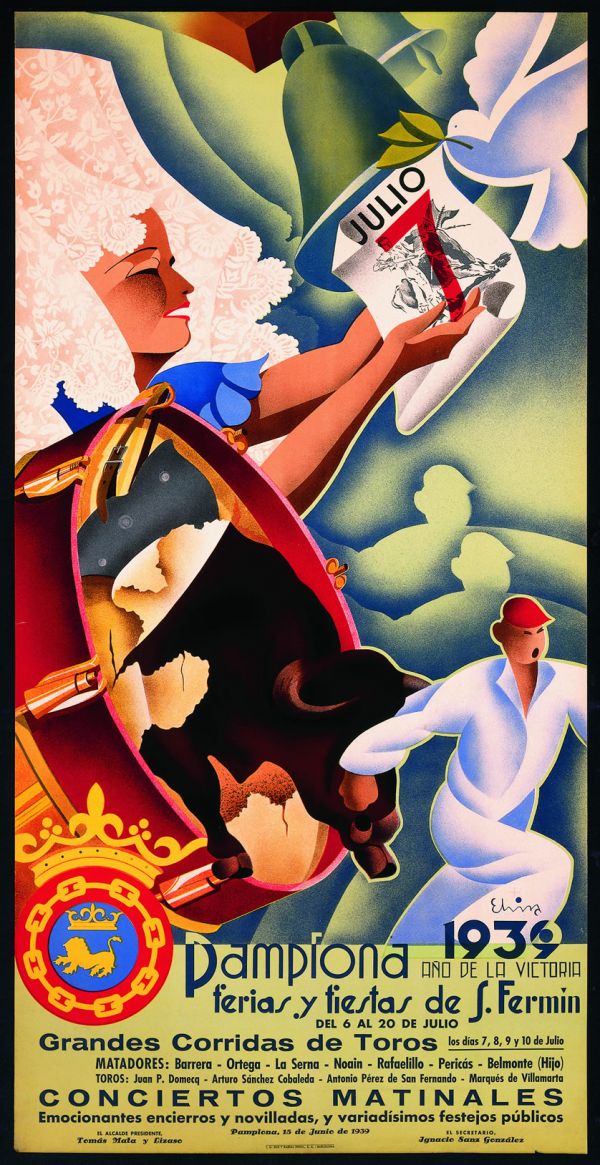
San Fermín 1939 poster (cartel)

San Fermín 1939 poster (cartel) by Elvira: a bull bursts through the skin of a drum while a woman in a white lace mantilla holds up a calendar page for July 7, a dove with an olive branch flies above and a runner in white with a red beret flees below
Cartel de San Fermín 1939. Poster of the Ferias y Fiestas de San Fermín 1939, signed Elvira. Tap the poster to see it full size. See every San Fermín poster.11, 12
San Fermín 1939 poster (cartel) by Elvira: a bull bursts through the skin of a drum while a woman in a white lace mantilla holds up a calendar page for July 7, a dove with an olive branch flies above and a runner in white with a red beret flees below
Artist
Elvira (signature)
Fiesta on the poster
Del 6 al 20 de julio
Dated
Pamplona, June 15, 1939

Ollaquindía reads the 1939 poster as a bull bursting out of a drum, breaking its skin, after years shut inside a war drum, with a dove flying above carrying something in its beak.12 On the poster a woman in a white lace mantilla holds up a calendar page for July 7, a bell hangs behind, and a runner in white with a red beret flees below; the poster also promises “Emocionantes encierros”.11

Pamplona in 1939

Words of 1939

El vejigazo

A “vejigazo” is a blow with an inflated bladder; Iribarren’s story of the first encierro of 1939 is called “El Vejigazo”.12

Photographs

Where to see old photographs

The city’s photo archive, the Fototeca de Pamplona, holds historic photographs of the encierro, free to view online.13

San Fermín 1939: questions and answers

When did the running of the bulls return after the Civil War?

The running of the bulls returned in San Fermín 1939, the first fiesta after the Civil War, with runs at seven in the morning from Friday, July 7, to Monday, July 10, 1939, and one more on July 19.2, 5, 6, 7, 9, 10

What happened in the encierro of July 8, 1939?

A Sánchez Cobaleda bull broke two boards of the fence by the ring entrance on July 8, 1939, at the very spot where a Domecq bull had hit it the day before, and got out among the packed crowd. A woman was gored twice, and the Diario de Navarra called it a true miracle that nothing worse happened.3, 6

Why was the July 19, 1939 encierro so dangerous?

The extra encierro of July 19, 1939 was run in rain, with the course and the ring deep in mud, and bulls and steers slipped and fell again and again. The Diario de Navarra said that in all its years of watching encierros it did not remember one as dangerous.10

What is the Vejigazo story?

“El Vejigazo” is José María Iribarren’s account of the first encierro of 1939: with the runners packed against the line of guards, a man knelt and brought an inflated bladder down on the pavement two minutes before seven, and at the crack the whole group shot off, running over the guards.12

Who made the San Fermín 1939 poster?

Elvira made the San Fermín 1939 poster, signed on the poster itself: a woman in a white lace mantilla holding up a calendar page for July 7, a runner fleeing below, and, as Ollaquindía reads it, a bull bursting out of a drum and a dove flying above.11, 12

Sources

Numbers on the page refer to this list. Diario de Navarra pages are cited from its archive (hemeroteca); quotations in Spanish are given as printed, in the spelling of the day.

Full source list
  1. Diario de Navarra, July 7, 1939, page 2: a bus notice, on July 9 leaving Santesteban at four and Areso at five “para llegar al encierro”. Diario de Navarra archive
  2. Diario de Navarra, July 7, 1939, page 10: programme for July 7: dianas from July 7 to 10 and on 18 and 19; at seven sharp the encierro of the day’s bulls; the procession at ten. Diario de Navarra archive
  3. Diario de Navarra, July 7, 1939, page 8: the bulls of Arturo Sánchez Cobaleda for Saturday, July 8. Diario de Navarra archive
  4. Diario de Navarra, July 9, 1939, page 8: programme for July 10, the encierro at seven sharp. Diario de Navarra archive
  5. Diario de Navarra, July 8, 1939, page 1: the Domecq encierro of July 7, “Los toros de Domecq hicieron el recorrido a velocidad vertiginosa”; the berrendo bull left behind. Diario de Navarra archive
  6. Diario de Navarra, July 9, 1939, page 1: the encierro of July 8: bulls loose on the course; a boy wounded in the ring; bull number 26 broke through the fence at the entrance “por el mismo sitio que el día anterior pegó otro toro de Domecq”; a woman gored; panic “en proporciones gigantescas”; “verdadero milagro”. Diario de Navarra archive
  7. Diario de Navarra, July 11, 1939, page 1: “El domingo”, July 9: the encierro of the Antonio Pérez de San Fernando bulls, some two thousand people in the passage and the arena; “Los ocho toros, en fila india”; the encierro of July 10, as many people in the ring as on the first two days. Diario de Navarra archive
  8. Diario de Navarra, July 11, 1939, page 5: lost property, a watch lost “en calle Estafeta en encierro día 9”. Diario de Navarra archive
  9. Diario de Navarra, July 18, 1939, page 1: programme for July 19, dianas “hasta las siete, hora en que se celebrará el encierro”. Diario de Navarra archive
  10. Diario de Navarra, July 20, 1939, page 3: the encierro of July 19, in rain, the most dangerous the writer remembered in many years of watching encierros. Diario de Navarra archive
  11. The poster of the Ferias y Fiestas de San Fermín 1939 itself, “Año de la Victoria”, “del 6 al 20 de julio”, dated Pamplona, June 15, 1939; signed Elvira.
  12. Ricardo Ollaquindía, 100 años de carteles de las fiestas y ferias de San Fermín (1882 to 1981), Pamplona, 1981, chapter “1939”. Free copy in the Biblioteca Navarra Digital (BiNaDi). binadi.navarra.es
  13. Fototeca de Pamplona, Archivo Municipal de Pamplona (photographs of the encierro, free to view online; publication needs the archive’s permission). archivo.pamplona.es
How to cite this page

Encierro. “Running of the Bulls 1939: San Fermín in Pamplona.” Encierro.com, November 9, 2026. https://encierro.com/san-fermin-1939/

Corrections and updates
  • : questions and answers rewritten around what people search, each answer with its sources; the poster labelled with its Spanish name, cartel.
  • : page published.

Walk the route with people who run it

Book your walk