San Fermín 2027: July 6 to 14. Tours filling fast. Book your spot  | 
ToursRunning with Bulls About Fiesta About UsShop Book Now
The Encierro archive · 1946

Running of the Bulls 1946: San Fermín in Pamplona

San Fermín 1946 had five bull runs (encierros): July 7, 8, 9 and 10, and one more on Sunday, July 14, the octave of San Fermín. They started at eight, which, the paper explained, was the old six: “las seis de antes”. The last, on July 14, was “quizá el más emocionante y el más bonito”, perhaps the most exciting and the finest of the year.1, 8, 13

By Encierro · Last reviewed

5runs: July 7 to 10 and 14
8:00start, “the old six”
200pesetas fine for a tail-puller

How the fiesta ran in 1946

The mayor’s bando set “los encierros que se celebrarán con motivo de las Fiestas de San Fermín los días 7, 8, 9, 10 y 14” at eight, on the course from the Rochapea gate by Santo Domingo, the Plaza Consistorial, Doña Blanca de Navarra and Estafeta to the ring, with the clock of San Saturnino as the official time.1

Outside reporters got the hour wrong. One wrote that the encierro was at six sharp, at dawn. The paper corrected him: “el encierro se hace á las ocho que, como dicen los aldeanos, son «las seis de antes»”, eight on the clock being, as the villagers said, the old six. The signal was a rocket, not a cannon-like petard, and the bulls did not run the course in two minutes.8

When a man was killed running before the bulls at Vila Franca de Xira in Portugal, and a Madrid paper’s headline brought up San Fermín, the paper replied that “para correr delante de los toros, hay que saber correr, como saben los de Pamplona”: to run before the bulls you have to know how to run, as Pamplona’s runners do.11

Every known encierro of 1946, by day and ranch

The encierros of San Fermín 1946, from the bando and the Diario de Navarra programmes and reports.
DateRunRanch (ganadería)What the paper reported
July 71Juan Pedro DomecqThe ring packed to the flagpole
July 82Joaquín BuendíaA bull alone in Estafeta, bothering no one
July 93Clemente TassaraA bull fell to its knees beside a fallen runner
July 104Carmen de FedericoWatched by the Pax Romana delegates
July 145, lastIsaías and Julio VázquezA lone bull; a man fined for holding its tail

The 1946 encierros, day by day

Run 1 of 5

· Juan Pedro Domecq

Start8:00 a.m.
DaySunday

For the first encierro the ring was packed, every seat taken “hasta el palo de la bandera”, up to the flagpole, as the saying went: a mass of people that was impressive and frightening. The bulls of the day were those of Domecq.1, 3, 2

Run 2 of 5

· Joaquín Buendía

Start8:00 a.m.
IncidentsNone unpleasant

Without the slightest unpleasant incident, the second encierro had more emotion than Sunday’s and was finer to watch. One bull broke completely away from the others and “se quedó solo en la calle Estafeta, sin meterse con nadie”: it stayed alone in Estafeta, bothering no one despite the young men shouting at it, and waited for the steers to come and take it to the corrals, where the others had gone in close together. The bulls were the Buendía “colomas”, of Santa Coloma blood.4, 5

Run 3 of 5

· Clemente Tassara

Start8:00 a.m.

“A las ocho de la mañana encierro de los toros”, the programme said, with the bulls of Clemente Tassara.7, 6 The run was “otro entre los calificados de normales”, another of the normal ones, except for one moment in the Plaza Consistorial: a bull a little ahead of the rest went for a young man who had just fallen, but it fell too, beside him, and stayed on its knees as if pleading. It got up, startled, and ran on up Estafeta, while the young man stayed on the ground with the other bulls almost upon him, and came through.9

Run 4 of 5

· Carmen de Federico

Start8:00 a.m.
GuestsPax Romana delegates

The programme set the encierro at eight.9 Among the crowd were the delegates of the Pax Romana Catholic congress, who after watching the encierro left with the civil governor, Juan Junquera, to visit a youth camp in the Ultzama valley. The bulls were those of doña Carmen de Federico.10

Run 5 of 5, the last

· Isaías and Julio Vázquez

Start8:00 a.m.
DaySunday
Fine200 pesetas

“A las ocho en punto se verificará el último encierro”, the programme announced for the Sunday of the octave, the last day of the fiesta; the bulls were those of Isaías and Julio Vázquez, of Seville.12, 14 It was “quizá el más emocionante y el más bonito de los de este año”: one bull stayed behind, spread alarm among the runners and entered the ring alone, master of the situation, sparing the reckless man who grabbed a horn in the street and the other who pulled its tail and, hanging on, reached the arena with it.13 The mayor fined the tail-puller 200 pesetas.15

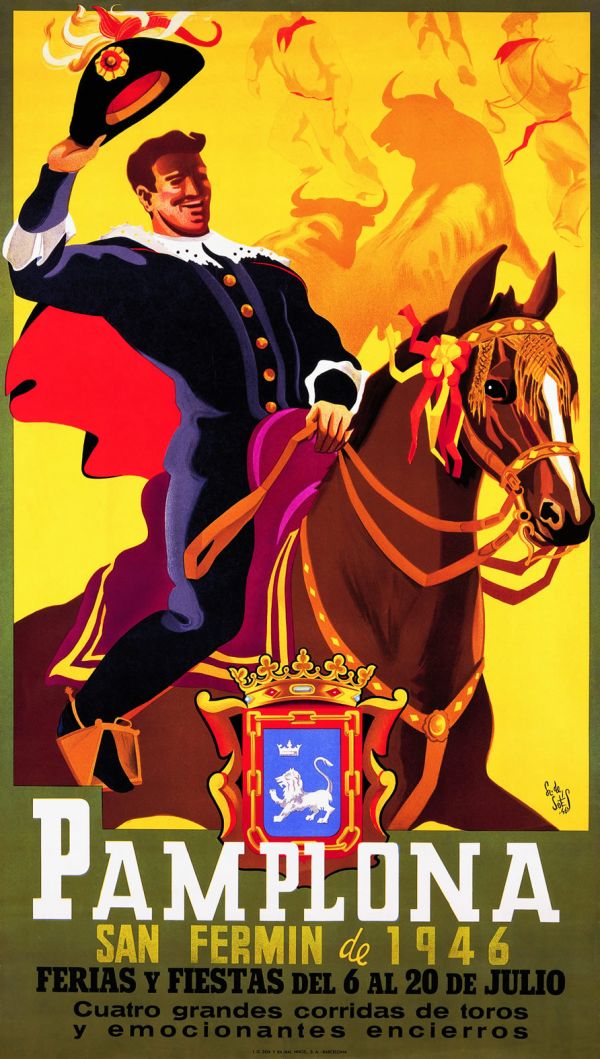
San Fermín 1946 poster (cartel)

San Fermín 1946 poster (cartel) by L. de Sotés: a smiling horseman raises his plumed hat in greeting on a bay horse decked with red and yellow ribbons, while bulls and runners rush across the yellow background behind him, above the crowned shield of Pamplona
Cartel de San Fermín 1946. Poster of the Ferias y Fiestas de San Fermín 1946, signed L. de Sotés. Tap the poster to see it full size. See every San Fermín poster.16, 17
San Fermín 1946 poster (cartel) by L. de Sotés: a smiling horseman raises his plumed hat in greeting on a bay horse decked with red and yellow ribbons, while bulls and runners rush across the yellow background behind him, above the crowned shield of Pamplona
Artist
L. de Sotés (signature; Ollaquindía)
Fiesta on the poster
Del 6 al 20 de julio
Printed by
Seix y Barral Hnos., Barcelona

A smiling horseman raises his plumed hat in greeting from a bay horse decked with red and yellow ribbons, while bulls and runners rush across the yellow background. The poster promises “emocionantes encierros”.16

Ollaquindía notes that the back cover of the 1946 programme showed the fairground rides, a girl going round and round on a cardboard horse, and that the fair was set up, as the year before, on the open ground at the end of the Avenida de Carlos III.17

Pamplona in 1946

The old six

Las seis de antes

In 1946 the encierro was at eight on the clock, but country people called it “las seis de antes”, the old six.8

Words of 1946

Saber correr

“Saber correr”, knowing how to run, was the paper’s answer to the death at Vila Franca de Xira. The encierros it called “normales” were those without incident.11, 9

Photographs

Where to see old photographs

The city’s photo archive, the Fototeca de Pamplona, holds historic photographs of the encierro, free to view online.18

San Fermín 1946: questions and answers

When were the bull runs of San Fermín 1946?

San Fermín 1946 had five bull runs at eight in the morning, on July 7, 8, 9 and 10, 1946, and on Sunday, July 14, the octave of San Fermín, as the mayor’s bando set them.1, 3, 4, 7, 10, 12

Why did people call eight o’clock “las seis de antes” in 1946?

Country people called the eight o’clock encierro of 1946 “las seis de antes”, the old six, the Diario de Navarra explained, correcting an outside reporter who wrote that the run was at six at dawn.8

What was the route of the running of the bulls in 1946?

The mayor’s bando of 1946 set the route of the running of the bulls from the Rochapea gate by Santo Domingo, the Plaza Consistorial, Doña Blanca de Navarra and Estafeta to the ring, with the clock of San Saturnino as the official time.1

What happened in the last encierro of 1946?

A bull stayed behind and entered the ring alone in the last encierro of 1946, on July 14, sparing a man who grabbed its horn in the street and another who held its tail into the arena; the mayor fined the tail-puller 200 pesetas.13, 15

Who made the San Fermín 1946 poster?

L. de Sotés made the San Fermín 1946 poster, signed on the poster itself: a smiling horseman raising his plumed hat from a bay horse decked with ribbons, with bulls and runners rushing behind.16

Sources

Numbers on the page refer to this list. Diario de Navarra pages are cited from its archive (hemeroteca); quotations in Spanish are given as printed, in the spelling of the day.

Full source list
  1. Diario de Navarra, July 6, 1946, page 3: bando of the mayor on “los encierros que se celebrarán con motivo de las Fiestas de San Fermín los días 7, 8, 9, 10 y 14”, at eight; the course from the Rochapea gate by Santo Domingo, the Plaza Consistorial, Doña Blanca de Navarra and Estafeta to the ring; the official time by the clock of San Saturnino. Diario de Navarra archive
  2. Diario de Navarra, July 7, 1946, page 8: an article on the herd of don Juan Pedro Domecq, which kept the brand, colours and seniority of Veragua. Diario de Navarra archive
  3. Diario de Navarra, July 9, 1946, page 5: “El primer encierro”, Sunday, July 7: the ring packed “hasta el palo de la bandera”; the first day’s bulls those of Domecq. Diario de Navarra archive
  4. Diario de Navarra, July 9, 1946, page 10: “El segundo encierro”, July 8: a bull “se quedó solo en la calle Estafeta, sin meterse con nadie”. Diario de Navarra archive
  5. Diario de Navarra, July 9, 1946, page 5: the bulls of Monday, July 8, the “colomas” of don Joaquín Buendía. Diario de Navarra archive
  6. Diario de Navarra, July 9, 1946, page 10: programme for July 9, the bulls of don Clemente Tassara. Diario de Navarra archive
  7. Diario de Navarra, July 9, 1946, page 7: programme for July 9, “A las ocho de la mañana encierro de los toros”. Diario de Navarra archive
  8. Diario de Navarra, July 10, 1946, page 1: “el encierro se hace á las ocho que, como dicen los aldeanos, son «las seis de antes»”; corrections to outside reporters. Diario de Navarra archive
  9. Diario de Navarra, July 10, 1946, page 3: “El tercer encierro”, July 9, “otro entre los calificados de normales”, except a moment in the Plaza Consistorial; programme for July 10, the encierro at eight. Diario de Navarra archive
  10. Diario de Navarra, July 11, 1946, page 3: the delegates of the Pax Romana congress, “después de presenciar el encierro”, left with the civil governor, Juan Junquera; the bulls of doña Carmen de Federico. Diario de Navarra archive
  11. Diario de Navarra, July 11, 1946, page 7: on a man killed running before the bulls in Vila Franca de Xira: “para correr delante de los toros, hay que saber correr, como saben los de Pamplona”. Diario de Navarra archive
  12. Diario de Navarra, July 14, 1946, page 3: programme for Sunday, July 14, “A las ocho en punto se verificará el último encierro”. Diario de Navarra archive
  13. Diario de Navarra, July 16, 1946, page 3: “El último encierro”, July 14, “quizá el más emocionante y el más bonito de los de este año”. Diario de Navarra archive
  14. Diario de Navarra, July 16, 1946, page 3: the bulls of the last day, those of don Isaías and don Julio Vázquez, of Seville; July 14 “el último día de las fiestas”. Diario de Navarra archive
  15. Diario de Navarra, July 16, 1946, page 4: the mayor fined a man 200 pesetas who “en el último encierro” entered the ring holding the tail of the lagging bull. Diario de Navarra archive
  16. The poster of the Ferias y Fiestas de San Fermín 1946 itself, “del 6 al 20 de julio”, “emocionantes encierros”; signed L. de Sotés ’46; printed by Seix y Barral Hnos., Barcelona.
  17. Ricardo Ollaquindía, 100 años de carteles de las fiestas y ferias de San Fermín (1882 to 1981), Pamplona, 1981, chapter “1946”. Free copy in the Biblioteca Navarra Digital (BiNaDi). binadi.navarra.es
  18. Fototeca de Pamplona, Archivo Municipal de Pamplona (photographs of the encierro, free to view online; publication needs the archive’s permission). archivo.pamplona.es
How to cite this page

Encierro. “Running of the Bulls 1946: San Fermín in Pamplona.” Encierro.com, November 9, 2026. https://encierro.com/san-fermin-1946/

Corrections and updates
  • : questions and answers rewritten around what people search, each answer with its sources; the poster labelled with its Spanish name, cartel.
  • : page published.

Walk the route with people who run it

Book your walk