
San Fermín 2027: July 6 to 14. Tours filling fast. Book your spot  | 
ToursRunning with Bulls About Fiesta About UsShop Book Now
The Encierro archive · 1945

Running of the Bulls 1945: San Fermín in Pamplona

The mayor’s bando for San Fermín 1945 set four bull runs (encierros), at eight in the morning from Saturday, July 7, to Tuesday, July 10. The first ended in a wall of fallen runners at the ring gate, “ahora no es encerrar, es machacarse”, the paper wrote: it is no longer penning, it is crushing yourself. From the next day the city forbade anyone to stand along Estafeta, and the next run had more room.1, 6, 8

By Encierro · Last reviewed

4runs, July 7 to 10
8:00start, a.m.
1wounded on the first day

How the fiesta ran in 1945

The mayor, Daniel Nagore, issued a bando with the governor’s agreement for “los encierros que se celebrarán con motivo de las Fiestas de San Fermín, los días 7, 8, 9 y 10”. Among its rules, the gate the bulls use into the ring was to open two minutes before eight, only for those running ahead of the bulls.1 The programme set dianas every day until July 10 and the encierro at eight, “según tradicional costumbre”, with the bulls of the day.2

After the crush of July 7, the city announced that from the encierro of July 8 “se prohibirá en absoluto el estacionamiento de personas” along the whole of Estafeta from half past seven: nobody could stand in the street to watch. The next run, the paper reported, had more room.6, 8

When a Madrid paper ran a headline of more than twenty wounded in the first encierro, the Diario de Navarra answered that “no hubo más que un herido”: there had been only one wounded, and the rest had a few scrapes from being trodden on that did not stop them dancing through the fiesta.10

Every known encierro of 1945, by day and ranch

The encierros of San Fermín 1945, from the bando, the Diario de Navarra programmes and reports, and the poster.
DateRunRanch (ganadería)What the paper reported
July 71Alipio Pérez T. SanchónA wall of fallen runners at the ring gate; one wounded
July 82Juan Pedro DomecqEstafeta cleared; a bull broke a leg
July 93Atanasio Fernández (programmed)Run day in the bando
July 104, lastCarmen de FedericoAlmost as fast as lightning; no incidents

The 1945 encierros, day by day

Run 1 of 4

· Alipio Pérez T. Sanchón

Start8:00 a.m.
Wounded1

The first encierro had, the paper wrote, what it almost always has: too much emotion. There were more people than room, and at the very gate into the ring a wall of fallen people built up. Over it went first the steers, which know the routine by heart, and then the bulls. “ahora no es encerrar, es machacarse”: it is no longer penning, it is crushing yourself.2, 6 There was one wounded.10 The paper printed a photograph of the bulls entering the ring, seen from the stands.7
Run 2 of 4

· Juan Pedro Domecq

Start8:00 a.m.
DaySunday
EstafetaCleared of onlookers

With Estafeta cleared of people standing to watch, the run went “con más holgura que el anterior día”, with more room than the day before, and those who ran had space to move without the crush and the jam at the ring gate. The Domecq bulls came in two groups: first four with the steers and one a little behind, which was slow to go into the corral; then, nearly half an hour later, another fine bull, limping. It had fallen turning into Estafeta and broken its right leg, yet it still had the spirit to turn on a waiter who took liberties with it in the second half of Estafeta and almost pinned him against a door, which splintered; the waiter came out of it unhurt.6, 8

Run 3 of 4, programmed

· Atanasio Fernández

Start8:00 a.m.
DayMonday

July 9 was one of the four run days in the mayor’s bando, and the bulls announced for the day were those of Atanasio Fernández, of Salamanca.1, 3, 11

Run 4 of 4, the last

· Carmen de Federico

Start8:00 a.m.
IncidentsNone

“A las ocho de la mañana tendrá lugar el último encierro”, the programme said.9 The encierro “se verificó sin incidentes”: the “murubes” of doña Carmen de Federico ran the course almost as fast as lightning, never leaving the company of the steers, crossed the ring ignoring the crowd around them, and went into the corral. Padded-horn cows were let out afterwards. The crowd was big, though smaller than on the days before.10, 11

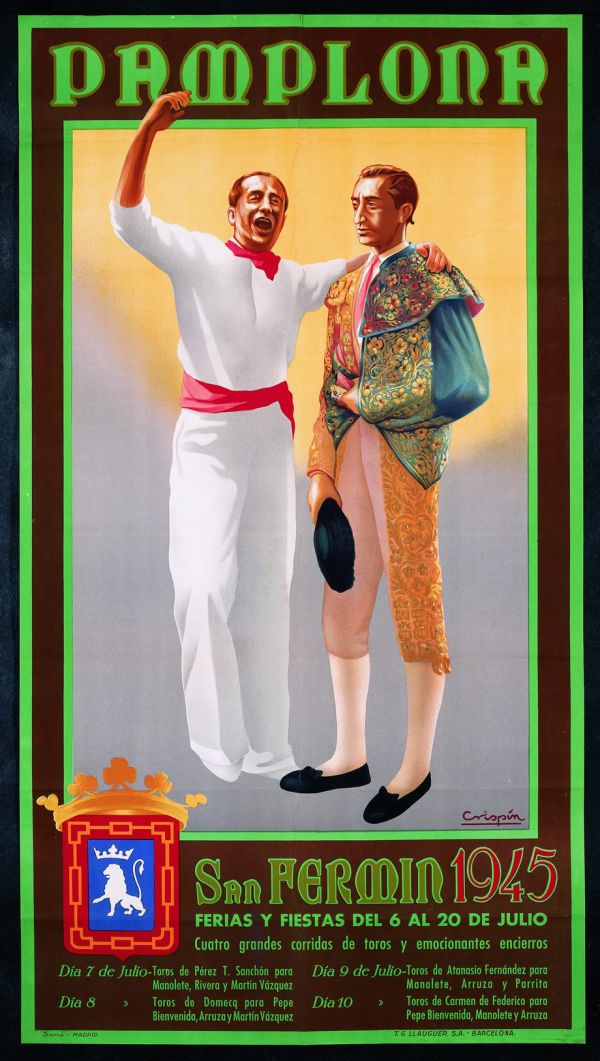
San Fermín 1945 poster (cartel)

San Fermín 1945 poster (cartel) by Crispín: a laughing young man in white with a red neckerchief and sash raises one arm and puts the other round a companion’s shoulders, under the word Pamplona, with the crowned shield of the city below
Cartel de San Fermín 1945. Poster of the Ferias y Fiestas de San Fermín 1945, signed Crispín. Tap the poster to see it full size. See every San Fermín poster.11, 12
San Fermín 1945 poster (cartel) by Crispín: a laughing young man in white with a red neckerchief and sash raises one arm and puts the other round a companion’s shoulders, under the word Pamplona, with the crowned shield of the city below
Artist
Crispín (signature; Ollaquindía)
Fiesta on the poster
Del 6 al 20 de julio
Printed by
T. G. Llauger, Barcelona

The poster, painted by Crispín, promises “emocionantes encierros” and lists the bulls of each day, from Pérez T. Sanchón on July 7 to Carmen de Federico on July 10.11, 12

Ollaquindía notes that in 1945 the programme began to print texts about the fiesta beyond the list of events: for July 6 an anonymous ballad that opens “Bien oiréis de hoy a las doce, campanas del mediodía”, about the noon bells on the eve of the fiesta, and a sonnet titled “Siete de Julio”.12

Pamplona in 1945

Twenty-five years earlier

The 1920 look-back

On the first day of the 1945 fiesta the paper looked back twenty-five years: then, box seats for the encierro were limited to a thousand, at one peseta, and the rest of the ring was free. On the first day of that fiesta, with Santa Coloma cattle, a lagging bull caught a young engineer from Logroño who had arrived by motorcycle minutes before, as he tried to squeeze into the passage, and gave him a big horn wound in the right thigh. He survived.4

Then and now

A photograph of 1921

The paper printed a 1921 photograph of a loose bull in the old ring under the heading “¡Lo que va de ayer a hoy!”, what a difference: runners then kept to the fence and left the ring clear so a straggler could be gathered without trouble, while in 1945 the bulls got lost among the people.5

Words of 1945

Machacarse

“Encerrar” is to pen the bulls; “machacarse” is to crush yourself. The rule of July 8 banned “el estacionamiento de personas”, people standing in the street. The steers were mansos.6

Photographs

Where to see old photographs

The city’s photo archive, the Fototeca de Pamplona, holds historic photographs of the encierro, free to view online.13

San Fermín 1945: questions and answers

When were the bull runs of San Fermín 1945?

San Fermín 1945 had four bull runs at eight in the morning on July 7, 8, 9 and 10, 1945, the days set in the mayor’s bando, with bulls of Alipio Pérez T. Sanchón, Juan Pedro Domecq, Atanasio Fernández and Carmen de Federico.1, 2, 6, 8, 9, 10, 11

Why was Estafeta cleared in 1945?

Pamplona banned people from standing anywhere along Estafeta from half past seven, starting with the encierro of July 8, 1945, after a wall of fallen runners formed at the ring gate on July 7; the Diario de Navarra reported that the next run had more room.6, 8

How many were wounded in the first encierro of 1945?

One person was wounded in the first encierro of 1945, “no hubo más que un herido”, according to the Diario de Navarra, which rejected a Madrid paper’s headline of more than twenty wounded; the others had only scrapes from being trodden on.10

What happened to the limping Domecq bull in 1945?

A Domecq bull fell turning into Estafeta on July 8, 1945 and broke its right leg, yet it came into the ring nearly half an hour after the other bulls, limping, the Diario de Navarra reported.8

Who made the San Fermín 1945 poster?

Crispín painted the San Fermín 1945 poster, which promises exciting encierros and lists the bulls of each day, from Pérez T. Sanchón on July 7 to Carmen de Federico on July 10.11, 12

Sources

Numbers on the page refer to this list. Diario de Navarra pages are cited from its archive (hemeroteca); quotations in Spanish are given as printed, in the spelling of the day.

Full source list
  1. Diario de Navarra, July 7, 1945, page 7: bando of the mayor, Daniel Nagore, on “los encierros que se celebrarán con motivo de las Fiestas de San Fermín, los días 7, 8, 9 y 10”; the gate the bulls use into the ring to open two minutes before eight, only for those running ahead of the bulls. Diario de Navarra archive
  2. Diario de Navarra, July 7, 1945, page 7: programme for July 7, dianas daily to July 10; “A las ocho se celebrará según tradicional costumbre, el encierro de los toros” of the day; the bulls of Alipio Pérez T. Sanchón, of Salamanca. Diario de Navarra archive
  3. Diario de Navarra, July 5, 1945, page 2: the bulls of the feria, “Día 9. Seis toros de D. Atanasio Fernández, de Salamanca”. Diario de Navarra archive
  4. Diario de Navarra, July 7, 1945, page 4: a look back twenty-five years: box seats for the encierro “limitadas a 1.000”, one peseta, the rest of the ring free; on the first day, with Santa Coloma cattle, a young engineer from Logroño caught by a lagging bull. Diario de Navarra archive
  5. Diario de Navarra, July 7, 1945, page 5: photograph of 1921, “¡Lo que va de ayer a hoy!”: runners used to keep to the fence and leave the ring clear for a loose bull. Diario de Navarra archive
  6. Diario de Navarra, July 8, 1945, page 8: the encierro of July 7, “ahora no es encerrar, es machacarse”; a wall of fallen people at the ring gate; notice: from the encierro of July 8, “se prohibirá en absoluto el estacionamiento de personas” along Estafeta from 7:30; programme for July 8, the bulls of Juan Pedro Domecq, of Seville. Diario de Navarra archive
  7. Diario de Navarra, July 8, 1945, page 1: photographs, “Un aspecto del encierro de ayer” and “La entrada de los toros en la plaza ayer, vista desde la grada” (Foto Urriza). Diario de Navarra archive
  8. Diario de Navarra, July 10, 1945, page 6: the encierro of Sunday, July 8, “con más holgura que el anterior día debido a la determinación de dejar despejada de corredores la calle de la Estafeta”; a Domecq bull that broke a leg at the Estafeta corner. Diario de Navarra archive
  9. Diario de Navarra, July 10, 1945, page 5: programme for July 10, “A las ocho de la mañana tendrá lugar el último encierro”. Diario de Navarra archive
  10. Diario de Navarra, July 11, 1945, page 2: the encierro of July 10, “se verificó sin incidentes. Los «murubes» de doña Carmen hicieron el recorrido a la velocidad casi del rayo”; a Madrid paper’s headline of more than twenty wounded on the first day, when “no hubo más que un herido”. Diario de Navarra archive
  11. The poster of the Ferias y Fiestas de San Fermín 1945 itself, “del 6 al 20 de julio”, “emocionantes encierros”, with the bulls of each day: July 7 Pérez T. Sanchón, July 8 Domecq, July 9 Atanasio Fernández, July 10 Carmen de Federico; signed Crispín; printed by T. G. Llauger, Barcelona.
  12. Ricardo Ollaquindía, 100 años de carteles de las fiestas y ferias de San Fermín (1882 to 1981), Pamplona, 1981, chapter “1945”. Free copy in the Biblioteca Navarra Digital (BiNaDi). binadi.navarra.es
  13. Fototeca de Pamplona, Archivo Municipal de Pamplona (photographs of the encierro, free to view online; publication needs the archive’s permission). archivo.pamplona.es
How to cite this page

Encierro. “Running of the Bulls 1945: San Fermín in Pamplona.” Encierro.com, November 9, 2026. https://encierro.com/san-fermin-1945/

Corrections and updates
  • : questions and answers rewritten around what people search, each answer with its sources; the poster labelled with its Spanish name, cartel.
  • : page published.

Walk the route with people who run it

Book your walk