
San Fermín 2027: July 6 to 14. Tours filling fast. Book your spot  | 
ToursRunning with Bulls About Fiesta About UsShop Book Now
The Encierro archive · 1956

Running of the Bulls 1956: San Fermín in Pamplona

San Fermín 1956 had seven bull runs (encierros), at seven in the morning: July 7 to 11, Sunday, July 15, and July 18. After the second, the paper wrote that the huge crowd of runners and the absence of any mishap were “la mejor demostración de que el peligro en este emocionante espectáculo es remoto”, the best proof that the danger of this thrilling spectacle is remote.2, 7, 11, 12

By Encierro · Last reviewed

7runs: July 7 to 11, 15 and 18
7:00start, a.m.
2groups of three, July 10

How the fiesta ran in 1956

The mayor’s bando, agreed with the civil governor, set “los Encierros que han de celebrarse con motivo de las Fiestas de San Fermín, los días 7, 8, 9, 10, 11 y 15”, and warned that anyone who distracted the bulls “tanto en la calle como en la plaza será castigado con todo rigor”, in the street or in the ring, would be punished severely.2 A seventh run followed on July 18.12

Before the fiesta a visiting columnist noted a Pamplona saying: when someone is killed or hurt in the encierro, “trátase de un forastero que no sabe resguardarse”, it is an outsider who does not know how to look after himself.1

Every known encierro of 1956, by day and ranch

The encierros of San Fermín 1956, from the bando and the Diario de Navarra programmes and reports.
DateRunRanch (ganadería)What the paper reported
July 71Sepúlveda de YeltesA fallen bull lifted by the young men
July 82Atanasio FernándezA huge crowd; nothing unpleasant
July 93Juan CobaledaA bull ahead; a runner flat on the ground
July 104Conde de la CorteTwo groups of three
July 115Fernández PachecoApart, with the usual frights
July 156Garci-GrandeA straggler took over Estafeta
July 187, lastRosa GonzálezBulls apart the whole way; no serious harm

The 1956 encierros, day by day

Run 1 of 7

· Sepúlveda de Yeltes

Start7:00 a.m.

The bulls were those of Sepúlveda de Yeltes, of Salamanca.4 The emotion came when one of them fell in the ring and could not get up by itself: several young men rushed to put it on its feet, “agarrándolo de los cuernos, de las patas y de la cola”, grabbing it by the horns, the legs and the tail, and the bull did not hook at any of them, perhaps grateful for the help.5
Run 2 of 7

· Atanasio Fernández

Start7:00 a.m.
DaySunday

“A las siete en punto, previo el disparo de un chupinazo”, after a rocket, the bulls of Atanasio Fernández, of Salamanca, were released.6, 7 With such an enormous crowd of runners anyone might have feared a catastrophe, but nothing unpleasant happened, “y esta es la mejor demostración de que el peligro en este emocionante espectáculo es remoto”, all the more when the runners keep their calm. One bull lagged behind, spreading fear the whole way, while its five brothers went quickly to the corrals wrapped by the steers; soon after, the straggler made its own entrance, guided in by two men, the Chico de Olite and Pepe Alaiza.7, 11

Run 3 of 7

· Juan Cobaleda

Start7:00 a.m.

Far fewer young men ran than on Sunday, but they ran splendidly, without obstacles. It had its emotion, as almost every encierro does: a fine bull of Juan Cobaleda went ahead, giving the runners many frights, and the biggest was for a tall young man who had to throw himself flat on the ground to escape its charge.3, 7

Run 4 of 7

· Conde de la Corte

Start7:00 a.m.

In complete normality, one of the finest runs and full of emotion, because “los seis toros de la ganadería del Conde de la Corte debieron de reñir entre sí y se separaron en dos lotes de tres”: the six bulls must have quarrelled among themselves, and they covered the course in two groups of three, with many runners ahead of them and among them running with a good eye and calm, and with room to move, because the crowd had thinned.3, 10

Run 5 of 7

· Fernández Pacheco

Start7:00 a.m.

The animals announced, those of Núñez, had been replaced by others of the Pacheco herd of Salamanca, which the report called Fernández Pacheco. “Vinieron separados y dieron los correspondientes sustos a los mozos corredores”: they came apart and gave the runners the usual frights, but, as in every run so far, nothing went wrong, and they entered the ring in two groups.9

Run 6 of 7

· Garci-Grande

Start7:00 a.m.
DaySunday

After a pause the fiesta resumed on Sunday, with bulls mainly of the Vizconde de Garci-Grande, of Salamanca.8, 3 “El sexto encierro fue uno de los más emocionantes de este año porque un toro se quedó rezagado”: one bull fell behind and, alone, sent the runners flying, giving the biggest frights during the long time it was master of part of Estafeta and above all before the gate into the ring. The herdsmen worked hard and at great risk.11

Run 7 of 7, the last

· Rosa González

Start7:00 a.m.

The seventh run was one of real, intense emotion, because “los seis bichos de la ganadería de doña Rosa González, de El Escorial, hicieron el recorrido separados”, spreading alarm and giving the runners great frights the whole way. But the young men ran very well, with a good eye and calm, and though some felt the bulls’ “caresses” and their chilling snort, it went no further; the bulls entered the ring and then the pens “sin causar graves consecuencias”.12

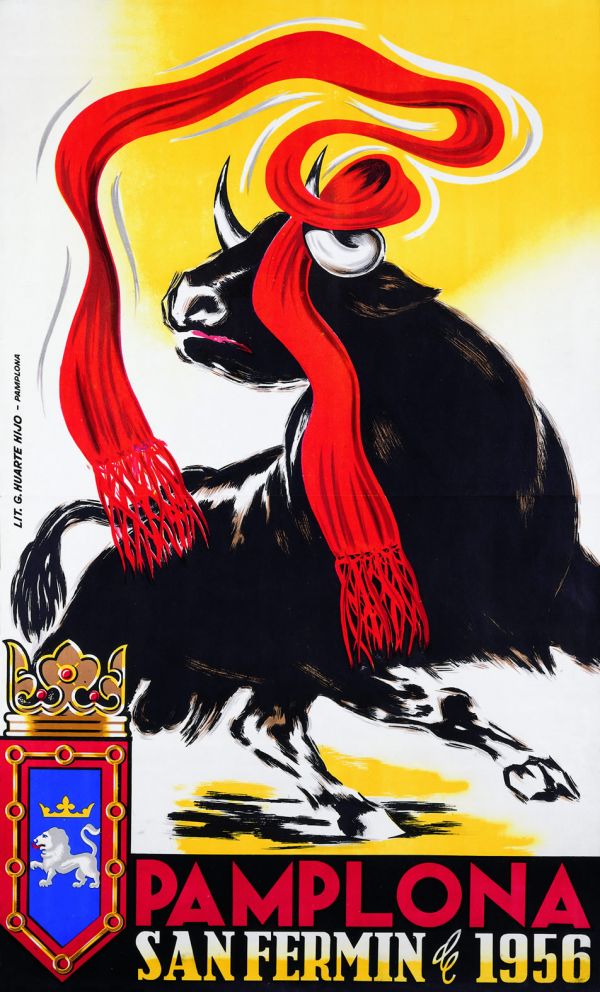
San Fermín 1956 poster (cartel)

San Fermín 1956 poster (cartel) by Balda: a black bull with a long red sash caught on one horn and streaming in the air, with the crowned shield of Pamplona at the lower left
Cartel de San Fermín 1956. Poster of San Fermín 1956, by Balda according to Ollaquindía. Tap the poster to see it full size. See every San Fermín poster.13, 14
San Fermín 1956 poster (cartel) by Balda: a black bull with a long red sash caught on one horn and streaming in the air, with the crowned shield of Pamplona at the lower left
Artist
Balda (Ollaquindía)
Printed by
Lit. G. Huarte Hijo, Pamplona

Ollaquindía describes Balda’s 1956 poster as the sash: a red sash, tossed and wound around the dagger-sharp horn of a black bull, a reminder of the runners caught and carried hanging from that sharp hook. On July 15, 1933, he recalls, a bull caught a runner known as Carroza by his sash and carried him round the ring.14 See San Fermín 1933.

Pamplona in 1956

A Pamplona saying

The outsider

In 1956 a visiting columnist reported the Pamplona saying that when someone is killed or hurt in the encierro, it is an outsider who does not know how to look after himself.1

Words of 1956

Dos lotes de tres

A herd that splits runs in “lotes”, groups. The bulls were “bichos”, and a bull left behind was rezagado.10, 11, 12

Photographs

Where to see old photographs

The city’s photo archive, the Fototeca de Pamplona, holds historic photographs of the encierro, free to view online.15

San Fermín 1956: questions and answers

When were the bull runs of San Fermín 1956?

San Fermín 1956 had seven bull runs, at seven in the morning, on July 7, 8, 9, 10 and 11, Sunday, July 15, and July 18, 1956. The mayor’s bando set the first six and warned that anyone who distracted the bulls would be punished severely.2, 12

Was anyone hurt in the 1956 running of the bulls?

The 1956 running of the bulls passed without serious harm, as the Diario de Navarra told it. After the crowded run of July 8, 1956 it wrote that the absence of any mishap was “la mejor demostración de que el peligro en este emocionante espectáculo es remoto”, the best proof that the danger is remote.7, 12

What did Pamplona say about outsiders hurt in the encierro in 1956?

In 1956 a visiting columnist noted a Pamplona saying: when someone is killed or hurt in the encierro, “trátase de un forastero que no sabe resguardarse”, it is an outsider who does not know how to look after himself.1

What happened in the first running of the bulls of 1956?

In the first running of the bulls of 1956, on July 7, a Sepúlveda de Yeltes bull fell in the ring and could not get up. Several young men rushed to lift it, “agarrándolo de los cuernos, de las patas y de la cola”, by the horns, legs and tail, and the bull hooked none of them.4, 5

Which ranches ran in the 1956 running of the bulls?

The bulls of the 1956 running of the bulls came from Sepúlveda de Yeltes, Atanasio Fernández, Juan Cobaleda, the Conde de la Corte, the Pacheco herd of Salamanca in place of the Núñez bulls announced, the Vizconde de Garci-Grande, and Rosa González of El Escorial.4, 6, 3, 9, 12

Who made the San Fermín 1956 poster?

Balda made the San Fermín 1956 poster: a red sash tossed and wound around the horn of a black bull. Ollaquindía reads it as a reminder of runners caught and carried on the horn, like the runner known as Carroza on July 15, 1933.14

Sources

Numbers on the page refer to this list. Diario de Navarra pages are cited from its archive (hemeroteca); quotations in Spanish are given as printed, in the spelling of the day.

Full source list
  1. Diario de Navarra, July 1, 1956, page 9: a visitor’s column: the people of Pamplona say that when someone is killed or hurt, “trátase de un forastero que no sabe resguardarse”. Diario de Navarra archive
  2. Diario de Navarra, July 6, 1956, page 10: bando of the mayor with the civil governor on “los Encierros que han de celebrarse con motivo de las Fiestas de San Fermín, los días 7, 8, 9, 10, 11 y 15”; anyone who distracts the bulls “tanto en la calle como en la plaza será castigado con todo rigor”. Diario de Navarra archive
  3. Diario de Navarra, July 7, 1956, page 3: the bulls of each day: July 9 don Juan Cobaleda, July 10 the Conde de la Corte, July 11 the young bulls of don Carlos Núñez, July 15 the Vizconde de Garci-Grande. Diario de Navarra archive
  4. Diario de Navarra, July 7, 1956, page 12: programme for July 7; the bulls of Sepúlveda de Yeltes, of Salamanca. Diario de Navarra archive
  5. Diario de Navarra, July 8, 1956, page 1: “El primer encierro”, July 7: a Sepúlveda de Yeltes bull fell in the ring and young men lifted it “agarrándolo de los cuernos, de las patas y de la cola”. Diario de Navarra archive
  6. Diario de Navarra, July 8, 1956, page 16: programme for July 8, “A las siete en punto, previo el disparo de un chupinazo, se celebrará el segundo encierro de los toros”; the bulls of Atanasio Fernández, of Salamanca. Diario de Navarra archive
  7. Diario de Navarra, July 10, 1956, page 1: “El segundo encierro”, Sunday, July 8: “nada desagradable ocurrió, y esta es la mejor demostración de que el peligro en este emocionante espectáculo es remoto”; “El tercer encierro”, July 9: a Cobaleda bull ran ahead, and one runner had to throw himself to the ground. Diario de Navarra archive
  8. Diario de Navarra, July 11, 1956, page 1: the fiesta pauses after July 11: “el 15 reanudaremos”. Diario de Navarra archive
  9. Diario de Navarra, July 12, 1956, page 1: “El quinto encierro”, July 11: the animals of the Fernández Pacheco herd, which replaced those of Núñez; “Vinieron separados y dieron los correspondientes sustos a los mozos corredores”; they entered the ring in two groups. Diario de Navarra archive
  10. Diario de Navarra, July 11, 1956, page 1: “El cuarto encierro”, July 10: “los seis toros de la ganadería del Conde de la Corte debieron de reñir entre sí y se separaron en dos lotes de tres”. Diario de Navarra archive
  11. Diario de Navarra, July 17, 1956, page 7: “El sexto encierro”, Sunday, July 15, “fue uno de los más emocionantes de este año porque un toro se quedó rezagado”. Diario de Navarra archive
  12. Diario de Navarra, July 19, 1956, page 2: “El séptimo encierro”, July 18: “los seis bichos de la ganadería de doña Rosa González, de El Escorial, hicieron el recorrido separados”; “sin causar graves consecuencias”. Diario de Navarra archive
  13. The poster of San Fermín 1956 itself, printed by Lit. G. Huarte Hijo, Pamplona; no signature visible.
  14. Ricardo Ollaquindía, 100 años de carteles de las fiestas y ferias de San Fermín (1882 to 1981), Pamplona, 1981, chapter “1956”. Free copy in the Biblioteca Navarra Digital (BiNaDi). binadi.navarra.es
  15. Fototeca de Pamplona, Archivo Municipal de Pamplona (photographs of the encierro, free to view online; publication needs the archive’s permission). archivo.pamplona.es
How to cite this page

Encierro. “Running of the Bulls 1956: San Fermín in Pamplona.” Encierro.com, November 9, 2026. https://encierro.com/san-fermin-1956/

Corrections and updates
  • : questions and answers rewritten around what people search, each answer with its sources; the poster labelled with its Spanish name, cartel.
  • : page published.

Walk the route with people who run it

Book your walk