
San Fermín 2027: July 6 to 14. Tours filling fast. Book your spot  | 
ToursRunning with Bulls About Fiesta About UsShop Book Now
The Encierro archive · 1959

Running of the Bulls 1959: San Fermín in Pamplona

San Fermín 1959 had seven bull runs (encierros), every morning from July 7 to July 13 at seven sharp. The Diario de Navarra closed the year saying the runs had given “muchos sustos, pero ningún herido”: many frights, but no one hurt. It was the last San Fermín of Ernest Hemingway.1, 12, 15

By Encierro · Last reviewed

7runs, July 7 to 13
7:00start, San Cernin time
4Miura bulls in the run of July 11

How the fiesta ran in 1959

The mayor’s bando set the runs at “las SIETE en punto de la mañana, hora de San Cernin”, seven sharp by the San Cernin clock, on July 7 to 13, from the Puerta de la Rochapea by Santo Domingo, the Plaza Consistorial, Doña Blanca de Navarra and Estafeta to the ring. From six no vehicles could use the course, and from half past six no women or children.1

Ollaquindía records that in his pregón the mayor said Pamplona had reached 100,000 inhabitants, and that a first class campsite was opened for visitors at the Ruiz de Alda stadium. Hemingway, now a Nobel laureate, spent his last San Fermín in Pamplona that year.15

In an interview the Diario de Navarra reported after the fiesta, Hemingway said that for him the sanfermines “de hacia los años 1923 y 1924” had been better, “por más íntimos y más cordiales”, more intimate and more friendly, and less overrun by tourism.13

Every known encierro of 1959, by day and ranch

The encierros of San Fermín 1959, from the bando and the Diario de Navarra programmes and reports.
DateRunRanch (ganadería)What the paper reported
July 71Ángel and Rafael PeraltaOne runner lightly hurt
July 82Juan Pedro DomecqA boy caught in Estafeta; nothing serious
July 93Álvaro DomecqA runner tossed in the ring, not a scratch
July 104Pablo RomeroAbsolute normality
July 115MiuraFour bulls ran; extra sand
July 126Garci-GrandeRunners on the horns
July 137, lastTulio and Isaías VázquezRain and falls; nobody hurt

The 1959 encierros, day by day

Run 1 of 7

· Ángel and Rafael Peralta

Start7:00 a.m.
Hurt1, slight

A thick, motley multitude ran, and with so many anything could have gone wrong, but “nada desagradable aconteció”: nothing unpleasant happened. Four bulls went ahead and two lagged behind. Only one reached a runner: Antonio Ordóñez, who, it was said, had stepped in to save a young man in danger; the doctors found a slight wound, and he was the infirmary’s “primer visitante este año”, its first visitor of the year. Another bull hooked a runner by his smock, with nothing worse than the fright. The six stopped in the ring, rested, and went into the corrals without charging anyone. The paper’s photograph was captioned “Encierro sin consecuencias, sin heridos, sin muertos”.2, 5
Run 2 of 7

· Juan Pedro Domecq

Start7:00 a.m.

The emotion of the morning was a boy caught at the start of Estafeta, “afortunadamente sin graves consecuencias”; as always, the paper said, the alarming talk was worse than the accident. One bull went ahead alone, hooking left and right, but once all were together in the ring they went straight into the pens. Many ran again, and ran better, without the crush of the first day. A photograph showed that “alguien ha perdido las alpargatas al entrar en la arena”: someone lost his espadrilles going into the ring.4, 6

Run 3 of 7

· Álvaro Domecq

Start7:00 a.m.

Álvaro Domecq’s bulls came to Pamplona for the first time. The reporter watched from the ring, where all the emotion was: two bulls stayed in the arena, and one, “un colorado imponente”, a big red bull, knocked a runner down and tossed him several times. He got up without “ni siquiera el menor rasguño ni un siete en su indumentaria”: not even a scratch, nor a tear in his clothes.3, 15, 7

Run 4 of 7

· Pablo Romero

Start7:00 a.m.

Those who like strong emotions were disappointed, because “el encierro fué de una normalidad absoluta”, with only the usual frights and falls. The six bulls of the Pablo Romero family ran almost together, now and then hooking to clear a way through the crowd of runners.8

Run 5 of 7

· Miura

Start7:00 a.m.
Bulls4

Rain had left the streets slippery, and in the most dangerous places more sand was spread for the runners. Only four Miura bulls ran: “los otros dos, como ya era sabido, estaban en la plaza”, the other two were already in the ring. Two of the four went ahead. The paper’s photographs showed a lone Miura entering the ring on the runners’ heels, and said the Miuras had won over the runners with their nobility, “a los corredores por su nobleza”.9, 10

Run 6 of 7

· Garci-Grande

Start7:00 a.m.
DaySunday

There was no paper on Monday, and Tuesday’s Diario de Navarra remembered Sunday’s run with a photograph: a steer between two of the Garci-Grande bulls and, in front, “en los mismos cuernos, un grupo de valientes pamplonicas”, a group of brave Pamplona runners right on the horns. “¡Así se corre, sí, señor!”, the caption said: that is how to run.2, 11

Run 7 of 7, the last

· Tulio and Isaías Vázquez

Start7:00 a.m.
Hurt0

The last run was “el más vistoso, el más impresionante y el de mayor emoción”: the showiest, most impressive and most moving. It had rained in the night and was still raining moments before the rocket, so people went to the run with umbrellas; the bulls fell several times and the runners many more, and the bulls split up, two by two, then one alone and another alone. The last bull stayed in the ring and hit two young men, who came away unhurt. The paper protested with all its soul against those who “agarran de la cola al bicho”, pull the bull by the tail, “cual si se tratase de cabras”, as if they were goats. Its verdict on the year: “muchos sustos, pero ningún herido”.2, 12

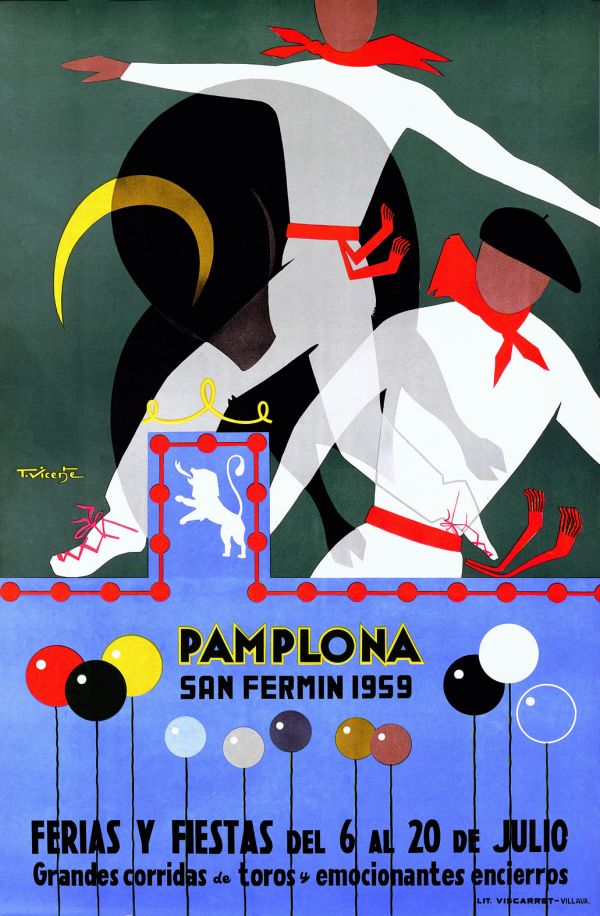
San Fermín 1959 poster (cartel)

San Fermín 1959 poster (cartel) by T. Vicente: two runners in white with red scarves and sashes run ahead of a black bull with yellow horns, above the white lion of Pamplona’s arms and a row of coloured balloons, with the words Pamplona San Fermín 1959
Cartel de San Fermín 1959. Poster of San Fermín 1959, signed T. Vicente. Tap the poster to see it full size. See every San Fermín poster.14, 15
San Fermín 1959 poster (cartel) by T. Vicente: two runners in white with red scarves and sashes run ahead of a black bull with yellow horns, above the white lion of Pamplona’s arms and a row of coloured balloons, with the words Pamplona San Fermín 1959
Artist
T. Vicente (signature; Ollaquindía)
On the poster
Ferias y fiestas del 6 al 20 de julio
Printed by
Lit. Viscarret, Villava

Two runners in white, with red scarves and sashes, one in a black beret, run ahead of a black bull with yellow horns, the figures overlapping like glass. Below them stands the white lion on blue of Pamplona’s arms, and along the bottom a row of coloured balloons on strings. The poster announces “Ferias y fiestas del 6 al 20 de julio”, the fairs and fiestas of July 6 to 20.14

Ollaquindía calls it “el cartel de los globos”, the balloon poster, and links it to the mayor’s pregón of that year: the city’s problems of land, water, housing, work and newcomers, he writes, would burst like balloons if pricked.15

Pamplona in 1959

City

Pamplona at 100,000

In his pregón of 1959 the mayor said Pamplona had reached 100,000 inhabitants. For visitors a first class campsite was opened at the Ruiz de Alda stadium.15

Words of 1959

Colorado and alpargatas

A “colorado” is a red bull. “Alpargatas” are the rope soled espadrilles runners wore, easy to lose in the crush at the ring gate.7, 6

Photographs

Where to see old photographs

The Diario de Navarra printed Galle’s photographs of the runs of 1959. The city’s photo archive, the Fototeca de Pamplona, holds historic photographs of the encierro, free to view online.5, 11, 16

San Fermín 1959: questions and answers

When were the bull runs of San Fermín 1959?

San Fermín 1959 had seven bull runs, every morning from July 7 to July 13, 1959, at “las SIETE en punto de la mañana, hora de San Cernin”, seven sharp by the San Cernin clock, as the mayor’s bando set them.1

Was 1959 Ernest Hemingway’s last San Fermín?

Ernest Hemingway spent his last San Fermín in Pamplona in 1959, by then a Nobel laureate, Ollaquindía records. In an interview the Diario de Navarra reported after the fiesta, he said the sanfermines of about 1923 and 1924 had been better, “por más íntimos y más cordiales”, more intimate and more friendly.15, 13

Was Antonio Ordóñez hurt in the running of the bulls of 1959?

Antonio Ordóñez was the only runner a bull reached on July 7, 1959: it was said he had stepped in to save a young man in danger. The doctors found a slight wound, and he was the ring infirmary’s “primer visitante este año”, its first visitor of the year.5

Was anyone hurt in the 1959 running of the bulls?

The 1959 running of the bulls gave “muchos sustos, pero ningún herido”, many frights but no one hurt, as the Diario de Navarra closed the year. Antonio Ordóñez was lightly wounded on July 7, and a boy caught at the start of Estafeta on July 8 came away “afortunadamente sin graves consecuencias”.12, 5, 6

How did the Miura bulls run in Pamplona in 1959?

Only four Miura bulls ran the encierro of July 11, 1959, on streets made slippery by rain, because the other two were already in the ring. The Diario de Navarra said the Miuras had won over the runners “por su nobleza”, by their nobility.9, 10

Which ranches ran in the 1959 running of the bulls?

The bulls of the 1959 running of the bulls came from Ángel and Rafael Peralta, Juan Pedro Domecq, Álvaro Domecq, whose bulls came to Pamplona for the first time, the Pablo Romero family, Miura, Garci-Grande, and Tulio and Isaías Vázquez on the last run, July 13.2, 4, 3, 15, 8, 9

Who made the San Fermín 1959 poster?

T. Vicente made the San Fermín 1959 poster: two runners in white ahead of a black bull with yellow horns, above the arms of Pamplona and a row of coloured balloons. Ollaquindía calls it “el cartel de los globos”, the balloon poster.14, 15

Sources

Numbers on the page refer to this list. Diario de Navarra pages are cited from its archive (hemeroteca); quotations in Spanish are given as printed, in the spelling of the day.

Full source list
  1. Diario de Navarra, July 5, 1959, page 5: bando of the mayor: the encierros at “las SIETE en punto de la mañana, hora de San Cernin”, “de los días 7, 8, 9, 10, 11, 12 y 13 del corriente”, from the Puerta de la Rochapea by Santo Domingo, the Plaza Consistorial, Doña Blanca de Navarra and Estafeta to the ring; no vehicles on the course from six, and from half past six no women or children. Diario de Navarra archive
  2. Diario de Navarra, July 7, 1959, page 3: the bulls of the fiesta day by day: July 7 Peralta Pineda (don Ángel and don Rafael), Puebla del Río; July 8 Juan Pedro Domecq, Jerez de la Frontera; July 11 don Eduardo Miura, Seville; July 12 the Vizconde de Garcigrande, Salamanca; July 13 don Tulio and don Isaías Vázquez, Villanueva de las Minas, Seville. Diario de Navarra archive
  3. Diario de Navarra, July 7, 1959, page 16: talk with the ranch foremen: “La ganadería de Alvaro Domecq viene por primera vez a Pamplona”. Diario de Navarra archive
  4. Diario de Navarra, July 8, 1959, page 10: programme for July 8: the bulls of don Juan Pedro Domecq, of Jerez de la Frontera. Diario de Navarra archive
  5. Diario de Navarra, July 8, 1959, page 1: “El primer encierro”, July 7: a thick and motley multitude of runners, but “nada desagradable aconteció”; four bulls went ahead and two lagged; one bull caught Antonio Ordóñez, running among the mozos, who, it was said, had stepped in to save a young man in danger, a slight wound, “primer visitante este año” of the infirmary; another bull hooked a runner by his smock, “sin más consecuencias que el susto”; the six stopped in the ring and went into the corrals without charging anyone. Photograph: “Encierro sin consecuencias, sin heridos, sin muertos” (Galle). Diario de Navarra archive
  6. Diario de Navarra, July 9, 1959, page 1: “El segundo encierro”, July 8: a boy caught at the start of Estafeta, “afortunadamente sin graves consecuencias”, “más fueron los alarmantes comentarios que la realidad del accidente”; the bulls of don Juan Pedro Domecq, one running ahead alone; the runners ran better without the crush of the first day. Photograph: “Alguien ha perdido las alpargatas al entrar en la arena” (Galle). Diario de Navarra archive
  7. Diario de Navarra, July 10, 1959, page 1: “El tercer encierro”, July 9: two bulls stayed in the ring and one, “un colorado imponente”, knocked a runner down and tossed him several times; he suffered “ni siquiera el menor rasguño ni un siete en su indumentaria”. Diario de Navarra archive
  8. Diario de Navarra, July 11, 1959, page 1: “El cuarto encierro”, July 10: “el encierro fué de una normalidad absoluta”, the six bulls of the Pablo Romero family running almost together. Diario de Navarra archive
  9. Diario de Navarra, July 12, 1959, page 1: “El quinto encierro”, July 11: slippery streets after rain, more sand spread in the most dangerous places; four Miura bulls ran, “los otros dos, como ya era sabido, estaban en la plaza”. Diario de Navarra archive
  10. Diario de Navarra, July 12, 1959, page 12: photographs of the July 11 run: “Los Miuras llegaron, corrieron y convencieron”, “a los corredores por su nobleza”; a lone Miura entering the ring on the heels of the runners (Galle). Diario de Navarra archive
  11. Diario de Navarra, July 14, 1959, page 10: photograph of Sunday’s run, July 12: a steer between two of the bulls of the Vizconde de Garci-Grande, and in front “en los mismos cuernos, un grupo de valientes pamplonicas. ¡Así se corre, sí, señor!” (Galle). Diario de Navarra archive
  12. Diario de Navarra, July 14, 1959, page 6: “El séptimo y último encierro”, July 13: “el más vistoso, el más impresionante y el de mayor emoción”; rain, falls, the bulls separating; two young men hit by the last bull, which stayed in the ring, unhurt; a protest against those who “agarran de la cola al bicho”, “cual si se tratase de cabras”; the encierros of the year gave “muchos sustos, pero ningún herido”; people went to the run with umbrellas. Diario de Navarra archive
  13. Diario de Navarra, July 29, 1959, page 2: a column: Ernest Hemingway told the paper that for him the sanfermines “de hacia los años 1923 y 1924” were better, “por más íntimos y más cordiales”, less overrun by tourism. Diario de Navarra archive
  14. The poster of San Fermín 1959 itself, signed “T. Vicente” at mid left, beside the shield; printed by Lit. Viscarret, Villava.
  15. Ricardo Ollaquindía, 100 años de carteles de las fiestas y ferias de San Fermín (1882 to 1981), Pamplona, 1981, chapter “1959”. Free copy in the Biblioteca Navarra Digital (BiNaDi). binadi.navarra.es
  16. Fototeca de Pamplona, Archivo Municipal de Pamplona (photographs of the encierro, free to view online; publication needs the archive’s permission). archivo.pamplona.es
How to cite this page

Encierro. “Running of the Bulls 1959: San Fermín in Pamplona.” Encierro.com, November 9, 2026. https://encierro.com/san-fermin-1959/

Corrections and updates
  • : questions and answers rewritten around what people search, each answer with its sources; the poster labelled with its Spanish name, cartel.
  • : page published.

Walk the route with people who run it

Book your walk