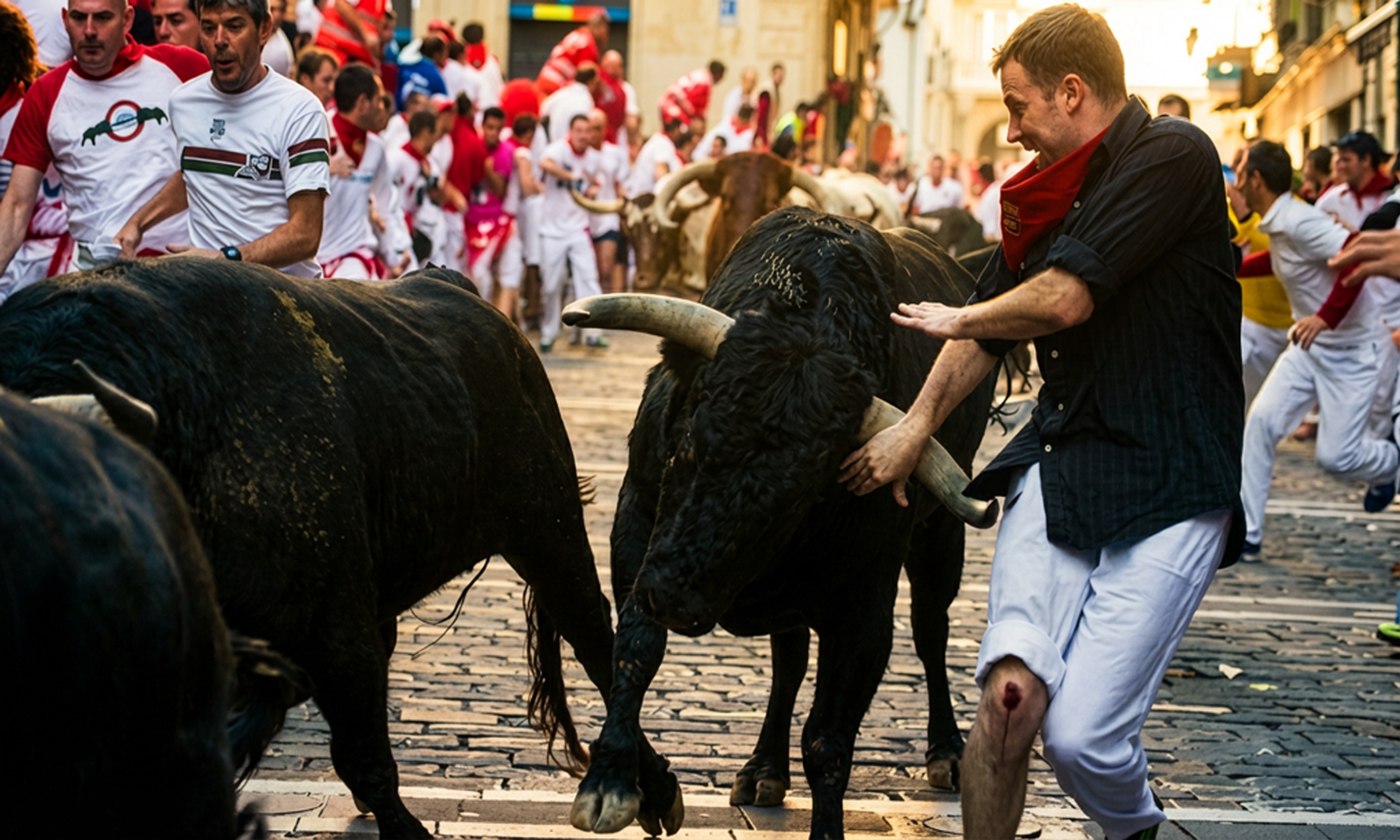
San Fermín 1962: The Running of the Bulls
July 6 to 14, 1962. The birth of a ritual. On July 10, an 85-year-old Pamplona native knelt before the saint and led the first singing of A San Fermín pedimos — the pre-run prayer that has opened every encierro since.
Looking Back at 1962
Looking back at 1962, the defining moment of the year was not a goring or a death but the birth of a ritual that now feels as old as the fiesta itself. On July 10, before the fourth run, an 85-year-old Pamplona resident named Jesús Ilundain Zaraguëta — known as El Tuli, member number one of peña Los de Bronce — knelt before a small figure of San Fermín placed in a window of the Hospital Militar on the Cuesta de Santo Domingo and led a small group in singing “A San Fermín pedimos / por ser nuestro patrón / nos guíe en el encierro / dándole su bendición.” No one would have predicted that this single act, by one elderly man, would become the immovable ritual that opens every encierro today.
The prayer itself came from the hymn of peña La Única, composed by Manuel Turrillas and recorded in 1956. What El Tuli did was transplant it to the start of the run, in front of the saint, at the most dangerous point of the course — and in doing so created something the fiesta had not had before: a moment of collective supplication before the bulls moved. The runners ask. The saint listens, or does not. And then the rocket fires.
Spain’s national television had begun broadcasting the bullfights of San Fermín this year, another step in the nationalization of what had always been a local celebration. Charlton Heston was in the crowd. The encierros still ran at seven in the morning. But what mattered most about 1962 was what an old man did before one run, and what it became.
Dennis Clancey, Founder, Encierro
The Year a Prayer Was Born
The 1962 fiesta opened on July 6 with the traditional chupinazo and ran its eight encierros through July 14. The runs took place at 7 a.m., as they had since 1924. The defining moment of the fiesta year came on the morning of July 10, when Jesús Ilundain Zaraguëta, known as “El Tuli,” an 85-year-old Pamplona native and the first registered member of peña Los de Bronce, knelt before a small figure of San Fermín placed in a window of the Hospital Militar on the Cuesta de Santo Domingo and led the first public singing of the prayer that would become the encierro’s defining pre-run ritual.
The year also marked TVE’s first broadcast of the San Fermín bullfights, a milestone in the nationalization and popularization of the fiesta. New national taurino regulations sparked a dispute about the definition of a mature fighting bull, which the Casa de Misericordia resolved by paying a 20 percent premium for bulls with fully developed dentition — reinforcing Pamplona’s reputation for running the most serious bulls in Spain. Hollywood star Charlton Heston was among the international visitors.
An 85-year-old man knelt before a saint in a window and sang. Nobody knew yet that he had just created the ritual that would open every encierro forever after.
Every 1962 Encierro, Day by Day
Eight runs, July 7–14, 1962. The route runs approximately 849 metres from Santo Domingo to the bullring. Ganadería assignments for most days are not in the digitized historical record; Run 4 is confirmed as Villamarta.
Run 1
The first encierro of the 1962 fiesta. Day-by-day ganadería assignments are not in the digitized historical record; the systematic per-day database begins in 1982. Archival NODO footage of the 1962 encierros appears in the film section above.
Run 2
The second morning of the 1962 fiesta.
Run 3
The third morning of the 1962 fiesta.
Run 4
The fourth morning of the 1962 fiesta, and the most historically significant. Before the run, 85-year-old Jesús Ilundain Zaraguëta, known as El Tuli, knelt before a figure of San Fermín in a window of the Hospital Militar and led a small group in the first singing of A San Fermín pedimos, the prayer that would become the defining pre-run ritual of modern San Fermín. The bulls that day were from Villamarta.
Run 5
The fifth morning of the 1962 fiesta.
Run 6
The sixth morning of the 1962 fiesta.
Run 7
The seventh morning of the 1962 fiesta.
Run 8
The eighth and final morning of the 1962 fiesta. At midnight, the Pobre de Mí ceremony closed the fiesta in the Plaza del Castillo.
The Official San Fermín 1962 Poster
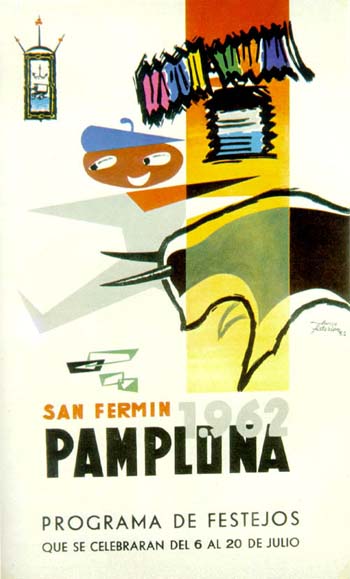
Cartel 1962 by Alonso Astarloa.
Selected as the official poster of Sanfermines 1962 through Pamplona’s annual concurso de carteles, Astarloa’s design captured the energy and color of the July festival in the graphic tradition of the era.
How 1962 Came Together
The planning and key dates, kept on the record.
The cartel by José Manuel Alonso Astarloa was confirmed for the fiesta. TVE prepared to broadcast the San Fermín bullfights for the first time. The Casa de Misericordia agreed to pay a premium for fully mature bulls under the revised national taurino regulations.
The chupinazo opened the fiesta at noon in the Plaza del Ayuntamiento. The first encierro was to follow the next morning at 7 a.m.
Before the fourth encierro, Jesús Ilundain Zaraguëta — El Tuli, 85 — led the first public singing of A San Fermín pedimos at the Cuesta de Santo Domingo. The bulls that day were from Villamarta. No deaths across the eight encierros.
The eighth and final encierro completed the 1962 fiesta. At midnight, the Pobre de Mí ceremony in the Plaza del Castillo closed the celebration.
San Fermín 1962, Answered
Was anyone killed in the 1962 San Fermín encierro?
No. There were no deaths in the 1962 encierros. The eight runs passed without a fatal goring.
Who started the “A San Fermín pedimos” prayer tradition?
Jesús Ilundain Zaraguëta, known as “El Tuli,” an 85-year-old Pamplona resident and the first registered member of peña Los de Bronce. On July 10, 1962, he knelt before a figure of San Fermín in a window of the Hospital Militar on the Cuesta de Santo Domingo and led the first singing of the prayer before the day’s encierro, which ran with Villamarta bulls.
What time did the encierros run in 1962?
The encierros ran at 7 a.m. in 1962, as they had since 1924. The start time was not moved to 8 a.m. until 1974.
What ganadéría ran on July 10, 1962?
The bulls on July 10, 1962 — the day of the first “A San Fermín pedimos” — were from Villamarta. This is the one day of the 1962 fiesta for which the ganadéría is recorded in available historical sources. Assignments for the other seven runs have not been preserved in accessible archives.
What came next
For what followed, see San Fermín 1963 — the year Hollywood came back and the new prayer tradition took hold — or explore the full 1960s archive.