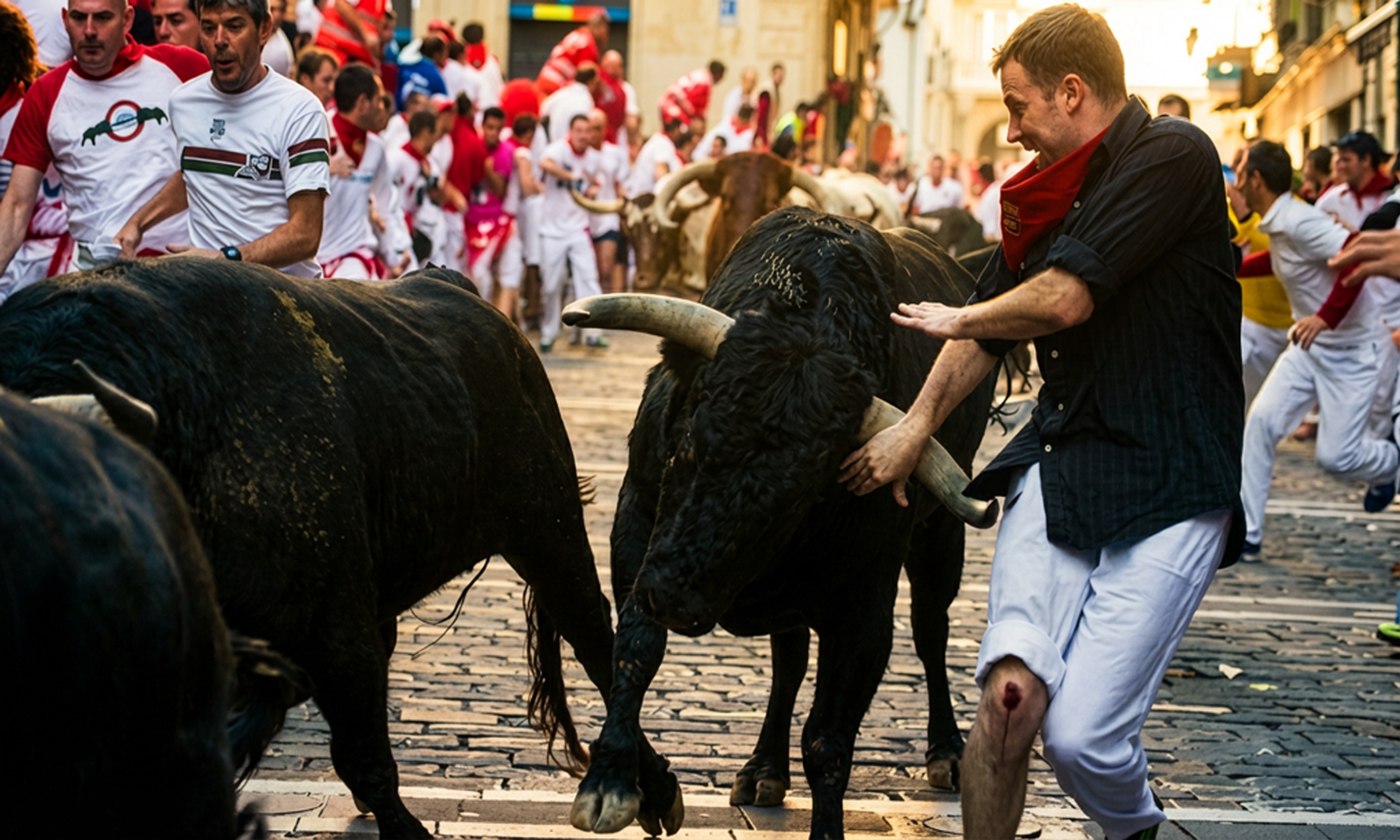
San Fermín 1964: The Running of the Bulls
July 6 to 14, 1964. The year San Fermín went live on European television. The encierro broadcast to millions for the first time, and nothing would ever be the same.
Looking Back at 1964
Looking back at 1964, the Eurovision broadcast of July 7 stands as the single most consequential event in the modern history of the encierro. For the first time, moving images of runners and bulls on the Pamplona cobblestones travelled live into living rooms across Europe. The footage was subsequently rebroadcast in the United States, taking a crowd event that Hemingway had made famous in prose and placing it, in motion, before an audience that numbered in the millions. Before 1964, San Fermín was something you read about or went to. After 1964, it was something the world had seen.
The chupinazo that year carried its own historical charge. Manuel Fraga Iribarne, then Spain’s Minister of Information and Tourism, fired the opening rocket – the first time someone outside the Pamplona Ayuntamiento had launched it. The peñas awarded him the red pañuelo, a gesture that captured the complicated relationship between the fiesta’s popular culture and a Francoist state that was simultaneously promoting it as a tool of international tourism policy. Spain was selling itself abroad, and San Fermín was a central part of the offering.
Looking back, the details that seem minor in 1964 were often signs of larger shifts. The new white police uniforms with their distinctive helmets – quickly nicknamed “calimeros” by Pamplona locals – were a small marker of a city adapting its infrastructure to a fiesta that had outgrown its origins. Mayor Urmeneta had been replaced by Juan Miguel Arrieta in February, and the Plan de Promoción Industrial had been launched. The Pamplona of 1964 was not the Pamplona of a decade earlier. The television cameras only confirmed what the crowds already knew.
Dennis Clancey, Founder, Encierro
The Morning the World Was Watching
The 1964 fiesta opened on July 6 with the traditional chupinazo and ran its eight encierros through July 14. The runs took place at 7 a.m., the start time that had been in place since 1924 and would not move to 8 a.m. until 1974. The city was under the governance of Mayor Juan Miguel Arrieta, who had taken office in February following the departure of Mayor Urmeneta.
The defining event of the 1964 fiesta came on the very first morning of the encierros. On July 7, the run was broadcast live across Europe via Eurovision, reaching television sets in multiple countries simultaneously. It was the first time the encierro had been transmitted live; TVE had broadcast the bullfights from 1962, but the encierro itself had not appeared live on screen until this moment. The footage was subsequently rebroadcast in the United States, extending the reach of the transmission well beyond Europe. Around 100,000 visitors came to Pamplona that summer, a figure that reflected both Hemingway’s literary legacy and Spain’s active promotion of the fiesta as an international attraction under Minister Fraga.
On July 7, 1964, the encierro left Pamplona for the first time. It went into living rooms across Europe, and then the United States, and it has never come back to being a purely local event.
Every 1964 Encierro, Day by Day
Eight runs, July 7-14, 1964. The route runs approximately 849 metres from Santo Domingo to the bull ring. Ganadería assignments for each day are not in the digitized historical record. No one died across all eight runs.
Run 1
The opening run of the 1964 fiesta, and the first encierro ever broadcast live on television. The run aired across Europe via the Eurovision network; footage was subsequently rebroadcast in the United States.
Run 2
The second morning of the 1964 fiesta. Individual ranch assignments from this era have not been preserved in accessible archives.
Run 3
The third morning of the 1964 fiesta.
Run 4
The fourth morning of the 1964 fiesta.
Run 5
The fifth morning of the 1964 fiesta.
Run 6
The sixth morning of the 1964 fiesta.
Run 7
The seventh morning of the 1964 fiesta.
Run 8
The eighth and final morning of the 1964 fiesta. At midnight, the Pobre de Mi ceremony closed the fiesta without a single death across all eight runs.
Official Poster: San Fermín 1964
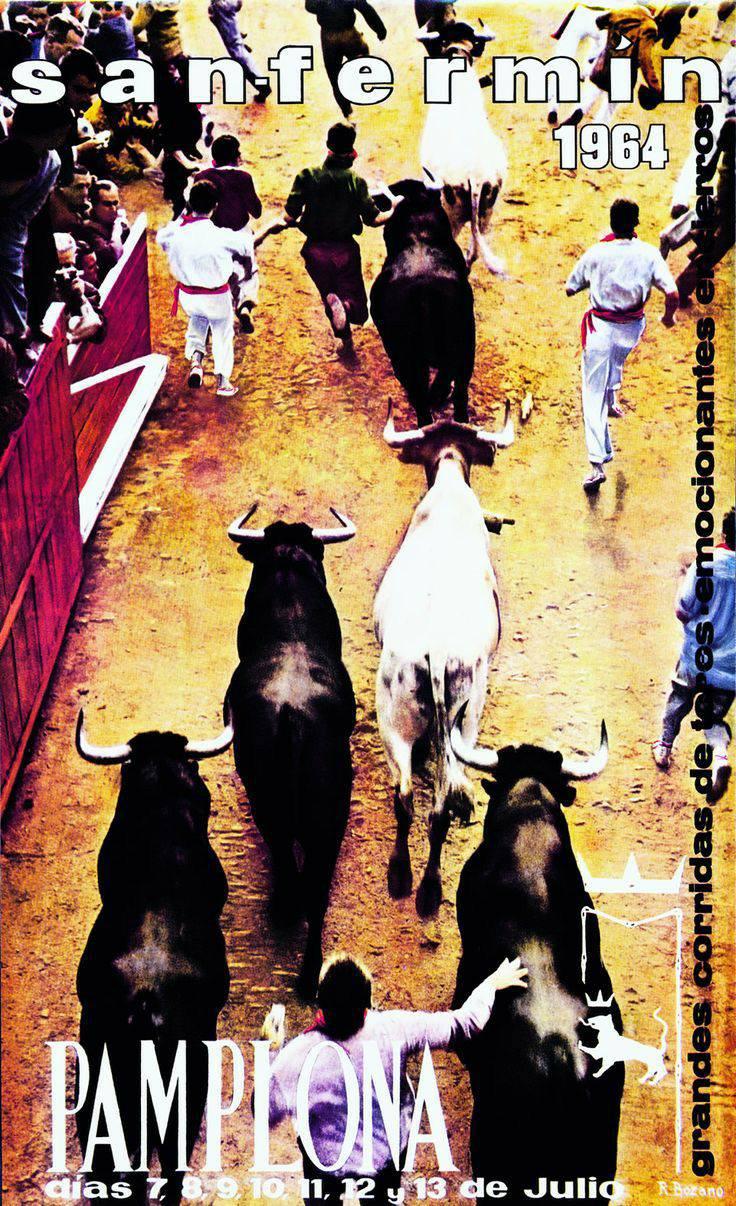
Cartel 1964, photograph by Rafael Bozano.
The 1964 San Fermín official poster was a milestone: the first time a photograph was used for the Sanfermines cartel. Bozano’s image captured the bulls entering the Plaza de Toros during the encierro. Pamplona’s annual concurso de carteles selected this as the official Sanfermines poster for 1964.
The 1964 Encierro on Film
Archival footage showing the encierros as they looked in 1964, the year San Fermín was first broadcast live on Eurovision.