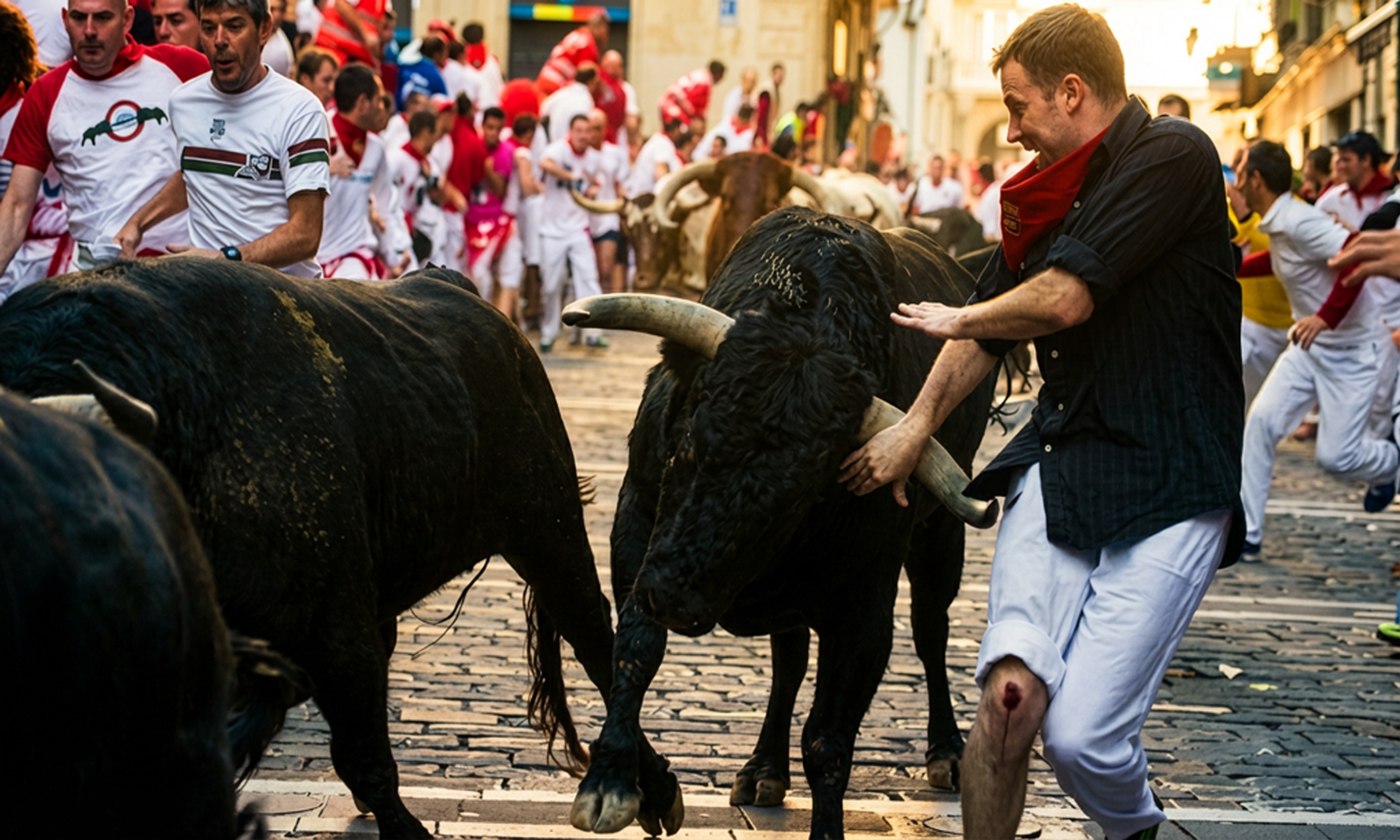
San Fermín 1965: The Running of the Bulls
July 6 to 14, 1965. The fiesta that nearly lost its final day. A dispute between the Ayuntamiento and La Meca brought the last encierro to the brink of cancellation – then the run went ahead.
Looking Back at 1965
Looking back at 1965, what stands out most is how close the fiesta came to ending without its final act. The dispute between the Ayuntamiento de Pamplona and the Casa de Misericordia – the institution known as La Meca, which organised the bullfighting programme – brought the closing day of the fiesta to the edge of collapse. No corrida, and almost certainly no encierro on July 14. That the situation was resolved and the eighth run went ahead is a fact often absent from general accounts of the year. It was a reminder that the institutional scaffolding behind the fiesta was always more fragile than the tradition appeared from the outside.
Looking back, 1965 was also the year Orson Welles returned to Pamplona. His visits – in 1961, in 1965, in 1966 – were not incidental. He was a serious aficionado and a genuine presence in the bullring. His return in 1965 came as El Cordobes, the most famous novillero in Spain, was making his debut at San Fermín and receiving from the Pamplona crowd precisely the hostile reception that Pamplona crowds have always given to spectacle that outpaces substance. El Cordobes was adored across Spain for his acrobatic style; Pamplona’s afición saw that style as an affront to classical toreo and made their view known without ambiguity.
Looking back, there is also the curious footnote of October 1965: the Comparsa de Gigantes – the giant processional figures that parade through Pamplona during the fiesta – traveling to New York to participate in the closing of the 1965 World’s Fair. San Fermín was already known to American audiences in 1965 through television and through the long reach of Hemingway’s fiction. The Giants in New York was the fiesta making that presence physical.
Dennis Clancey, Founder, Encierro
The Day the Last Run Nearly Did Not Happen
The 1965 fiesta opened on July 6 with the chupinazo and ran its eight encierros through July 14. The runs took place at 7 a.m., the traditional start time that would remain in place until 1974, when it was moved to 8 a.m. The city in 1965 was in the middle of Spain’s desarrollismo decade, the period of rapid economic growth and social transformation under the later phase of the Franco regime.
The defining event of the 1965 fiesta was institutional rather than athletic. A dispute between the Ayuntamiento de Pamplona and the Casa de Misericordia – the charitable institution known as La Meca, which held the concession to organise the bullfighting programme – came close to leaving the final day of the fiesta, July 14, without a corrida or an encierro. The disagreement was resolved and the eighth run took place as scheduled. The episode illustrated how the relationships between the city government, the traditional institutions, and the festive calendar could fracture under the pressures of a fiesta that had grown well beyond its original scale.
In 1965, the final day of San Fermín nearly did not happen. The institutional dispute was resolved and the eighth run went ahead – but the episode revealed the fragility behind the tradition’s apparent permanence.
Every 1965 Encierro, Day by Day
Eight runs, July 7–14, 1965. The route runs approximately 849 metres from Santo Domingo to the bull ring. See the route map.
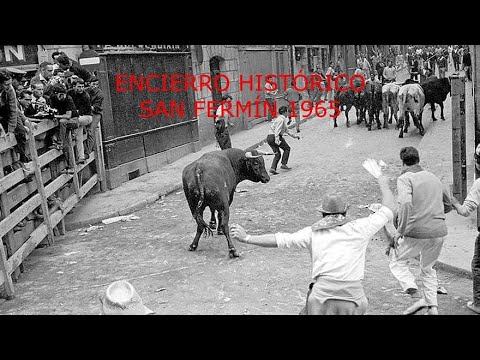
Run 1 – Ganadéria Not Recorded
The opening run of the 1965 fiesta. Day-by-day ganadéria assignments for the 1965 encierros are not in the digitized historical record. See the compilation footage above for archival coverage of the 1965 encierros, from the channel Encierros San Fermín.
Run 2 – Ganadéria Not Recorded
The second morning of the 1965 fiesta. Day-by-day ganadéria assignments for the 1965 encierros are not in the digitized historical record.
Run 3 – Ganadéria Not Recorded
The third morning of the 1965 fiesta. Day-by-day ganadéria assignments for the 1965 encierros are not in the digitized historical record.
Run 4 – Ganadéria Not Recorded
The fourth morning of the 1965 fiesta. Day-by-day ganadéria assignments for the 1965 encierros are not in the digitized historical record.
Run 5 – Ganadéria Not Recorded
The fifth morning of the 1965 fiesta. Day-by-day ganadéria assignments for the 1965 encierros are not in the digitized historical record.
Run 6 – Ganadéria Not Recorded
The sixth morning of the 1965 fiesta. Day-by-day ganadéria assignments for the 1965 encierros are not in the digitized historical record.
Run 7 – Ganadéria Not Recorded
The seventh morning of the 1965 fiesta. Day-by-day ganadéria assignments for the 1965 encierros are not in the digitized historical record. The dispute between the Ayuntamiento and La Meca was already a live concern by this point in the fiesta.
Run 8 – Ganadéria Not Recorded
The eighth and final morning of the 1965 fiesta – and the one that nearly did not happen. A dispute between the Ayuntamiento de Pamplona and the Casa de Misericordia (La Meca) had threatened to cancel the closing-day corrida and encierro. The disagreement was resolved and the run went ahead. At midnight, the Pobre de Mí ceremony closed the fiesta.
The Stories the Numbers Leave Out
The 1965 Sanfermines Official Cartel
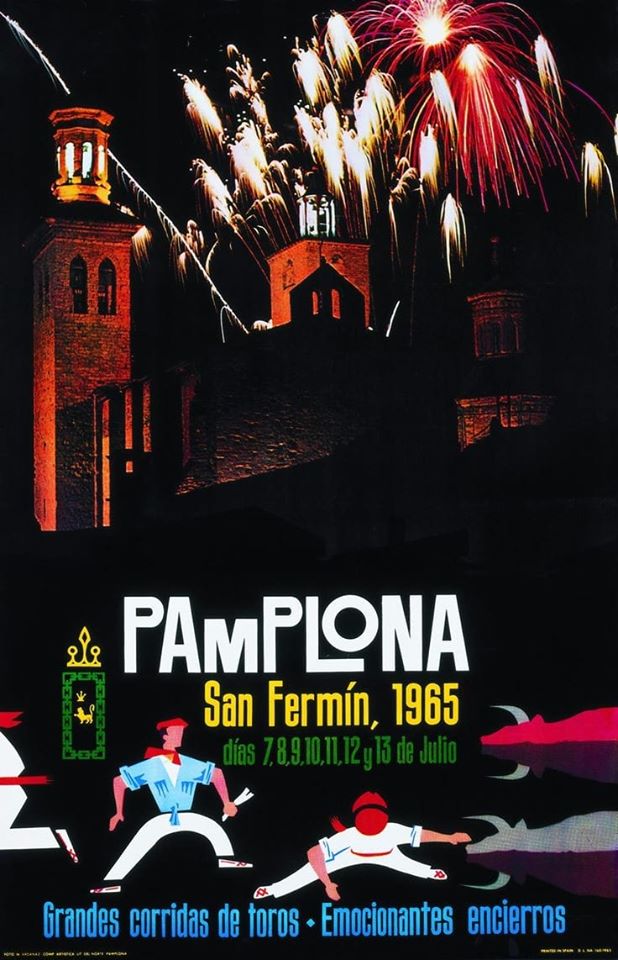
Cartel: Nicolás Ardanaz.
The 1965 San Fermín poster was the work of Nicolás Ardanaz, who also designed the 1966 cartel. The poster was produced for the Ayuntamiento de Pamplona ahead of the July fiesta.
The full archive of San Fermín official posters from 1846 to the present is maintained by the Ayuntamiento de Pamplona, cartel archive.
Named the official cartel of San Fermín 1965 after winning the Ayuntamiento’s annual poster contest.
The City in 1965
The chupinazo opened the fiesta at noon on Tuesday, July 6, in the Plaza del Ayuntamiento. The encierros followed each morning at 7 a.m. The fiesta ran its full nine days through July 14.
Orson Welles was among the visitors in 1965, returning to Pamplona as he had in 1961 and would again in 1966. His visits were those of a serious aficionado. El Cordobes, the most celebrated novillero in Spain at the time, debuted at the San Fermín corridas and received a reception from the Pamplona crowd that was notable for its hostility. The city’s afición prized classical toreo above all else, and El Cordobes’s acrobatic, crowd-pleasing style found no favour there despite its enormous popularity elsewhere in Spain.
The final day of the fiesta, July 14, was nearly without its closing encierro. A dispute between the Ayuntamiento de Pamplona and the Casa de Misericordia – La Meca, the institution that organised the bullfighting programme – threatened to cancel both the corrida and the encierro. The disagreement was resolved and the eighth run went ahead. The fiesta closed at midnight with the candlelit Pobre de Mí in the Plaza del Castillo. In October 1965, the Comparsa de Gigantes traveled to New York to participate in the closing ceremony of the 1965 World’s Fair.
How 1965 Came Together
The planning and key dates, kept on the record.
The chupinazo opened the fiesta at noon in the Plaza del Ayuntamiento. Orson Welles was among the visitors. El Cordobes was among the matadors on the programme. Encierros were to run each morning at 7 a.m.
El Cordobes debuted at the San Fermín corridas and received a hostile reception from the Pamplona crowd, who preferred classical toreo. His acrobatic style, enormously popular elsewhere in Spain, found no favour with the Pamplona afición.
A dispute between the Ayuntamiento and the Casa de Misericordia (La Meca) threatened to cancel the final-day corrida and encierro. The situation was resolved and the eighth run took place on July 14.
The Comparsa de Gigantes traveled to New York to participate in the closing ceremony of the 1965 World’s Fair, bringing a piece of San Fermín’s visual identity to the United States.
San Fermín 1965, Answered
Was anyone killed in the 1965 San Fermín encierro?
No. There were no deaths in the 1965 encierro.
Was the final-day encierro in 1965 really nearly canceled?
Yes. A dispute between the Ayuntamiento de Pamplona and the Casa de Misericordia (La Meca), which organized the bullfighting program, came close to leaving July 14 without a corrida or an encierro. The disagreement was ultimately resolved and the eighth run took place as scheduled.
How did El Cordobes do at San Fermín 1965?
El Cordobes debuted at San Fermín in 1965 and received a hostile reception from the Pamplona crowd. The city’s audiences prized classical toreo and rejected his popular, acrobatic style. His reception in Pamplona was notably at odds with his enormous popularity elsewhere in Spain.
Which ganadérias ran in the 1965 encierros?
The day-by-day ganadéria assignments for 1965 are not in the digitized historical record.
What came before and after
For 1966 – the year newspaper copies were burned in the bullring – see what followed. Or return to 1964, the year the encierro went live on Eurovision.