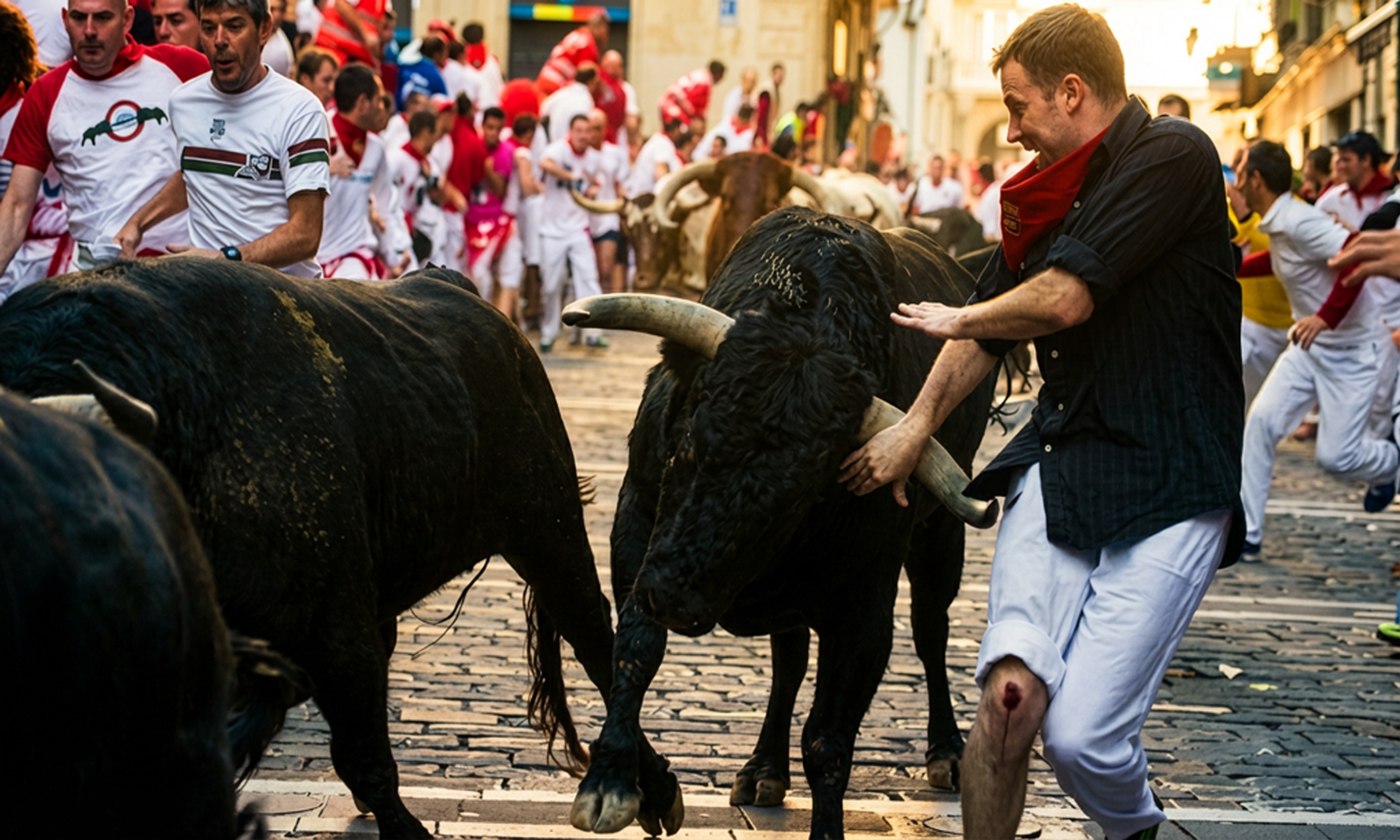
San Fermín 1966: The Running of the Bulls
July 6 to 14, 1966. Newspapers burned in the bullring. The ancient Ciudadela fortress passes from military to municipal hands. Orson Welles films again. A fiesta pushing against the limits of Francoism.
Looking Back at 1966
Looking back at 1966, the most politically charged moment of the fiesta was not in the encierro at all, but in the bullring on the evening of July 12. Copies of the Madrid newspaper ABC were publicly burned by Navarrese protesters who had taken offense at coverage they saw as dismissive of Navarra’s distinct identity and fiscal arrangements within Spain. That this happened inside the plaza de toros, at San Fermín, tells you something about how much the fiesta functioned as a space for political expression under a regime that suppressed almost every other kind.
Orson Welles was filming in Pamplona again. Welles had a long relationship with the fiesta and with bullfighting more broadly, he had been coming since the early 1950s and the footage he was gathering would eventually contribute to his documentary work on the corrida. The Ciudadela, the old star-shaped fortification that sits at the edge of the old city, was transferred from military to municipal administration this year, a small but symbolic recession of Franco’s army from Pamplona’s everyday urban life. The “Pañuelo de Honor” award was inaugurated, recognising figures who had served the fiesta with distinction. Among those honoured in the early years of the award was Hemingway, posthumously.
No one died in the 1966 encierros. The political fire was in the stands, not on the course.
Dennis Clancey, Founder, Encierro
Politics in the Bullring
The 1966 fiesta opened on July 6 and ran its eight encierros through July 14 at 7 a.m. The defining political event of the fiesta year was not in the encierro but in the bullring itself: on the evening of July 12, copies of the Madrid newspaper ABC were publicly burned in the plaza de toros. The burnings were provoked by articles in TVE and ABC that Navarrese spectators perceived as offensive to Navarra’s distinct identity and fiscal arrangements within Spain.
The Ciudadela, the 16th-century star-shaped fortress at the edge of the old city, was transferred from military to municipal administration in July 1966, coinciding with the symbolic inauguration of the Avenida del Ejército. The cattle fair relocated to the glacis of the Vuelta del Castillo, where it would remain until 1971. The Ayuntamiento inaugurated the “Pañuelo de Honor” award (1966-1971) to recognise figures distinguished in service to the fiesta. Orson Welles was present and filming.
The bulls ran without incident. The political fire was in the bullring stands that evening, where newspapers burned under Franco’s Spain in protest at how Navarra was being seen from Madrid.
Every 1966 Encierro, Day by Day
Eight runs, July 7–14, 1966. The route runs approximately 849 metres from Santo Domingo to the bullring. See the route map.
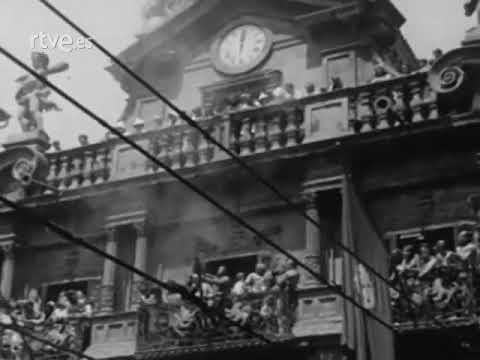
Run 1, Ganadéría Not Recorded
The opening run of the 1966 fiesta. Day-by-day ganadéría assignments for this year’s encierros are not in the digitized historical record. The systematic per-day database on sanfermin.com begins in 1982. The footage above is an archival San Fermín 1966 compilation.
Run 2, Ganadéría Not Recorded
The second morning of the 1966 fiesta. Day-by-day ganadéría assignments for this year’s encierros are not in the digitized historical record. The systematic per-day database on sanfermin.com begins in 1982.
Run 3, Ganadéría Not Recorded
The third morning of the 1966 fiesta. Day-by-day ganadéría assignments for this year’s encierros are not in the digitized historical record. The systematic per-day database on sanfermin.com begins in 1982.
Run 4, Ganadéría Not Recorded
The fourth morning of the 1966 fiesta. Day-by-day ganadéría assignments for this year’s encierros are not in the digitized historical record. The systematic per-day database on sanfermin.com begins in 1982.
Run 5, Ganadéría Not Recorded
The fifth morning of the 1966 fiesta. Day-by-day ganadéría assignments for this year’s encierros are not in the digitized historical record. The systematic per-day database on sanfermin.com begins in 1982.
Run 6, Ganadéría Not Recorded
The sixth morning of the 1966 fiesta. Day-by-day ganadéría assignments for this year’s encierros are not in the digitized historical record. The systematic per-day database on sanfermin.com begins in 1982. That evening, copies of the Madrid newspaper ABC were publicly burned in the plaza de toros by Navarrese protesters angered by coverage they deemed offensive to Navarra’s identity and fiscal arrangements.
Run 7, Ganadéría Not Recorded
The seventh morning of the 1966 fiesta. Day-by-day ganadéría assignments for this year’s encierros are not in the digitized historical record. The systematic per-day database on sanfermin.com begins in 1982.
Run 8, Ganadéría Not Recorded
The eighth and final morning of the 1966 fiesta. Day-by-day ganadéría assignments for this year’s encierros are not in the digitized historical record. The systematic per-day database on sanfermin.com begins in 1982. At midnight, the Pobre de Mí ceremony closed the fiesta.
The Stories the Numbers Leave Out
San Fermín 1966 Official Poster
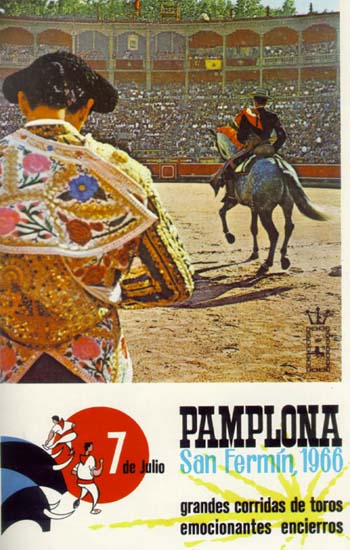
Cartel: Nicolás Ardanaz.
The 1966 San Fermín poster was the work of Nicolás Ardanaz, who also designed the 1965 cartel. The poster was produced for the Ayuntamiento de Pamplona ahead of the July fiesta.
The full archive of San Fermín official posters is maintained by the Ayuntamiento de Pamplona, cartel archive.
The 1966 San Fermín official poster, selected through the annual concurso de carteles held by Pamplona each year.
The City in 1966
The chupinazo opened the fiesta at noon on Wednesday, July 6. Encierros followed at 7 a.m. through July 14. Pamplona’s population was growing rapidly through industrial immigration, with the Authi automobile factory (opened nearby in 1966) drawing migrant workers into the region. The barracas (fairground stalls) relocated to the glacis of the Vuelta del Castillo this year, where they would remain until 1971.
The new “Pañuelo de Honor” award recognised service to San Fermín; its first recipients included posthumous recognition of Hemingway. The fiesta closed at midnight on July 14 with the Pobre de Mí in the Plaza del Castillo. Popular songs of the 1966 fiesta included “Esperanza,” “El chachacha,” and “Mustafá”, a snapshot of mid-1960s Spain opening cautiously to international pop.
How 1966 Came Together
The cartel by Nicolás Ardanaz confirmed. The Ciudadela transferred from military to municipal administration. The barracas and cattle fair relocated to the glacis of the Vuelta del Castillo. The Ayuntamiento inaugurated the “Pañuelo de Honor” award.
The chupinazo opened the fiesta at noon. Eight encierros were to follow at 7 a.m. through July 14.
That evening, copies of the newspaper ABC were publicly burned in the plaza de toros by Navarrese protesters. No deaths in the encierros. Orson Welles present and filming throughout the fiesta.
The final encierro completed the 1966 fiesta. At midnight, the Pobre de Mí in the Plaza del Castillo closed the celebration.
San Fermín 1966, Answered
Was anyone killed in the 1966 encierros?
No. There were no deaths in the 1966 encierros across all eight runs.
Why were newspapers burned at the 1966 San Fermín?
On the evening of July 12, 1966, copies of the Madrid newspaper ABC were burned in the plaza de toros by Navarrese protesters. The burning was a response to coverage in ABC and TVE that was perceived as dismissive of Navarra’s distinct identity and its historic fueros (fiscal and legal arrangements) with the Spanish state. It was one of the most openly political acts of the mid-Franco era to occur within the fiesta.
What time did the encierros run in 1966?
7 a.m., as they had since 1924. The start time shifted to 8 a.m. in 1974.
What came next
For what followed, see San Fermín 1967, the year Rafael Moneo doubled the bullring’s capacity, or explore the full 1960s archive.