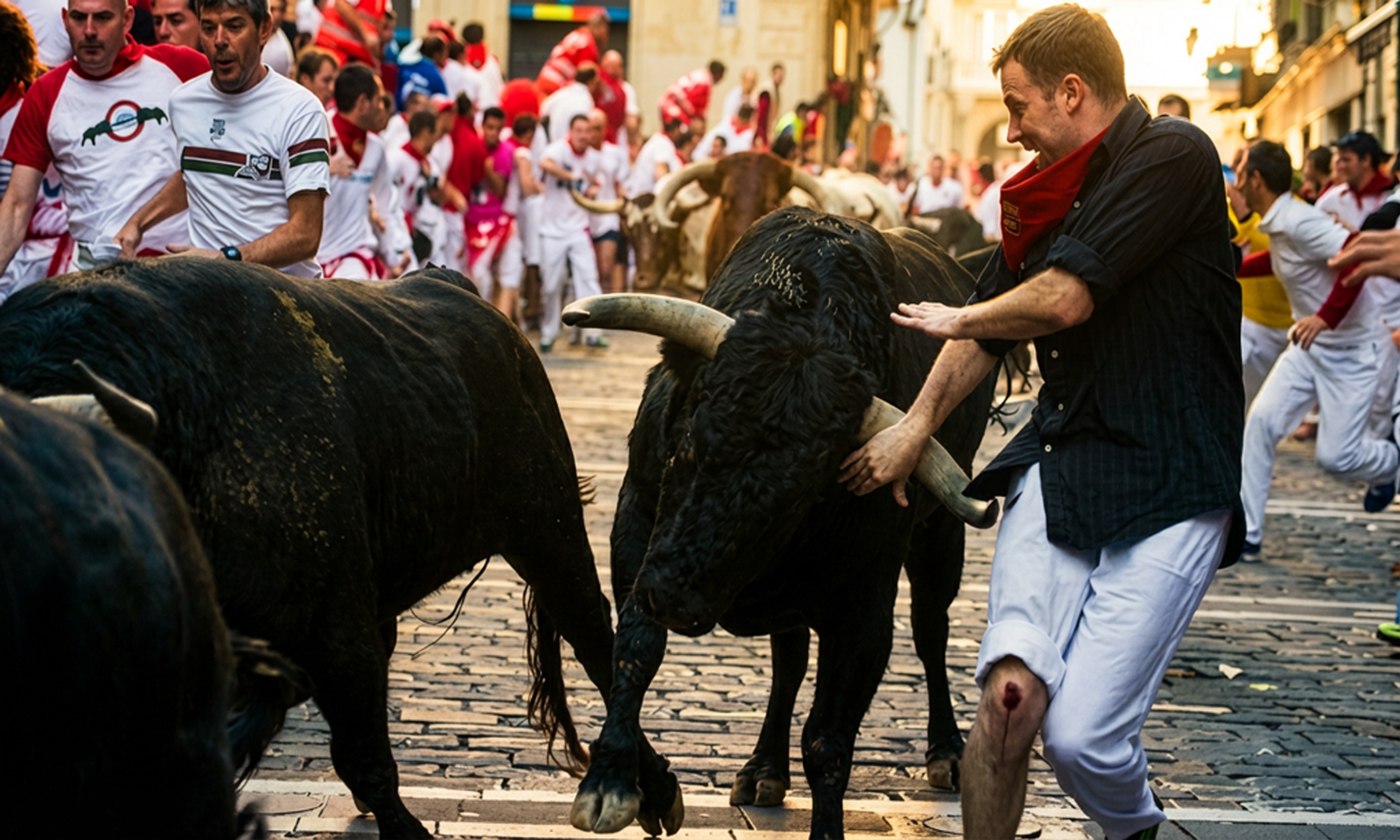
San Fermín 1968: The Running of the Bulls
July 6 to 14, 1968. On the opening day of the fiesta, Mary Welsh Hemingway attends the unveiling of a bronze monument to her husband near the bullring. A permanent memorial to the writer who made San Fermín world-famous.
Looking Back at 1968
Looking back at 1968, the day that stands out is not a run day at all, it is July 6, the chupinazo day, when Mary Welsh Hemingway stood at the ceremony for the inauguration of a bronze bust of her husband near the Parador El Toro, alongside the Monumento al Encierro. Hemingway had been dead seven years by then. The statue was on an 8,000-kilogram granite block. Pamplona was putting him in stone.
What interests me about 1968 as a moment in the fiesta’s history is the way it formalized something that had been informal. For years the connection between Hemingway and San Fermín was literary, cultural, a matter of readers finding the fiesta through his pages. The monument transformed that connection into civic infrastructure. Hemingway was now part of the fabric of the place in the same way the walls of the old city or the route of the encierro were. The fiesta had absorbed him.
Across Europe and the world, 1968 was a year of upheaval. In Spain the Franco dictatorship held firm, but social tensions were growing and ETA’s violence was escalating. None of that was visible in the encierros. Eight runs, no deaths, the morning at seven in the morning. The fiesta inside its own walls.
Dennis Clancey, Founder, Encierro
Hemingway in Bronze and Granite
The 1968 fiesta opened on July 6 and ran its eight encierros through July 14 at 7 a.m. The defining event of the fiesta year was the inauguration, on the opening day of the festival, of two monuments near the Parador El Toro: a bronze bust of Ernest Hemingway on an 8,000-kilogram granite block, and the Monumento al Encierro. Hemingway’s widow, Mary Welsh Hemingway, attended the ceremony. The bust was the first permanent public monument to the writer in Pamplona.
The COTUP (Coordinadora de Urbanismo de Pamplona) was created in 1968, reflecting the increasing complexity of the city’s planning challenges as industrial growth continued. In December 1968, the city’s central military barracks were vacated, another step in the slow recession of the garrison from Pamplona’s urban centre. The Gayarre theater suffered a fire in November 1968, requiring a 15-million-peseta renovation before San Fermín 1969.
On the day the chupinazo fired in 1968, Hemingway’s widow was in Pamplona to see her husband immortalised in bronze and granite. The man who made the fiesta world-famous was now part of its permanent architecture.
Every 1968 Encierro, Day by Day
Eight runs, July 7–14, 1968. The route runs approximately 849 metres from Santo Domingo to the bullring. See the route map.
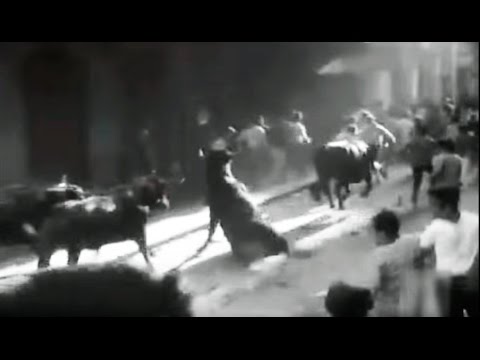
Run 1, Ganadéría Not Recorded
The opening run of the 1968 fiesta. Day-by-day ganadéría assignments for this year’s encierros are not in the digitized historical record. The systematic per-day database on sanfermin.com begins in 1982. The footage above is an archival 1968 encierro compilation (Retroclips channel).
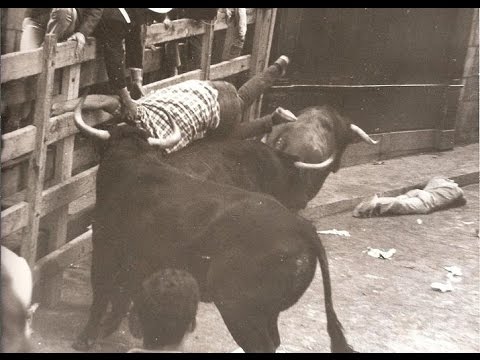
Run 2, Ganadéría Not Recorded
The second morning of the 1968 fiesta. Day-by-day ganadéría assignments for this year’s encierros are not in the digitized historical record. The systematic per-day database on sanfermin.com begins in 1982. A second archival NODO footage compilation is available above (Pachi Mendiburu channel).
Run 3, Ganadéría Not Recorded
The third morning of the 1968 fiesta. Day-by-day ganadéría assignments for this year’s encierros are not in the digitized historical record. The systematic per-day database on sanfermin.com begins in 1982.
Run 4, Ganadéría Not Recorded
The fourth morning of the 1968 fiesta. Day-by-day ganadéría assignments for this year’s encierros are not in the digitized historical record. The systematic per-day database on sanfermin.com begins in 1982.
Run 5, Ganadéría Not Recorded
The fifth morning of the 1968 fiesta. Day-by-day ganadéría assignments for this year’s encierros are not in the digitized historical record. The systematic per-day database on sanfermin.com begins in 1982.
Run 6, Ganadéría Not Recorded
The sixth morning of the 1968 fiesta. Day-by-day ganadéría assignments for this year’s encierros are not in the digitized historical record. The systematic per-day database on sanfermin.com begins in 1982.
Run 7, Ganadéría Not Recorded
The seventh morning of the 1968 fiesta. Day-by-day ganadéría assignments for this year’s encierros are not in the digitized historical record. The systematic per-day database on sanfermin.com begins in 1982.
Run 8, Ganadéría Not Recorded
The eighth and final morning of the 1968 fiesta. Day-by-day ganadéría assignments for this year’s encierros are not in the digitized historical record. The systematic per-day database on sanfermin.com begins in 1982. At midnight, the Pobre de Mí ceremony closed the fiesta.
The Stories the Numbers Leave Out
San Fermín 1968: Official Cartel
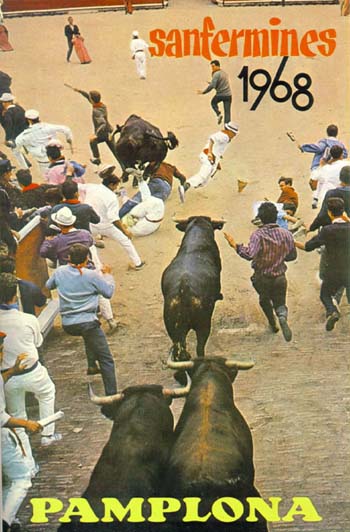
Cartel: Fernando Galle.
The 1968 San Fermín poster was the work of Fernando Galle, who also designed the 1967 cartel. The poster was produced for the Ayuntamiento de Pamplona ahead of the July fiesta.
The full archive of San Fermín official posters is maintained by the Ayuntamiento de Pamplona, cartel archive.
Selected as the official poster of Sanfermines 1968 through Pamplona’s annual concurso de carteles.
The City in 1968
The chupinazo opened the fiesta at noon on Saturday, July 6, the same day as the Hemingway monument inauguration. Encierros followed at 7 a.m. through July 14. The city was in the middle of rapid demographic and urban change, with the COTUP planning body newly created to manage growth that the old civic structures were struggling to absorb.
The fiesta closed at midnight on July 14 with the Pobre de Mí in the Plaza del Castillo. Four months later, in November, the Gayarre theater would burn. By December, the military barracks in the centre of the city would be empty. Pamplona was becoming, one building at a time, a different kind of city.
How 1968 Came Together
The cartel by Fernando Galle confirmed. COTUP (Coordinadora de Urbanismo de Pamplona) created to manage the city’s rapid growth.
The chupinazo opens the 1968 fiesta at noon. On the same day, the Hemingway monument and Monumento al Encierro are inaugurated near the Parador El Toro. His widow Mary Welsh Hemingway attends.
Eight encierros at 7 a.m. No deaths. The encierros run in the shadow of 1968’s international upheaval; in Pamplona itself, the fiesta proceeds with its usual ritual.
The final encierro completes the 1968 fiesta. At midnight, the Pobre de Mí closes the celebration. In November, the Gayarre theater suffers a fire; in December, the central military barracks are vacated.
San Fermín 1968, Answered
Was anyone killed in the 1968 encierros?
No. There were no deaths in the 1968 encierros across all eight runs.
When was the Hemingway monument inaugurated in Pamplona?
The bronze bust of Ernest Hemingway was inaugurated on July 6, 1968, the opening day of the fiesta, the day of the chupinazo. Hemingway’s widow Mary Welsh Hemingway attended the ceremony. The bust sits on an 8,000-kilogram granite block near the Parador El Toro, alongside the Monumento al Encierro.
What time did the encierros run in 1968?
7 a.m., as they had since 1924. The start time was not moved to 8 a.m. until 1974.
What came next
For what followed, see San Fermín 1969, one death, a misidentified fatality, and the most dramatic goring of the decade, or explore the full 1960s archive.