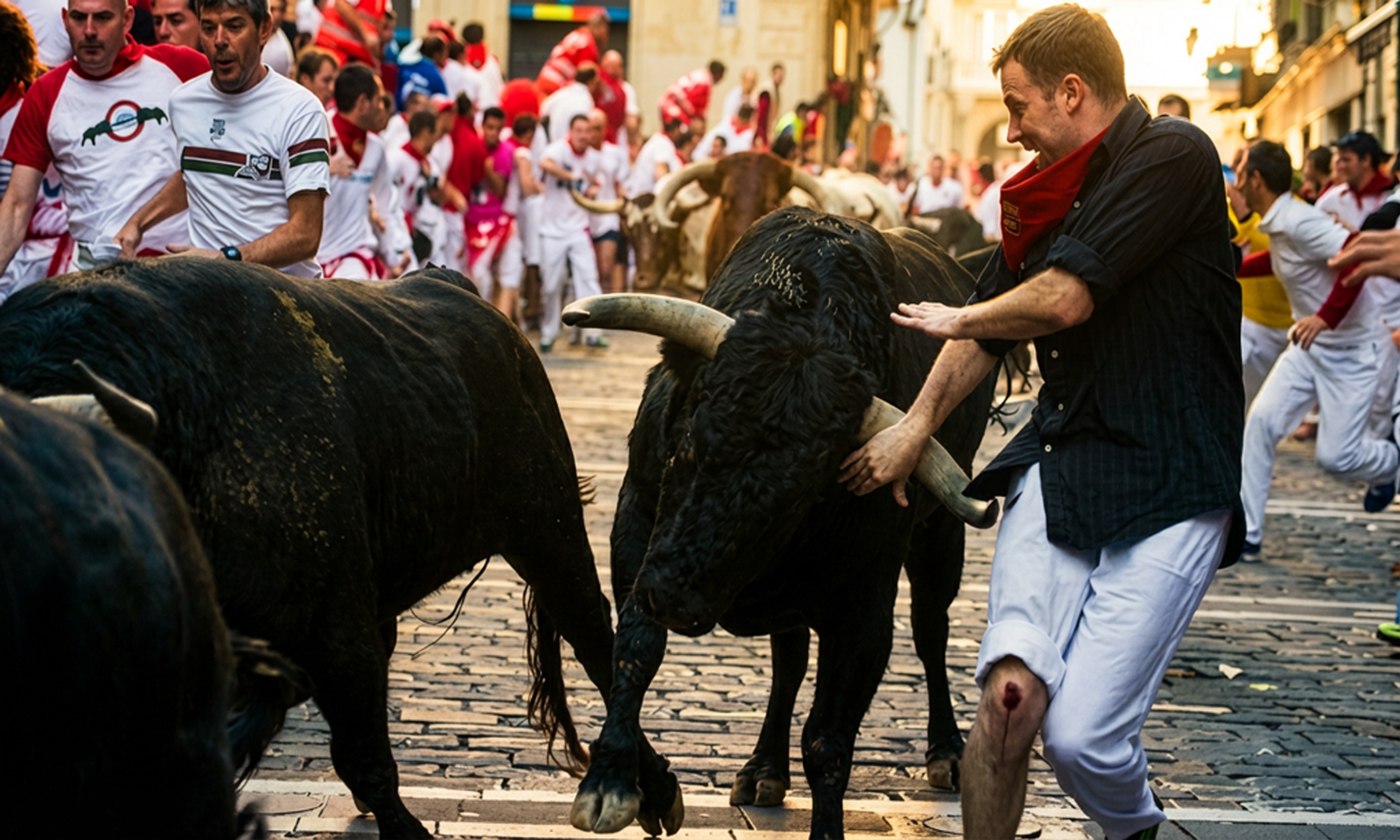
San Fermín 1969: The Running of the Bulls
July 6 to 14, 1969. One death. The bull “Reprochado” gores two men on the Cuesta de Santo Domingo on July 12. For nearly a day, the wrong man was believed to have died.
Looking Back at 1969
Looking back at 1969, the detail that haunts me most is not the death itself but the misidentification that followed. Two men were gored by the same bull on the Cuesta de Santo Domingo within seconds of each other. One of them, Gregorio Zamora, was hit in the abdomen with such force that his intestines were exposed. The other, Hilario Pardo, was also gored in the abdomen, but the wound appeared less dramatic at first sight. For nearly a full day, everyone assumed it was Zamora who had died. It was Pardo. Zamora survived his terrible wound.
That confusion says something about the encierro that is easy to forget: the difference between a fatal wound and a survivable one is not always visible from the outside. The most dramatic-looking injury is not necessarily the worst one. The doctors who worked on both men knew something that the onlookers and the press did not. In the first hours after a serious goring, the facts are often wrong.
The bull was called “Reprochado.” It was from the Salvador Guardiola Fantoni ganadéría, a ranch that would go on to kill two more men in a single run in 1980. The 1969 death was the second encierro fatality of the 1960s, after Vicente Urrizola in 1961. Both died on the Cuesta de Santo Domingo. The first climb of the course is where the bulls are fastest and most unpredictable.
Dennis Clancey, Founder, Encierro
Two Gorings, One Misidentified Death
The 1969 fiesta opened on July 6 and ran its eight encierros through July 14 at 7 a.m. Seven of the eight runs passed without death or exceptional incident. On July 12, the sixth run, bulls from Salvador Guardiola Fantoni produced the most dangerous encierro of the decade. The bull “Reprochado” gored Gregorio Zamora Irazabal (34, painter, from Pamplona) on the Cuesta de Santo Domingo, a wound of such visible severity that his intestines were exposed, and then, only metres further up the slope, gored Hilario Pardo Simón (42, wine merchant, from Murchante, Navarra).
Because Zamora’s wound appeared catastrophic while Pardo’s looked less extreme externally, press and public initially assumed Zamora was the fatality. It took nearly a day to establish the truth: Pardo had died of his abdominal cornada; Zamora, despite the dramatic appearance of his wound, survived. Both were photographed by the Diario de Navarra press team; the photographs are preserved in that archive. It was the second encierro death of the 1960s, after Vicente Urrizola in 1961.
For nearly a day, Pamplona believed the wrong man had died. The most dramatic wound was not the fatal one. The encierro does not grade injuries by appearance.
Every 1969 Encierro, Day by Day
Eight runs, July 7–14, 1969. One death, on July 12. The route runs approximately 849 metres from Santo Domingo to the bullring. See the route map.
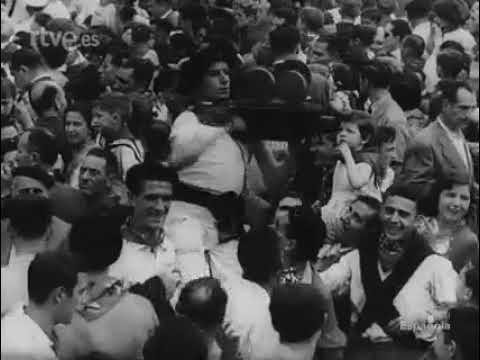
Run 1, Ganadéría Not Recorded
The opening run of the 1969 fiesta. Day-by-day ganadéría assignments for this year’s encierros are not in the digitized historical record. The systematic per-day database on sanfermin.com begins in 1982. The footage above is an archival San Fermín 1969 compilation (los videos de Mayka Ramos channel).
Run 2, Ganadéría Not Recorded
The second morning of the 1969 fiesta. Day-by-day ganadéría assignments for this year’s encierros are not in the digitized historical record. The systematic per-day database on sanfermin.com begins in 1982.
Run 3, Ganadéría Not Recorded
The third morning of the 1969 fiesta. Day-by-day ganadéría assignments for this year’s encierros are not in the digitized historical record. The systematic per-day database on sanfermin.com begins in 1982.
Run 4, Ganadéría Not Recorded
The fourth morning of the 1969 fiesta. Day-by-day ganadéría assignments for this year’s encierros are not in the digitized historical record. The systematic per-day database on sanfermin.com begins in 1982.
Run 5, Ganadéría Not Recorded
The fifth morning of the 1969 fiesta. Day-by-day ganadéría assignments for this year’s encierros are not in the digitized historical record. The systematic per-day database on sanfermin.com begins in 1982.
Run 6, Salvador Guardiola Fantoni
The sixth encierro of the 1969 fiesta, and the most dangerous of the decade. Bulls from Salvador Guardiola Fantoni. The bull “Reprochado” gored two men on the Cuesta de Santo Domingo. Gregorio Zamora Irazabal (34, painter, Pamplona) suffered a catastrophic visible wound to the abdomen, with intestines exposed. Only metres further up the hill, Reprochado gored Hilario Pardo Simón (42, wine merchant, Murchante). Because Zamora’s wound was so visibly extreme, press and public initially assumed he was the fatality. It took nearly a day to clarify that Pardo had died of his cornada and Zamora had survived his more dramatic-looking wound.
Run 7, Ganadéría Not Recorded
The seventh morning of the 1969 fiesta. Day-by-day ganadéría assignments for this year’s encierros are not in the digitized historical record. The systematic per-day database on sanfermin.com begins in 1982.
Run 8, Ganadéría Not Recorded
The eighth and final morning of the 1969 fiesta. Day-by-day ganadéría assignments for this year’s encierros are not in the digitized historical record. The systematic per-day database on sanfermin.com begins in 1982. At midnight, the Pobre de Mí ceremony closed the fiesta.
The Stories the Numbers Leave Out
The Official San Fermín 1969 Poster
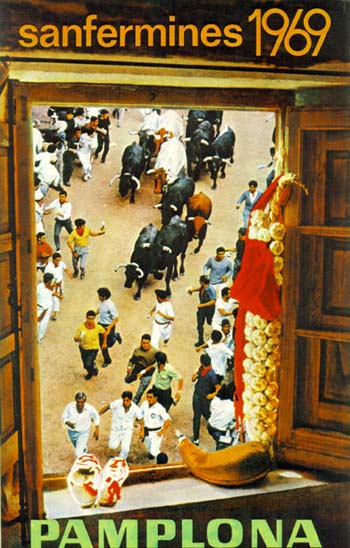
Cartel: J. M. Goñi Irisarri.
The 1969 San Fermín poster was the work of J. M. Goñi Irisarri. The poster was produced for the Ayuntamiento de Pamplona ahead of the July fiesta.
The full archive of San Fermín official posters is maintained by the Ayuntamiento de Pamplona, cartel archive.
The official San Fermín 1969 cartel was chosen via the city’s annual poster contest, the concurso de carteles.
The City in 1969
The chupinazo opened the fiesta at noon on Saturday, July 6. Encierros followed at 7 a.m. through July 14. Mayor Ángel Goicoechea was replaced in May 1969 by Manuel Agreda, who held office for less than a year before Joaquín Sagués took over. The political backdrop was tense: the Franco regime had declared a state of emergency in January 1969 following ETA violence, and Navarrese society was operating under heightened political pressure.
The Gayarre theater, which had burned in November 1968, reopened after its 15-million-peseta renovation, restored in time for the 1969 fiesta. A Russian circus visited Pamplona. The fiesta closed at midnight on July 14 with the Pobre de Mí in the Plaza del Castillo.
How 1969 Came Together
The cartel by J. M. Goñi Irisarri confirmed. The Gayarre theater reopened after its 1968 fire. Franco declared a state of emergency in January 1969 following ETA violence.
The chupinazo opened the 1969 fiesta at noon in the Plaza del Ayuntamiento.
The sixth encierro. Bulls from Salvador Guardiola Fantoni. The bull “Reprochado” gored Gregorio Zamora Irazabal and Hilario Pardo Simón on the Cuesta de Santo Domingo. Pardo died; Zamora survived. For nearly a day, the press reported the wrong victim as the fatality.
The final encierro completed the 1969 fiesta. At midnight, the Pobre de Mí in the Plaza del Castillo closed the celebration.
San Fermín 1969, Answered
Who died in the 1969 San Fermín encierro?
Hilario Pardo Simón, 42, a wine merchant from Murchante, Navarra. He was gored in the abdomen on July 12 by the bull “Reprochado” from the Salvador Guardiola Fantoni ganadéría on the Cuesta de Santo Domingo. For nearly a day, press reports incorrectly identified Gregorio Zamora Irazabal, gored in the same run with a more visually dramatic wound, as the fatality. Zamora survived.
What ganadéría was responsible for the 1969 death?
Salvador Guardiola Fantoni. The specific bull was called “Reprochado.” The Guardiola ganadéría would go on to produce two deaths in a single encierro on July 8, 1980, the only time in the post-war era that two runners died on the same morning.
What time did the encierros run in 1969?
7 a.m., as they had since 1924. The start time was moved to 8 a.m. in 1974.
What came next
For what followed, see San Fermín 1970, or explore the full 1970s archive.