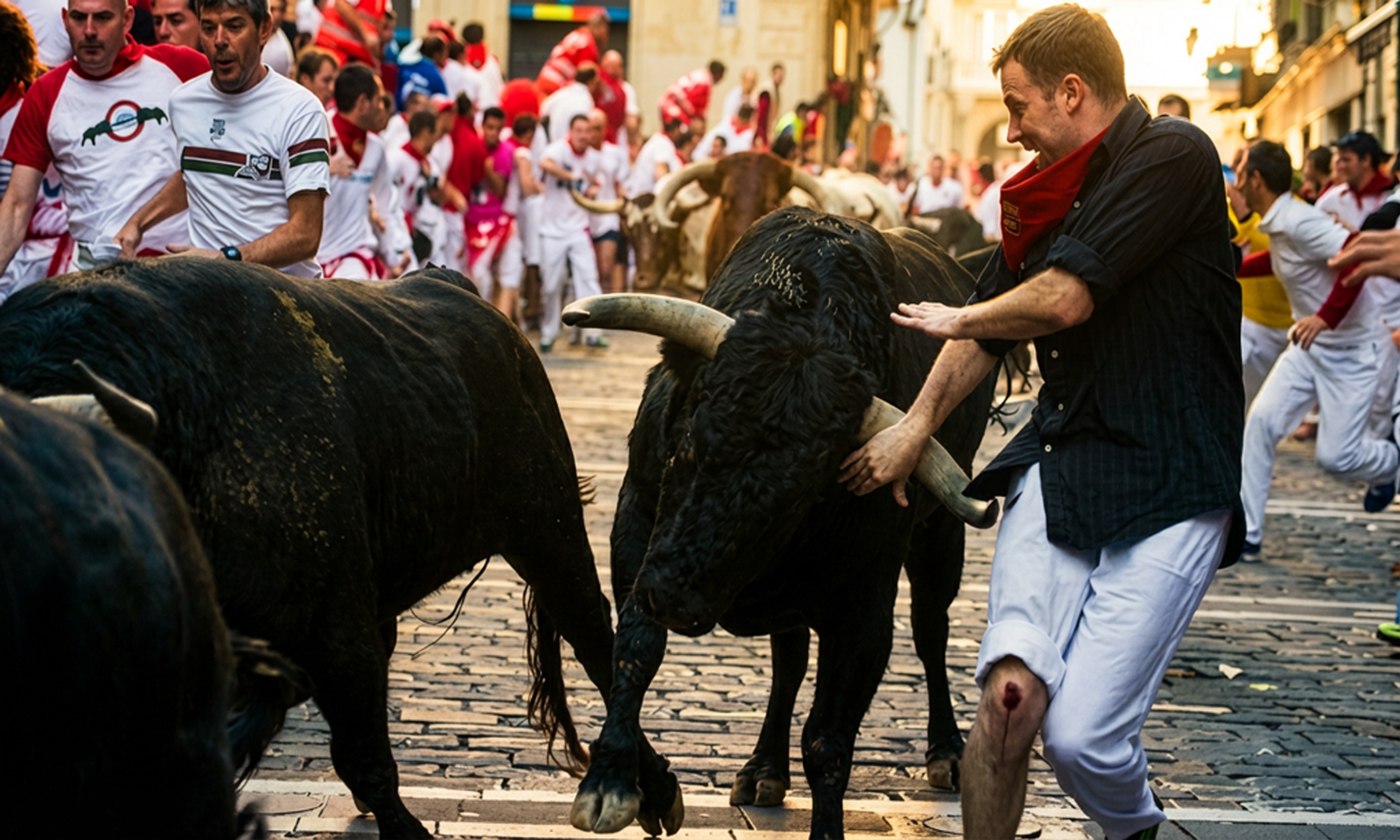
San Fermín 1971: The Running of the Bulls
July 6 to 14, 1971. Miura returned for their second year on the Pamplona course. Eight mornings at six in the morning, in a Spain watching its aging dictator and a growing labour movement with equal unease.
Looking Back at 1971
Looking back at 1971, it was in many ways a continuation of what 1970 had begun. Miura returned to the encierro for their second year, which confirmed them as part of the Pamplona rotation rather than a one-time experiment. Their reputation from the corrida preceded them onto the course, and the Sevillian bulls were becoming part of what runners expected from the fiesta. They would continue returning through the decade, missing only 1976.
The political backdrop had not eased. Franco was 78 years old in 1971, his health beginning to show the decline that would define the final years of his rule. The question of succession, and what Spain would become after him, was sharpening in the minds of industrialists, unionists, the Church, and the opposition movements that operated at risk in the shadows of the regime. Navarra’s industrial workforce, concentrated in the factories that had grown up around Pamplona in the previous two decades, was increasingly restive. Labour unrest was rising across the country. ETA was escalating its campaign. Admiral Carrero Blanco, the man Franco had positioned as the institutional backbone of the regime’s continuation, was widely understood to be the real power behind government by this point.
Javier Cejuela returned for his second consecutive year as cartel artist, continuing a modernizing thread in the visual identity of the fiesta that had begun in 1970. The ganaderías for the eight individual mornings are not recorded in the available sources, beyond Miura’s confirmed participation. The fiesta passed without fatalities. The encierros ran at 6:00 AM, three years before the hour would be moved to 8:00 AM.
Dennis Clancey, Founder, Encierro
Continuity and Change
The 1971 fiesta ran from July 6 to July 14, with the chupinazo opening at noon in the Plaza del Ayuntamiento. Eight encierros followed on consecutive mornings at 6:00 AM. Miura confirmed their place in the rotation with a second consecutive year on the Pamplona course, their long-horned bulls covering the same 849 metres they had first run in 1970.
The broader Spanish context in 1971 was one of accelerating tension beneath an ageing regime. Franco, now 78, retained formal power but was increasingly removed from day-to-day governance. Admiral Luis Carrero Blanco, his long-serving deputy, had become the effective guarantor of regime continuity and was widely seen as the man who would manage Spain’s institutions through and after the succession. Labour strikes had intensified in Navarra’s industrial belt, drawing on the same working-class communities that sent workers to the factories of Pamplona’s expanding periphery and also filled the fiestas every July.
Miura ran in Pamplona for the second consecutive year in 1971. Their presence was becoming a feature of the fiesta rather than a novelty.
TVE’s coverage of the encierro was continuing to grow, carrying the morning runs to a national audience. The fiesta’s international profile was also developing steadily, with visitors from France and North America making up a growing proportion of the crowds in the old city. The fiesta closed as always at midnight on July 14 with the Pobre de Mí in the Plaza del Castillo.
Every 1971 Encierro, Day by Day
Eight runs, July 7–14, 1971. The route runs approximately 849 metres from Santo Domingo to the bull ring. The ganaderías for individual mornings are not recorded, beyond Miura’s confirmed participation that year. See the route map.
First Run
The opening encierro of 1971 took place at 6:00 AM. The specific ganadéria for this morning is not recorded in the available historical sources. Miura is confirmed among the ganaderías of the 1971 fiesta, though which morning they ran has not been established with certainty.
Second Run
The second encierro of 1971. Ganadéria not recorded in the available sources. The run took place at 6:00 AM. No fatalities are recorded for this morning or for the 1971 fiesta as a whole.
Third Run
The third morning of the 1971 encierro. Ganadéria not recorded. The route ran from Santo Domingo through Mercaderes and into the Plaza del Toros, as it does today, with the principal danger points at the corners of Mercaderes and Estafeta.
Fourth Run
The fourth encierro of 1971. Ganadéria not recorded. The 6:00 AM start placed the runs in the early morning, well before the 8:00 AM hour that would become standard from 1974 onward.
Fifth Run
The fifth encierro of the 1971 fiesta. Ganadéria not recorded. Miura is confirmed in the 1971 rotation; the specific morning of their run is not established in the available record.
Sixth Run
The sixth morning of the 1971 fiesta. Ganadéria not recorded in available sources. No gorings or fatalities confirmed for this morning.
Seventh Run
The seventh encierro of 1971. Ganadéria not recorded. The penultimate morning of the fiesta, with one encierro remaining before the closing Pobre de Mí ceremony.
Eighth Run
The closing encierro of the 1971 fiesta. Ganadéria not recorded. The fiesta closed at midnight with the Pobre de Mí in the Plaza del Castillo, ending eight mornings of running in which no deaths were recorded.
The Stories the Numbers Leave Out
Official Poster: San Fermín 1971
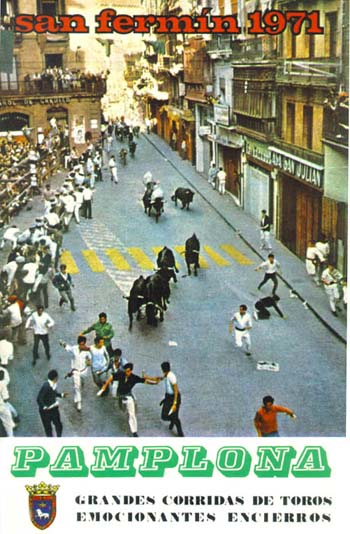
Cartel: Javier Cejuela (second consecutive year).
Javier Cejuela was chosen as the poster artist for the second year running in 1971, a continuity that reflected both satisfaction with his approach and a desire to develop a more coherent visual identity for the fiesta across consecutive years. Cejuela’s work engaged with the modernizing currents in Spanish graphic design of the period, moving away from the strictly traditional painted imagery that had characterized many earlier San Fermín posters.
The full archive of San Fermín official posters from 1846 to the present is maintained by the Ayuntamiento de Pamplona, cartel archive.
Named the official cartel of San Fermín 1971 after winning the Ayuntamiento’s annual poster contest.
The City in 1971
The chupinazo opened the fiesta at noon on Tuesday, July 6, 1971. The encierros ran each morning at 6:00 AM, unchanged from the previous year. The 1971 fiesta drew its customary crowd from across Spain and from the international visitors for whom the encierro was an increasingly well-known destination. ETA’s campaign was escalating, and the political temperature in the Basque Country and Navarra was high, but the fiesta proceeded on its traditional calendar.
Pamplona’s population was growing in this period, fed by internal migration from rural Spain and by the industrial expansion that had brought new factories and new workers to the city’s outskirts. The fiesta was both a civic celebration and a commercial engine for the city, drawing visitors whose spending supported the local economy through the nine days. The closing Pobre de Mí at midnight on July 14 marked the end of the 1971 fiesta and the beginning of another year of anticipation.
How 1971 Came Together
Key dates in the 1971 fiesta, as the record stands.
The official cartel by Javier Cejuela, serving his second consecutive year, was announced. The encierro ganaderías were confirmed, including a second participation by Miura in the Pamplona rotation.
The chupinazo opened the fiesta at noon in the Plaza del Ayuntamiento. The vallado was in place along the 849-metre route. The encierros were scheduled to begin the following morning at 6:00 AM.
Eight encierros ran on consecutive mornings at 6:00 AM. Miura participated in the 1971 rotation for the second consecutive year. The specific morning is not confirmed in the available record. No deaths were recorded across the eight runs.
The eighth and final encierro completed the 1971 fiesta. At midnight, the Pobre de Mí ceremony in the Plaza del Castillo closed the fiesta as it does every year, marking the end of nine days of celebration.
San Fermín 1971, Answered
Did Miura run in the 1971 San Fermín encierro?
Yes. Miura is confirmed as having participated in the 1971 encierro rotation, their second consecutive year in Pamplona following their debut in 1970. The specific morning on which they ran is not confirmed in the available historical record. They would continue running through the decade, missing only 1976.
What time did the encierro start in 1971?
The encierro ran at 6:00 AM in 1971, unchanged from the previous years. In 1974 the Ayuntamiento moved the start to 8:00 AM. The 8:00 AM time has remained standard since then.
Were there any deaths in the 1971 encierro?
No deaths are recorded for the 1971 San Fermín encierro. The eight runs passed without a fatality on the course.
Who designed the 1971 San Fermín poster?
Javier Cejuela designed the 1971 official cartel, his second consecutive year as poster artist for the fiesta. His work brought a contemporary graphic sensibility to the San Fermín poster during this period, continuing the approach he had established in 1970.
Explore the encierro by year
1971 is part of the record. For the years on either side, see San Fermín 1970 or San Fermín 1972.