
San Fermín 1972 · Pamplona, Spain
The Encierro
of 1972
Eight runs through the streets of Pamplona. Miura’s “León” wins the Carriquiri prize. Hemingway’s shadow stretches over a changing city.
Founder’s Perspective
Looking Back at 1972
Dennis Clancey · Founder, Encierro.com
Looking back at 1972, what strikes me most is the link the Carriquiri prize draws between the encierro and the corrida. Most people think of the running and the bullfight as separate events — and in a practical sense they are. But when Miura’s bull “León” ran the streets on July 10 and then appeared that afternoon in the ring, where Andrés Vázquez cut an ear, you had a single animal connecting both halves of the fiesta. The Carriquiri prize — awarded to the best bull of the entire Feria del Toro — went to “León” that year. That is a rare kind of distinction. It tells you something about what Miura was producing at that moment.
Hemingway had been dead for eleven years by July 1972, but his novel was still driving American and British travelers to Pamplona in numbers that would have been unimaginable before The Sun Also Rises. The international atmosphere at the fiestas was already well established — local newspapers reported on the foreign visitors with a mixture of pride and mild exasperation that I find familiar even now. The fiesta had become, in some sense, a global event dressed in local clothes.
And beneath the celebration, the political context was real. Spain’s labor movement was straining against the Franco regime in 1972. Factories in Navarra and the Basque Country were seeing strikes with increasing frequency. The men and women running through the streets of Pamplona each morning included workers from those same industries. The fiesta did not dissolve those tensions — it sat on top of them.
Dennis Clancey, Founder · Encierro.com
Historical Context
San Fermín 1972
July 6-14, 1972. Eight encierros through the cobblestones of the old city. A year when the corrida and the encierro intersected in an exceptional way.
The 1972 fiestas ran under the same pre-dawn start time that had governed encierros since well before the modern era: 6:00 AM. The change to 8:00 AM would not come until 1974. Runners in 1972 gathered in darkness and ran into a city still waking up, with the route from the corrals of Santo Domingo to the Plaza de Toros unchanged from previous decades.
International tourism had been accelerating through the late 1960s and into the 1970s, fueled in large part by the ongoing influence of Ernest Hemingway’s 1926 novel. Pamplona was no longer a purely local or even purely Spanish event. By 1972 the presence of foreign runners — Americans, Australians, British, and others — was a recognized feature of the encierro, not a novelty.
The political atmosphere of Spain in 1972 was one of increasing pressure on the Franco regime. Labor strikes in the industrial regions of Navarra and the Basque Country were becoming more frequent, and the question of Spain’s political future — still nominally tied to the aging dictator — was beginning to weigh more openly on public life. The fiestas continued regardless, as they always have.
The Eight Runs
Encierros, July 7-14, 1972
Detailed ganaderia records for 1972 are not comprehensively documented in available sources. July 10 is confirmed as Miura. All other dates list the ganaderia as not recorded.
July 7, 1972 · First Run
Opening Encierro
The first encierro of San Fermín 1972. The ganaderia for this run is not recorded in available historical sources. The route ran from the corrals of Santo Domingo through Mercaderes and Estafeta to the Plaza de Toros.
July 8, 1972 · Second Run
Second Encierro
The ganaderia for the second encierro of 1972 is not recorded in available historical sources.
July 9, 1972 · Third Run
Third Encierro
The ganaderia for the third encierro of 1972 is not recorded in available historical sources.
July 10, 1972 · Fourth Run
Miura · León Wins the Carriquiri
The July 10 encierro is confirmed as Miura. That afternoon, Miura’s bull “León” was lidiado by matador Andrés Vázquez, who cut an ear. “León” was subsequently awarded the Carriquiri prize — given to the best bull of the entire Feria del Toro — making July 10 the defining day of the 1972 fiestas in terms of both encierro and corrida.
July 11, 1972 · Fifth Run
Fifth Encierro
The ganaderia for the fifth encierro of 1972 is not recorded in available historical sources.
July 12, 1972 · Sixth Run
Sixth Encierro
The ganaderia for the sixth encierro of 1972 is not recorded in available historical sources.
July 13, 1972 · Seventh Run
Seventh Encierro
The ganaderia for the seventh encierro of 1972 is not recorded in available historical sources.
July 14, 1972 · Eighth Run
Closing Encierro
The final encierro of San Fermín 1972. The ganaderia is not recorded in available historical sources. That evening, the Pobre de Mí ceremony would close the fiestas until 1973.
Stories from 1972
Three Threads That Defined the Year
The corrida prize, the literary inheritance, and the labor unrest that ran beneath the surface of the fiestas.
Official Poster
Official: Cartel de San Fermín 1972
Fernando Maritorena designed the official poster for 1972, taking over from the two-year run of the previous artist.
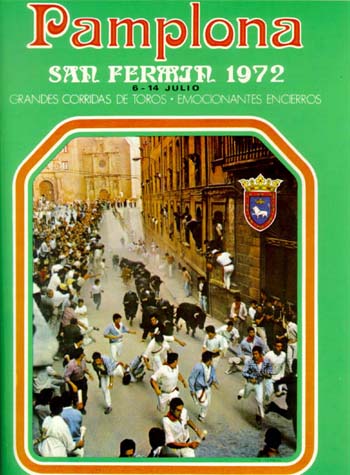
Artist: Fernando Maritorena
Year: 1972
The San Fermín poster competition was growing in recognition through the early 1970s, with each year’s selection becoming a collectible document of the fiesta. Maritorena’s 1972 design continued the tradition of imagery rooted in the encierro and the celebration of San Fermín.
The 1972 San Fermín official poster, selected through the annual concurso de carteles held by Pamplona each year.
Pamplona in 1972
The City and the Fiestas
What Pamplona looked like in July 1972: the encierro at 6:00 AM, a regime in its final years, and a city balancing tradition with an accelerating world.
In July 1972, Pamplona was a mid-sized city of roughly 150,000 people, the capital of the Foral Community of Navarra and a significant industrial center in northern Spain. The encierros ran at 6:00 AM, as they had for decades — the shift to the current 8:00 AM start was still two years away. Runners would gather in the pre-dawn dark near the corrals of Santo Domingo, the rocket would sound, and the bulls would move.
The Franco regime was still in place in 1972, though Francisco Franco himself was in declining health. The political succession question — who and what would follow — was a subject of increasing public discussion. The regime’s relationship with the Catholic Church, once its most reliable institutional support, was becoming more complicated as younger clergy aligned with social movements.
International tourism was a real economic presence. Hotels in Pamplona were full during the fiestas, and the city was aware that the encierro had become something larger than a local tradition. The challenge of managing that reality — the crowds, the foreign press, the expectations shaped by Hemingway — was already familiar to city administrators by 1972.
Resources and Archives
Further Reading on San Fermín 1972
Historical records, encierro archives, and press coverage from and about the 1972 fiestas.
pamplona.es
SanFerminEncierroTV Archive
Timeline
Key Moments of San Fermín 1972
Spring 1972
Fernando Maritorena’s poster announced as the official cartel for San Fermín 1972, continuing the growing tradition of the poster competition.
July 6, 1972
Chupinazo. The rocket fired from the balcony of Pamplona’s city hall opens the fiestas. The streets of the old city fill.
July 10, 1972
Miura encierro. The July 10 run is confirmed as Miura. That afternoon, Miura’s bull “León” is lidiado by Andrés Vázquez, who cuts an ear. “León” is subsequently named winner of the Carriquiri prize — best bull of the Feria del Toro 1972.
July 14, 1972
Pobre de Mí. The final encierro runs in the morning. That night, the traditional farewell ceremony closes the fiestas until 1973.
Frequently Asked Questions
San Fermín 1972 FAQ
Which ganaderias ran in the 1972 encierros?
Only one ganaderia is confirmed from available historical records: Miura ran on July 10. The ganaderias for the other seven encierros (July 7-9 and July 11-14) are not recorded in accessible sources.
How was July 10 confirmed as Miura?
The July 10 date is confirmed through the Carriquiri prize record. The prize is awarded to the best bull of the Feria del Toro corridas, and the 1972 winner — Miura’s “León” — is documented as having been lidiado on July 10 by Andrés Vázquez. Because the encierro and the corrida share the same ganaderia each day, this confirms Miura for the July 10 encierro as well.
What is the Carriquiri prize?
The Carriquiri prize is awarded at the conclusion of the Feria del Toro in Pamplona to the best bull of the entire fair. It is named after Nazario Carriquiri, a 19th-century Navarrese livestock breeder. The prize recognizes bravery and quality in the corrida. In 1972, it was awarded to Miura’s “León,” lidiado by Andrés Vázquez on July 10, with Vázquez cutting an ear.
Were there any deaths in the 1972 encierros?
No deaths were recorded in the 1972 encierros. The run at 6:00 AM produced injuries in most years, as it always has, but 1972 was not a year with a fatality on record.
Explore the Archive
San Fermín Through the Years
The encierro has run every July since the early modern period. Explore the years surrounding 1972 or browse the full historical archive.