
San Fermín 1973 · Pamplona, Spain
The Encierro
of 1973
Eight runs. Miura’s “Importuno” wins the Carriquiri on the final day. Antonio José Galán cuts two ears and a tail. A fiesta held five months before Spain’s history changed.
Founder’s Perspective
Looking Back at 1973
Dennis Clancey · Founder, Encierro.com
Looking back at 1973, what stays with me is the rarity of what Antonio José Galán achieved on July 14. Two ears and a tail is the maximum award in bullfighting — you can sit through a decade of corridas in Pamplona without seeing it. For it to happen with a Miura bull, on the last day of the fiestas, with the same animal that had just earned the Carriquiri prize as best bull of the fair: that is an alignment of circumstances you cannot plan. “Importuno” ran in the encierro that morning and was exceptional again in the ring that afternoon. Some bulls have that quality. Miura produced more of them than anyone.
Looking back from the distance of decades, 1973 stands at a genuine hinge point in Spanish history. In June of that year, Admiral Luis Carrero Blanco was named President of the Government — effectively confirming him as Franco’s chosen successor, the man who was supposed to hold the regime together after Franco was gone. The fiestas ran in July with that succession appearing, for the moment, settled. Five months later, in December 1973, ETA assassinated Carrero Blanco in Madrid. The political trajectory that had seemed fixed suddenly was not. Spain’s transition to democracy moved along a different path than the regime had intended.
The people in the streets of Pamplona in July 1973 had no knowledge of what was coming. That is always the condition of living inside events rather than observing them afterward. The labor movement in Navarra was active that year, the regime was still in place, and the fiestas ran as they always did — loud, crowded, and charged with the particular energy of a city that has been doing this for centuries and intends to keep doing it.
Dennis Clancey, Founder · Encierro.com
Historical Context
San Fermín 1973
July 6-14, 1973. Eight encierros. The final day produced a Carriquiri prize winner and the maximum trophies in a single corrida — two ears and a tail.
The 1973 fiestas ran at 6:00 AM, the pre-1974 start time that placed the encierros in the early morning darkness. The route was the same as it had been for decades — from the corrals at Santo Domingo, up through Mercaderes, along Estafeta, and into the Plaza de Toros.
The confirmed record from 1973 centers on the final encierro. On July 14, Miura’s bulls ran through the streets. That afternoon, Miura’s bull “Importuno” was lidiado by Antonio José Galán, who achieved the maximum award in a single corrida: two ears and a tail. “Importuno” was subsequently named winner of the Carriquiri prize, given to the best bull of the entire Feria del Toro. The same afternoon closed the fiestas.
The political backdrop was significant. In June 1973 — one month before the fiestas — Admiral Luis Carrero Blanco had been named President of the Government, cementing his role as the intended successor to Francisco Franco. The question of Spain’s post-Franco future seemed, in July 1973, to have an answer. By December it would not.
The Eight Runs
Encierros, July 7-14, 1973
Ganaderia records for 1973 are not comprehensively documented in available sources for most dates. July 14 is confirmed as Miura. All other encierros list the ganaderia as not recorded.
July 7, 1973 · First Run
Opening Encierro
The first encierro of San Fermín 1973. The ganaderia for this run is not recorded in available historical sources.
July 8, 1973 · Second Run
Second Encierro
The ganaderia for the second encierro of 1973 is not recorded in available historical sources.
July 9, 1973 · Third Run
Third Encierro
The ganaderia for the third encierro of 1973 is not recorded in available historical sources.
July 10, 1973 · Fourth Run
Fourth Encierro
The ganaderia for the fourth encierro of 1973 is not recorded in available historical sources.
July 11, 1973 · Fifth Run
Fifth Encierro
The ganaderia for the fifth encierro of 1973 is not recorded in available historical sources.
July 12, 1973 · Sixth Run
Sixth Encierro
The ganaderia for the sixth encierro of 1973 is not recorded in available historical sources.
July 13, 1973 · Seventh Run
Seventh Encierro
The ganaderia for the seventh encierro of 1973 is not recorded in available historical sources.
July 14, 1973 · Eighth Run
Miura · “Importuno” Wins the Carriquiri
The final encierro of San Fermín 1973 is confirmed as Miura. That afternoon, Miura’s bull “Importuno” was lidiado by Antonio José Galán, who cut two ears and a tail — the maximum award in bullfighting, rarely achieved at Pamplona. “Importuno” was subsequently named winner of the Carriquiri prize as best bull of the Feria del Toro 1973. That evening, the Pobre de Mí ceremony closed the fiestas.
Stories from 1973
Three Threads That Defined the Year
A maximum trophies corrida, a political succession about to fracture, and the labor current running beneath the celebration.
Official Poster
Official: Cartel de San Fermín 1973
Mariano Sinúes designed the official poster for 1973, taking over from Fernando Maritorena’s 1972 design.
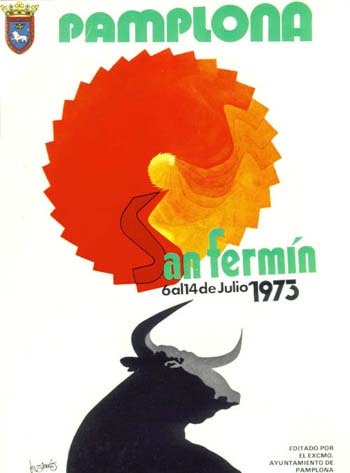
Artist: Mariano Sinúes
Year: 1973
The annual selection of the San Fermín poster was becoming an established cultural event by the early 1970s. Mariano Sinúes took over from Maritorena’s 1972 design, continuing the tradition of imagery rooted in the encierro and the iconography of the fiestas. The poster competition was growing in visibility and in the recognition of its selections as collectible documents of the fiesta.
Winner of the annual cartel contest and the official San Fermín 1973 poster for Sanfermines.
Pamplona in 1973
The City and the Fiestas
What Pamplona looked like in July 1973: the encierro at 6:00 AM, a political succession that looked settled, and a city at the edge of a decade of major change.
In July 1973, Pamplona was a city of roughly 150,000 people going about the business of its most significant annual event. The encierros ran at 6:00 AM — the same pre-dawn start that had governed the running for decades. The crowd gathered, the rocket sounded from Santo Domingo, and the bulls moved through the streets toward the plaza. The 8:00 AM start would not come until 1974.
The Franco regime was visibly aging alongside its founder. Francisco Franco himself was 80 years old in 1973 and in declining health. The question of what came after was the defining political question of the era, and in June 1973 it had appeared to receive an answer: Carrero Blanco as President of the Government, the continuity figure, the man who would hold the apparatus together. The fiestas of July 1973 ran under that assumption. December would dissolve it.
International tourism continued to be a presence at the fiestas. The Hemingway legacy, now more than a decade old since his death, remained the primary draw for foreign runners and spectators. Pamplona’s city administration was well practiced by 1973 in managing the combination of local tradition and international attention that the encierro had become.
Resources and Archives
Further Reading on San Fermín 1973
Historical records, encierro archives, and press coverage from and about the 1973 fiestas.
pamplona.es
SanFerminEncierroTV Archive
Timeline
Key Moments of San Fermín 1973
June 1973
Carrero Blanco named President of the Government. Admiral Luis Carrero Blanco is confirmed as Spain’s head of government, solidifying his role as Franco’s intended successor. The political succession question appears settled as the fiestas approach.
July 6, 1973
Chupinazo. The rocket fired from the balcony of Pamplona’s city hall opens the fiestas. The streets of the old city fill for the first of nine days of celebration.
July 14, 1973
Final encierro: Miura (confirmed). The eighth and final run is confirmed as Miura. That afternoon, Miura’s bull “Importuno” is lidiado by Antonio José Galán, who cuts two ears and a tail — the maximum award. “Importuno” wins the Carriquiri prize as best bull of the Feria del Toro 1973. That night, Pobre de Mí closes the fiestas.
December 20, 1973
ETA assassinates Carrero Blanco. Five months after the fiestas, ETA detonates a bomb beneath Carrero Blanco’s car in Madrid. He is killed. Spain’s planned political succession collapses, and the country’s path toward the transition to democracy shifts. This event falls outside the fiestas but is essential context for understanding what July 1973 meant in retrospect.
Frequently Asked Questions
San Fermín 1973 FAQ
Which ganaderias ran in the 1973 encierros?
Only one ganaderia is confirmed from available historical records: Miura ran on July 14, the final encierro. The ganaderias for the other seven encierros (July 7-13) are not recorded in accessible sources.
What happened with Miura’s “Importuno” on July 14?
“Importuno” ran in the July 14 encierro as part of the Miura herd. That afternoon in the corrida, Antonio José Galán lidiado “Importuno” and was awarded two ears and a tail — the maximum trophies in a single bullfight. At the conclusion of the Feria del Toro, “Importuno” was named the Carriquiri prize winner as the best bull of the entire fair.
What is the significance of two ears and a tail?
In bullfighting, trophies are awarded by the president of the corrida at the request of the crowd. One ear is the standard award for a notable performance; two ears indicates an exceptional one; two ears and a tail is the maximum, awarded only when the performance of both the matador and the bull is judged outstanding. At the Pamplona Feria, which has demanding crowds and a tradition of rigorous judging, this award is particularly rare.
How does the Carrero Blanco assassination relate to the 1973 fiestas?
The fiestas ran in July 1973, five months before ETA’s assassination of Admiral Carrero Blanco in December. At fiesta time, Carrero Blanco had just been named President of the Government (June 1973) and was widely regarded as Franco’s chosen successor. His assassination in December removed the intended continuity figure for the regime and significantly affected Spain’s political trajectory toward the transition to democracy. The fiestas are not connected to the assassination — they occurred well before it — but the two events are part of the same historical year.
Explore the Archive
San Fermín Through the Years
The encierro has run every July since the early modern period. Explore the years surrounding 1973 or browse the full historical archive.