San Fermin · Pamplona · 1974
San Fermin 1974
July 6 to 14, 1974. The year the encierro moved to 8:00 AM, a death on the sixth morning, and a cartel controversy that captured the spirit of an era.
Founder’s Note
Looking Back at 1974
Dennis Clancey, Founder, Encierro.com
The start time change from 6:00 AM to 8:00 AM was not cosmetic. It changed the entire character of the run. At 6:00 in the morning the course was dark, the crowds were mostly local, and there was a particular quality of silence before the rocket. Moving to 8:00 AM meant daylight, more spectators lining the barriers, more runners from outside Pamplona. The encierro became a different kind of public event on that first morning in July 1974. The rocket still fired, the bulls still ran, but the audience had changed.
Looking back, 1974 also stands out for two things that had nothing to do with the running itself. A young man named Juan Ignacio Eraso Martiartu died on July 12, the first death in the encierro since 1969. He was eighteen years old, from Pamplona. The bull was named Palmello. He died in the bajada al callejon, the descending passageway into the bullring, after five hours of surgery. There is not much more to say about that.
The other thing was the cartel. Agustin Ibarrola, a Basque artist associated with the labor and independence movement, was commissioned to design the official poster. He painted Guernica’s bull and raised fists. The Franco regime rejected the design and censored it before it could be printed. The prize went instead to Pedro Lozano de Sotes and Francis Bartolozzi. Francis “Pitti” Bartolozzi, working and living in Pamplona, became the first woman to win the San Fermin poster competition. The censored image never appeared. The censorship itself became the story, and it said more about Spain in 1974 than any corrida could.
Dennis Clancey, Founder, Encierro.com
The Eight Encierros
The Runs of 1974
All eight morning runs of the 1974 San Fermin fiesta. Ganaderias are noted where confirmed by the historical record; where the record is silent, this is stated.
Monday, July 7 · First Run
Ganaderia Not Recorded
Run 1 of 8
The first encierro of the 1974 fiesta. The ganaderia is not recorded in available sources. This was one of the first mornings under the new 8:00 AM start time regulation.
Tuesday, July 8 · Second Run
Ganaderia Not Recorded
Run 2 of 8
The ganaderia for this run is not recorded in available sources.
Wednesday, July 9 · Third Run
Ganaderia Not Recorded
The ganaderia for this run is not recorded in available sources.
Thursday, July 10 · Fourth Run
Ganaderia Not Recorded
The ganaderia for this run is not recorded in available sources.
Friday, July 11 · Fifth Run
Ganaderia Not Recorded
The ganaderia for this run is not recorded in available sources.
Saturday, July 12 · Sixth Run
Herederos de Don Manuel Arranz
Confirmed Ganaderia
Run 6 of 8
Juan Ignacio Eraso Martiartu, 18 years old, from Pamplona, was killed by the bull “Palmello” of Herederos de Don Manuel Arranz in the bajada al callejon, the descending passageway at the entrance to the bullring. He suffered a cornada al cuello (horn wound to the neck) with multiple lesions. Five hours of emergency surgery could not save him. He was the first person to die in the encierro since 1969.
Sunday, July 13 · Seventh Run
Ganaderia Not Recorded
The ganaderia for this run is not recorded in available sources. The afternoon corrida featured Manolo Cortes, Jose Luis Parada, and Antonio Jose Galan.
Monday, July 14 · Eighth Run
Miura
Carriquiri Prize
Feria del Toro Best
Run 8 of 8
The Miura bulls ran on the final morning. In the afternoon corrida, bull “Galguito” won the Carriquiri prize, lidiado by Manolo Cortes who cut an ear. The Miura corrida was awarded the Feria del Toro prize as the best corrida of the 1974 season. The fiesta closed at midnight with the Pobre de Mi.
In Memoriam
Juan Ignacio Eraso Martiartu
The 1974 San Fermin fiesta claimed one life in the encierro.
Juan Ignacio Eraso Martiartu, 18 years old. Pamplona, Navarra.
Date: Saturday, July 12, 1974.
Bull: “Palmello” of Herederos de Don Manuel Arranz.
Location: Bajada al callejon, the descending passageway leading to the entrance of the Plaza de Toros.
Cause: Cornada al cuello (horn wound to the neck) with multiple lesions. Emergency surgery lasting five hours was unsuccessful.
Juan Ignacio Eraso Martiartu was the first person to die in the San Fermin encierro since Hilario Pardo Simon in 1969. He was eighteen years old and from the city where he died.
Stories of the Year
Three Things That Defined 1974
The censored poster, the first woman to win, and the morning the clocks moved to eight.
The Official Cartel
Official: Cartel de San Fermin 1974
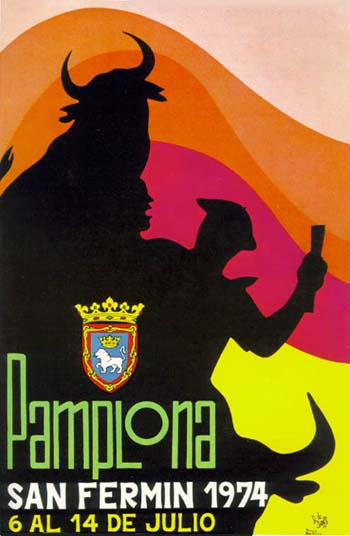
Official winners: Pedro Lozano de Sotes and Francis “Pitti” Bartolozzi (joint award).
The 1974 cartel competition produced one of the most consequential controversies in the history of the San Fermin poster. Agustin Ibarrola, a Basque artist with documented connections to the labor and Basque independence movements, was commissioned to produce the design. His submission incorporated the bull from Picasso’s Guernica alongside raised fists, imagery drawn directly from the rhetoric of the worker’s movement then active in Navarra, centred on factories including Seat and Authi. The Franco regime, in its final years and under increasing internal pressure, rejected and censored the work.
The prize was then awarded to the joint submission of Pedro Lozano de Sotes and Francis “Pitti” Bartolozzi. Bartolozzi (Madrid, 1908 – Iruna, 2004) became the first woman to win the San Fermin poster competition. The censored Ibarrola design, precisely because it was suppressed, achieved a visibility of its own and became one of the documents of its political moment.
The full archive of San Fermin carteles is held at pamplona.es/turismo/sanfermin/carteles.
Selected as the official poster of Sanfermines 1974 through Pamplona’s annual concurso de carteles.
Pamplona and Spain in 1974
The City That Year
By late 1974, Francisco Franco was gravely ill. He was hospitalized in October and Juan Carlos briefly assumed the role of acting head of state. The regime that had governed Spain since 1939 was visibly weakening, though it had not yet ended. In Navarra, the labor movement was among the most militant in the country, organized around the large industrial plants including Seat and Authi. The energy that Ibarrola tried to capture in his censored poster was real and present in the streets.
The fiesta ran against this background. The new 8:00 AM encierro start time was a practical regulatory decision, but it also reflected a gradual opening of the event to a broader public. The death of Juan Ignacio Eraso Martiartu on July 12 prompted renewed debate about safety in the encierro, a conversation that would continue in the years that followed. The Miura corrida on the final day won the Feria del Toro prize as the best of the season.
Timeline
San Fermin 1974: Key Moments
Spring 1974
Cartel controversy. Agustin Ibarrola’s commissioned design is censored by the Franco regime. Pedro Lozano de Sotes and Francis Bartolozzi are announced as the official winners. Bartolozzi becomes the first woman to win the competition.
Saturday, July 6, 1974
Chupinazo. The opening rocket fires from the balcony of the Pamplona town hall. The 1974 San Fermin fiesta begins.
Sunday, July 7, 1974
First encierro at 8:00 AM. The new start time takes effect. The ganaderia for this run is not recorded.
Saturday, July 12, 1974
Fatal run. Herederos de Don Manuel Arranz. Juan Ignacio Eraso Martiartu, 18, is killed by bull “Palmello” in the bajada al callejon. Five-hour emergency surgery is unsuccessful. He is the first encierro death since 1969.
Monday, July 14, 1974
Miura runs. Bull “Galguito” wins the Carriquiri prize. Manolo Cortes cuts an ear in the afternoon corrida. The Miura corrida is named the best of the Feria del Toro. Pobre de Mi closes the fiesta at midnight.
Frequently Asked Questions
1974: Common Questions
Who died in the 1974 San Fermin encierro?
Juan Ignacio Eraso Martiartu, 18 years old, from Pamplona, died on July 12, 1974. He was gored in the bajada al callejon by the bull “Palmello” of Herederos de Don Manuel Arranz. A cornada al cuello (horn wound to the neck) with multiple lesions proved fatal despite five hours of surgery. He was the first person to die in the encierro since Hilario Pardo Simon in 1969.
What was the Ibarrola cartel controversy in 1974?
Agustin Ibarrola, a Basque artist associated with the labor and independence movements, was commissioned to design the 1974 San Fermin poster. His design incorporated the bull from Picasso’s Guernica and raised fists representing the labor movement in Navarra. The Franco regime censored the work before it could be printed. The prize was awarded instead to Pedro Lozano de Sotes and Francis Bartolozzi. The censored image became widely known precisely because it was suppressed.
Who was the first woman to win the San Fermin poster prize?
Francis “Pitti” Bartolozzi (Madrid, 1908 – Iruna, 2004) became the first woman to win the San Fermin cartel competition in 1974, as a joint winner alongside Pedro Lozano de Sotes. She was a painter and visual artist who lived and worked in Pamplona for much of her life.
When did the encierro change from 6:00 AM to 8:00 AM?
The encierro start time changed from 6:00 AM to 8:00 AM with the 1974 San Fermin fiesta. The change was a regulatory decision and took effect on the first morning of that year’s runs. The new start time shifted the character of the event: more daylight, more spectators, and a larger pool of runners from outside Pamplona.
Continue the Record
Explore Adjacent Years
The encierro record continues year by year. Read the account of San Fermin 1973 or continue forward to San Fermin 1975, the fastest encierro in history and the last fiesta of the Franco era.