San Fermin · Pamplona · 1975
San Fermin 1975
July 6 to 14, 1975. The fastest encierro in history, a death in the callejon, and the last San Fermin before Franco’s Spain came to an end.
Founder’s Note
Looking Back at 1975
Dennis Clancey, Founder, Encierro.com
The 1:50 on July 7 is a number that needs to be heard in context. The modern encierro runs between two and three minutes on a normal day, with exceptional runs approaching two minutes ten seconds. One minute fifty seconds means the bulls covered the 849-metre route from the corral gate at Santo Domingo to the entrance of the Plaza de Toros at a pace that gave runners almost no time to think and almost no room for error. The Benitez Cubero herd ran that morning. The time has never been beaten. As of 2026, it remains the fastest encierro in the recorded history of San Fermin.
Two days later, Gregorio Gorriz Sarasa was killed in the callejon. He was forty-one years old, a bricklayer, a track athletics coach at the University of Navarra. Three rezagado bulls had separated from the main pack. He was running ahead of them and encountered the bull “Navarrico” of Francisco Javier Osborne at the entrance to the passageway. He was pinned against the wall and gored and he died from his injuries. After his death, escape hatches were cut into the walls of the callejon. Those hatches, the gateras, are still there today. They have saved lives in the years since.
Looking back across decades: 1975 was the last San Fermin of the Franco era. Franco died in November. The fiestas that July were, without anyone knowing it at the time, the last under a dictatorship that had governed Spain for thirty-six years. People in Pamplona knew something was ending. The political atmosphere was charged with anticipation of a change that had not yet arrived. By the end of the year, it had.
Dennis Clancey, Founder, Encierro.com
The Eight Encierros
The Runs of 1975
All eight morning runs of the 1975 San Fermin fiesta. Ganaderias are noted where confirmed by the historical record; where the record is silent, this is stated.
Monday, July 7 · First Run
Benitez Cubero
1:50
All-Time Record
Run 1 of 8
The Benitez Cubero bulls ran the 849-metre course from the corral gate at Santo Domingo to the entrance of the Plaza de Toros in 1 minute 50 seconds. This is the fastest encierro in the recorded history of San Fermin. The record has not been broken as of 2026.
Tuesday, July 8 · Second Run
Ganaderia Not Recorded
The ganaderia for this run is not recorded in available sources.
Wednesday, July 9 · Third Run
Francisco Javier Osborne
Confirmed Ganaderia
Run 3 of 8
Three rezagado bulls had separated from the main pack. Gregorio Gorriz Sarasa, 41 years old, from Arazuri, Navarra, was running ahead of them in the callejon de entrada a la Plaza de Toros. He encountered the bull “Navarrico” (colorao bragao) at the callejon entrance, was pinned against the wall, and was gored. He died from his injuries. After his death, escape hatches (gateras) were installed in the callejon walls. They are still in use today.
Thursday, July 10 · Fourth Run
Miura
Carriquiri Prize
Run 4 of 8
The Miura bulls ran on the fourth morning. In the afternoon corrida, bull “Aguijito” won the Carriquiri prize. Antonio Jose Galan cut an ear in the corrida.
Friday, July 11 · Fifth Run
Ganaderia Not Recorded
The ganaderia for this run is not recorded in available sources.
Saturday, July 12 · Sixth Run
Ganaderia Not Recorded
The ganaderia for this run is not recorded in available sources.
Sunday, July 13 · Seventh Run
Ganaderia Not Recorded
The ganaderia for this run is not recorded in available sources.
Monday, July 14 · Eighth Run
Ganaderia Not Recorded
The ganaderia for the final run of the 1975 fiesta is not recorded in available sources. The fiesta closed at midnight with the Pobre de Mi.
In Memoriam
Gregorio Gorriz Sarasa
The 1975 San Fermin fiesta claimed one life in the encierro.
Gregorio Gorriz Sarasa, 41 years old. Arazuri, Navarra.
Date: Wednesday, July 9, 1975.
Bull: “Navarrico” (colorao bragao, reddish brindle coloring) of Francisco Javier Osborne.
Location: Callejon de entrada a la Plaza de Toros. Three rezagado bulls had separated from the main pack. Gorriz Sarasa was running ahead of them. Entering the callejon, he encountered “Navarrico” and was pinned against the wall and gored.
Gregorio Gorriz Sarasa was a bricklayer (albanil) and a track athletics coach at the University of Navarra. After his death, escape hatches were installed in the walls of the callejon. Those hatches, the gateras, are a permanent feature of the encierro course. They are still in use today and have prevented further deaths in the years since.
Stories of the Year
Three Things That Defined 1975
The fastest run ever, the gateras, and the last July under Franco.
Official Poster of 1975
Official: Cartel de San Fermin 1975
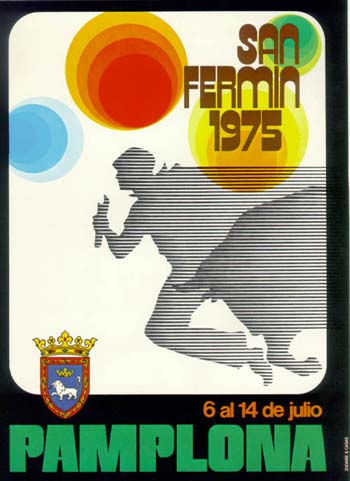
Official artist: Zudaire y Casas.
The 1975 San Fermin cartel was the work of Zudaire y Casas, a collaborative submission, which was unusual for the competition. Collaborative entries were rare; the competition typically recognized individual artists. No further detail on the design has been recorded in sources available to us.
The full archive of San Fermin carteles is held at pamplona.es/turismo/sanfermin/carteles.
The official San Fermín 1975 cartel was chosen via the city’s annual poster contest, the concurso de carteles.
Pamplona and Spain in 1975
The City That Year
The 1975 fiesta was the second year of encierros under the 8:00 AM start time, now established as the norm. The crowds and the character of the run had already shifted from what they had been in the pre-1974 mornings. The record run on July 7 happened in front of more spectators than would have been present under the old 6:00 AM format.
Franco’s health was the dominant political reality in Spain that summer. His final decline was not hidden. Political expression in Pamplona and across Navarra was suppressed but visible, and the Basque and Navarrese labor movements remained active. The encierro safety debate was renewed by Gorriz Sarasa’s death on July 9, which led directly to the physical modification of the callejon route.
By November 20, 1975, the era was over. The fiestas of that July were the last under the regime. The encierro, the chupinazo, the Pobre de Mi: all of it ran one final time as things had been. Then Spain changed.
Timeline
San Fermin 1975: Key Moments
Sunday, July 6, 1975
Chupinazo. The opening rocket fires from the balcony of the Pamplona town hall. The 1975 San Fermin fiesta begins.
Monday, July 7, 1975
All-time speed record. Benitez Cubero bulls cover the 849-metre encierro route in 1 minute 50 seconds. The fastest encierro in San Fermin history. The record has not been beaten as of 2026.
Wednesday, July 9, 1975
Fatal run. Francisco Javier Osborne. Three rezagado bulls. Gregorio Gorriz Sarasa, 41, from Arazuri, Navarra, is killed by bull “Navarrico” in the callejon de entrada a la Plaza de Toros. He was a bricklayer and a track coach at the University of Navarra.
Thursday, July 10, 1975
Miura runs. Bull “Aguijito” wins the Carriquiri prize. Antonio Jose Galan cuts an ear in the afternoon corrida.
Monday, July 14, 1975
Final encierro. The ganaderia is not recorded. Pobre de Mi closes the fiesta at midnight. The last San Fermin of the Franco era ends.
November 20, 1975
Francisco Franco dies. Juan Carlos I is proclaimed King of Spain on November 22, 1975. The transition to democracy begins.
After 1975
Gateras installed. Escape hatches are cut into the walls of the callejon de entrada a la Plaza de Toros following the death of Gregorio Gorriz Sarasa. The gateras remain a permanent feature of the encierro course today.
Frequently Asked Questions
1975: Common Questions
What is the fastest encierro in San Fermin history?
The fastest encierro in the recorded history of San Fermin was run on July 7, 1975, by the bulls of Benitez Cubero. The time was 1 minute 50 seconds for the 849-metre course from the corral gate at Santo Domingo to the entrance of the Plaza de Toros. The record has not been beaten as of 2026.
Who died in the 1975 San Fermin encierro?
Gregorio Gorriz Sarasa, 41 years old, from Arazuri, Navarra, died on July 9, 1975. He was killed by the bull “Navarrico” (colorao bragao) of Francisco Javier Osborne in the callejon de entrada a la Plaza de Toros. Three rezagado bulls had separated from the main pack; he was running ahead of them and encountered the bull in the narrow passageway. He was a bricklayer (albanil) and a track athletics coach at the University of Navarra.
What are the callejon gateras and why were they installed?
The gateras are escape hatches cut into the walls of the callejon de entrada a la Plaza de Toros, the narrow passageway leading from the street into the bullring. They were installed after the death of Gregorio Gorriz Sarasa on July 9, 1975, who was killed in the callejon when rezagado bulls separated from the main pack and he had no way out of the enclosed space. The gateras give runners a route of escape when the passage becomes dangerous. They remain in the walls today and have prevented further deaths.
Was 1975 the last San Fermin under Franco?
Yes. The 1975 San Fermin fiesta, which ran July 6 to 14, was the last before the death of Francisco Franco on November 20, 1975. Juan Carlos I was proclaimed King of Spain on November 22. The 1976 San Fermin fiesta was the first under the new political order. The July 1975 fiestas were, at the time, the last under a regime that had governed Spain for thirty-six years.
Continue the Record
Explore Adjacent Years
The encierro record continues year by year. Read the account of San Fermin 1974, the year the start time moved to 8:00 AM, or continue forward to San Fermin 1976, the first fiesta after Franco.