
San Fermín 1976 · Pamplona, Spain
The Encierro
of 1976
July 6 to 14, 1976. The first San Fermín of the democratic transition. Franco was gone, Juan Carlos was king, and the city ran into a new era.
Founder’s Perspective
Looking Back at 1976
Dennis Clancey · Founder, Encierro.com
Looking back at 1976, what is hard to appreciate from outside the moment is just how much weight the first post-Franco San Fermín carried. The regime had shaped every aspect of public life for thirty-six years, and the fiestas were no exception — the flags permitted on balconies, the banners tolerated in the streets, who policed the crowds and how. Francisco Franco had died in November 1975, and by July 1976 King Juan Carlos I was already pushing Spain toward political reform. Prime Minister Arias Navarro resigned that same month and was replaced by Adolfo Suárez, who would drive the Law for Political Reform through the Cortes that November. The city that gathered for the chupinazo on July 6 was a city that sensed, however cautiously, that something had changed.
The July 12 run is the data point that stays with you. Sixteen minutes from start to finish — one of the longest encierros in the modern recorded era, with the record being thirty minutes set in 1958. Sixteen minutes means bulls on the course for a quarter of an hour, runners unable to clear, the course in a sustained state of danger in a way that a three-minute run simply is not. The ganaderia that day was Ramón Sánchez and Arranz. The result: one very serious injury from blunt force, four horn gorings, six runners dazed from blows, and approximately twenty with minor injuries. No deaths, but the morning left its mark.
It is also worth noting what was absent in 1976: Miura. The only year of the entire decade that the Miura ganaderia did not run San Fermín. Their return in 1977 would prove fatal. But in 1976 the encierros ran without them, and the longest run of the year belonged to a different ranch entirely.
Dennis Clancey, Founder · Encierro.com
Historical Context
San Fermín 1976
July 6-14, 1976. Eight encierros through the streets of Pamplona. The first fiestas of Spain’s democratic transition, with Basque and Navarrese flags more openly displayed than at any point in the Franco decades.
The 1976 fiestas carried a symbolic weight that was unusual even by the standards of a celebration that had always meant something to the people of Navarra. Francisco Franco had died on November 20, 1975. The fiestas that followed in the summer of 1976 were the first San Fermín in which Basque and Navarrese identity — flags, banners, public expressions that had been suppressed or discouraged under the regime — was more openly displayed. This was not a politically uniform moment: the fiestas contained both the jubilation of those who had waited decades for greater freedom and the anxiety of those uncertain about what Spain would become.
The political backdrop was moving rapidly. Prime Minister Carlos Arias Navarro, a holdover from the Franco era, resigned in July 1976 and was replaced by Adolfo Suárez. Suárez’s appointment was the signal that the king intended genuine reform. The Law for Political Reform, which would legalize political parties and pave the way for democratic elections, was being prepared that summer and would be approved by referendum in November 1976.
The encierros themselves ran at 8:00 AM, the start time that had replaced the earlier 6:00 AM in 1974. The route ran unchanged: from the corrals of Santo Domingo, up through Mercaderes, along Estafeta, and into the Plaza de Toros. Eight runs, July 7 through July 14.
The Eight Runs
Encierros, July 7-14, 1976
Ganaderia records for 1976 are only partially documented. July 12 is confirmed as Ramón Sánchez and Arranz. All other dates list the ganaderia as not recorded.
July 7, 1976 · First Run
Opening Encierro
The first encierro of San Fermín 1976. The ganaderia for this run is not recorded in available historical sources. The route ran from the corrals of Santo Domingo through Mercaderes and Estafeta to the Plaza de Toros.
July 8, 1976 · Second Run
Second Encierro
The ganaderia for the second encierro of 1976 is not recorded in available historical sources.
July 9, 1976 · Third Run
Third Encierro
The ganaderia for the third encierro of 1976 is not recorded in available historical sources.
July 10, 1976 · Fourth Run
Fourth Encierro
The ganaderia for the fourth encierro of 1976 is not recorded in available historical sources.
July 11, 1976 · Fifth Run
Fifth Encierro
The ganaderia for the fifth encierro of 1976 is not recorded in available historical sources.
July 12, 1976 · Sixth Run
Ramón Sánchez and Arranz · The Sixteen-Minute Run
The most significant run of the 1976 fiestas and one of the longest encierros in the modern recorded era. The run lasted sixteen minutes from start to finish — a duration that kept bulls on the course through the entire route for a sustained period, with runners unable to clear. One runner suffered a very serious injury from blunt force impact. Four runners received horn gorings. Six were dazed from blows. Approximately twenty others sustained minor injuries. No deaths.
July 13, 1976 · Seventh Run
Seventh Encierro
The ganaderia for the seventh encierro of 1976 is not recorded in available historical sources.
July 14, 1976 · Eighth Run
Closing Encierro
The final encierro of San Fermín 1976. The ganaderia is not recorded in available historical sources. That evening, the Pobre de Mí ceremony closed the first post-Franco fiestas.
Stories from 1976
Three Threads That Defined the Year
The sixteen-minute run, the political symbolism of the first new July, and the absence that would make 1977 more dangerous.
Official Poster
Official: Cartel de San Fermín 1976
The 1976 poster was designed by Antonio Porres Minañro — the first San Fermín cartel competition to operate in the new political environment following Franco’s death.
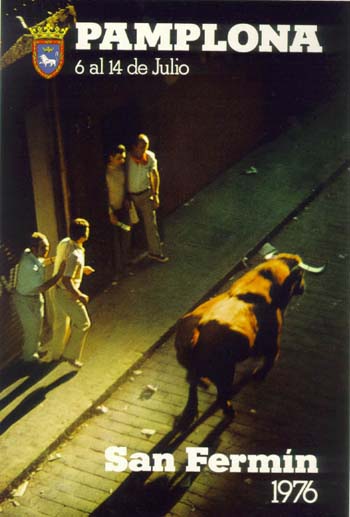
Artist: Antonio Porres Minañro
Year: 1976
The poster competition for San Fermín had been running for decades, but 1976 was the first competition held after the end of the Franco regime. The full archive of San Fermín cartels, including 1976, is available through the official city tourism site: pamplona.es/turismo/sanfermin/carteles.
Pamplona’s annual concurso de carteles selected this as the official Sanfermines poster for 1976.
Pamplona in 1976
The City and the Transition
What Pamplona looked like in July 1976: the encierros at 8:00 AM, a king pushing for reform, and a city releasing decades of suppressed political expression.
In July 1976, Pamplona was a city in transition alongside the rest of Spain. King Juan Carlos I had been on the throne since Franco’s death in November 1975, and his intention to move Spain toward democratic governance was becoming clearer by the month. Prime Minister Arias Navarro had resigned that same July, replaced by Adolfo Suárez — a relatively young technocrat whose appointment signaled the king’s direction. The Law for Political Reform that Suárez would push through the Cortes in November 1976, and then put to a national referendum, would effectively dismantle the Franco-era legal framework and set up Spain’s first democratic elections since 1936.
At street level, the fiestas of 1976 reflected this moment. Political expression that had been suppressed for decades was surfacing — on balconies, in the streets, in the company people kept and the things they said aloud. Basque and Navarrese nationalist sentiment, always present but rarely displayed openly during the Franco years, was more visible. The pro-amnesty movement for political prisoners was active. The atmosphere was neither simple celebration nor simple protest, but something more complicated: a city and a country testing the boundaries of a freedom they had not yet formally been granted.
The encierros ran at 8:00 AM, the start time adopted in 1974. Eight bulls each morning, the same route, the same corrals, the same Plaza de Toros. Whatever was changing in the streets outside, the encierro itself was continuous — the same event it had been for centuries, now running through a city that was becoming something new.
Resources and Archives
Further Reading on San Fermín 1976
Historical records, encierro archives, and sources covering the 1976 fiestas and the Transition period in Navarra.
Timeline
Key Moments of San Fermín 1976
November 20, 1975
Francisco Franco dies. Spain enters the period of democratic transition under King Juan Carlos I.
July 1976 (before the fiestas)
Arias Navarro resigns as Prime Minister and is replaced by Adolfo Suárez, signaling King Juan Carlos I’s commitment to political reform.
July 6, 1976
Chupinazo. The first San Fermín of the democratic transition opens. Flags and banners reflecting Basque and Navarrese identity are more openly displayed than at any point during the Franco era.
July 12, 1976
Ramón Sánchez and Arranz encierro lasts sixteen minutes — one of the longest runs in the modern era. One very serious injury, four horn gorings, six runners dazed, approximately twenty with minor injuries. No deaths.
July 14, 1976
Pobre de Mí. The final encierro runs in the morning. That night the farewell ceremony closes the first post-Franco fiestas.
November 1976
Suárez’s Law for Political Reform approved by national referendum, beginning the formal dismantling of the Franco-era legal structure.
Frequently Asked Questions
San Fermín 1976 FAQ
Was 1976 the first San Fermín after Franco’s death?
Yes. Francisco Franco died on November 20, 1975. The fiestas of July 1976 were the first San Fermín held after his death, during the early months of Spain’s democratic transition under King Juan Carlos I. They were not yet the fiestas of democratic Spain — the first democratic elections would not be held until June 1977 — but they were the first under the new political order.
What happened in the sixteen-minute run of July 12, 1976?
The July 12 encierro, with bulls from Ramón Sánchez and Arranz, lasted sixteen minutes from start to finish. This is one of the longest runs in the modern recorded era; the all-time record is thirty minutes, set in 1958. A run of this duration means bulls on the course for a sustained period with runners unable to clear the route. The result was one very serious injury from blunt force, four horn gorings, six runners dazed from blows, and approximately twenty with minor injuries. There were no deaths.
Did Miura run in the 1976 encierros?
No. Nineteen seventy-six was the only year of the entire 1970s in which the Miura ganaderia did not run San Fermín. The reason for their absence in that specific year is not documented in available sources. Miura returned in 1977, and the July 8 run that year — a Miura encierro — produced a fatal crush in the callejon.
Explore the Archive
San Fermín Through the Years
The encierro has run every July since the early modern period. Explore the years surrounding 1976 or browse the full historical archive.