
San Fermín 1977 · Pamplona, Spain
The Encierro
of 1977
July 6 to 14, 1977. Spain’s first democratic elections had been held three weeks earlier. The fiestas ran in the new Spain — and on the second morning, the callejon claimed a seventeen-year-old.
Founder’s Perspective
Looking Back at 1977
Dennis Clancey · Founder, Encierro.com
Looking back at 1977, it is almost impossible to overstate the political charge of that particular July. Spain’s first free elections in forty-one years had taken place on June 15, 1977 — three weeks before the chupinazo. Adolfo Suárez’s UCD had won a plurality, the PCE had been legalized, the PSOE competed openly, and Basque and Navarrese nationalist parties took seats for the first time since the Republic. The country was, formally, a democracy. And three weeks later the entire country came to Pamplona for San Fermín.
The atmosphere of that July is almost impossible to reconstruct from the outside. Pro-amnesty banners for political prisoners still in jail were on the balconies. Flags that had been banned during the Franco decades were flying in the streets. ETA was still operating. The Navarrese question — whether Navarra would join or remain separate from a future Basque autonomous region — was very much alive. The fiestas sat on top of all of this: eight mornings of encierros, the corridas of the Feria del Toro, nine days of celebration in a city that was still determining what its freedom meant.
And then on the second morning, July 8, the Miura encierro produced a pile-up at the entrance to the callejon de la Plaza de Toros. José Joaquín Esparza Sarasibar, seventeen years old, from the Chantrea neighborhood of Pamplona, was trapped in the crush. He died from asphyxiation and liver rupture — not a horn wound, but no less fatal for that. He was the youngest encierro death of the decade. The same morning, Miura’s “Algabeño” won the Carriquiri prize. Joy and tragedy on the same morning in a city that was still learning what it meant to be free.
Dennis Clancey, Founder · Encierro.com
In Memoriam
José Joaquín Esparza Sarasibar
July 8, 1977. Chantrea, Pamplona. Seventeen years old.
José Joaquín Esparza Sarasibar was seventeen years old, from the Chantrea district of Pamplona. He died on July 8, 1977, during the Miura encierro of San Fermín.
A montón — a pile-up of runners — formed at the entrance to the callejon de la Plaza de Toros, the narrow passageway leading into the bullring. Esparza Sarasibar was trapped in the crush. He died from asfixia (asphyxiation) and rotura hepática (liver rupture) caused by the pressure of bodies in the confined space. The cause of death was not a direct horn wound.
The bull attributed in some accounts is “Silletero,” though the exact attribution is uncertain given that the cause of death was crushing rather than a direct cornada. He was seventeen years old — the youngest encierro death of the 1970s.
His death came on a morning when Miura’s bull “Algabeño” won the Carriquiri prize and the afternoon corrida — with matadors Ruiz Miguel, José Luis Parada, and Antonio José Galán — won the Feria del Toro prize for best corrida of the season. The same bulls, the same morning, the same ganaderia: the corrida’s greatest honor and the encierro’s greatest tragedy, inseparable.
Historical Context
San Fermín 1977
July 6-14, 1977. Eight encierros through the streets of Pamplona. The first San Fermín of democratic Spain, held three weeks after the country’s first free elections since 1936.
Spain’s general elections on June 15, 1977 were the first free democratic elections since 1936. Adolfo Suárez and his UCD won a plurality. The Communist Party (PCE) competed legally for the first time in decades. The PSOE, led by Felipe González, emerged as a major force. Basque and Navarrese nationalist parties won seats. The elections were not a revolution — they were a negotiated transition — but they were genuine. Three weeks later, San Fermín opened.
The atmosphere in Pamplona in July 1977 was one of political complexity layered over celebration. The pro-amnesty movement for political prisoners still in jail was very active. Basque nationalist sentiment was strong and openly expressed. The question of whether Navarra would join a future Basque autonomous community or remain a separate region was politically contested. ETA continued operations. None of this stopped the fiestas, which have never stopped.
The encierros ran at 8:00 AM. Eight bulls each morning, July 7 through July 14. The Miura ganaderia, absent in 1976, returned. Their July 8 run produced the death. The afternoon corrida that day, featuring Miura bulls with matadors Ruiz Miguel, José Luis Parada, and Antonio José Galán, won the Feria del Toro prize for best corrida of the season — Miura’s second such prize in four years.
The Eight Runs
Encierros, July 7-14, 1977
Ganaderia records for 1977 are only partially documented. July 8 is confirmed as Miura. All other dates list the ganaderia as not recorded.
July 7, 1977 · First Run
Opening Encierro
The first encierro of San Fermín 1977. The ganaderia for this run is not recorded in available historical sources. The route ran from the corrals of Santo Domingo through Mercaderes and Estafeta to the Plaza de Toros.
July 8, 1977 · Second Run
Miura · Fatal Run
A montón (pile-up of runners) formed at the entrance to the callejon de la Plaza de Toros. José Joaquín Esparza Sarasibar, 17 years old, from the Chantrea district of Pamplona, was trapped in the crush and died from asphyxiation and liver rupture. The bull attributed is “Silletero,” though the cause of death was crushing, not a direct horn wound. Separately, Miura’s bull “Algabeño” won the Carriquiri prize. The afternoon corrida with Ruiz Miguel, José Luis Parada, and Antonio José Galán won the Feria del Toro prize for best corrida of the season.
July 9, 1977 · Third Run
Third Encierro
The ganaderia for the third encierro of 1977 is not recorded in available historical sources.
July 10, 1977 · Fourth Run
Fourth Encierro
The ganaderia for the fourth encierro of 1977 is not recorded in available historical sources.
July 11, 1977 · Fifth Run
Fifth Encierro
The ganaderia for the fifth encierro of 1977 is not recorded in available historical sources.
July 12, 1977 · Sixth Run
Sixth Encierro
The ganaderia for the sixth encierro of 1977 is not recorded in available historical sources.
July 13, 1977 · Seventh Run
Seventh Encierro
The ganaderia for the seventh encierro of 1977 is not recorded in available historical sources.
July 14, 1977 · Eighth Run
Closing Encierro
The final encierro of San Fermín 1977. The ganaderia is not recorded in available historical sources. That evening, the Pobre de Mí ceremony closed the first democratic fiestas.
Stories from 1977
Three Threads That Defined the Year
The first democratic fiestas, the fatal montón of July 8, and the prize that Miura won on the same morning.
Official Poster
Official: Cartel de San Fermín 1977
The 1977 poster was designed by Fco. González Salvatierra — weeks after Spain’s first democratic elections, in a newly free political environment.
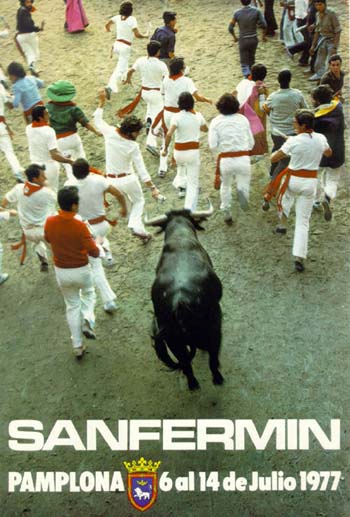
Artist: Fco. González Salvatierra
Year: 1977
The 1977 San Fermín poster was created in a political environment transformed by the June 15 elections. The full archive of San Fermín cartels, including 1977, is available through the official city tourism site: pamplona.es/turismo/sanfermin/carteles.
Named the official cartel of San Fermín 1977 after winning the Ayuntamiento’s annual poster contest.
Pamplona in 1977
The City and the New Democracy
What Pamplona looked like in July 1977: the first democratic San Fermín, open political expression, and the complicated reality of a region navigating its own future within the new Spain.
Three weeks before the chupinazo of July 6, 1977, Spain had held its first free general elections since the Second Republic. The results were a genuine political pluralism: Suárez’s UCD, the PSOE, the PCE, and a range of regional nationalist parties all competed. In Navarra, the question of the region’s relationship to the emerging Basque autonomous framework was actively debated — whether Navarra would join or remain separate was not yet settled, and the fiestas of 1977 took place against the backdrop of that unresolved question.
The pro-amnesty movement was very active in Pamplona in July 1977. Political prisoners from the Franco era remained in jail; their supporters marched and displayed banners in the streets during the fiestas. ETA continued operations through this period. The atmosphere was not simply joyful — it was politically charged in a way that made the fiestas of 1977 different from any that had come before.
The encierros ran at 8:00 AM. The route, the corrals, the Plaza de Toros — all unchanged from previous years. The death of José Joaquín Esparza Sarasibar on July 8, at seventeen, was particularly painful in a year when so much hope was in the air. It was a reminder that the encierro does not pause for history, does not pause for politics, does not pause for hope. It runs regardless.
Resources and Archives
Further Reading on San Fermín 1977
Historical records, encierro archives, and sources covering the 1977 fiestas and the democratic transition in Navarra.
Timeline
Key Moments of San Fermín 1977
June 15, 1977
Spain’s first democratic elections since 1936. Adolfo Suárez’s UCD wins a plurality. The PCE is legalized and competes. The PSOE and nationalist parties take seats. Three weeks later, San Fermín opens.
July 6, 1977
Chupinazo. The first San Fermín of democratic Spain opens. Pro-amnesty banners, nationalist flags, and open political expression mark a fiesta unlike any that preceded it.
July 8, 1977
Miura encierro. A montón forms at the entrance to the callejon de la Plaza de Toros. José Joaquín Esparza Sarasibar, 17, of Chantrea, Pamplona, is trapped in the crush. He dies from asphyxiation and liver rupture. Separately, Miura’s “Algabeño” wins the Carriquiri prize. The afternoon corrida wins the Feria del Toro prize for best corrida of the season.
July 14, 1977
Pobre de Mí. The final encierro runs in the morning. That night the farewell ceremony closes the first democratic San Fermín.
Frequently Asked Questions
San Fermín 1977 FAQ
Who died in the 1977 San Fermín encierro?
José Joaquín Esparza Sarasibar, seventeen years old, from the Chantrea district of Pamplona. He died on July 8, 1977, during the Miura encierro. He was caught in a montón (pile-up of runners) at the entrance to the callejon de la Plaza de Toros and died from asphyxiation and liver rupture caused by the pressure of bodies in the confined space. The cause of death was crushing, not a direct horn wound. He was the youngest encierro death of the 1970s.
What was the montón (pile-up) on July 8, 1977?
A montón is a pile-up of runners, typically forming when the flow of the encierro breaks down in a narrow section. On July 8, one formed at the entrance to the callejon de la Plaza de Toros — the narrow passageway leading from the street into the bullring. The passage is one of the most confined points on the entire route. When a crush forms there, runners cannot move and cannot breathe. José Joaquín Esparza Sarasibar, 17, was trapped in that crush. He died from asphyxiation and liver rupture. The bull attributed in some accounts is “Silletero,” though the exact attribution is uncertain since the cause of death was crushing rather than a horn wound.
Was 1977 the first democratic San Fermín?
Yes, in the sense that it was the first San Fermín held after Spain’s first democratic elections since 1936, which took place on June 15, 1977 — three weeks before the fiestas opened. The 1976 fiestas were the first after Franco’s death and the beginning of the transition, but Spain had not yet voted. By July 1977 it had. The distinction matters: 1976 was the first post-Franco San Fermín; 1977 was the first democratic one.
Did Germán Rodríguez die in the 1977 encierro?
No. Germán Rodríguez died in 1978, not 1977. He was not killed in the encierro. He was shot by police during an evening political demonstration inside the Plaza de Toros on July 8, 1978 — a separate event from the morning encierro. His death was from police gunfire, not from a bull or a crush in the encierro. The two events — the death of Esparza Sarasibar in 1977 and the death of Rodríguez in 1978 — are frequently confused but are entirely distinct.
Explore the Archive
San Fermín Through the Years
The encierro has run every July since the early modern period. Explore the years surrounding 1977 or browse the full historical archive.
The 1977 Encierro on Film
Archival footage from July 8, 1977, one of the eight daily encierros that year. Filmed from the Estafeta stretch of the route.