San Fermín 1979: The Running of the Bulls
July 6 to 14, 1979. The first fiesta under Spain’s new democratic constitution. Pamplona has a democratically elected city council for the first time since 1936. The shadow of 1978 still present. Miura returns for the final run.
Looking Back at 1979
Looking back at 1979, what strikes me is how much history was compressed into the fiesta that year. Spain had approved its democratic constitution in December 1978. The first municipal elections in over forty years had been held in April 1979, putting a democratically elected council in the Pamplona town hall for the first time since 1936. And yet ETA’s campaign was intensifying, the Atocha station bombing attempt in Madrid had been in 1979, and multiple assassinations had followed. The shadow of Sanfermines 78, where a man had been shot dead in the bullring, was still very present.
The encierros ran without incident. Eight clean runs, no deaths. Miura on the final morning, as they had been since 1977. The city was different in 1979 than it had been even two years before: the political street had changed, the language of protest had changed, the sense of what was possible had changed. But the encierro was still the encierro. The bulls still ran Santo Domingo to the ring. The prayer was still sung at the Cuesta. At midnight on July 14, the Pobre de Mí was still sung in the Plaza del Castillo.
There is something stabilizing about that. Not everything that was true about Pamplona changed when Spain became a democracy. The parts that had always been there were still there.
Dennis Clancey, Founder, Encierro
The First Democratic Fiesta
The 1979 fiesta opened on July 6 and ran its eight encierros through July 14 at 8 a.m. It was the first San Fermín held under Spain’s new democratic constitution, approved by referendum on December 6, 1978. The first democratic municipal elections had been held on April 3, 1979, Pamplona’s new city council was democratically elected for the first time since 1936. The chupinazo was fired from the correct second-floor balcony for the first time since 1977 (in 1978 it had been displaced by protesters).
The question of Navarra’s future status, whether it would integrate into a Basque Autonomous Community or maintain its own arrangement (which became the régimen foral under the 1979 Amejoramiento del Fuero), was a central political fault line. ETA’s campaign intensified through 1979. The shadow of Sanfermines 78 hung over the week. Political banners, pro-amnesty chants, and nationalist symbols were present throughout the fiesta. But the encierros ran. Miura bulls ran on July 14, as they had from 1977 onward.
Pamplona’s city hall was democratically elected for the first time since 1936. ETA was intensifying its campaign. The encierros ran. Miura ran on the last morning. Some things change; the run itself does not.
Every 1979 Encierro, Day by Day
Eight runs, July 7–14, 1979. No deaths. Miura confirmed on July 14. The route runs approximately 849 metres from Santo Domingo to the bullring. See the route map.
Run 1, Ganadéría Not Recorded
The first morning of the 1979 fiesta. Day-by-day ganadéría assignments are not in the digitized historical record for this year.
Run 2, Ganadéría Not Recorded
The second morning of the 1979 fiesta. Day-by-day ganadéría assignments are not in the digitized historical record for this year.
Run 3, Ganadéría Not Recorded
The third morning of the 1979 fiesta. Day-by-day ganadéría assignments are not in the digitized historical record for this year.
Run 4, Ganadéría Not Recorded
The fourth morning of the 1979 fiesta. Day-by-day ganadéría assignments are not in the digitized historical record for this year.
Run 5, Ganadéría Not Recorded
The fifth morning of the 1979 fiesta. Day-by-day ganadéría assignments are not in the digitized historical record for this year.
Run 6, Ganadéría Not Recorded
The sixth morning of the 1979 fiesta. Day-by-day ganadéría assignments are not in the digitized historical record for this year.
Run 7, Ganadéría Not Recorded
The seventh morning of the 1979 fiesta. Day-by-day ganadéría assignments are not in the digitized historical record for this year.
Run 8, Miura
The eighth and final morning of the 1979 fiesta. Miura bulls ran on July 14, as they had annually from 1977 onward (the 1978 Miura corrida had been cancelled due to the political violence, but their presence in the encierro rotation from 1977 is confirmed). No deaths. At midnight, the Pobre de Mí closed the fiesta.
The Stories the Numbers Leave Out
The 1979 Sanfermines Official Cartel
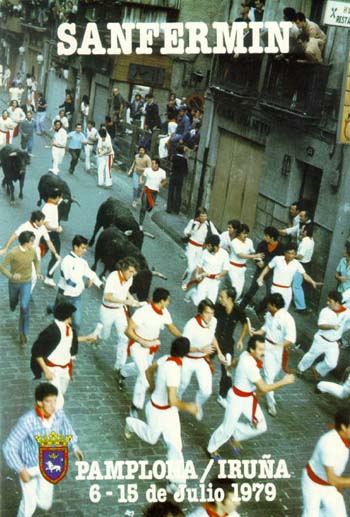
Cartel: Juan Gómez.
The 1979 San Fermín poster was the work of Juan Gómez. His poster closed the decade, a decade that had begun under the censorship and restrictions of late Francoism and ended in Spain’s first democratic summer. The poster competition by 1979 was operating in a fully democratic context for the first time in the fiesta’s modern history.
The full archive of San Fermín official posters is maintained by the Ayuntamiento de Pamplona, cartel archive.
Winner of the annual cartel contest and the official San Fermín 1979 poster for Sanfermines.
The City in 1979
The chupinazo opened the fiesta at noon on Friday, July 6, in the Plaza del Ayuntamiento, from the second-floor balcony, restored to the traditional location after the 1978 disruption. The new democratically elected city council organised the 1979 fiesta, the first council of its kind since before the Civil War.
The question of Navarra’s autonomous status was being negotiated simultaneously with the Basque autonomy statute; it would eventually result in the Amejoramiento del Fuero of 1982. International runner numbers were growing. Foreign media coverage of the encierro was expanding. The fiesta closed at midnight on July 14 with the Pobre de Mí in the Plaza del Castillo, on a night when Miura had run that morning.
How 1979 Came Together
Spain’s democratic constitution approved by referendum. The political framework for the 1979 fiesta was now fundamentally different from any previous San Fermín.
First democratic municipal elections in Spain since 1936. Pamplona’s new democratically elected city council takes office.
The chupinazo opens the 1979 fiesta at noon from the second-floor balcony of the town hall. Encierros to follow each morning at 8 a.m.
Seven encierros at 8 a.m. No deaths. Political banners and nationalist symbols present throughout the week. The shadow of Sanfermines 78 remains visible.
Miura bulls run in the final encierro. No deaths. At midnight, the Pobre de Mí closes the 1979 fiesta and the decade.
San Fermín 1979, Answered
Was anyone killed in the 1979 encierros?
No. There were no deaths in the 1979 encierros across all eight runs.
What ganadéría ran in the 1979 encierros?
The only confirmed ganadéría for the 1979 encierros is Miura, which ran on July 14 in the traditional final-day slot. Day-by-day assignments for the other seven runs are not available in accessible digitized sources. The systematic per-day database on sanfermin.com begins in 1982.
What was the political context of San Fermín 1979?
Spain had just approved its democratic constitution (December 1978) and held its first democratic municipal elections (April 1979). Pamplona’s city council was democratically elected for the first time since 1936. ETA’s campaign was intensifying. The shadow of the 1978 fiesta, when Germán Rodríguez was killed by police in the bullring, was still very present. The 1979 fiesta ran under a new constitutional order but in an atmosphere that was still politically charged.
What came next
For what followed, see San Fermín 1980, the year two men died in a single encierro, or explore the full 1980s archive.